Rutgers University-Newark’s Honors Living-Learning Community (HLLC) is an initiative intended to go beyond high SAT scores or high school rankings. The goal is to identify and blend an international group of traditional and non-traditional students into a curriculum based on themes of “Local Citizenship in a Global World,” and focusing on academic, social, and personal development.
Among the targeted student populations are high school graduates, first-generation college students, transfer students, veterans, older students, General Education Development (GED) recipients, student parents, and financially independent students. Dana librarians will be important liaisons in building the effort, according to Bobbie Tipton, the library’s point person who recently met with Marta Esquilin, the associate dean of HLLC and assistant professor of professional practice. HLLC will be divided into “cohorts,” each containing about ten students, which may be mentored by a librarian. The curriculum will be a mixture of core classes specific to HLLC, as well as a capstone project, filled in by required classes to earn an undergraduate degree.
Among the areas of instruction librarians would provide to new and transfer students through workshops are finding their subject librarian; finding core databases in the subject area; using a citation manager; determining the correction citation style for the subject; and avoiding plagiarism.
“This is intended to be a holistic learning experience with a strong emphasis on social justice and community,” Tipton said. “It is definitely an expanded definition of ‘honors’ that goes beyond academic performance. The intention is to educate movers and shakers in social engagement.”
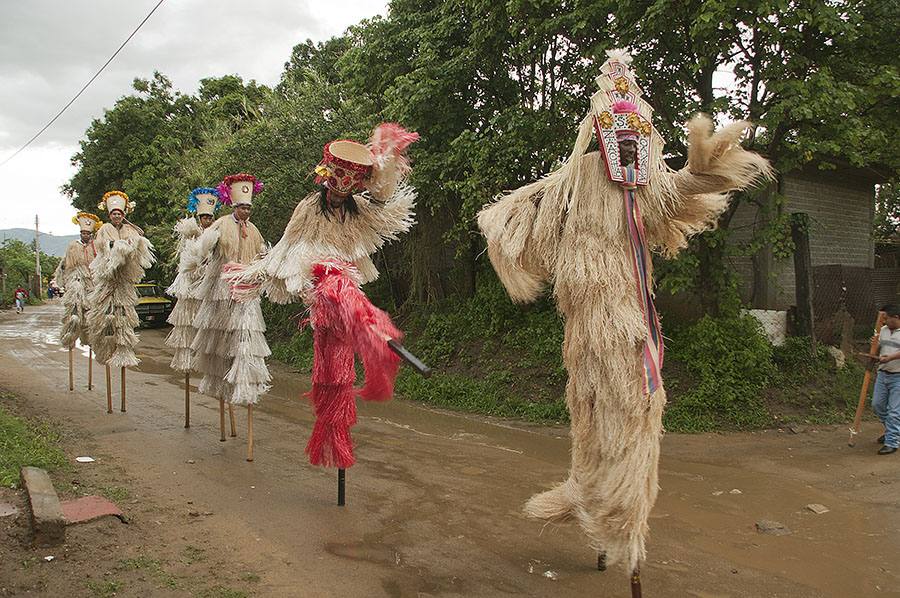
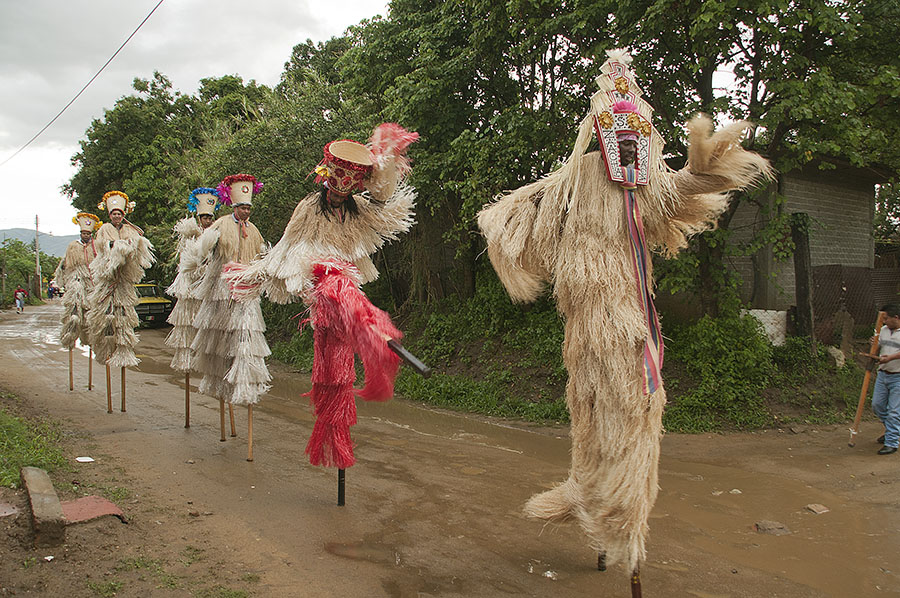
Credit Line: Laura Anderson Barbata, Performance for San Pedro Festivities, 2011, Zaachila, Oaxaca. Photo: Marco Pacheco / Image courtesy of the artist.
This fall, the Mary H. Dana Women Artists Series Galleries in the Mabel Smith Douglass Library will welcome the 2016-17 Estelle Lebowitz Endowed Visiting Artist Exhibition, Laura Anderson Barbata: Collaborations Beyond Borders. The exhibit contains selected highlights of textile, sculptural, 2-dimensional, and video works from the traveling exhibition Transcommunality.
Save the Dates: Tuesday, November 1st, 5:30 p.m. – 6:30 p.m Join us for a reception in honor of the artist at 5 p.m. and a free public artist lecture on in the Mabel Smith Douglass Room at Douglass Library.
Wednesday, November 2nd, 10:30 a.m. – 12 p.m.
Barbata will presentLa Extraordinaria Historia de Julia Pastrana, a performance work in progress at Alexander Library in the Scholarly Communications Center.
Background: Born in Mexico City and based in New York, Laura Anderson Barbata’s work focuses on participatory art initiatives that document communities and traditions, using storied art forms as platforms for social change, contemporary performance, group participation, and protest. Her collaborative and ongoing transdisciplinary works have been initiated in places such as the Amazon of Venezuela, Trinidad and Tobago, Norway, the United States., and Mexico. Her practice intertwines traditional and contemporary mediums, so-called “fine art” and popular art, and craft and folk customs forging links between the past and the present, as well as the individual and the community.
Among her most well-known projects are: Transcommunality, a decade-long project with communities in Trinidad and Tobago, Mexico, and Brooklyn highlighting the moko jumbie stilt walking tradition; Intervention: Wall Street, a collaborative performance with the Brooklyn Jumbies that took place during 2011’s Occupy Wall Street protests; and The Repatriation of Julia Pastrana, a project involving the return of Ms. Pastrana (a woman who was exhibited in the 19th century as the ugliest woman in the world) for burial in her homeland of Mexico.
Barbata’s work is included in numerous private and public collections, among them, the Metropolitan Museum of Art, New York; the Museo de Arte Moderno, Mexico City; and Landesbank Baden-Wϋrttemberg, Stuttgart, Germany. She is a member of the Sistema Nacional de Creadores de Arte, FONCA-CONACULTA, México; and the Julia Pastrana project is supported by the Sistema Nacional de Creadores de Arte, FONCA-CONACULTA, México.
Rutgers is not the only major New Jersey institution celebrating its 250th anniversary this year!
On Saturday May 23, I attended the Medical Society of New Jersey’s 250th Anniversary Celebration and Inaugural Gala. The celebration was held at the Heldrich Hotel in New Brunswick, on the actual 250th anniversary of the Medical Society of New Jersey’s first ever meeting, also held in New Brunswick (at Duff’s Tavern!). The Medical Society of New Jersey (MSNJ) is America’s oldest state medical society, and has over 5000 members. RBHS–Special Collections holds a nearly complete run of MSNJ journal publications from 1848 to 2005, as well as substantial archival holdings of its constituent Burlington, Essex, Hudson, Monmouth, Passaic, and Warren County Medical Societies. We also hold the records of the Medical Alliance of the Medical Society of New Jersey (formerly the Women’s Auxiliary).
Credit: Robert Vietrogoski
At the gala, I joined Dr. Peter Carmel, the emeritus chair of the Department of Neurological Surgery at New Jersey Medical School. Dr. Carmel is also the current president of the Medical History Society of New Jersey and a recent past president of the American Medical Association! During the program, Dr. Carmel presented a well-received illustrated historical retrospective on the MSNJ’s founding and its centennial and bicentennial celebrations. Some of the images used by Dr. Carmel were drawn from RBHS–Special Collections materials.
For the gala, Dr. Carmel also organized an exhibit on Dr. Wells P. Eagleton, the first New Jersey neurosurgeon, and a medical luminary who received the first Edward J. Ill award from the Academy of Medicine of New Jersey in 1939. Thanks to Dr. Carmel’s generous restoration efforts, Eagleton’s actual Edward J. Ill medal was on display. This artifact was rediscovered last summer in storage at Robert Wood Johnson Medical School and is now part of the holdings of RBHS–Special Collections. Dr. Carmel’s exhibit and the Eagleton artifacts will soon be on display in the lobby of Smith Library.
Credit: Robert Vietrogoski
If the Eagleton name seems familiar at Rutgers, Dr. Eagleton’s wife Florence Peshine Eagleton was a founding member of the board of managers of the New Jersey College for Women (now Douglass College) and a Rutgers trustee from 1932 to 1946. She made the bequest in 1956 that established Rutgers University’s Eagleton Institute of Politics, which itself is celebrating its 60th anniversary this year.
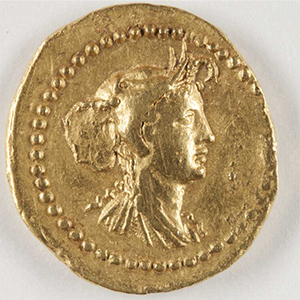
The newest addition to the RBHS–Special Collections artifact collection is the commemorative 250th anniversary “challenge coin” given to gala attendees by Captain Joseph P. Costabile, the incoming MSNJ president. The gala was a most enjoyable event and I hope to extend the relationship between the Medical Society of New Jersey and RBHS–Special Collections. (And for those familiar with my normal mode of dress, here is photographic proof of me in a tuxedo!)
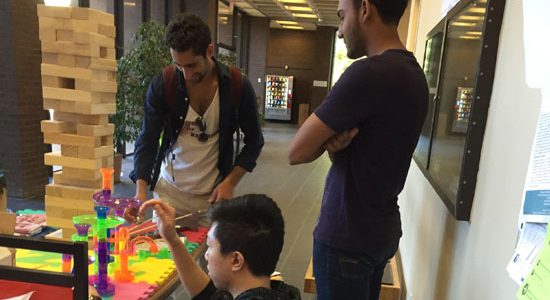
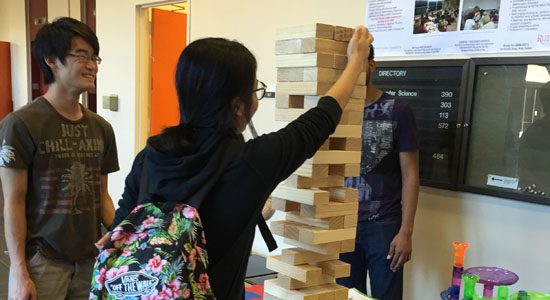
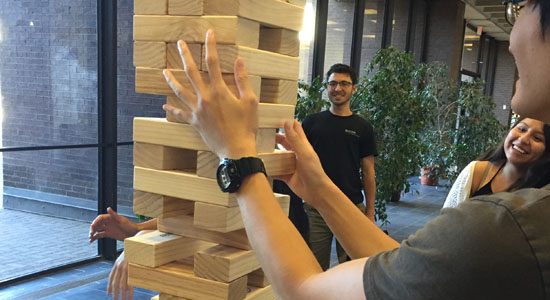
Rutgers Future Scholars use Legos at the Art Library to learn about teamwork and libraries. Photo credit: Megan Lotts.
The Rutgers Future Scholars program places rising High School juniors in an internship for one week during the summer. This summer, the New Brunswick Libraries hosted two internships. Ryan Womack hosted 5 students and worked with them on Big Data, and Jill Nathanson hosted 5 students working on gamification.
For those unfamiliar with the Rutgers Future Scholars Program, here is the description from its website:
The goal of the Rutgers Future Scholars program is to increase the numbers of academically ambitious high school graduates who come from less-advantaged communities, inspire and prepare them meet the standards to be admitted to colleges and universities, and then provide tuition funding to those who are admitted and choose to attend Rutgers University.
In addition to working on their respective projects, the interns were provided an overview of the Libraries and had an opportunity to meet a variety of faculty and staff. Snack breaks were hosted each day by librarians, access services staff, and the communications team. The interns also traveled to the Art Library one day to participate in using Legos to learn about teamwork and libraries.
The students working with Jill Nathanson created an event for transfer students. The challenge was to create an event that reinforced the library instruction transfer students received in their library sessions while also making it fun and giving them an opportunity to interact with other transfer students. The students worked together to create a team based activity that will be used this fall at the Alexander Library.
The students working with Ryan Womack explored data science with R, working through exercises on data wrangling, data analysis, and data visualization using the R open source statistical software environment. By working with real-world College Scorecard data, the students gained understanding of the challenges and possibilities of working with live, raw data sources.
Click to enlarge. Photo credit: Michael Joseph, Rutgers University Libraries.
In preparing a pop-up exhibition for the Northeast Victorian Studies Conference in April, we turned up a previously unknown and unrecorded letter from Charles Dickens bound into one of the Libraries’ books. Written by Dickens on 24 November 1849 to the Reverend John Dufton, the 3 p. letter responds to Dufton’s pamphlet, The Prison and the School: a Letter to Lord John Russell, M.P. (London: John W. Parker, 1848). Dickens writes warmly in support of the pamphlet, though he registers a disagreement with Dufton’s apparent enthusiasm for the “reformatory influences” of the new “model prisons,” noting, with a Dickensian touch, that the reformatory spirit cannot “[survive] the unnatural air of the solitary cell.”
Penal reform was a complex and pressing topic, then as now. The skepticism of the reforming capacities of prison Dickens shared with Dufton anticipates his 1850 essay “Pet Prisoners,” as well as David’s cynical views of the “model prison” in chapter 61 of David Copperfield, which Dickens would begin writing in 1849. Despite their disagreement on what Dickens calls a “momentous”—and Phillip Collins in Dickens and Crime (1968) a “blood-heating”—issue, Dickens concludes his letter on amiable terms by inviting Dufton to visit him in London. Quite familiarly, he invites himself to visit Dufton: “if I should find myself near Ashford as I generally do, sometime in the autumn I shall make bold to remind you for a few minutes, of our correspondence.” No such visit has been recorded.
Dickens thought well enough of Dufton’s pamphlet to keep and annotate it, and it has survived into our time. Regrettably, however, it is currently unavailable to scholars. In 2010, it was sold by Henry Sothern Limited to a private collector in Switzerland (see Piccadilly Notes 56 [2010] item 100, no. 11). [i]
Click to enlarge. Photo credit: Michael Joseph, Rutgers University Libraries.
Dickens and Dufton were not strangers. Elsewhere in the volume housing the Dickens letter (noted below) is a manuscript note, dated 1846, from George Cruikshank to Dufton, written on behalf of Dickens and the Committee of the Ashford Mechanics’ Institution, thanking Dufton for sending a lecture, as requested.
The letter is captioned “Devonshire Terrace.” Dickens lived at 1 Devonshire Terrace (now 15-17 Marylebone Road, Marylebone), near Regent’s Park, from December 1939–1851.
John Dufton was rector of Warehorne, in the Ashford Borough of Kent and the author of other ephemeral publications including National Education, What it is and What it Should be (1848).
The letter has escaped detection because it was all but buried within an extra-illustrated copy of Blanchard Jerrold’s Life of George Cruikshank (1882). As Ron Becker discovered in a search of the archives of the Journal of the Rutgers University Libraries, Don Sinclair recorded the acquisition of the volume in 1956:
Click to enlarge. Photo credit: Michael Joseph, Rutgers University Libraries.
Without doubt the most striking single gift is that of the Class of 1933, which had presented earlier an extra-illustrated set of Benjamin West material. The present gift, preserved in the same form, is the Jesse Metcalf collection of George Cruikshank prints and manuscripts. It is interleaved in a first edition of Blanchard Jerrold’s Life of George Cruikshank (1882), published originally in two octavo volumes, here expanded to seven gilt-edged, large folio volumes
bound in scarlet crushed Levant morocco. The items have not been counted, but a careful estimate places the number of prints at nearly a thousand, with perhaps six dozen manuscript letters. Virtually all types of Cruikshank’s artistic work are represented (oil paintings excluded): etchings, some in color, woodcuts, at least one original watercolor, etc.; caricatures, book illustrations for Dickens and others. His well-known Temperance series, The Bottle (1847) and The Drunkard’s Children (1848), are present. The first volume also contains his famous Specimen of a Bank Note—not to be imitated (1818), a bitter, effective caricature inspired by the hanging of several women convicted of passing counterfeit notes. Engraved in banknote style, it shows eleven hooded figures hanging by the neck, and other macabre decorations. (19:2)
George Cruikshank (1792–1878) was an important caricaturist, illustrator, and print-maker, perhaps best known now for his illustrations of Sketches by Boz (1836) and Oliver Twist (1838). In George Cruikshank, Life, Times and Art: Volume 1, 1792–1835, Robert E. Patton notes that Ruskin thought him second only to Rembrandt in etching (8). “He infused his pictures with a humor at times bawdy, crude, sentimental, inconsequent, grotesque, bathetic, or pathetic. Like Dickens, to whom he was frequently compared, he was both a ‘special correspondent to posterity,’ focusing a journalist’s eye on the rapidly changing world around him, and a visionary humanist, outraged by injustice, greed, and folly, sympathetic to the defenseless and neglected,moralistic toward those who abused their power, their prerogatives, their neighbors, or their bodies.” (8)
Michael Joseph
Kevin Mulcahy
[i] Andrew McGeachin, e-mail message to M. Joseph, March 31, 2016.
Most of you have, by now, visited the Rutgers Connection Migration Support website. I hope you are finding a lot of useful information there, but if anything is missing, please let us know using the Submit Your Questions form. This story is meant to update everyone on the newest pieces of the migration plan. Most importantly, to let you know that everyone’s email in Rutgers University Libraries will be migrated August 23–25, 2016. The exact grouping will be worked out in collaboration with AULs and library directors.
Kickoff meeting:
A successful kickoff meeting was held on Friday, July 22, with four representatives of OIT, all UCSs; and all IIS staff, joined by a special Migration Representative from the Health Sciences Libraries. A four-hour recording of that discussion is available with RUL NetID authentication–but you are hereby warned: It is heavy on technical jargon! Unless you want to delve into every detail, you would be better off perusing the support site and attending the upcoming information sessions and subsequent training.
Prepping for the migration:
But first, as the most important part of preparations, we must collect information about all existing accounts, as only one account per Rutgers employee can be migrated automatically. Content from other accounts should be first transferred to the primary account, or migrated later.
For this purpose, IIS has developed an instrument with half a dozen questions and a lot of help on how to respond to them. Please use your NetID to log in (each RUL member needs to fill it out personally or with the help of their UCSs) and provide the required information about the Rutgers email accounts you currently hold. The more accurate the data we receive, the more efficient and more painless the migration will be.
Since the new email and calendaring tools will appear quite different from what Zimbra users are used to, IIS will offer a series of 90-minute information sessions August 8–19 in several libraries covering all three geographic regions. The schedule for these sessions will soon follow via RUL_Everyone messages, and will be available on the support site’s calendar by August 5.
The plan for the migration:
All three hundred email users at RUL will be migrated over a three-day period August 23–25. Groups of account holders will be scheduled for each day based on organizational, geographic, and logical criteria. When you come to work on your assigned day of the migration, all your email and calendar appointments will be ready for you in the new system. You can immediately access them and continue working with them in the new interface called OWA (Outlook Web Access) by logging in through any browser using the link connect.rutgers.edu and your new email address [NetID]@libraries.rutgers.edu. (Please see details about account names in the Questionnaire and at the support site.)
Throughout the days of the migration, IIS staff and UCSs will be “roaming the halls” in the libraries to help users access their mailboxes using the client of their choice: The desktop version of Microsoft Outlook, available on every RUL workstation, is the preferred client for work in the office, while any browser may be used to log into OWA away from your desk.
Training opportunities:
Two-hour-long introductory, instructor-led, classroom-based, hands-on training will be offered in several sessions over two days of the migration. If you cannot make it during those days, the training sessions will come back after Labor Day, including more advanced training later on. Individual introductory sessions will also be available for those who learn best that way. Please check back to the support site’s calendar around August 15 for the exact schedule and to sign up.
In the first wave of training sessions we will focus on the communication tools included with Rutgers Connect (which is, as you know, a customized version of Microsoft’s Office 365 running in the Microsoft cloud): OWA (and Outlook on the desktop), Calendar, People, Tasks, OneDrive for Business (cloud-based file storage), and Skype for Business. But the rest of the Office 365 tools will also be immediately available to everyone from the same online interface: Word, Excel, PowerPoint, and OneNote. At the same time, the respective applications can be downloaded and installed on your home computer and mobile devices, while you will have them installed on your RUL desktops in the Office 2016 version that is fully interchangeable with the cloud-based apps.
Questions or concerns:
Much more information will continue to become available as we approach the migration week. In the meantime, please let IIS know of any concerns or questions you might have by writing to support@rulhelp.rutgers.edu or using the support site’s Submit Your Questions form.
Like most other people, I cringe at the very thought that the fall semester is only a month away. Didn’t the summer just start? Where did all the time go? Why couldn’t we have a summer that is all year long? Oh well, such is life. But here is the good news, if there is good news in contemplating that the summer days are numbered: in September when tens of thousands of students return to or come to Rutgers for the first time, the Libraries will have a better collection of information resources waiting for them.
Cover of the May 1917 issue. (American Vogue) https://commons.wikimedia.org/wiki/File:Vogue,_portada_de_mayo_de_1917.jpg
Fiscal Year 2016 that ended on June 30 started off as a very challenging year for collection development, due to the loss of about $1 million of purchasing power in the collections budget in the previous year. Thanks to the strong support and guidance from the new Libraries administration and the tireless work of all the colleagues involved in collection development, we have more or less turned a corner. The University Librarian’s Report from the July issue of the newsletter includes a summary of major acquisitions that the Libraries made in FY16. Additionally, at the end of FY16 we purchased the British Periodicals collections and Vogue archive, two valuable humanities resources that have been on our wish list for a very long time. It is fair to say that, since last year, the Libraries have been making considerable progress to improve access to all kinds of scholarly resources (online journals, e-books, and primary sources) that the entire Rutgers community can benefit from.
Our collection development program is continuing the upward trend that began last year. Since July 1, which is when the new fiscal year started, we have been focusing on acquiring and upgrading resources essential to the education mission of the University, in anticipation of the beginning of the new academic year. These new resources include:
ProQuest ebrary Academic Complete: a collection of about 140,000 current scholarly e-books on all academic subjects.
Springer Nature STM (Science, Technology, and Medicine) and social sciences frontlist e-books: over 7000 newly published titles from the largest STM e-book publisher, paid for with a funding increase from the universities.
Academic Video Online: Premium (AVON): over 50,000 videos on Social Sciences, Arts & Humanities, Science & Engineering, and Health Sciences topics from many reputable producers such as BBC and PBS.
ProQuest Dissertations and Theses (PQDT) Global: 1.7 million full-text dissertations and theses from both American and international institutions.
Clinical resources: In the spring, the Libraries received a funding increase from the universities for five new clinical resources. UpToDate and Bates’ Visual Guide are already available. VisualDx, DynaMed Plus, and JAMA Evidence will be added soon.
Some of the resources are available now and others will be available later in the fiscal year. We are confident that these new resources will greatly enhance the Libraries’ support for undergraduate, graduate, and medical education at Rutgers. Yes, even when summer is ending, there will be a lot to look forward to in the fall!
Also, join us as we celebrate a milestone in the historical research at the Center of Alcohol Studies Library. One of the most important founders of alcohol and addiction studies, E. M. Jellinek, also laid down the foundations of the current CAS Library. The most recent issue of the Journal of Studies on Alcohol and Drugs, published at CAS, features three open-access articles with CAS Library’s contributions to the history of alcohol studies. CAS Library staff has compiled Jellinek’s most comprehensive bibliography to date based on their original research that discovered new biographical data and articles. His seminal articles have also become freely available on the JSAD website. See the reintroduction of Jellinek to current addiction science at: http://www.jsad.com/page/bunkybundle
The Carey Library has been recently redesigned with comfortable seating, functional work spaces, bright lighting, and fun colors.
On June 8th, the James B. Carey Library at School of Management and Labor Relations (SMLR) hosted librarians from the Martin P. Catherwood Library of the Cornell University School of Industrial and Labor Relations (ILR). As part of a “Liaison Exchange Travel Award” program, Suzanne Cohen, collection development librarian, and Aliqae Geraci, ILR research librarian, were given the opportunity to visit liaison universities in order to connect with and learn from institutions with similar programs and public mission. The program focused on liaison roles in the areas of collection development, reference, instruction, outreach services, scholarly communication, and assessment.
The agenda for the day consisted of a tour of the Labor Education Center on the Cook Campus, followed by lengthy discussions covering Carey Library projects, the structure of the Rutgers University Libraries, and information about the library’s collection development, reference, and instruction services. Meetings were arranged to provide more insight on Carey Library outreach services with SMLR’s director of undergraduate & master’s programs in labor education and employment relations, with SMLR’s career management specialist, and with the director of assessment, research, and writing support from Rutgers University. These key positions were selected in order to showcase the Carey Library’s involvement in student and faculty success, career services, and the writing centers.
Suzanne summarized the Cornell visit stating that “We were excited to visit the James B. Carey Library, which has many parallels to the Martin P. Catherwood Library at Cornell University’s ILR School. Both libraries serve the academic missions of schools studying and teaching management and labor relations; both have faculty, staff, and students distributed across multiple locations; and both have public missions, serving labor relations and human resource management professionals, working people, employers and government agencies of their states. We came away from our visit with a lot of great ideas related to library spaces, services, and potential partnerships with other school/library departments. One of the most important outcomes was developing a stronger relationship with Julie. As there are fewer librarians specializing in the subject areas served by our libraries, it is more important than ever that we create a network of ILR information professionals. It was a great day!”
Overall, the visit was a success. It not only built a stronger relationship between the James B. Carey Library and the Catherwood Library, but opened the lines of communication between the two libraries and sparked many new ideas for future collaboration. A standing invitation to visit Ithaca was offered, which I will gladly take advantage of.
With Gabryel Smith, Assistant Archivist at NY Philharmonic Archive, Lincoln Center
With Gino Francesconi, Director of Archives and the Rose Museum at Carnegie Hall
The fellows and Angela Lawrence with Gino Francesconi, Carnegie Hall
The three Fellows with Duke Ellington’s piano at the Jazz Museum in Harlem
ith archivist Matt Snyder at the New York Public Library Services Center, Queens
Archivist Ricky Riccardi shares some treasures at the Louis Armstrong Archive, Queens College
Treshani, Brad, and Veronica holdi Louis’ horns as Ricky Riccardi and Satchmo himself look on.
With Kathy Kauhl, Archivist at the Essex County Parks Archive.
The fellows during Q&A with Rutgers University Library administrators
Brad, Veronica, and Treshani with Joanne Hill and the Andrew Hill Collection.
The Institute of Jazz Studies Archival Fellowship Program was established in 2011 to support archival career development, as well as to promote diversity in the archival field. Each year, three Fellows are selected from among dozens of applicants, who are either currently enrolled in, or recent graduates of, an MLIS program, have a special interest in jazz and or African American culture, and aspire to careers as archivists. Fellows receive a stipend to cover travel, hotel, and miscellaneous expenses. The Fellowship Program is funded by longtime IJS supporter John Van Rens.
The Fellows spend two weeks on campus working closely with IJS archivists and staff. Participants gain hands-on experience processing one of the Institute’s multi-faceted collections and preparing a related digital project that can be shared with colleagues and prospective employers. There are also seminars with RUL as well as Newark campus administrators, who provide an overview of Rutgers-Newark as the nation’s most diverse university, as well as role of an archive within an urban university library. The Program also involves two days of visits to other area archives and institutions, which have included the Schomburg Center for Research in Black Culture, The New York Public Library Archival Processing Center, the Louis Armstrong House Museum and Archive, the Jazz Museum in Harlem, the Carnegie Hall Archive, and the New York Philharmonic Archive at Lincoln Center. There are also several social gatherings with IJS staff and area librarians and archivists.
This year’s fellows were Veronica Johnson (MLIS student at Wayne State Univ.), Treshani Perera (MLIS student at Univ. of Wisconsin-Milwaukee), and Brad San Martin (MLIS student at Univ. of North Carolina-Chapel Hill), who were on campus from June 6 to June 17. In collaboration with IJS archivists Elizabeth Surles, Angela Lawrence, and Tad Hershorn, and Digital Humanities Librarian Krista White, they processed the collection of pianist/composer and NEA Jazz Master Andrew Hill (1931-2007). Hill as both player and composer was a unique figure, who forged an original style that was at once part of the jazz tradition while extending its boundaries. On the last day of the fellowship program, Hill’s widow, Joanne, and donor of the collection, visited IJS to meet with the Fellows and to examine the newly processed collection she had donated as well as to view digital presentations by the fellows covering selected aspects of her husband’s distinguished career.
Veronica Johnson, photo by Ed Berger.
VERONICA JOHNSON:
Completing the IJS fellowship at Rutgers was an amazing experience and one that I will forever be grateful for. I learned so much about processing and the steps it takes to make a collection available to users. Working on the Andrew Hill Collection was great, and it really gave me the opportunity to process a larger collection, which I had never done before. I learned a lot about Hill and quickly became a fan of his work, which was very innovative. My favorite part of the program was learning about EAD and being able to create a finding aid using Oxygen. EAD was an area I did not have much experience in outside of school, so having Elizabeth and Angela show me how to use the software and create this awesome finding aid for the collection was very enlightening. I also really enjoyed visiting the other archives like the Jazz Museum of Harlem and the New York Philharmonic in order to see how other archives both large and small operate. The IJS Fellows program really gives graduate students the opportunity to be archivists for two weeks and get a real sense of the day to day tasks of the profession. The IJS staff is awesome and really made me feel welcome and a part of the team. I also developed some great friendships with the other fellows and am so thankful that I was able to take advantage of this great opportunity.
Treshani Perera, photo by Ed Berger.
TRESHANI PERERA:
I’m really thankful that I was chosen as a 2016 IJS Fellow. Throughout my two-week experience, I was so impressed with the work ethic and collegiality of the IJS staff, and their willingness to make every moment a teachable one during and outside of processing the collection. I was thrilled for the opportunity to process jazz pianist Andrew Hill’s collection, and discover his genius and creative thought captured in his music. The icing on the cake was meeting Mrs. Hill at the end of the experience, and talking to her about Mr. Hill as a musician and spouse. My favorite part of the experience was visiting music archives in the Greater New York area, and learning about how each archives does things differently. Throughout the two week internship, I was able to put into practice what I had learned in the classroom, and process the collection as a group, which was a unique experience. I’m truly grateful for this opportunity, and can honestly say that it was a transformative experience!
Brad San Martin, photo by Ed Berger.
BRAD SAN MARTIN:
The greatest strength of the Institute of Jazz Studies Fellowship was in the way it provided well-rounded insight into nearly all facets of an archives’ operations. While processing a collection at a fairly granular level (as we did with Andrew Hill’s papers) gave us invaluable experience in the most fundamental archivist tasks, our meetings and discussions with administrators, directors, historians, and even a donor offered much-needed perspective into archives role in the larger arts community – and the associated challenges entailed with maintaining and evolving that presence. It didn’t hurt that the people we met were all passionate, thoughtful, accomplished professionals who were willing to both share their time and speak candidly about the pleasures and pressures of the field. The two weeks flew by, and I’m sure that, when I look back, I’ll find my time at the IJS to have been a perfect (and much-needed) enrichment to my formal library and archive science studies.