Category: Department

  • New Library Resources for a New Academic Year

    Like most other people, I cringe at the very thought that the fall semester is only a month away. Didn’t the summer just start? Where did all the time go? Why couldn’t we have a summer that is all year long? Oh well, such is life. But here is the good news, if there is good news in contemplating that the summer days are numbered: in September when tens of thousands of students return to or come to Rutgers for the first time, the Libraries will have a better collection of information resources waiting for them.

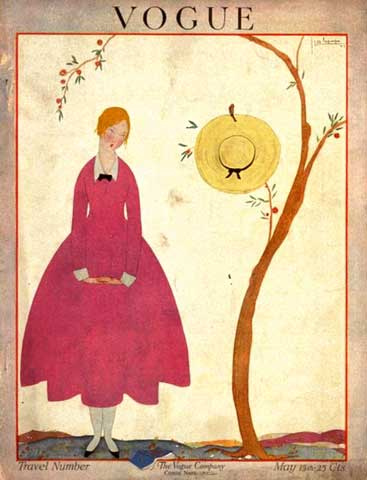
    Cover of 1917 Vogue
    Cover of the May 1917 issue. (American Vogue) https://commons.wikimedia.org/wiki/File:Vogue,_portada_de_mayo_de_1917.jpg

    Fiscal Year 2016 that ended on June 30 started off as a very challenging year for collection development, due to the loss of about $1 million of purchasing power in the collections budget in the previous year. Thanks to the strong support and guidance from the new Libraries administration and the tireless work of all the colleagues involved in collection development, we have more or less turned a corner. The University Librarian’s Report from the July issue of the newsletter includes a summary of major acquisitions that the Libraries made in FY16. Additionally, at the end of FY16 we purchased the British Periodicals collections and Vogue archive, two valuable humanities resources that have been on our wish list for a very long time. It is fair to say that, since last year, the Libraries have been making considerable progress to improve access to all kinds of scholarly resources (online journals, e-books, and primary sources) that the entire Rutgers community can benefit from.

    Our collection development program is continuing the upward trend that began last year. Since July 1, which is when the new fiscal year started, we have been focusing on acquiring and upgrading resources essential to the education mission of the University, in anticipation of the beginning of the new academic year. These new resources include:

    • ProQuest ebrary Academic Complete: a collection of about 140,000 current scholarly e-books on all academic subjects.
    • Springer Nature STM (Science, Technology, and Medicine) and social sciences frontlist e-books: over 7000 newly published titles from the largest STM e-book publisher, paid for with a funding increase from the universities.
    • Academic Video Online: Premium (AVON): over 50,000 videos on Social Sciences, Arts & Humanities, Science & Engineering, and Health Sciences topics from many reputable producers such as BBC and PBS.
    • ProQuest Dissertations and Theses (PQDT) Global: 1.7 million full-text dissertations and theses from both American and international institutions.
    • Clinical resources: In the spring, the Libraries received a funding increase from the universities for five new clinical resources. UpToDate and Bates’ Visual Guide are already available. VisualDx, DynaMed Plus, and JAMA Evidence will be added soon.

    Some of the resources are available now and others will be available later in the fiscal year. We are confident that these new resources will greatly enhance the Libraries’ support for undergraduate, graduate, and medical education at Rutgers. Yes, even when summer is ending, there will be a lot to look forward to in the fall!

  • Highlights from the Center of Alcohol Studies Library

    The Center of Alcohol Studies (CAS) Library had the unique opportunity to meet with Jeffrey Beall at his office in Denver. The first part of the interview is featured in their most recent newsletter, (http://library.alcoholstudies.rutgers.edu/sites/library.alcoholstudies.rutgers.edu/files/documents/newsletters/Spring2016_May.pdf) entitled Predatory Publishers: An Interview with Jeffrey Beall, Pt. 1. The second part will soon be available in the newsletter of the Substance Abuse Libraries and Information Specialists (SALIS), freely available for a brief time after publication.

    Also, join us as we celebrate a milestone in the historical research at the Center of Alcohol Studies Library. One of the most important founders of alcohol and addiction studies, E. M. Jellinek, also laid down the foundations of the current CAS Library. The most recent issue of the Journal of Studies on Alcohol and Drugs, published at CAS, features three open-access articles with CAS Library’s contributions to the history of alcohol studies. CAS Library staff has compiled Jellinek’s most comprehensive bibliography to date based on their original research that discovered new biographical data and articles. His seminal articles have also become freely available on the JSAD website. See the reintroduction of Jellinek to current addiction science at: http://www.jsad.com/page/bunkybundle

  • Carey Library Hosts Visitors from Catherwood Library at Cornell University

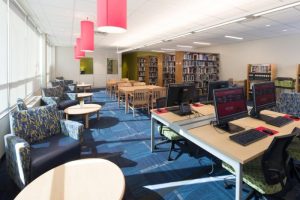
    Carey Library interior
    The Carey Library has been recently redesigned with comfortable seating, functional work spaces, bright lighting, and fun colors.

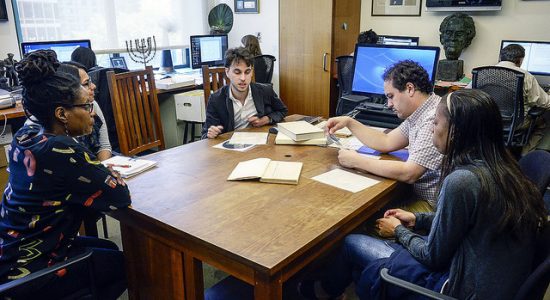
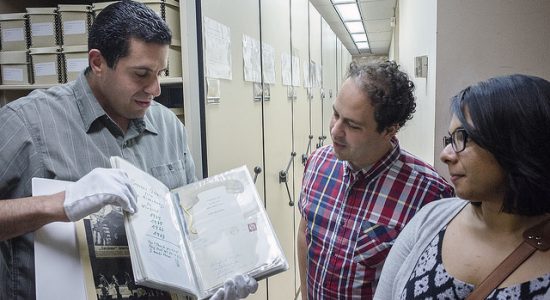
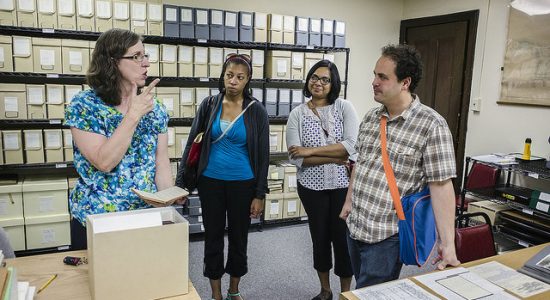
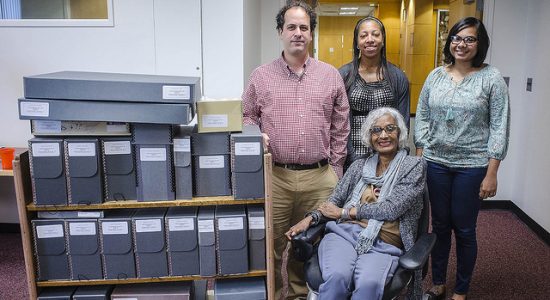
    On June 8th, the James B. Carey Library at School of Management and Labor Relations (SMLR) hosted librarians from the Martin P. Catherwood Library of the Cornell University School of Industrial and Labor Relations (ILR). As part of a “Liaison Exchange Travel Award” program, Suzanne Cohen, collection development librarian, and Aliqae Geraci, ILR research librarian, were given the opportunity to visit liaison universities in order to connect with and learn from institutions with similar programs and public mission. The program focused on liaison roles in the areas of collection development, reference, instruction, outreach services, scholarly communication, and assessment.

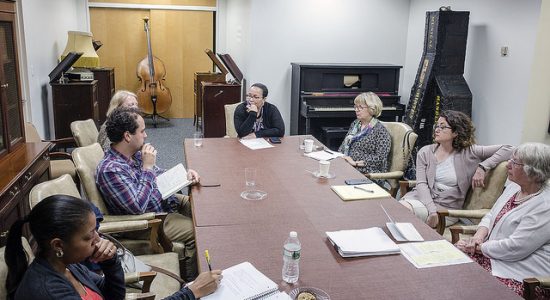
    The agenda for the day consisted of a tour of the Labor Education Center on the Cook Campus, followed by lengthy discussions covering Carey Library projects, the structure of the Rutgers University Libraries, and information about the library’s collection development, reference, and instruction services. Meetings were arranged to provide more insight on Carey Library outreach services with SMLR’s director of undergraduate & master’s programs in labor education and employment relations, with SMLR’s career management specialist, and with the director of assessment, research, and writing support from Rutgers University. These key positions were selected in order to showcase the Carey Library’s involvement in student and faculty success, career services, and the writing centers.

    Suzanne summarized the Cornell visit stating that “We were excited to visit the James B. Carey Library, which has many parallels to the Martin P. Catherwood Library at Cornell University’s ILR School. Both libraries serve the academic missions of schools studying and teaching management and labor relations; both have faculty, staff, and students distributed across multiple locations; and both have public missions, serving labor relations and human resource management professionals, working people, employers and government agencies of their states. We came away from our visit with a lot of great ideas related to library spaces, services, and potential partnerships with other school/library departments. One of the most important outcomes was developing a stronger relationship with Julie. As there are fewer librarians specializing in the subject areas served by our libraries, it is more important than ever that we create a network of ILR information professionals. It was a great day!”

    Overall, the visit was a success. It not only built a stronger relationship between the James B. Carey Library and the Catherwood Library, but opened the lines of communication between the two libraries and sparked many new ideas for future collaboration. A standing invitation to visit Ithaca was offered, which I will gladly take advantage of.

  • Institute of Jazz Studies Archival Fellowship Program Participants Reflect on Their Experiences

    The Institute of Jazz Studies Archival Fellowship Program was established in 2011 to support archival career development, as well as to promote diversity in the archival field. Each year, three Fellows are selected from among dozens of applicants, who are either currently enrolled in, or recent graduates of, an MLIS program, have a special interest in jazz and or African American culture, and aspire to careers as archivists. Fellows receive a stipend to cover travel, hotel, and miscellaneous expenses. The Fellowship Program is funded by longtime IJS supporter John Van Rens.

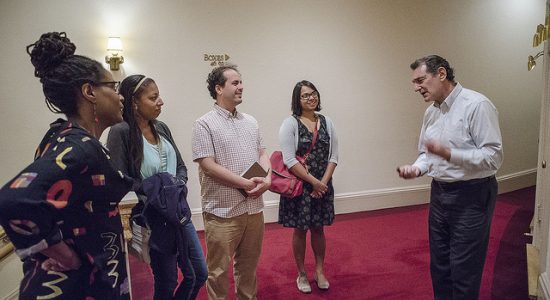
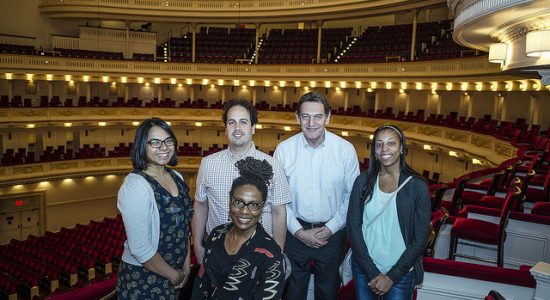
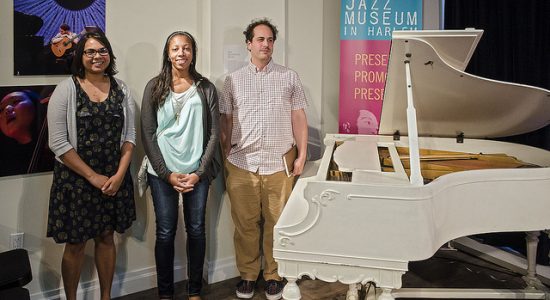
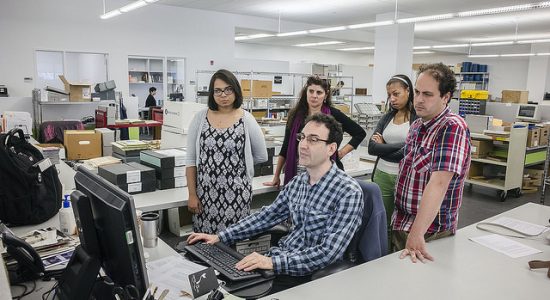
    The Fellows spend two weeks on campus working closely with IJS archivists and staff. Participants gain hands-on experience processing one of the Institute’s multi-faceted collections and preparing a related digital project that can be shared with colleagues and prospective employers. There are also seminars with RUL as well as Newark campus administrators, who provide an overview of Rutgers-Newark as the nation’s most diverse university, as well as role of an archive within an urban university library. The Program also involves two days of visits to other area archives and institutions, which have included the Schomburg Center for Research in Black Culture, The New York Public Library Archival Processing Center, the Louis Armstrong House Museum and Archive, the Jazz Museum in Harlem, the Carnegie Hall Archive, and the New York Philharmonic Archive at Lincoln Center. There are also several social gatherings with IJS staff and area librarians and archivists.

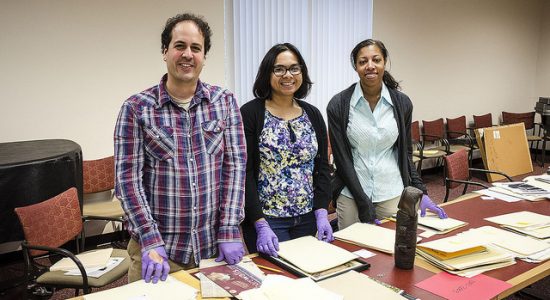
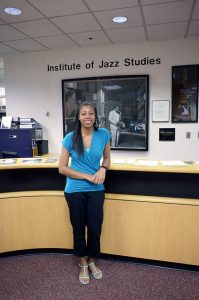
    This year’s fellows were Veronica Johnson (MLIS student at Wayne State Univ.), Treshani Perera (MLIS student at Univ. of Wisconsin-Milwaukee), and Brad San Martin (MLIS student at Univ. of North Carolina-Chapel Hill), who were on campus from June 6 to June 17. In collaboration with IJS archivists Elizabeth Surles, Angela Lawrence, and Tad Hershorn, and Digital Humanities Librarian Krista White, they processed the collection of pianist/composer and NEA Jazz Master Andrew Hill (1931-2007). Hill as both player and composer was a unique figure, who forged an original style that was at once part of the jazz tradition while extending its boundaries. On the last day of the fellowship program, Hill’s widow, Joanne, and donor of the collection, visited IJS to meet with the Fellows and to examine the newly processed collection she had donated as well as to view digital presentations by the fellows covering selected aspects of her husband’s distinguished career.

    Veronica Johnson, photo by Ed Berger.
    Veronica Johnson, photo by Ed Berger.

    VERONICA JOHNSON:

    Completing the IJS fellowship at Rutgers was an amazing experience and one that I will forever be grateful for. I learned so much about processing and the steps it takes to make a collection available to users. Working on the Andrew Hill Collection was great, and it really gave me the opportunity to process a larger collection, which I had never done before. I learned a lot about Hill and quickly became a fan of his work, which was very innovative. My favorite part of the program was learning about EAD and being able to create a finding aid using Oxygen. EAD was an area I did not have much experience in outside of school, so having Elizabeth and Angela show me how to use the software and create this awesome finding aid for the collection was very enlightening. I also really enjoyed visiting the other archives like the Jazz Museum of Harlem and the New York Philharmonic in order to see how other archives both large and small operate. The IJS Fellows program really gives graduate students the opportunity to be archivists for two weeks and get a real sense of the day to day tasks of the profession. The IJS staff is awesome and really made me feel welcome and a part of the team. I also developed some great friendships with the other fellows and am so thankful that I was able to take advantage of this great opportunity.

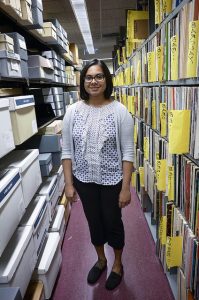
    Treshani Peterson, photo by Ed Berger.
    Treshani Perera, photo by Ed Berger.

    TRESHANI PERERA:

    I’m really thankful that I was chosen as a 2016 IJS Fellow. Throughout my two-week experience, I was so impressed with the work ethic and collegiality of the IJS staff, and their willingness to make every moment a teachable one during and outside of processing the collection. I was thrilled for the opportunity to process jazz pianist Andrew Hill’s collection, and discover his genius and creative thought captured in his music. The icing on the cake was meeting Mrs. Hill at the end of the experience, and talking to her about Mr. Hill as a musician and spouse. My favorite part of the experience was visiting music archives in the Greater New York area, and learning about how each archives does things differently. Throughout the two week internship, I was able to put into practice what I had learned in the classroom, and process the collection as a group, which was a unique experience. I’m truly grateful for this opportunity, and can honestly say that it was a transformative experience!

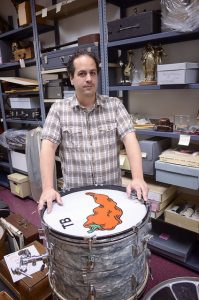
    Brad Martin, photo by Ed Berger.
    Brad San Martin, photo by Ed Berger.

    BRAD SAN MARTIN:

    The greatest strength of the Institute of Jazz Studies Fellowship was in the way it provided well-rounded insight into nearly all facets of an archives’ operations. While processing a collection at a fairly granular level (as we did with Andrew Hill’s papers) gave us invaluable experience in the most fundamental archivist tasks, our meetings and discussions with administrators, directors, historians, and even a donor offered much-needed perspective into archives role in the larger arts community – and the associated challenges entailed with maintaining and evolving that presence. It didn’t hurt that the people we met were all passionate, thoughtful, accomplished professionals who were willing to both share their time and speak candidly about the pleasures and pressures of the field. The two weeks flew by, and I’m sure that, when I look back, I’ll find my time at the IJS to have been a perfect (and much-needed) enrichment to my formal library and archive science studies.

    Photos by Ed Berger. More photos from the Fellowship Program are available here: https://www.flickr.com/photos/eebeephoto/sets/72157669425866802


  • Behind the Scenes of the Historic Commencement of 2016

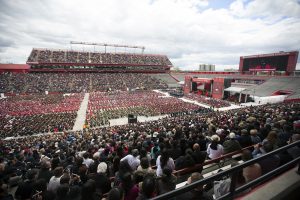
    The view on commencement day. Photo credit: Nick Romanenko, University Photographer, Creative Services
    The view on commencement day. Photo credit: Nick Romanenko, University Photographer, Creative Services

    On September 27, 2005 at the opening of the exhibition of the newly purchased East Jersey materials held at Morven Museum and Gardens in Princeton, Richard P. McCormick, distinguished professor of history at Rutgers, presented remarks on the extraordinary acquisition of colonial New Jersey documents from Christie’s. “What a glorious day!” McCormick stated at the beginning of his address. I’m sure that, as a Rutgers University historian, he would have felt the same way about Commencement in 2016.

    Indeed, it was a “glorious day” for the entire university community. To have the first sitting President of United States present the Commencement address was perhaps the signature event in the year-long celebration of Rutgers’ 250th anniversary.

    As a member of the Executive Planning Committee for Rutgers 250, I was involved in early discussions and was delighted to hear Matt Weismantel, Senior Director of Rutgers 250, was considering extending an invitation to President Barack Obama. We knew it was likely a far-fetched idea, given the complexity of scheduling and the number of invitations a president receives for such occasions, but there were numerous factors that weighed in favor of Rutgers, particularly its celebration as the eighth oldest college in the nation and its distinctly diverse student population. A three-year campaign, as highlighted in President Obama’s commencement remarks, resulted in a last-minute acceptance and dramatic preparations for a presidential visit to the Banks of the Old Raritan.

    I was fortunate to contribute to the events of this remarkable day. On the Friday preceding commencement, I received a call from Greg Trevor, director of media relations, asking if I would do an interview with WNYC (NPR) about Rutgers history. I told Greg that I would be more than willing to participate and that evening I participated in a five-minute conversation for a segment of “All Things Considered” that aired the following day at 5:30 p.m.

    During our preparations for the “All Things Considered” interview, I mentioned to Greg that I did not have a ticket for Sunday’s ceremony. If anything, I thought he might be able to get me a ticket as a professional courtesy, so I could observe this historic moment in my capacity as the university archivist. But Greg went one step further and added me to the Media Relations team that assembled in the press box at High Point Solutions Stadium.

    So, in addition to being a spectator, I also contributed to the event by informing the media about Rutgers past. During commencement, I was interviewed by both print media (the Star Ledger, Home News, Bergen Record, among others) as well as broadcast media (WCTC and WRSU).

    As I sat in the box at the 50-yard line looking at the crowd and listening to a wonderful commencement address, I kept thinking about Richard P. McCormick and wondering what his reaction would have been. To me, it was one of the most significant days in Rutgers history and I’m sure Richard McCormick would have agreed!

    “What a glorious day!” indeed.

  • Making an Impact: Bringing the Spring 2017 Mid-Atlantic Regional Archives Conference Meeting to Newark

    MARAC newarkUnder the leadership of Chancellor Nancy Cantor, Rutgers University—Newark (RUN) is implementing a number of initiatives to advance the role of RUN as an anchor institution in the city. In the spirit of these efforts, in June 2014 I organized an informal group, the Brick City Archivists and Friends (BCAF), to bring together local archivists, librarians, and community members who care for and support historic collections.

    With help from Natalie Borisovets and Gayle Malmgreen of the Newark Archives Project, I obtained contact information for potential Brick City members and convened an initial happy hour to coincide with the Institute of Jazz Studies’ (IJS) Jazz Archives Fellowship residency. The event was well-attended, so I continued to organize regular gatherings. Having the support of RUL’s Angela Lawrence, Bob Vietrogoski, and Adriana Cuervo has been particularly invaluable in the growth and sustenance of the BCAF, and I am grateful for their support. In all, fifteen archivists and other interested folks have come to events, and we’ve toured four area institutions along the way.

    I began to announce upcoming BCAF meetings via the Mid-Atlantic Regional Archives Conference’s (MARAC) New Jersey caucus listserv, and evidently, MARAC noticed. In late 2014 MARAC leadership decided that New Jersey deserved a turn as a meeting host, and given that Newark had not hosted a MARAC meeting since the 1970s, it was selected as the location for the spring 2017 conference. I like to think that the BCAF also played a role in this decision.

    We announced the exciting news to a joint meeting at the IJS of MARAC’s New Jersey caucus and the BCAF in January 2015. Shortly before this meeting, I was asked to serve as a Local Arrangements Committee (LAC) tri-chair, a position that I gladly accepted. Becoming a tri-chair appealed to me because it offers me the opportunity to serve MARAC’s membership and the archives profession, represent RUL in a leadership role, and support RUN’s efforts to make an impact in Newark. Seven of the twenty-two LAC members have been active in the BCAF, and RUL is also well-represented on the LAC through the service of Natalie Borisovets, Tim Corlis, Angela Lawrence, Tara Maharjan, and Bob Vietrogoski.

    Bringing MARAC to Newark provides opportunities to give back to the Newark community and to showcase Rutgers University Libraries:

    • To support local historical collections, the LAC is planning a “Day of Service” through which MARAC members will help a Newark institution with a hands-on archives project.
    • RUN and the IJS are sponsoring the all-attendee reception on April 21st, which will be held in the Great Hall at 15 Washington Street in Newark, adjacent to the IJS-sponsored and soon-to-open “Clem’s Place,” a lounge and performance venue dedicated to the late Dr. Clement Price currently being developed for RUN faculty and special guests.
    • The IJS will showcase its most ambitious exhibition to date, Records at Play: A Century of Jazz from New Orleans to Newark, which is scheduled to open in January 2017 and run through the end of the semester. Records at Play will be the inaugural exhibit in RUN’s Express Newark, a university-community collaboratory under development in the former Hahne and Company Department Store. Stay tuned for more information about the exhibit in a future edition of The Agenda!

    The meeting will be April 20th through 22nd at the Robert Treat Hotel, and we expect between 350-400 conference-goers. Even though the conference is a year away, the LAC is currently recruiting volunteers to work during the meeting, so please contact me at elizabeth.surles@rutgers.edu if you have an interest in getting involved.

  • Libraries Get Social at Social Media Summit

    The Libraries’ first Social Media Summit was held on Tuesday, April 19. More than 20 of our colleagues gathered at Alexander Library or attended remotely for a day-long program focused on all things social media at the Libraries and beyond.

    The morning began with a presentation by Karen Smith, assistant director of new and emerging media for Rutgers University. Smith discussed the key elements of building an effective social media strategy as well as the most popular social media platforms and their uses. She also shared best practices developed from the experience of managing the university’s primary social media accounts (RutgersU on Facebook, Twitter, Instagram, and Snapchat).

    The emphasis for RutgersU social media is encouraging conversation — asking questions, posting interactive materials, highlighting student contributions (everyone likes their 15 minutes, and the RU Speaks campaign featured below is a good example of this). Some takeaways:

    • Rutgers invites a student to guest post on their Instagram each week – creates lots of student-friendly content and interest.
    • Tease out big news by asking “Guess who?” or “Guess what?” questions. We tried this for our Rutgers Day John Morton reveal and it generated a lot of chatter and feedback.
    • Run lots of contests for prizes like mugs (they will do person on the street — “show us your follow on any social media and you can win a prize”)
    • Try to create an accessible, authentic space by avoiding overly moderating contributions and academic language and jargon.

    The afternoon was highlighted by a presentation from Aaron K. Ginoza, social media and community engagement coordinator for the University of Maryland Libraries (UMDLibraries on Twitter, Instagram, and Snapchat). Ginoza gave an overview of the evolving social media landscape at the University of Maryland, provided case studies of UMD Libraries’ most successful social media campaigns, and offered his own set of best practices for generating online engagement.

    umd
    During Exam Wars, UMD Libraries hosted yoga classes.

    Some of the social media campaigns UMD has run in recent months are

    • Parody music videos
    • Light painting (great for nighttime study breaks!)
    • Exam Wars campaign (utilizing Star Wars visuals for reading time promotions and stressbuster activities)
    • Throwback recess (complete with potato sack and three-legged races)
    • Zombie, Pokemon, and Game of Thrones-inspired scavenger hunts to encourage exploration of the libraries
    • An extensive campaign for Alice in Wonderland exhibit.

    The program was wrapped up by Jessica Pellien, director of communications, who discussed a proposal for a Social Media Taskforce that was recently reviewed and approved by Cabinet. The Taskforce members will be selected with input from the Libraries’ Cabinet and will hopefully begin work over the summer.

  • Tara Maharjan’s visit to Kaiser Library in Nepal [Photos]

    Special collections and university archives processing archivist, Tara Maharjan, recently traveled to Nepal, almost one year after the 7.8 magnitude earthquake. While in Nepal, she took a trip to the 120-year old Kaiser Library, the oldest library in the country. The library building, as well as one-third of the 28,000 books, were damaged. The books from the four floors have all been moved to the ground level, the only part of the building which is somewhat structurally sound, and are now in plastic bags until the building can be reopened to the public. In the mean time, the small library staff serves patrons from a tent outside the building, where people can view newspapers and a few books.

    Here are just a few of Tara’s images from the Kaiser Library:

    • OLYMPUS DIGITAL CAMERA
  • Call for Submissions to Featured Collections

    featured collections
    What would you feature in this spot on our homepage?

    In order to better represent the magnitude and diversity of materials the Libraries hold, we are opening up the Featured Collections block on the Rutgers University Libraries homepage to submissions. We can include a photograph and a brief description of a physical or digital collection or other materials you think will be of interest to our users.

    To be included, please send Mary Ann Koruth an image with a caption and a description with a link (if available) to any item that you feel deserves to be showcased on the homepage. These could include photographs, prints, videos, maps, books, collections, items relating to science and medicine, oddities from the archives–you name it.

    We’d like to extend a special thanks to Caryn Radick and Tara Maharjan in Special collections in Alexander, for the wealth of material they have brought to our notice over the past years.

    Please take some time to peruse through collections in your specialty and send in a submission that grabs your eye and piques your interest!

  • 30 Years of the Bishop Lecture

    30 Years of the Bishop Lecture

    If you have a photo that might complement one of the lectures that don’t currently have a photo, please send it along to kuehl@rci.rutgers.edu.