Category: University Librarian Report

This the collection of monthly newsletter articles from Krisellen Maloney, Vice President for Information Services and University Librarian.

  • The BIG Convenings: Why Now?

    As you may already have seen elsewhere in this issue of the Agenda, the BTAA has scheduled a series of BIG Collection Convenings for all faculty and staff of member libraries. This series of keynotes will focus on generating broad community engagement with the vision, themes, and practical direction for the BIG Collection.

    As a member of the BIG Collection Steering Committee, I invite you all to register to attend. But further, I thought I’d use this month’s column to give a bit of additional context about these events and discuss why now is a great time for us to be engaging in these conversations as a community.

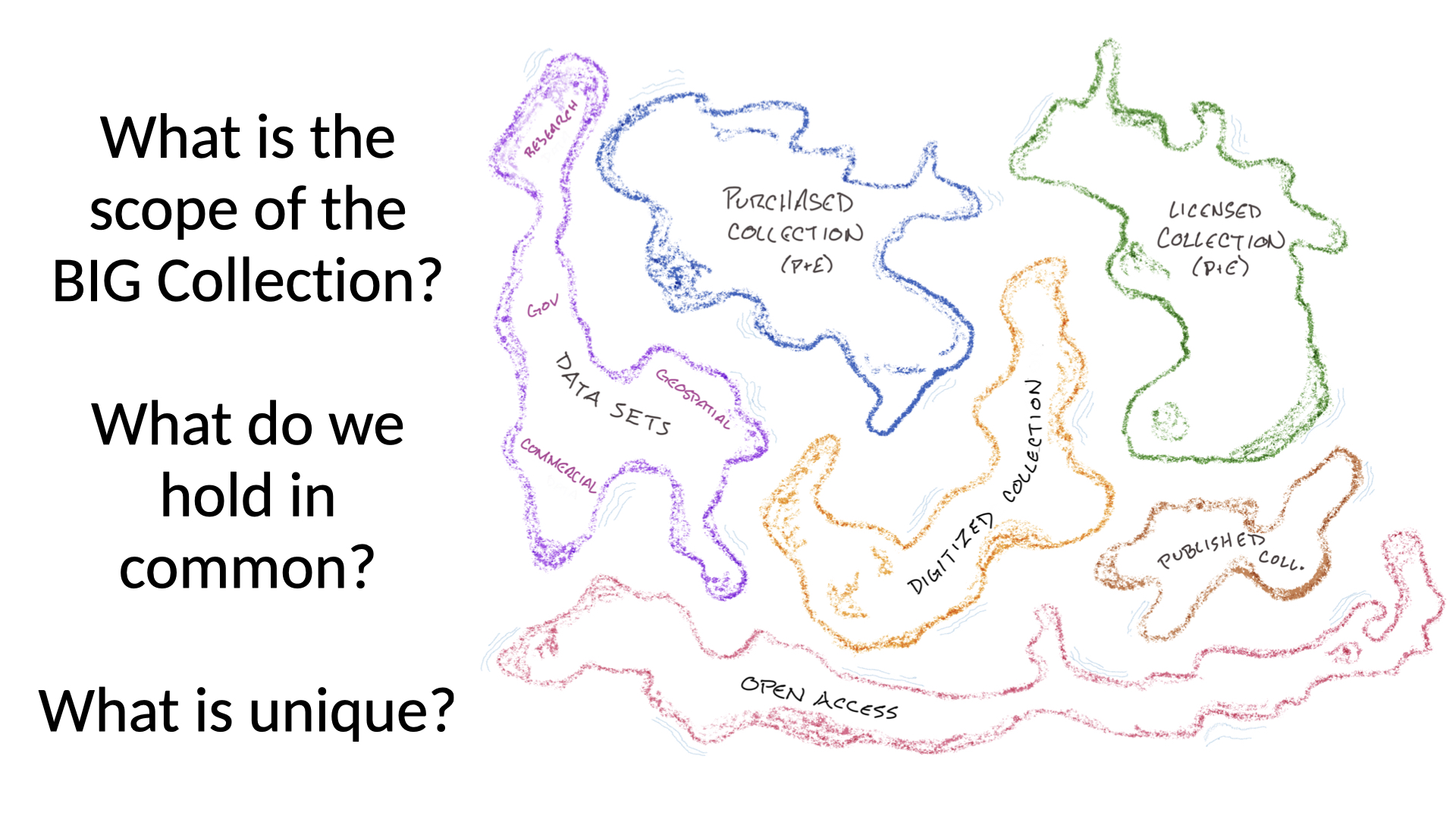
    In a recent presentation, BTAA’s director of library initiatives Maurice York described our current operating environment as a sort of “Pangea,” with each of the self-contained land masses representing a distinct element of the member libraries’ collections and operations—our purchased collections versus our licensed collections, for instance, or the material we digitize from our physical holdings versus that which we make available as part of our various publishing initiatives.

    From my perspective as a member of the Steering Committee, the issue with the way this landscape has developed over time is that each area has grown in isolation from the others. Until very recently, no one had taken a step back to survey the environment holistically, to consider these elements as interconnected and interdependent, and to imagine the possibilities that can emerge when treating our Pangea not as a loosely related set of activities, but as a single entity with a unified purpose.

    The Convenings are our first step toward getting the people on all these separate land masses to see a common future—of moving us closer toward that unified purpose. They are also a way for us to hear from representatives of all these different groups, to understand them better and learn both what they can offer the BIG Collection and what they might need from the BIG Collection to be successful.

    As I have written several times over the last number of months, the scholarly communication landscape is evolving, precipitated in part by changes brought about by the pandemic and the shift to an online-centric model of teaching and research. At the same time as our users’ expectations shift to demanding access to materials “at the speed of now,” pressure is being put on academic libraries across the country to maximize their budgets and achieve efficiencies of scale. Set against this backdrop, how do we align resources and activities across BTAA libraries to work toward a “knowledge commons” and maximize our impact? How can we work together—leveraging shared services, infrastructure, and strategy—to better serve all our communities? These are the questions that we will begin to explore throughout the BIG Convenings. I hope you will plan to join us!

  • University Librarian’s Report – January 2021

    Welcome back, everyone—I hope you all had a restful winter break and are feeling energized and ready to tackle the challenges of a new semester.

    Before we look forward to what the new year has in store, I wanted to take one last opportunity to thank you for all your excellent work in 2020. If you haven’t yet had a chance to do so, I’d like to encourage you to review our 2020 annual report. While the items collected there only begin to scratch the surface of what we took on in the last year, they do serve as a reminder of how we were able to rise to the challenges that were presented to us—particularly in light of the pandemic and all of the changes that it necessitated to the ways in which we work. I know that when the university looks back on this unique moment in its history, the Libraries will be remembered as a key contributor in the transition to online education and as an essential component in the successful continuation of research and teaching despite the turbulent times—so we should take pride in what we were able to accomplish on behalf of the Rutgers community and in support of the university’s mission.

    Turning the page on 2020, there is plenty more exciting work coming down the pike in 2021. As you know, last week we launched our revamped SOAR website, built on the infrastructure provided by Ex Libris’s Esploro product. While additional enhancements are planned over the course of the year to come, you can begin working with your departments to bring them up to speed on the changes. To that end, a toolkit of materials has been developed to support your outreach, so I hope you will take advantage of it and help raise awareness about this important service we provide to the university community.

    Changes are also well underway in our transition to Leganto for course reserves and our overall reimagining of course reserves workflows. Earlier this week, the course reserves scope in QuickSearch was formally removed and changes were made to our website reflecting this change. In addition to these more technical elements, we are moving in a direction with our overall course reserves strategy that will be more collaborative and better leverage the expertise of our subject specialists. I know that there may be some discomfort as we adjust to new workflows and processes in this area, but we should be encouraged that ultimately, we are making these changes to provide a more streamlined, consistent, and convenient experience to all our users. As we move forward with our explorations of tools like Alma Digital and Rapido, we should also remember that a user-centered philosophy is one of our core principles as an organization, and doing what we can to advance and uphold this ideal will always be a worthy endeavor—even if it challenges us to step outside our comfort zones temporarily as we adjust to changes in our day-to-day work.

    Finally, I’d like to touch on our ongoing website redesign. We have entered an exciting phase of the project as design elements are being approved and our partners at NewCity move into the front-end development work that will bring life to the layouts. In the coming weeks, we will also start turning our attention to content development and governance modeling. There is too much to go over in detail here, so I will encourage you to save the date for next Wednesday, January 27 at 4:00 p.m., when project co-leads Amy Kimura and Antonio Barrera will be leading a Central Forum to provide an update on the website redesign. I hope you will plan to join us then and bring any questions you may have.

    Again, these are just a few snapshots from among all the good work that is going on across the Libraries, but I hope they will serve as sufficient indication that we have plenty to be excited for heading into the new year. Thanks for everything you are doing, and I can’t wait to see what we will accomplish together in 2021.

  • Serving the Post-Pandemic University

    It has been eight months since the university moved online and it is still difficult to believe that it is real. The sudden change that we experienced is gradually transitioning to a new normal, along with the insight that it is unlikely that we will ever return to the operations that we left in April. We are beginning to understand that we have the opportunity to build a future that combines the best of the past with the elements of our current environment that work well.

    In a blog post related to the pandemic, Lorcan Dempsey writes about the ways in which the pandemic is accelerating changes in library collections that previously had been slowly evolving. Dempsey discusses three pandemic effects that have contributed to this acceleration and will shape our environment going forward:

    • Budget reductions and the possibility that recovery will not come quickly
    • The rapid shift to online learning and research that most likely will only be partially reversed
    • The need for libraries to visibly and proactively align their services with the mission of the university

    As we develop strategies, it is imperative that we continue to look closely at how these pandemic effects are changing both higher education in general and Rutgers in particular, to try to discern how we use our strengths in the new environment. Some collection-related trends that I believe will be most relevant for us include:

    • The need to advance undergraduate student success. Student success is a critical element for the future of Rutgers. We have seen that—perhaps surprisingly—certain courses like traditionally large lectures can actually work better in an online format, creating more opportunities for participation and engagement than would previously be possible. We also know that students and their families are facing unprecedented financial struggles because of the pandemic, and the economic ramifications of the virus are still not even fully understood. I expect that these factors will cause the delivery of some of the undergraduate curriculum to change, even after it is safe to return to classroom settings. Accordingly, we should expand our efforts to replace traditional textbooks with open and affordable information resources. We have been successful in this area with OAT and Leganto, but we should be asking ourselves what this could mean for how we develop our collections, offer instruction, and participate in shared activities moving forward.
    • The continued erosion of the scholarly communication system. Academic libraries have worked on multiple fronts to develop new models of scholarly communication that center the researcher and the scholarship rather than the publisher. Fueled by the success of the University of California system in breaking the Big Deal, for the first time libraries are seriously considering large-scale cancellation of packages as viable option. Publishers, in collaboration with libraries, have responded with transformative license agreements that may simply shift who pays for publications without solving the underlying problem of unsustainable costs. Library budgets have also supported other forms of academic publishing. Over the past few decades, libraries have systematically reduced the number of monographs purchased from university presses, creating—for all but a few large presses—the need for substantial university subsidies. Now scholarly associations are facing a similar future. Together, these changes represent substantial shifts in the scholarly communication environment and will require responses much broader than a single library. As such, we should join our institutional partners in continuing to advocate for a sustainable and open ecosystem of publication, one that recognizes and rebalances the contributions that authors, institutions, and publishers make.
    • The rise of multiple formats. Libraries have always dealt with multiple formats, and this trend only continues to grow. In addition to print and online journals and books, we also provide access to multiple forms of audio, video, data, and other media. Print continues to be an essential part of our collections; however, the rapid shift online has exposed the costs of acquiring and managing print collections and has changed the calculations that determine what format is optimal. Moving forward, we should look carefully at how we optimize the Libraries’ collection budget to provide access to content, balancing the diverse needs of the various disciplines with overall trends and preferences toward the use of digital media.

    Taken together, I see these trends pushing us further in the direction of interdependence and collaboration among libraries. For instance, the cancellation of “Big Deals” requires unprecedented levels of collaboration and reliance on borrowing networks. Strong and established partnerships with PALCI, BTAA, and VALE position us well in this environment, as do our membership with HathiTrust and leadership in the BTAA Collective Collection initiative. As we invest in these efforts, we will be forced to navigate the tradeoffs between local control versus participating in shared activities at the consortial level to achieve efficiencies of scale in purchasing, licensing, and sharing resources.

    At this moment, we have the opportunity to look more holistically at our collections, to ask important questions about our priorities and approach, and to begin charting a course forward that will help us address not only the difficulties we are facing in the immediate present, but also the shifting landscape of scholarly communication and higher education more broadly moving into the future. We have an informed and engaged library faculty who can share their insights and expertise with discipline-specific perspectives on these issues, as well as a faculty planning committee who are tasked with helping the Libraries develop a more focused long-term vision that will allow us to flourish in the face of the many challenges before us. It may be difficult, but with the willingness and flexibility to adapt to a rapidly changing environment, the courage to make bold decisions, and a genuine commitment to deep collaboration (both within the Libraries and across our many external partnerships), I am confident that we can position ourselves to provide excellent service to the post-pandemic university.

  • Introducing Our New Values and Principles

    In the last issue of the Agenda, I wrote about the role of our Values and Principles and reflected a bit on the primacy of Diversity, Equity, and Inclusion among them.

    Now that the final version has been posted publicly to our website—you can find them here or by navigating to About > Mission, Vision, & Strategic Plan on the Libraries’ homepage—I wanted to take some time to discuss the changes that Cabinet made.

    You will see that this document is not considerably different from what was initially recommended to us by the Values and Principles Taskforce. However, we thought it was important to add some prefatory remarks to describe the function of these values and principles within our organizational culture and explain the order in which they are listed:

    Rutgers University Libraries’ values and principles inform our efforts to support and enrich the instructional, research, and public service missions of Rutgers University. Our values represent our core beliefs, while each of the supporting principles describes how these values can and should be manifested in our day-to-day work. Serving as a compass to guide our interactions and decision-making, these elements differ from our annual priorities, which describe the “what” of our work rather than the “how” and “why.”
    We also acknowledge the difficult truth that not all of these values fully reflect our current reality. For this reason, we have chosen to foreground our commitment to Diversity, Equity, and Inclusion in recognition that we must do more to create a workplace that embraces individuals with a diversity of backgrounds, identities, and roles. Moving forward, we pledge to strive toward these standards of thought and behavior so that we may become an organization distinguished by a culture of fairness, respect, and opportunity for all.

    From the perspective of our leadership group, it is especially helpful to have these values and principles in place at this moment, when we are tasked with making difficult decisions related to budgetary reductions while continuing to provide excellent library service, all despite the challenges and uncertainties of the ever-shifting environment created by the pandemic. With this document as our “North Star,” we can continually look inward, examine our thoughts and behaviors, and make sure we are living up to the standards we have formally set forth.

    We should also not shy away from the fact that these values and principles are in some ways aspirational, particularly when it comes to our commitment to Diversity, Equity, and Inclusion. While we have made some strides in this area over the years through various programs, policy changes, and other activities, there is still work that remains to be done. Acknowledging our current situation is an important first step for us, as is the work that will be undertaken by the newly formed DEI Committee.

    Please do take the time to read back over these values and principles and reflect on how they can be brought to bear on your own day-to-day work and in your interactions with patrons and colleagues. Remember, as an organization, we have all contributed to the development of these ideals—and it is now our shared responsibility to collectively embody them.

  • Reflecting on Our Values and Principles

    As I’m sure you’ve seen in your email or the Cabinet minutes, the Libraries’ Values and Principles Taskforce recently completed its work and issued a final recommendation to Cabinet for consideration. We are still in the process of finalizing our values and principles and will post them to our website soon—but in my mind, this work could not have come at a better time, as the COVID pandemic, the shift to online-only, and now, planning for the phased return to our buildings, have all forced us to take a step back and determine what is core to library service.

    Our values and principles are different from our goals and priorities. The latter identify “what” we do, while the former describe the “how” and “why.” When these are finalized, we will have a set of ideals that we can use to guide our decision-making in the future—and in some ways, they have already begun to do so. For example, at the last Cabinet meeting, during which we discussed the taskforce’s recommendation to us, we decided to move the value of Diversity, Equity, and Inclusion (DEI) to the top of the list. This was a recognition of the importance of this value to us as a leadership group and an organization, as well as an acknowledgment of the reality that we have work to do in this area. Our first step forward is charging a new Diversity, Equity, and Inclusion Committee, which will take stock of our current environment in order to guide and recommend processes within the Libraries that embrace DEI. As a reflection of our ongoing commitment to this value, the DEI Committee will be a permanent group designed to provide continuing guidance on these issues, not a working group tasked with producing a single report or planning a one-off training.

    Of course, this is only one example of how our values and principles can serve as a compass for us. Moving forward, we should consistently refer to them as a guide when there are hard decisions to make or difficult conversations to have. When we embrace these values—DEI, Inquiry, Access, Service, and Collaboration—with the intent of truly living them, we can be confident in our ability to move forward in a way that meaningfully advances the missions of the Libraries and the university.

    I would once again like to thank the members of the taskforce—Mina Ghajar, Tom Glynn, Samantha Kannegiser, Elizabeth Surles, and Geoffrey Wood—for their extraordinary work. Their job was certainly not an easy one, and the way in which they sought input from faculty and staff across the Libraries was admirable. I encourage you to review our values and principles once they are posted and reflect on how you can embody them in your own day-to-day work.

  • Recapping State of the Libraries 2020

    Thanks to everyone who attended State of the Libraries on Wednesday. We had over 200 folks join the meeting, and I’m so glad you all found the time to be there even with the competing demands of work and home. It was no replacement for our traditional in-person gathering, but it was nice to feel a sense of togetherness despite the circumstances and our physical distance.

    If you haven’t had a chance to yet, I encourage you to view the poster presentations prepared by our colleagues from across the Libraries:

    It is so inspiring to view these and reflect on all the good work that has been done over the last year, as well as how we are preparing for the work that lies ahead. There will be no shortage of challenges in the year to come, but with all the creativity and dedication on display through these presentations, I know we are well-equipped to handle whatever comes our way.

    If you’d like to review them, you can view the slides from all the presentations on our staff resources site or a recording of the entire event on YouTube.

    As you might imagine, a lot of activity happened behind the scenes to make sure everything went smoothly. Special thanks to Kalaivani Ananthan, Matt Badessa, Tracey Meyer, Joann Parrone, Ed Smith, and the Major Events Committee—Elsa Alves, Matt Bridgeman, Ann Marie Latini, Erica Parin, Tonie Perkins, Jennifer Reiber, and Daphne Roberts—for their support.

    We also received some great actionable feedback that we will incorporate into our future virtual gatherings, so thanks to everyone who provided thoughtful comments via the feedback form.

    A theme that emerged from all of yesterday’s presentations was collaboration, and State of the Libraries was just another example of what we can accomplish when we all work together with a common goal and sense of purpose. I hope we can carry forth some of those lessons and apply them to our work moving forward. In the coming months, it’ll be more important than ever to identify the areas where we can leverage our shared interests and maximize our impact on the university community.

  • Kicking Off another Planning Cycle

    It’s March, which means that another planning cycle is getting into full swing. At the Cabinet retreat tomorrow, we will begin discussing the 2020–2022 local priorities that have been developed by the directors. You can read them yourself on our Annual Planning and Priorities page: Camden, Newark, New Brunswick, RBHS.

    Over the past several planning cycles, information control has been among our top priorities as a system. This was based on feedback we received in the 2016 LibQUAL+ survey, which indicated we had room for improvement in this area in particular. As you know, this led to a whole suite of changes, not the least of which was the implementation of QuickSearch. We’ve also added extensive backfiles in recent years, working to address gaps in our collections so that they better meet the needs of Rutgers researchers. It has been a lot of hard work, but signs point to it paying off. The 2019 LibQUAL+ results, for instance, coupled with indicators like the drop in ILL numbers, give us reason to believe that we have made significant improvements when it comes to information control. This is a huge achievement for us, because it’s where our users indicate that they have the highest expectations for library service.

    That said, it isn’t entirely surprising to see that information control is becoming less of a focus area in some of the plans for this cycle. Of course, this doesn’t mean that this aspect of our work is any less important—it just means that we’ve laid an effective foundation and are ready to build toward new things.

    It is important that we take a moment to congratulate ourselves for this amazing accomplishment. Having a strong information control foundation allows us to build new services that will be both scalable and robust. These services fall into a category that we are calling in our priorities information management.

    Information management will be the organizing theme for many of our new initiatives in the coming years. One such area is our support for scholarly communication, and I wrote in my last post about Esploro and how it will strengthen our ability to provide open access to articles and data. We also see local initiatives in this cycle’s plans such as the Health Sciences Libraries’ pursuit of research information management services, Newark’s revitalization of the open access Journal of Jazz Studies, New Brunswick’s development of bibliometrics, or Camden’s creation of digital projects based on undergraduate and graduate student research. These are all encouraging signs that the work we’ve done is opening up new possibilities for how we serve the scholarly communities on our respective campuses, and I’m excited that we’re finally at the point where we can pursue these sorts of activities.

    My next Agenda post will be in May, and by then we’ll have had a chance to review the local plans and determine which priorities require central support. We’ll then begin finalizing the plans based on the capacity of our infrastructure and which priorities will move the most people forward. It’s an exciting time of year as the work on our horizons comes into sharper focus, and I look forward to exploring all the possibilities with Cabinet. But it’s also an occasion to reflect on how far we’ve come, and for that I have all of you to thank.

  • Looking Forward to 2020

    Welcome back! I hope you’re all feeling rested and rejuvenated from a well-deserved winter break.

    As I mentioned in my holiday email last month, I am so impressed by the amount of work we were able to accomplish last year. None of the achievements I chose to highlight was the result of a cookie-cutter project. Each of them required hard work, creative problem solving, and deep collaboration across the library system and with local campus partners. I know it isn’t always easy, but when these things come together, the impact is felt by students and faculty across the university. Thank you again for all your good work in 2019.

    As we turn our collective attention to 2020, I’d like to kick off the New Year by sharing some fantastic news. We have received our official FY21 budget awards and I am happy to report that we have received full support for salary increases and collection inflation, exceeding our expectations for funding in both these areas. Moreover, this funding is not representative of what was awarded to other cost pool units across the university. Simply put, this means that all our hard work is paying off. It’s a strong vote of confidence for the Libraries and the direction in which we’re headed, and I’m proud that we’ve received this recognition of our importance to Rutgers students and faculty.

    I’m glad that we will continue this momentum and hit the ground running this year with several impactful, large-scale projects. One such undertaking is the redesign of our website. While this project is still in its early stages, we have contracted with a vendor that will be performing the work. A web group is being convened to manage the project internally, establishing a timeline and benchmarks and communicating progress with the rest of our colleagues. The first step of the redesign is a discovery phase that includes surveying site visitors to learn more about their goals and experiences. This is another project that will draw on the expertise of many of us across the Libraries, and I look forward to following its progress as we continue to cater our services to meet the unique needs of our local communities.

    Another important project for us is Esploro. One of the priorities that arose from our last planning cycle was to implement an information management solution that will allow us to support the university’s open access policy in a sustainable manner, and Esploro represents a huge step toward meeting that goal. Esploro automates the management of research output—including capture and direct deposit—and helps streamline the process of depositing the results of scholarship into SOAR. It integrates directly with our library system and leverages one of the largest indexes of scholarly research available in order to ensure the broadest possible capture. Because it automatically harvests scholarly work done by Rutgers faculty, Esploro should give us a more comprehensive repository of Rutgers scholarship than we have with our current, purely manual deposit process. It will also help us better partner with the Office of Research & Economic Development by providing them with data on faculty output and productivity that can be used when pursuing research grants or steering potential industry partners toward relevant faculty experts. With projects like this, is it encouraging for me to see how the foundations we’ve laid over the last several years open up new possibilities for us moving forward. Adding a tool like Esploro builds on the work that groups like the Ex Libris Implementation Team have done in the past, and allows us to deliver value-added services that uplift the entire Rutgers community.

    Of course these are only a couple examples of the many exciting projects we have slated for 2020, but I hope they serve as compelling illustrations of all the progress we’re making. I look forward to another productive year ahead!

  • “Sticky Interdependence” and the BIG Collection

    Earlier this semester, my fellow BTAA library directors and I issued a joint statement publicly committing to an interdependent future and introducing the idea of the BIG Collection.

    This is a strategic and coordinated approach to sustaining the scholarly content held in our collections and enhancing our users’ path from discovery to delivery of that content. The initiative draws on the analysis of collective collection opportunities conducted by Lorcan Dempsey in the report Operationalizing the BIG Collective Collection: A Case Study of Consolidation vs Autonomy, which I have discussed in previous issues of the Agenda.

    Planning for this initiative is underway with the appointment of three committees to scope, plan, and realize the necessary programmatic components. These include the Content Committee, which will identify strategies for managing existing print collections and more strongly coordinating collections for optimal distribution; the Applications Committee, which is responsible for improving network fulfillment and creating unified and coherent discovery of BTAA collections; and the Enterprise (Steering) Committee, which works in the areas of strategy and policy and is responsible for oversight of the BIG Collection.

    As co-chair of the Applications Committee and a member of the Enterprise Committee, I am deeply invested in the success of the BIG Collection initiative and committed to the vision that it represents. This vision—“of a more codependent system in which research libraries pledge to preserve individual collection areas, allowing other institutions to allocate spending elsewhere”—as it was described in a recent article in the Chronicle of Higher Education—comes from the understanding that the time has come to move away from models based on non-productive competition. Throughout the BTAA, library directors have embraced the idea that you don’t get big by making someone else small, and it will take a real, lasting commitment to collaboration for us to successfully chart a course forward in the current information landscape. My colleague James Hilton at Michigan calls this idea “sticky interdependence” and I think this phrase captures nicely the imperative for us not just to work together, but to do so in a way that is sustainable in the long term.

    At Rutgers, we are well positioned to contribute to this sort of initiative because of our experience building interdependence between the four campuses. As you know, our planning process helps us determine the best ways to work together and how to leverage shared resources so that they have the greatest impact on the most users. It has also helped us understand how more purposeful coordination can lead to a more effective system overall. This is the experience that I plan to bring to my work on the BIG Collection committees.

    Simply put, in any networked environment, all members have to rise up together. Nobody can do it alone. This is as true for the libraries at Rutgers as it is for the institutions across the BTAA.

    In our statement on the BIG Collection, we emphasize the importance of intentional, collaborative action that advances a shared mission and ensures the collective good. We have learned this lesson first-hand at Rutgers, and now we are seeing the idea take hold at a larger scale. I believe very strongly that this cooperative, interdependent future is the best way forward—for Rutgers, for the Big Ten, and for all the students and scholars that our institutions collectively serve.

  • Google Books, HathiTrust, and Our Contribution to the Collective Collection

    The record for a HathiTrust text displayed in QuickSearch.

    As you may have read in the Cabinet minutes, the Libraries recently formalized our commitment to participate in the Google Books Library Project. With the goal “to create a comprehensive, searchable, virtual card catalog of all books in all languages,” this partnership between Google and dozens of libraries worldwide—including those of the BTAA, which signed an agreement to participate in 2007—has digitized millions of books and made them searchable through the Google Books platform.

    In addition to improving Google’s search, the books scanned through the Google Books Library Project are deposited into the HathiTrust Digital Library. The BTAA and University of California system were instrumental in setting up HathiTrust, a community-owned partnership developed to “be a vital catalyst for emerging forms of research, teaching, and learning that engage the scholarly and cultural record.” We already benefit greatly from the services of HathiTrust, which include preservation of the scanned versions of the content, access to research tools such as textual analysis, and books for people with print disabilities. Moreover, full-text content from HathiTrust is discoverable in QuickSearch, adding to the amount of resources our users have access to at the click of a button.

    Though our work on this project is really just beginning, it has already been months in the making. Last spring, we worked with Google to go through a test run of their digitization process, from the identification of books in our collection to the review of the final, scanned versions. Now that we’re moving forward, a Librarieswide team has been formed to carry out the project with Joann Parrone acting as the central coordinator. This group had its kick-off meeting last month and is already working to comb through the candidate list provided by Google, which amounts to nearly 170,000 unique items. Each needs to be reviewed for eligibility, taking into consideration size, condition, and a variety of other factors.

    And this is all just the tip of the iceberg. This project will call upon many of us throughout its lifecycle, from the selection of materials, to packing and staging, to coordinating checkout policies while the books are away being scanned. But this this is an important undertaking and a great opportunity for us to further our contribution to the collective collection, advancing the elements of our mission to accelerate discovery, illuminate understanding, and contribute to the public good.

    In their new report on operationalizing the BTAA collective collection, Lorcan Dempsey and his colleagues write that “effective collaboration, the provision of shared infrastructure, and operational sustainability are all now central issues for libraries and the institutions of which they are a part.” Contributing to initiatives like the Google Books Library Project and the HathiTrust Digital Library is one of the many ways we can embrace this spirit of collaboration and ensure that we maximize the impact of our collections—not just in the here and now, but around the world, and for generations to come.