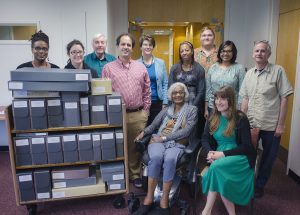
2016 Jazz Archives Fellows and Institute of Jazz Studies and Dana Library faculty and staff pose with Joanne Robinson Hill and the processed Andrew Hill collection. Pictured (L-R) Angela Lawrence, Adriana Cuervo, Bob Nahory, Brad San Martin, Krista White, Joanne Robinson Hill, Veronica Johnson, Max Dienemann, Treshani Perera, Elizabeth Surles, and Tad Hershorn. Photo by Ed Berger, some rights reserved.
The Institute of Jazz Studies (IJS) is pleased to announce the availability of the Andrew Hill papers, music and audiovisual recordings, 1956–2011. Hill (1931–2007) was an influential and acclaimed jazz pianist, composer, band leader, educator, and winner of numerous prestigious jazz accolades, including the National Endowment for the Arts Jazz Master award in 2008, among the highest honors in jazz in the United States. The extensive collection, generously donated in 2015 by Hill’s widow, Joanne Robinson Hill, includes materials ranging from his musical compositions, sound recordings, correspondence, and awards, to press kits and even one of his favorite hats.
The collection was processed as part of the 2016 Jazz Archives Fellows residency, with IJS archivists Angela Lawrence, Tad Hershorn, and Elizabeth Surles working in tandem with jazz fellows Veronica Johnson, Brad San Martin, and Treshani Perera and intern Max Dienemann to arrange, describe, and rehouse the collection and create an EAD finding aid for the materials. The (IJS) started the Jazz Archives Fellows program in 2012 with two purposes in mind: to improve diversity in the archives profession and to provide a meaningful professional development opportunity for early career archivists and for students in graduate programs who intend to become archivists. In addition, the IJS benefits directly from the fellows’ work to process a collection. To see firsthand the fellows’ work and learn more about the collection and Andrew Hill, please explore the online finding aid at http://www2.scc.rutgers.edu/ead/ijs/hillf.html.
The processing of the collection is timely. While it has only been open to researchers for a couple of months (before being announced publicly), the collection has already been used to produce a series of Andrew Hill legacy concerts at the Jazz Standard in New York City to celebrate what would have been Hill’s 85th birthday, as well as supported research by scholars visiting the Institute.
Rutgers University Libraries faculty and staff had a busy summer preparing for the email and calendar migration to Rutgers Connect. The migration took place over three days between August 23 and August 25, 2016, but by the time we reached this milestone, over two months of work by Unit Computing Specialists (UCSs) and Integrated Information Systems (IIS) staff had already been invested into planning the process, preparing for the transition, and learning the new environment.
Here are some of the highlights:
261 users responded successfully to the pre-migration questionnaire
151 RUL members attended one of seven Information Sessions before the migration
Please fill out a brief survey by Friday, October 14, and let us know how we did and what you are looking for, in terms of Rutgers Connect training and support, in the future.
277 user accounts, 61 distribution lists, and 59 shared (resource) accounts were migrated
146 RUL member participated in 9 hands-on training sessions conducted by Comparex and IIS (and paid for by the Rutgers Office of Information Technology)
227 support requests have been completed since August 1
RUL retirees are also getting help migrating to ScarletMail, but that is a slower process and we respect their schedules
IIS was successful in arguing for reduced University requirements related to central management of personal mobile devices when accessing Rutgers Connect mail
The migration went relatively smoothly, without any significant data loss, but there were inevitable glitches given the complex nature of the system and the four-way handling of the process: Microsoft as the owner of the platform, Rutgers as the customer (represented by OIT), Comparex as the University’s partner performing the actual migration, and, in RUL’s case, IIS as the local IT support unit, together with our UCS colleagues.
We want to thank everyone for your patience and understanding as we have worked, and still keep working, to make the new tools perform efficiently for all. The Rutgers Connect environment is new to all of us, and there is still a lot to learn. IIS will transform the Rutgers Connect Migration Support website into an ongoing support site in the next couple of weeks. We will also try to prepare advanced training classes in the coming months.
Since the Rutgers Connect/Office 365 platform lives in the Microsoft cloud, several features are difficult or impossible to adjust to our exact requirements. Rutgers is still working with the vendor to make changes, including the ability to set the default Sender address.
All IIS members and UCSs added supporting the migration to their regular responsibilities, and they deserve our thanks. Tracey Meyer has been, and remains, our lead support person, and Kalaivani Anathan coordinated the migration process. We hope we have been able to help you all, and look forward to respond to any future question or support request.
Please fill out a brief survey by Friday, October 14, and let us know how we did and what you are looking for, in terms of Rutgers Connect training and support, in the future.
On December 26, 2015, Izzy Stern tweeted: “Today is the day I found out that Rutgers doesn’t even have full ebrary access. So many sad faces.” As a graduate student in a major humanities department at Rutgers–New Brunswick, Izzy might have expected to use ebrary, one of the largest academic e-book resources, for her research in the winter break, but then had a rude awakening that day when she found out that it was not available at Rutgers, yet. So she went online and shared her frustration on Twitter with the entire world, which was totally understandable. As a matter of fact, the lack of access to e-books was a major source of complaint from our students and faculty about the library collections—hundreds of similar comments can be found in the results of the LibQual+ and previous Counting Opinions surveys. Here, I quoted only Izzy’s tweet because it is on the open web, but the problem she reported was a common one.
What a difference a few months have made! Izzy and her fellow students may be glad to hear that the Libraries have made great strides to improve their access to e-books. Here are the major e-book resources that became available at Rutgers in the last several months:
Ebrary Academic Complete: a subscription-based collection of about 140 thousand e-books on all academic subjects.
Springer Nature frontlist e-book collections: 7,175 purchased e-books published in 2016 in STM (Science, Technology, and Medicine) and Social Sciences.
PALCI/EBSCO Demand-Driven Acquisitions Program: about 1,000 new e-books expected to be purchased during the academic year.
In addition, we are evaluating a new PALCI/JSTOR e-book program. The program will purchase several hundred high-use titles and also provide academic year-round access to all the JSTOR e-books, a collection of over 40,000 high quality scholarly monographs from many of the major university presses.
Over a decade ago, the Libraries began to acquire small, subject-based e-book collections. In 2014 we joined HathiTrust, which gives us access to several million out-of-copyright works. However, the availability of large, comprehensive collections of current e-books today represents a quantum leap or a sea change. Since the Rutgers community is celebrating the 250th anniversary of the University this year with a revolutionary spirit, it may be befitting to call this significant change a revolution, an e-book revolution.
Stepping outside Rutgers, we will find that the e-book revolution is sweeping through the academic and research libraries in the region and the country. Actually, all of our major e-book acquisitions I mentioned earlier were made or will be made together with our partners in BTAA, PALCI, and VALE. This shows that Rutgers is adopting e-books at about the same pace as the majority of academic libraries. Being in the majority does not seem as glorious as playing the role of innovator or early adopter, but it is still an advantageous position, especially from a user perspective. Of course, if we moved any slower, we would have been left behind or characterized as reactionary by our peers.
Peer pressure is not why we are joining the e-book revolution. It is for the good of our own community. Within our organizational context, there are many reasons why the large-scale shift to e-books is happening now:
The arrival of Krisellen as our University Librarian last year set a new direction for the Libraries.
E-books provide convenient, equal, and equitable access to the entire Rutgers community, which happens to be a mandate under the University’s RCM budgeting model as well as a core value of librarianship.
The loss of $1 million purchasing power in the collections budget in FY15, combined with the ongoing inflationary pressures, forces us to rethink our collection development priorities and strategies.
When adopted by instructors as textbooks, e-books can generate substantial savings for students struggling with high textbook costs (see one reported example at Rutgers), which is important in the context of a large public university.
The adoption of e-books can be part of the solution to our space shortage problem. As the Library Annex is full, our largest library locations are experiencing the stacks overflow problem at the same time that the universities want the Libraries to create more study space for a growing student population.
Relating to the last point, I distinctly remember a scene from the Library Town Hall meeting in the spring—a brave staff member stood up and asked everyone: “Since there is really no space in the Libraries, why do we keep buying print books?” Does this remind you of that fabled child who cried “The emperor has no clothes!” or what? I believe that print books are not obsolete and probably won’t be for a long time. There are also situations when only print is available. But we do have to be mindful of our space constraints when making book purchase decisions.
The e-book revolution is giving our community unprecedented access, but what it cannot do is bring a paradise to libraryland, not at Rutgers nor anywhere else. On the contrary, profound changes are always messy, chaotic, and uncomfortable and this one will be no exception. We have already started to face a new set of problems: how to make print available to the users who need it, in spite of our space and financial constraints; how to minimize the inevitable duplication between different e-book providers; and how to improve the discoverability of e-books, just to name a few. As we navigate these complex and difficult issues and find solutions, we will continuously improve our collections for the benefit of students like Izzy Stern.
Libraries operate on the premise of cooperation and support. Technical services, in particular, embodies this ideal, as evidenced by international union catalogs such as OCLC’s WorldCat and programs like the Program for Cooperative Cataloging (PCC), which contribute catalog records that are created to specific standards that are shared with other libraries, ensuring an efficient, accurate, and timely workflow.
One of the most challenging aspects of cataloging is handling foreign languages, especially when in-house expertise is lacking. Outsourcing materials is costly and a challenge when funding isn’t available. Hiring someone short-term to handle a gift isn’t always feasible or productive. The Big Ten Academic Alliance (BTAA) recently instituted a partnership to solve this problem in a collaborative and cost effective way.
Catalogers from Central Technical Services (CTS) are participating in the BTAA Cataloging Partnership, a collaboration between 12 of the 14 BTAA institutions’ libraries to cooperatively share cataloging expertise for languages and formats. The partnership, coordinated by The University of Chicago, enables participants to leverage expertise across their libraries and is effective for the next two years (July 1, 2016–June 3, 2018).
Here’s a broad overview of how the partnership works and the benefits to Rutgers:
Step One – take inventory, create a work plan
The first step was to conduct an inventory of language expertise and needs, plus format expertise and needs. A spreadsheet with this information was compiled that includes a proposed work plan that details which institutions will handle what work. Rutgers will contribute expertise in Hungarian, Polish, and Hindi, as well as music scores.
Materials cataloged for the partnership are sent via the BTAA’s Uborrow interlibrary loan program to hold down costs. All resources are marked by a purple band that stays on them until they are cataloged and returned to the owning institution. Cataloging can be done either using Resource Description and Access (RDA), the prevailing cataloging standard, or AACR2 (RDA’s predecessor). Materials will receive copy cataloging or original cataloging treatment, and all work is done using OCLC’s Connexion cataloging client. Catalogers will follow the BIBCO* Standard Record (BSR), which emphasizes access points over description. Participating libraries are required to commit to a minimum of ten hours of cataloging per month (ten hours per institution, not ten hours per cataloger).
Step Three – stay in touch and assess
A discussion list has been established for the heads of technical services at each participating institution, and there is a monthly conference call to discuss progress, concerns, etc. Statistics are submitted online monthly via a Google documents form and include language, format, number of titles cataloged (titles, not volumes, are counted), and any anomalies encountered while cataloging.
Outcomes
Thanks to this collaborative program, we will be able to catalog dozens of foreign language publications, exposing these valuable resources and making them discoverable. We have already sent Persian and Hebrew books to Maryland, Belarussian books to Northwestern, and Greek books to the University of Minnesota. Michigan will catalog 130 Arabic books and 72 serials for Rutgers later in 2016.
We are also providing cataloging for many of our peer libraries. To date, Rutgers is cataloging 32 music scores for the University of Chicago and 25 Hungarian books from the University of Illinois. Rutgers will also receive 100 Polish books to catalog from Michigan and Hindi books from Northwestern.
Roman Frackowski, Bela Gupta, Julianna (Kati) Ritter, and Catherine Sauceda are providing cataloging for Rutgers and Mary Beth Weber is Rutgers’ point person for the partnership. If you have questions about this program or the materials that are being processed, please contact Mary Beth.
*BIBCO is a program within the PCC that contributes high quality bibliographic records for books.
Overnight library hours are among the most frequently requested service enhancements students would like to see in the New Brunswick Libraries. Popular during finals, students would like the option to work 24/7 during other parts of the academic year too. Twenty-four hour spaces are also standard in most of our peer libraries—in fact, only two of our Big Ten partner institutions do not provide this service.
In response to user request and with one-year pilot funding from the New Brunswick Chancellor, the New Brunswick Libraries are launching 24/5 hours in two locations starting on October 10. Kilmer Library and parts of the first floor and basement level in Alex will be open overnight Sunday – Thursday. That means those libraries will open for their regular Sunday operations and remain open through regular closing time on Friday nights. 24/5 hours will operate during the fall and spring semesters including reading days and finals, excluding university holidays and intersession periods.
Overnight operations will support student study in quiet, collaborative, and group environments. OIT and Libraries computers will also be available. Library student workers will be onsite until 2 a.m., providing some circulation services, but from 2 a.m.–8 a.m., the spaces will be monitored by Rutgers University Police Department security staff and no library services will be available. Rutgers students and affiliates will have to show a Rutgers ID in order to gain entry to the building from 10 p.m. to 8 a.m.
Throughout the year we will take hourly headcounts to measure usage and identify patterns. We will also set assessment benchmarks to determine whether the pilot was successful and whether the 24/5 hours should be continued.
I’m excited to bring this pilot to the students in New Brunswick this fall and look forward to seeing how the spaces are used overnight to support student work, learning, and success!
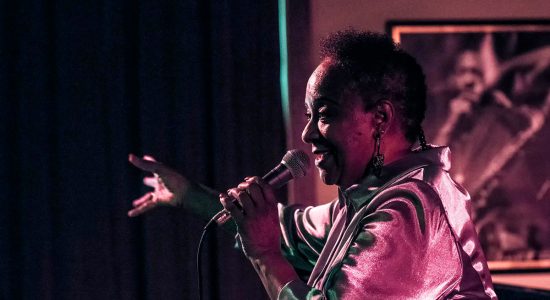
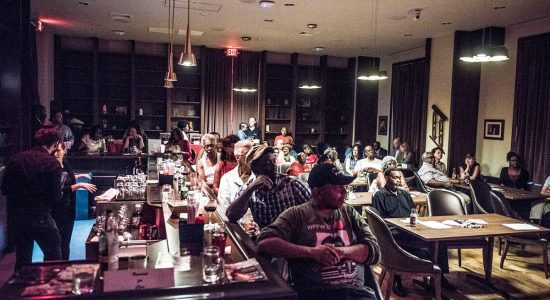
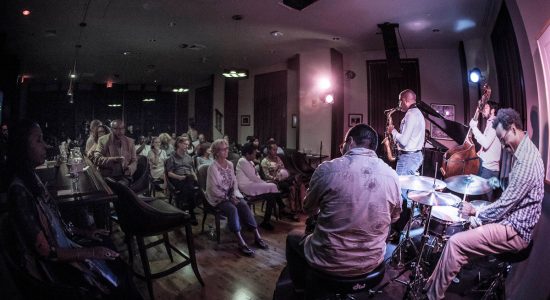
Group led by pianist James Austin, Jr. at first Jazz Jam, 8/18/16, credit Ed Berger.
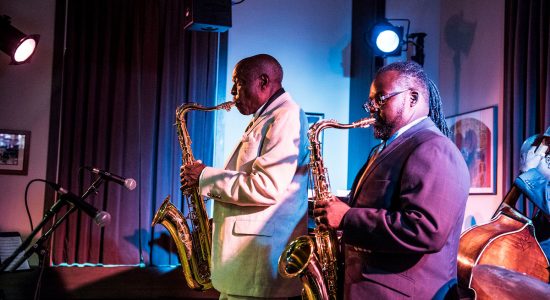
Saxophonists Leo Johnson and Anthony Nelson at opening NC 350 performance, 8/12/16, credit Ed Berger.
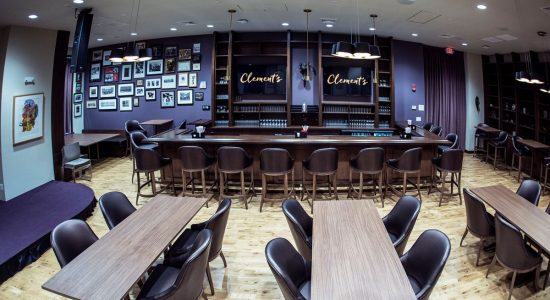
The decor at Clement’s Place includes items from the personal collection of Dr. Clement Price, credit Ed Berger.
The Institute of Jazz Studies is partnering with NJPAC and the Newark 350 Celebration Committee to bring two series of jazz performances to Clement’s Place, a new venue located in the iconic 15 Washington Street building, located next to the Newark Museum. Clement’s Place, which looks like a classic jazz club, honors the memory of the late Dr. Clement Price, a beloved professor of history at Rutgers–Newark and official historian of the city of Newark.
The NC350 Series
The NC350 series, which is free and open to the public, takes place the second Friday of each month. To date, performers have included groups led by Newark legends saxophonist Leo Johnson and vocalist Carrie Jackson.
The NJPAC “Jazz Jam” Series
The NJPAC “Jazz Jam” series, coordinated by pianist James Austin, Jr., features a mix of younger and more seasoned performers in the time-honored, informal jam session tradition.
Among his wide-ranging interests, Dr. Price was a serious student of jazz and a longtime supporter of the Institute of Jazz Studies. Jazz-related art and artifacts from Dr. Price’s personal collection adorn the walls of Clement’s Place.
IJS excutive director Wayne Winborne, oversees the programming and management of the space, which mixes top jazz musicians from the Newark area with world renowned artists. Spoken, salsa, classical, and other related musical performances will be presented in the space, as well as a series of curated listening sessions, hosted by IJS staff members.
Upcoming Events
10/7, 5:30-7 p.m.
IJS Curated Listening Session: Early Louis Armstrong
10/8, 4-6 p.m.
IJS Occasional Film Series: Stepping Up: Stories of Jazz & Caregiving (screening at the Newark Museum)
10/14, 6-8 p.m.
NC350 Series: Bobby Sanabria Quartet
10/15, (time TBD)
Joe Louis: Am Opera by Count Basie (in the Great Hall, 15 Washington Street)
10/20, 7-9:30 p.m.
NJPAC Jazz Jam with James Austin
10/21, 7-9 p.m.
IJS Concert Series: Randy Sandke Quartet
10/27, 5:30-8 p.m.
Salsa Night (free lessons begin at 5:30; music at 6:30)
11/1, 7-9:30 p.m.
NJPAC Jazz Jam with James Austin
11/4, 5:30-7:30 p.m.
IJS Curated Listening Session: After Bitches Brew: the 1970s
11/11, 6-8 p.m.
NC350 Series: Return to the Source Reunion
11/17, 7-9:30 p.m.
NJPAC Jazz Jam with James Austin
12/1, 5:30-8 p.m.
Salsa Night (free lessons begin at 5:30; music at 6:30)
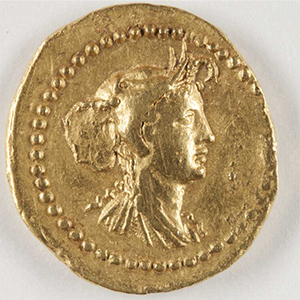
The Roman Coins project is a collaborative effort to bring the Rutgers’ Ernst Badian Collection of Roman Republican Coins fully into the digital realm and to contextualize its 1200+ items in such a way that students, researchers, and a broad section of the public can readily understand the general patterns of development in Roman money during its first 250 years.
The collection holds many coins that hold particular historic, economic, or artistic interest and is one of the largest of its type in North America. However, for a variety of reasons, the coins are not readily consulted in person. In order to make them broadly accessible for study and teaching, the Classics Department and Rutgers University Libraries are working together to create a web-based public portal and archive.
This summer with additional funding from the Classics Department and the dedicated efforts of three summer part-time employees, we were able to add another 200 coins to the portal, bringing the total to some 700 coins.
The portal features multi-faceted display of high-resolution images of individual coins and metadata specifically designed to render ancient numismatics comprehensible to non-specialists, while offering experts much in the way of original and unpublished research.
High-resolution digital imaging available in the Digital Curation Research Center was used to capture archival and presentation images for each coin in a format called Pyramid Tiff (or ptiff) that allows us to represent the same image at different spatial resolutions. This feature was developed for RUcore and is useful for viewing other formats such as maps.
To see ptiff in action, click on “view slideshow” below the coin image at https://rucore.libraries.rutgers.edu/rutgers-lib/47436/. Use the buttons to pan, zoom, and rotate the image. These are truly beautiful artifacts and the ptiff technology allows users to explore them like never before.
The user experience is further enhanced by specialized metadata detailing the legends and images found on the coins and newly implemented faceted browsing. Faceted browsing is available at the Coins portal where users can narrow searches by denomination, material, time period, moneyer, subject, and method.
To complete the digitization of the Badian collection, professor Corey Brennan (Classics Department) will apply for another grant from the Loeb Classical Library Foundation. These additional funds will enable us to image and ingest the remaining 500 coins into the RUcore portal. Professor Brennan will also use the Coins portal in a graduate seminar this Fall.
As recently announced, University Human Resources (UHR) will host a series of Open Enrollment Benefits Fairs throughout the month of October to educate employees about their SHBP benefits options, as well as other benefits and services that are available and may be of interest.
Save the date and plan to attend the Open Enrollment Benefit Fair that is most convenient for you:
Rutgers University/ Rutgers Biomedical and Health Sciences (RBHS) New Brunswick
Oct. 10, 2016, 10 a.m. – 4 p.m.
Medical Education Building, 1 Robert Wood Johnson Pl.
Rutgers University – New Brunswick/Piscataway
Oct. 11, 2016, 10 a.m. – 4 p.m.
Rutgers Student Center, College Avenue Campus
Oct. 20, 2016, 10 a.m. – 4 p.m.
Busch Student Center, Busch Campus
Rutgers University – Camden
Oct. 13, 2016, 10 a.m. – 2:30 p.m.
Athletic and Fitness Center, 301 Linden St.
Rutgers University – Newark
Oct. 19, 2016, 10 a.m. – 4 p.m.
Paul Robeson Campus Center, 350 Martin Luther King Jr. Blvd.
Rutgers University – Rutgers Biomedical and Health Sciences (RBHS) Newark
Oct. 25, 2016, 10 a.m. – 4 p.m.
Medical Science Building, 185 South Orange Ave.
Contact the Benefits Administration staff with questions regarding benefits at (848) 932-3990 or via email at benefits@hr.rutgers.edu.
Save the date for State of the Libraries – December 7, 2016
Many more details will follow, but please save the date of December 7 for the 2016 State of the Libraries. The program will begin with poster presentations at 10:30 a.m., lunch will be served around noon, and presentations by Krisellen Maloney and others at 1 p.m. The event will take place at the Busch Campus Center, so hopefully this schedule will allow many of our colleagues from Camden and Newark to avoid the brunt of rush hour traffic.
Judy Cohn to be a mentor in the 2016-2017 NLM/AAHSL Leadership Fellows Program
Congratulations to Judy Cohn who has been selected as a mentor in the 2016-2017 NLM/AAHSL Leadership Fellows Program, sponsored by the National Library of Medicine and the Association of Academic Health Sciences Libraries. The Program prepares emerging leaders for director positions in academic health sciences libraries through a year-long mentoring relationship with a director of another library and a curriculum focused on developing leadership knowledge critical to enhancing the value of libraries in their institutions.
In this highly competitive program, Judy will be one of ten fellows and mentors from academic health sciences libraries across the U.S. who will begin their work together in November. Since the program began in 2002, 42% of all fellow graduates have assumed director positions.
President Barchi mentions Libraries’ capital construction projects in Report to the University Senate
Excerpt: “University Libraries: The University has also launched an in-depth master plan for the university libraries. Libraries have changed their mission; we are looking to align them with what students want and need today, including better computing resources, collaborative areas, and other amenities. Individual projects have been identified and designs are under way for a new OIT computer center at Alexander Library in New Brunswick and a Professional Development and Scholarship Center in Dana Library in Newark.”
“The centipede party,” 40 inches by 42 inches, oil painting by BFA student Audrey Meehan. This will be on view at the Mason Gross Galleries.
Art Library participating in The Co-Cureate Show
Undergraduate and graduate visual arts students are teaming up to conceptualize and install a collection of eight student exhibits at three locations across the New Brunswick campus: the Mason Gross Galleries, Rutgers Art Library, and Douglass Student Center. The co-cureate shows (the title is a mash-up of what the initiative has prompted teams to engage in: conceive, curate and create exhibits) are set to run from Thursday, September 29 through Monday, October 17, 2016. The shows will feature student performances, paintings, photographs, sculptures, media, and prints. Admission is free.
The Art Library will host In Search of Punchline is curated by Johanna Boyce, Audrey Meehan, and Ed Weisgerber and features the work of Johanna Boyce, Erin Keane, Audrey Meehan, Carlyn Perlow, Delfina Picchio, and Ed Weisgerber.
New Brunswick Music Scene Symposium Planned for October 27, 2016
Save the date. Special Collections and University Archives will hold the next New Brunswick Music Scene Archive symposium on October 27, 6 p.m. in the Teleconference Lecture Hall at Alexander Library. Stay tuned for more information, including the participants. In the meantime, here’s a look back at the 2015 symposium, featuring a who’s who of New Jersey music (http://www.libraries.rutgers.edu/news/symposium-local-notables-inaugurate-new-brunswick-music-scene-archive).
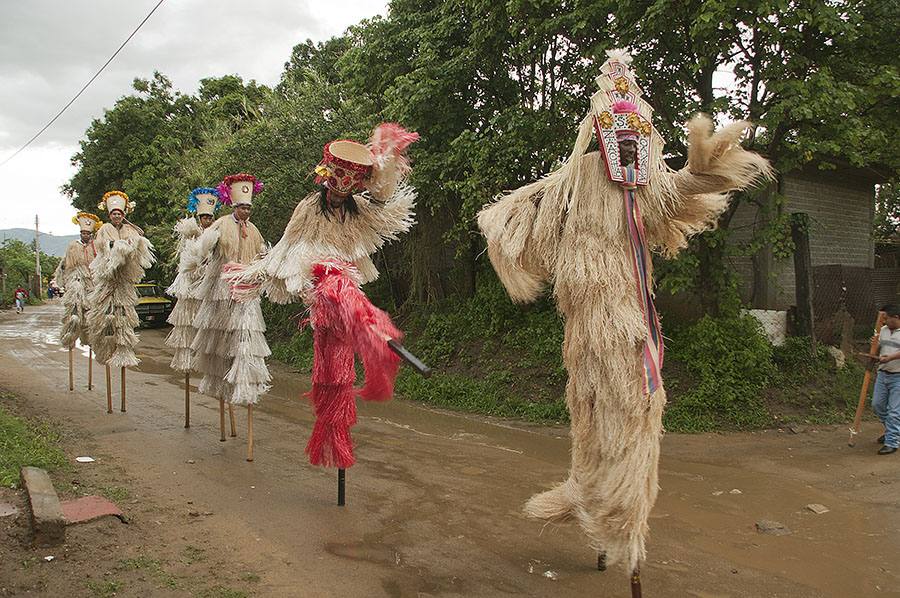
Credit: Laura Anderson Barbata.
Mary H. Dana Women Artists Series Galleries Welcomes “Laura Anderson Barbata: Collaborations beyond Borders”
This fall, the Mary H. Dana Women Artists Series Galleries in the Mabel Smith Douglass Library will welcome the 2016-17 Estelle Lebowitz Endowed Visiting Artist Exhibition, Laura Anderson Barbata: Collaborations Beyond Borders. The exhibit contains selected highlights of textile, sculptural, 2-dimensional, and video works from the traveling exhibition Transcommunality.
The New Brunswick Libraries hosted several events to welcome students to the new semester, as part of the campus-wide Welcome Days activities, which are organized by New Student Orientation and Family Programs (a division of Student Affairs).
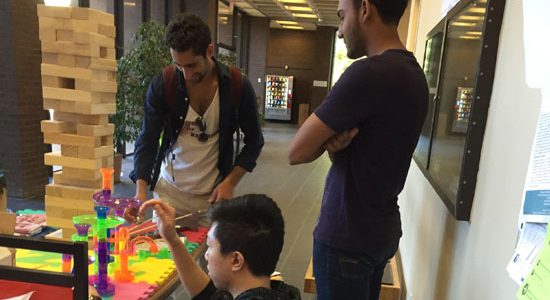
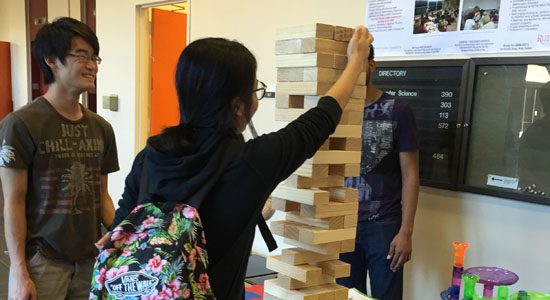
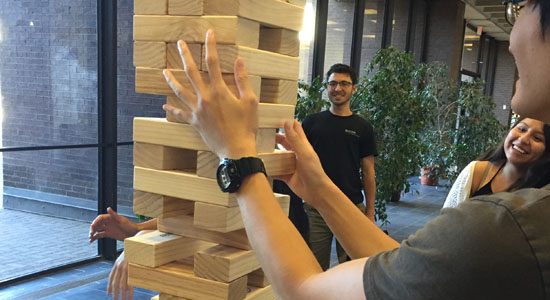
This year, staff and librarians at the Mathematical Sciences and Physics Library in Hill Center challenged students with a giant tumbling tower, while the Library of Science and Medicine offered free snacks and science puzzles. At the Alexander Library, students enjoyed cookies and the chance to spin a wheel for prizes after successfully answering library trivia. Kilmer Library offered carts of granola bars and other treats popcorn was handed out at the steps of the Art Library on College Avenue, and the Douglass Library offered students a much-appreciated coffee/cookie break.
All of these activities were made possible through the annual Senior Class gift, which is offered in appreciation to the library for hosting the wildly popular ClubAlex dance. The Undergraduate Experience Team sends a HUGE thank you to all of the staff and librarians who made these events possible and helped to create a warm welcoming atmosphere at the libraries.


 Rutgers University Libraries faculty and staff had a busy summer preparing for the email and calendar migration to Rutgers Connect. The migration took place over three days between August 23 and August 25, 2016, but by the time we reached this milestone, over two months of work by Unit Computing Specialists (UCSs) and Integrated Information Systems (IIS) staff had already been invested into planning the process, preparing for the transition, and learning the new environment.
 On December 26, 2015, Izzy Stern tweeted: “Today is the day I found out that Rutgers doesn’t even have full ebrary access. So many sad faces.” As a graduate student in a major humanities department at Rutgers–New Brunswick, Izzy might have expected to use ebrary, one of the largest academic e-book resources, for her research in the winter break, but then had a rude awakening that day when she found out that it was not available at Rutgers, yet. So she went online and shared her frustration on Twitter with the entire world, which was totally understandable. As a matter of fact, the lack of access to e-books was a major source of complaint from our students and faculty about the library collections—hundreds of similar comments can be found in the results of the LibQual+ and previous Counting Opinions surveys. Here, I quoted only Izzy’s tweet because it is on the open web, but the problem she reported was a common one.
 Libraries operate on the premise of cooperation and support. Technical services, in particular, embodies this ideal, as evidenced by international union catalogs such as OCLC’s WorldCat and programs like the Program for Cooperative Cataloging (PCC), which contribute catalog records that are created to specific standards that are shared with other libraries, ensuring an efficient, accurate, and timely workflow.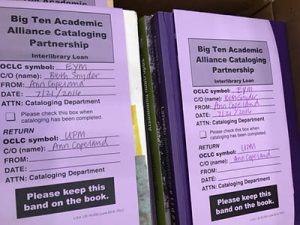
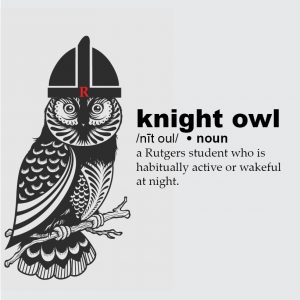 Overnight library hours are among the most frequently requested service enhancements students would like to see in the New Brunswick Libraries. Popular during finals, students would like the option to work 24/7 during other parts of the academic year too. Twenty-four hour spaces are also standard in most of our peer libraries—in fact, only two of our Big Ten partner institutions do not provide this service.