It’s March, which means that another planning cycle is getting into full swing. At the Cabinet retreat tomorrow, we will begin discussing the 2020–2022 local priorities that have been developed by the directors. You can read them yourself on our Annual Planning and Priorities page: Camden, Newark, New Brunswick, RBHS.
Over the past several planning cycles, information control has been among our top priorities as a system. This was based on feedback we received in the 2016 LibQUAL+ survey, which indicated we had room for improvement in this area in particular. As you know, this led to a whole suite of changes, not the least of which was the implementation of QuickSearch. We’ve also added extensive backfiles in recent years, working to address gaps in our collections so that they better meet the needs of Rutgers researchers. It has been a lot of hard work, but signs point to it paying off. The 2019 LibQUAL+ results, for instance, coupled with indicators like the drop in ILL numbers, give us reason to believe that we have made significant improvements when it comes to information control. This is a huge achievement for us, because it’s where our users indicate that they have the highest expectations for library service.
That said, it isn’t entirely surprising to see that information control is becoming less of a focus area in some of the plans for this cycle. Of course, this doesn’t mean that this aspect of our work is any less important—it just means that we’ve laid an effective foundation and are ready to build toward new things.
It is important that we take a moment to congratulate ourselves for this amazing accomplishment. Having a strong information control foundation allows us to build new services that will be both scalable and robust. These services fall into a category that we are calling in our priorities information management.
Information management will be the organizing theme for many of our new initiatives in the coming years. One such area is our support for scholarly communication, and I wrote in my last post about Esploro and how it will strengthen our ability to provide open access to articles and data. We also see local initiatives in this cycle’s plans such as the Health Sciences Libraries’ pursuit of research information management services, Newark’s revitalization of the open access Journal of Jazz Studies, New Brunswick’s development of bibliometrics, or Camden’s creation of digital projects based on undergraduate and graduate student research. These are all encouraging signs that the work we’ve done is opening up new possibilities for how we serve the scholarly communities on our respective campuses, and I’m excited that we’re finally at the point where we can pursue these sorts of activities.
My next Agenda post will be in May, and by then we’ll have had a chance to review the local plans and determine which priorities require central support. We’ll then begin finalizing the plans based on the capacity of our infrastructure and which priorities will move the most people forward. It’s an exciting time of year as the work on our horizons comes into sharper focus, and I look forward to exploring all the possibilities with Cabinet. But it’s also an occasion to reflect on how far we’ve come, and for that I have all of you to thank.
For the last two months, I have used the Agenda to provide updates about a framework we are developing to provide us with a common vocabulary and a shared understanding of the relationships and dependencies between local and central services. Last month I focused on the local aspects of the framework, with the intent of talking about the central aspects this month.
However, two weeks ago Cabinet had a retreat to discuss local priorities and to begin developing realistic expectations of what would be possible for the Libraries to accomplish with our shared infrastructure. Before continuing the framework discussion, I think it will be useful to review the outcomes of the retreat, including the overarching themes that emerged from our discussions.
Now that we have filled the Library Director positions, our planning processes are in full swing. The Library Directors came to the retreat prepared to discuss their most pressing needs and how best to use the shared infrastructure. The conversations were good because they were based on the needs of the campuses and communicated with a strong sense of collaboration and common purpose.
By the end of the day, several themes emerged that describe opportunities and constraints that are common to all units.
Access to Collections: It is clear that the Alma/Primo implementation will be a catalyst for organizational change. The new systems will provide a platform to strengthen foundation services and will help us to better assess our effectiveness. They will also drive changes in workflows in every unit of the Libraries. It is easy to see how this implementation will result in changes for people working directly with the system (e.g., cataloging, acquisition, circulation), but what may be less obvious are the effects for those with less direct daily interaction with the system. Discovery will change, driving changes in the broader website. Links to our resources will change, meaning that every research guide and instructional object that directs users to a specific resource will need to be updated. Needless to say, the Alma/Primo implementation will be a big part of all of our lives in the coming year.
Library Instruction: There is a need for us to build course-related infrastructure to support student success and to improve access to open and affordable resources within courses. We have begun this process with the implementation of PressBooks, but it appears that changes on the horizon may also include Leganto, an advanced Alma module related to course reserves, and Credo Education, customizable information literacy modules. We will have to determine the balance between central coordination and local autonomy in the coming year. Student success is such an important part of the library mission that we have to take the time to invest in shared infrastructure.
Discovery and Website modifications: There were many requests for new features related to discovery and the website. In the coming year, most of the attention of the Discovery Working Group and Web Improvement Team will be focused on integrating new features related to the Alma/Primo implementation and to integrating the emerging course-related infrastructure. It will be necessary to focus our attention on foundation services this year; however, the strong platform that we are establishing will allow us to continue to develop boutique services in the coming years.
I started this article with a mention of the effective discussions we had at this year’s retreat which is in and of itself a strong indicator of the final theme that emerged. The Libraries have succeeded for many years in an environment of grassroots endeavors that eventually coalesced into larger themes. The environment in which we find ourselves is moving far too quickly for this approach. In the coming year, it will be necessary to acknowledge and support the roles of managers in prioritizing and effectively advancing the missions of the Libraries. Over the past few years, we have focused on the importance of Library Directors in setting priorities for their libraries that meet the needs of and support the unique priorities of the campus environments in which they operate. For an example of how that is happening, take a look at the Framework for Change established for Dana Library and the Institute of Jazz Studies in response to Rutgers-Newark priorities. In order to support robust local plans and Librarieswide priorities, we need to focus on infrastructure and strengthen the role of the manager in understanding the priorities of the Libraries and prioritizing work accordingly. The Alma/Primo implementation is the perfect catalyst for this change.
This is an exciting time for the Libraries. We are recognized as a unit that provides leadership at Rutgers and is focused on the mission(s) of the University. I can see the progress we are making. Although we have a lot to do, this will be a productive year and will result in a stronger and more flexible organizational structure. Next month, we are back to frameworks!
Last month I introduced the idea of using Frameworks to describe our increasingly complex environment. As a reminder, Frameworks provide a way to divide complex processes into manageable chunks while retaining information about relationships and dependencies between the components. Developing a Service and Project Framework will give us a common vocabulary and a better understanding of the relationships and dependencies between local and central services.
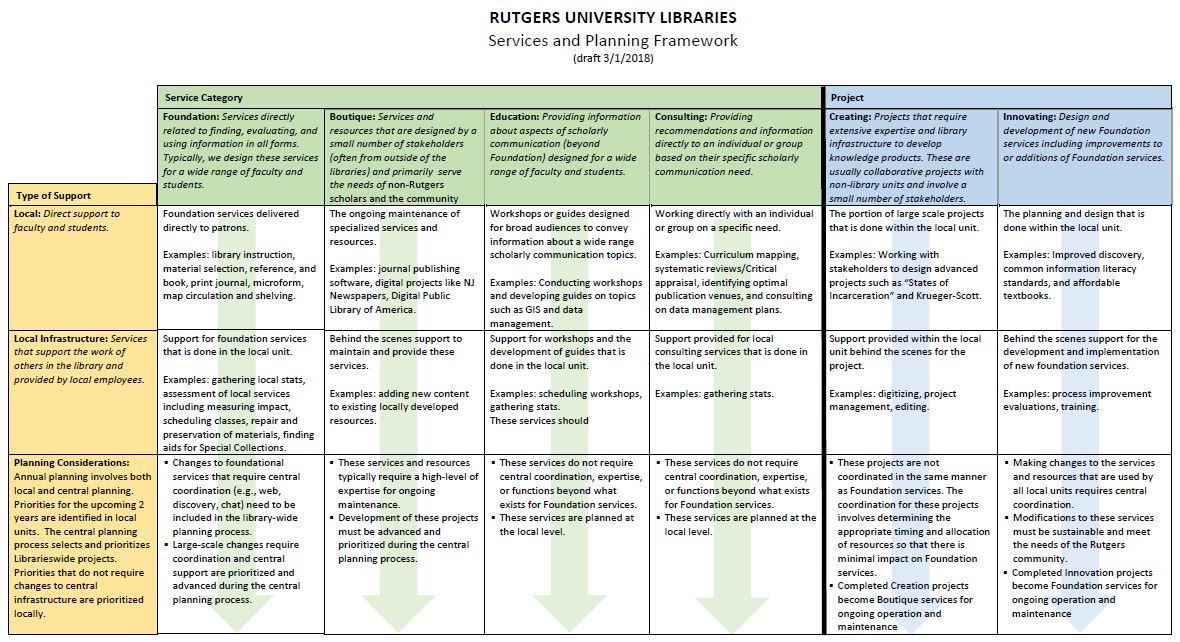
Over the past two Cabinet meetings, we have worked to establish a Framework by using a matrix to describe components of a range of our services, including items like instruction, reference, or access to collections, and projects like ExLibris and OAT implementation. With each pass, we identified areas for improving the Framework and developed better ways to describe the work we do within our unique environment.
This matrix expands on the service categories outlined in the OCLC Research Library Partnership Reports on the Realities of Research Data Management—education, expertise, curation—to accommodate the full range of work done at Rutgers University Libraries. The matrix continues to evolve, but the important thing to note is that it breaks down our work into components related to Service Category or Project and Type of Support.
The best way to read this draft of the matrix is to start with a Service category and read down the column. Each of the cells describes one component of a service or project, with the lower cells describing the infrastructure required to deliver the service or complete the project.
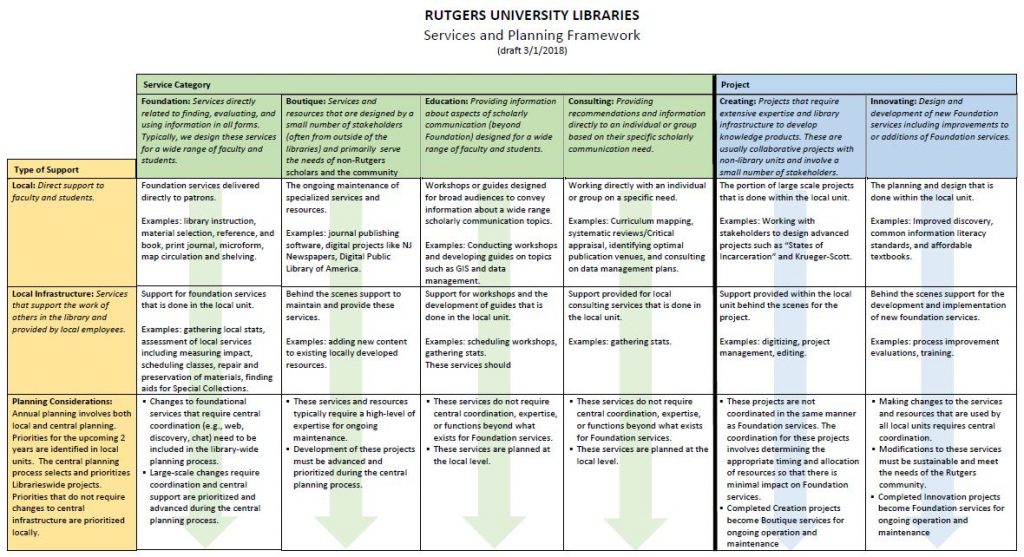
Click this image to download and view a PDF version of the matrix.
About Service Categories
There are many different ways that we could describe the categories of service that we provide, but based on our discussions, we found it most useful to group our services based roughly on the breadth of the audience; whether it serves mostly Rutgers faculty and students or external scholars and the public; and the number of stakeholders we work with to design of the service or resource. The Service Categories include:
Foundation:Services directly related to finding, evaluating, and using information in all forms. Typically, we design these services for a wide range of faculty and students. These are sometimes referred to as “core” library services.
Boutique: Focused services and resources that are designed by a small number of stakeholders (often outside of the Libraries) and that primarily serve a targeted audience within Rutgers, the needs of scholars outside of Rutgers, or the community.
Education: Providing information about aspects of scholarly communication (beyond Foundation instruction like information literacy) designed for a wide range of faculty and students.
Consulting:Providing specialized recommendations and information to an individual or group based on their specific scholarly communication need.
About Projects:
These projects are planned, intentional activities that span local and central units and expertise to change our infrastructure, create new services, or generate new information resources. Our central infrastructure has to support four unique missions, so we need to ensure that changes to our services and resources work to advance all of these goals.
Innovating: Projects that lead to the design and development of new Foundation services, including improvements to existing Foundation services. Upon completion, the long-term operation and maintenance of these projects shifts to the Foundation service category.
Creating:Projects that require extensive expertise and central and local infrastructure to develop Boutigue services and knowledge products. These are usually collaborative projects with non-library units and involve a small number of stakeholders. Upon completion, the long-term operation and maintenance of these projects shifts to the Boutique service category.
Local: Direct support to faculty and students. Examples include library instruction, material selection, and reference support.
Local Infrastructure: Services that support the work of others in the library and that are provided by local faculty and staff. Examples include gathering local statistics, scheduling classes, and the repair and preservation of materials.
So how does this impact the Planning Process?
The Framework will need refinement, but even the process of creating this matrix has resulted in important conversations and clarification of the work we do, the locus of responsibility for processes, and how we identify and distinguish between local-level and Libraries-wide priorities. Although I am asking library directors to provide a comprehensive list of priorities for the coming years, the central planning process will only focus on priorities that need central coordination or changes in the central infrastructure.
Foundation services represent the bulk of what we do. Ongoing work and even some improvements in these services can be completed at the local level, but changes that need support from central infrastructure—for example coding, non-routine digital projects, changes to a website, or programming—require coordination to ensure that they do not cause unexpected problems. Modifications that may seem small on the surface can have a big impact on the workflows in the central units. During the planning process we will distinguish between priorities that can be completed on the local level and those that require new Innovating projects to ensure that services are coordinated and effectively use the shared infrastructure.
Boutique services also come with their own quirks. Because these projects are expensive—they use a lot of expertise and library infrastructure to complete and to maintain—the bar is particularly high for new priorities. The consideration here will be how significant is the impact of this proposal? What audiences or needs does it address? During the planning process we will prioritize projects and assign resources to Creating projects to develop new services and resources.
There is a circular movement between Foundation services and Innovating projects—significant changes to Foundation services are accomplished via Innovating projects; and once complete, Innovating projects shift to Foundation services. This flow is also present in the movement between Boutique services and Creating projects.
By definition, Education and Consulting services are local and should only use existing shared infrastructure. There are many ideas for improvement—workshops for graduate students or consultations on data management—that are worthy initiatives and can be coordinated within the local units.
Next month, I will include the portions of the matrix that describe how central infrastructure, coordination, and expertise interacts with the other parts of the matrix. In the meantime, please explore the matrix (the best way, as I mentioned earlier is to read down the columns). Think about how your work would fit into these columns–which of our services would fit into each category? How are services delivered to our users at the local level? How are they supported by local infrastructure? Are there services that don’t fit into this matrix?
This is an evolving document and I encourage you to talk to your library director or AUL and to send in feedback and suggestions.
I know that we spend a lot of time focused on building infrastructure. Our top priorities involve undergraduate success and strengthening information control to ensure that our users have efficient, reliable access to information resources.
I just got back from a Big10 meeting at Purdue. At the meeting, we reviewed the results of a survey of the BTAA library directors’ top priorities for future collaborative activities. Each director picked three areas of interest. The results:
Collection Management 54%
Student Success Measures 46%
OER 46%
Data Management/Curation 38%
Analytics/Assessment 38%
Open Access 15%
The remaining four items: Special Collections, Professional Development, Digital Humanities, and Library Publishing all were 8%.
In another part of the survey, the directors listed the most important BTAA initiatives as Discovery to Delivery, Collections Infrastructure and Management, and Student Success.
Although these priorities and initiatives do not represent the most important work of the libraries, the selections do say something about initiatives that are most effective when done ‘at scale’ with the broader community. As I listened to my colleagues share their experiences and challenges, it struck me that we are not the only research library that is focusing on basics.
In a meeting back here at Rutgers, Judy Cohn brought up the NMC Horizon Report: 2017 Library Edition. This report from the New Media Consortium looks at trends in libraries, technology, and education to imagine what is on the five-year horizon for academic and research libraries. It is produced in collaboration with University of Applied Sciences (HTW) Chur, Technische Informationsbibliothek (TIB), ETH Library, and the Association of College & Research Libraries (ACRL). It identifies trends, challenges, and developments in technology that will impact how libraries plan to meet the needs of their users, how we function day to day and year to year, and the services that will be in highest demand. The first of the top 10 highlights listed was:
Libraries remain the gatekeepers to rich tapestries of information and knowledge. As the volume of we resources increases, libraries are charged with finding new ways to organize and disseminate research to make it easier to discover, digest, and track.
It was surprised to see that improving ‘information control’ was featured so prominently in the report. It seems that academic and research libraries have a renewed focus on the fundamentals and are redesigning infrastructure so that it better meets the changes in the environment. I know there are times when we feel like we are behind; however, it appears that we are actually in sync with many of our peers.
Over the next week, we will have meetings with Office of Information Technology and the Office of Research and Economic Development to discuss potential collaboration on research and digital humanities infrastructure. This will move us closer to another one of our priorities: identifying and communicating our role in the broader research environment of Rutgers. We are making progress!
While we are moving fast, our activities continue to be guided by the expertise and research of our colleagues. There are several examples of this that come to mind, all with librarywide participation. The Discovery Working Group has offered a model of how to harness data and best practices to make impactful changes in how our users discover and access collections via our website. Their work continues to propel us forward, even as the Ex Libris Implementation Team works to create nimble and knowledgeable teams to accommodate the anticipated workload over the next 7 months. And the Website Improvement Team is rolling out an impressive, incremental website refresh derived from extensive user research and analytics. The work that we are doing now will pay off in the coming years with flexible and easy to manage systems. It is my hope that these changes will make it easier for you to do the important work that you do.
As we move into the holiday season, I would like to thank you for your dedication and patience. It has been a difficult few years of change in response to the new environment, but, thanks to your efforts, these challenges continue to be met with creativity, hard work, and shared purpose. Your dedication to Rutgers, our students, and our faculty is impressive and collectively, we are creating libraries—digital and physical—that encourage learning and exploration and support to the success of our users. I am very grateful to count you all as my colleagues and I wish you and your families the happiest of holidays and all the best for the New Year!
As busy as we all are, sometimes it can be difficult to see the tremendous progress we’ve made in the last couple of years—particularly with something as diffuse as the priorities planning process. Our most recent cabinet meeting provides a snapshot of how far we’ve come.
As indicated in cabinet minutes, earlier this year cabinet produced a set of priorities to guide our activities over the next 18 months or so. These priorities have specific projects in mind and reflect the capacity of our central units. This planning document is intended to be the scaffolding for our collective work and, by definition, we must work within its bounds. While this may sound limiting—“We only do what’s on the list!”—when it is working well, the opposite is true. A good plan enables us to take advantage of unexpected opportunities as they arise. And in recent weeks, four such opportunities have been brought to the Libraries.
These requests are for activities that are not currently part of our plan and must be weighed against our existing commitments. Our recent discussion at Cabinet illustrates the give and take negotiations that must take place when we consider new projects or services.
Our shared list of priorities forms the foundation of purposeful discussions about tradeoffs and how best to shift priorities to new opportunities. For example, we have been asked to create space for a new OIT Lab in Alexander Library and to provide dedicated health sciences library services at LSM. Both of these requests stem from strategic initiatives within the university. We have also been approached about integrating ORCID into our journal platform and providing ETD support for honors undergraduate theses. Each of these is a reasonable request, but they require time and effort from the same central units that support our existing weeding projects, the implementation of ExLibris, and the development of digital projects templates, among other items identified through the planning process.
Cabinet considered the source of the requests; the anticipated benefit to local users; staffing and capacity in the central Libraries units; the amount of development vs. coordination required; and more, before deciding which opportunities to pursue. The outcomes, communicated in the minutes, are to move forward with adding ORCID iDs to the Open Journal System workflow and to shift weeding priorities to accommodate the deadlines for the Alexander OIT Lab and the LSM renovations. We also decided to hold off on the development of honors ETDs process.
This is not because including honors theses in RUCore is a bad idea—we simply don’t have capacity this year and we have other priorities to complete. But this is where the planning process kicks in. A local need has been identified, and while we don’t have capacity to follow through this year, the proposal will be moved forward to next year’s planning process for consideration.
No doubt, there will be additional requests from the university and additional local needs identified throughout the year. In fact, I would argue that the level of attention we are receiving from the university is an indicator of the important role of the Libraries on campus. We are viewed as strong partners and collaborators, our spaces are appreciated student resources, and our services are recognized as key to student success.
Thankfully, we now have a planning model that allows us to assess these opportunities in objective, realistic, and equitable ways that balance the needs of Camden, Newark, New Brunswick, and RBHS. We must continue to take on high priority projects for the university, but we must also make sure we have the capacity, technology, and resources to succeed. The only thing worse than saying “not now,” is saying “yes,” and not completing the task. These types of discussions are much easier to have when we have a shared understanding of priorities and capacity.