Tag: Ex Libris

  • Ex Libris Implementation Project Update – March 2019

    quicksearch logoThis month, the Ex Libris Implementation Team welcomed back Megan Drake from Ex Libris for our follow up to the six-month health check. Following two days of meeting with representatives from various Ex Libris working groups, Megan provided some very actionable suggestions for improving our processes and making our workflow more efficient in Alma. The team is working hard to integrate her suggestions into our processes.

    Leganto Implementation

    This month also marked the kickoff of the Ex Libris Leganto project. Leganto is a course reserves platform that is integrated with both Alma and the course management systems we support at Rutgers, like Canvas, Sakai, Moodle, and Blackboard. This product will give instructors more control over developing their course reserves lists and put the power of the library directly in their course space to help them provide electronic resources and streaming video from our subscriptions, and realtime catalog information for physical reserves.

    Because faculty members are able to create their own course reading lists, Leganto will enable us to increase our course reserves services without creating additional work for reserves management in access services. Students will be able to access course reserves directly from their course management system on any device and Leganto will help faculty select clean pdfs from our subscription databases rather than scans of readings. The system also provides robust analytics and encourages faculty to use materials from within our subscription databases for course reserves, providing us with a more accurate understanding of usage. Ex Libris provides a good overview of the product in this video demo.

    Ex Libris expects that our implementation process will take 12 weeks and the team plans to conduct a pilot with several courses during the summer with an official launch in Fall 2019. Faculty engagement is important for the success of Leganto, so expect to hear soon from your campus Leganto Team representative about communication strategies and training.

  • Ex Libris Implementation Project Update – January 2019

    quicksearch logoAs we move into spring semester, the Ex Libris Implementation Team is working towards optimizing our workflows and resolving remaining issues in the systems. We passed a major milestone in December with the end of our subscription to Symphony. Integrated Information Systems (IIS) has archived our data and will make it available on request. The Ex Libris Fulfillment Team has also transformed in the New Year and will continue in a new form as the Fulfillment Working Group, addressing central coordination for systems and processes for access services. The Ex Libris Implementation Team moved to a new schedule and will be meeting every other week during spring semester as we address the remaining implementation issues. Some other updates from our work include:

    Updates to QuickSearch

    We made several updates to QuickSearch in early January based on feedback from user testing and from system enhancements provided by Ex Libris. These updates include direct linking through Get it @ R, increased clarity in the display of some menus and options, and search improvements.

    Six-Month Health Check

    Megan Drake, a representative from Ex Libris, visited onsite in January to review workflows and address system issues. Representatives from each working group brought lingering problems for review and Megan suggested alternative strategies and optimizations that will help improve efficiency in Alma.

    Analytics Training for Selectors

    We held our first analytics training session for selectors on January 7. This active training session focused on learning the analytics platform and testing queries related to circulation and fund information. Future sessions are planned for 1–3 p.m. on January 17 and January 22 in New Brunswick and via WebEx and 9–11 a.m. on January 18 in Newark. Prior registration is not necessary, but if you have questions, please contact Laura Costello.

    Ex Libris Identity Service

    At the end of January, Ex Libris will debut an identity management service that will improve security for our barcode and password users. New security standards will ensure better privacy protection and users will be able to change their own password and retrieve a lost password via “My Account.” This update will not impact our users that authenticate via NetID.

  • Ex Libris Implementation Project Update – November 2018

    quicksearch logoAs we reach the midpoint of the semester, the focus of the Ex Libris project has begun to shift from planning and implementation to maintenance and support. Since its formation, the team has received close to 700 questions, comments, and suggestions on issues ranging from access and authentication to resource management and user interface design. Approximately 75% of tickets were answered in under 12 hours (40% were answered in under 10 minutes!). Thanks to feedback from library users and staff, the team has continued to make improvements to QuickSearch. Some highlights since the last update include:

    Improved journal searching
    Relevance ranking of one-word journal titles (Nature, Science, Cell, etc.) has been improved, making these publications easier to locate using the Journal Search option

    Browse options restored
    The ability to browse library materials by title, author, and subject has been restored. (These options were disabled at the start of the semester due to a software bug.)

    Can’t find what you’re looking for?
    Suggestions have been added to the bottom of the search results page to help users improve or expand their search. Suggestions vary depending on the type of search performed and include links to external borrowing services such as E-ZBorrow and Interlibrary Loan.

    System alerts
    System alerts have been added to allow for improved communication of service disruptions and outages.

    Improved facet and summary holdings display
    The formatting of long facets and summary holdings statements has been improved by allowing them to wrap to the next line instead of truncating them.

    Next/previous record
    When viewing a record, users can navigate to the next or previous record without having to return to the search results page.

    Translation of foreign language serial titles
    English translations of foreign language serial titles now appear in the main title entry of the brief and full record display.

    Firefox bug fix
    There was a bug in Firefox that produced different results depending on whether a search was executed by clicking the search button or pressing enter. This has been fixed.

    Since going live in June, QuickSearch has clocked over 470,000 sessions and handled roughly 850,000 queries. Though transaction logs are useful for measuring usage, they don’t tell us how well a product meets the needs of its users. That’s why, in November, we’ll be conducting a universitywide usability study to learn more about how library patrons use QuickSearch. Students and faculty from all four campuses have been invited to participate and share their thoughts on the new interface. Findings from the study will be used to guide further enhancements to QuickSearch and improve the overall user experience.

  • Ex Libris Implementation Project Update – September 2018

    quicksearch logoThe fall semester has started, and September 5 marks the third month of Alma and QuickSearch implementation. We have focused on rectifying known problems in preparation for the new school year, and have made many improvements to the system and the services it provides. Thanks to feedback from users and library staff, we are continually making improvements to the system. We encourage and welcome your input and questions—submit them by visiting https://apps.libraries.rutgers.edu/ex-libris/contact.

    As reported in the July update, the Implementation Team visited all four campuses in August. During those meetings, the team reported on the respective working groups and held discussions with library personnel. We appreciate the fact that people took the time to participate in these sessions and provided thoughtful feedback and questions. The discussions were lively and productive.

    The Implementation Team would like to take this opportunity to share the following updates:

    • A QuickSearch tutorial has been created and will be available this fall. An announcement is forthcoming.
    • The library names facet in Primo has been revised to reflect abbreviated and more commonly known library names, making it more usable for patrons. For example, Archibald S. Alexander Library will now display as “Alexander Library”.
    • 856 links to finding aids and other materials are now available in the “Links” section of QuickSearch records.
    • Sign in has been improved to allow users to sign in with fewer actions and to more easily access account options such as loans, requests, and favorites.
    • Database lookup has been enabled so that users who enter database names (PubMed, JSTOR, Factiva) in the search box get a direct link to that resource at the top of their search results.
    • An open access filter is now available in QuickSearch, enabling users to limit results to content published in open access publications.
    • A number of fields are now available in QuickSearch record displays, including uniform title, language, identifier, related work, and several local note fields (e.g., general, bound with, performer, production credits, donor, and finding aid). Additionally, the donor note is now searchable, making it easier to identify specific gift collections and to retrieve records for items in those collections.
    • Harvard has been added to the list of citation options and MLA has been updated to the 8th edition.
    • Users can now save records to Zotero.
    • Users are now able to pick up materials from off-site delivery locations, such as the law libraries.
    • A new marketing campaign for QuickSearch will be unveiled this fall.

    The Implementation Team’s website is available at https://apps.libraries.rutgers.edu/ex-libris. It includes the various teams and working groups associated with the implementation, a timeline for the project, resources, an FAQ, and a list of known issues for Alma and QuickSearch (alias Primo). The team is working through both lists of issues, and the lists are updated as progress is made and issues are resolved.

    We are fully aware that our experience with QuickSearch and Alma is one of learning and trial and error. The Implementation Team values input and collaboration from the Libraries as well as our user community to continually refine and improve this service.

  • Ex Libris Implementation Project Update – July 2018

    quicksearch logo
    The team is planning to visit each campus where we will hold open Q&A sessions. This will be an open forum where you can bring any questions or concerns you have about QuickSearch, Alma, or related processes.

    After much planning and preparation from all of the Libraries, QuickSearch and Alma went live on June 5. It’s so hard to believe that we are already almost four weeks past go live! The implementation team would like to thank everyone for your hard work in making go live a success. Each and every person in the Libraries has helped move us forward, be it by serving on a working group, attending a training, or by submitting a help ticket to point out a concern. We couldn’t have done it without you!

    Of course, we also continue to experience bumps along the way, but this is expected with an implementation this large. The team has spent much of the time since our last post focused on those bumps… addressing critical post-go live activities, implementing fixes, and responding to help tickets. In addition, we are reviewing our lists of known issues and possible future improvements in order to prioritize items for completion. The website will be updated with this information as soon as the process is complete.

    The team is also planning to visit each campus where we will hold open Q&A sessions. This will be an open forum where you can bring any questions or concerns you have about QuickSearch, Alma, or related processes. Be on the lookout for an announcement about dates in the very near future. Your feedback is critical and we really hope that you will join us.

    Lastly, as Tao steps away from the team, I would like to thank him for his contributions to the group and to the project. I know that we will all miss working with him as we continue to forge ahead.

    Abbey

  • Ex Libris Implementation Project Update – June 2018

    quicksearch logo
    QuickSearch goes live on June 5.

    Our new library system Alma and Primo (a.k.a QuickSearch) are expected to go live next week. It is incredibly exciting to be in the home stretch after more than a year of hard work. We truly appreciate what library colleagues, especially those on the Implementation Team and working groups, have done to get us to this point. We anticipate that the last few days before launch will be full of questions and new developments, so we have started to send daily emails to RUL everyone with updates and additional information. Please follow these daily messages for up-to-date information. In this report, we will summarize the progress made in the previous month.

    Migration Update

    The Libraries began technical services freeze to extract Sirsi data for the migration to Alma in early May. The Implementation Team submitted the data on May 11 and received the migrated data in the Alma implementation environment from Ex Libris on May 25, both on schedule. Over the Memorial Day weekend, we discovered some errors in the migrated data and had a conference call with Ex Libris. Ex Libris assured us that they would work with us to correct the errors but several additional days would be required to complete the necessary work. Therefore, we determined the launch of the new system would be delayed until Tuesday, June 5. The delay has ramifications for workflows, work schedules, and more, but there are also benefits to the change. Going live early in the work week is much better and the extra time can be used for additional preparations. We thank everyone for their patience and support as we work through these unexpected hiccups.

    The Access Services staff started to use Alma offline client for circulation activities on May 26. On May 28, we delivered to Ex Libris the Sirsi circulation (or fulfillment) data for migration to Alma. The offline client will be in use until go-live on June 5.

    In anticipation of the launch of the new system, the Implementation Team and working groups made significant progress on many issues related to the new system, including the access for barcode and PIN users, simplification of location codes, digitization and ILL workflows, and Alma permissions and roles. The content on the library website has been updated to reflect the adoption of Primo, and further changes will be planned and implemented after go-live. Our communications activities were strengthened by the expert advice and support from the Communications Department. In the meantime, we are continuing to investigate some outstanding issues, such as book delivery to offsite locations.

    Primo Training and Important Links

    Earlier in May, a total of over 150 library faculty and staff attended nine Primo (QuickSearch) training sessions across all four campuses. We thank everyone who participated in the training. Here are some additional resources about Primo features and functionalities:

    Search Box and Website

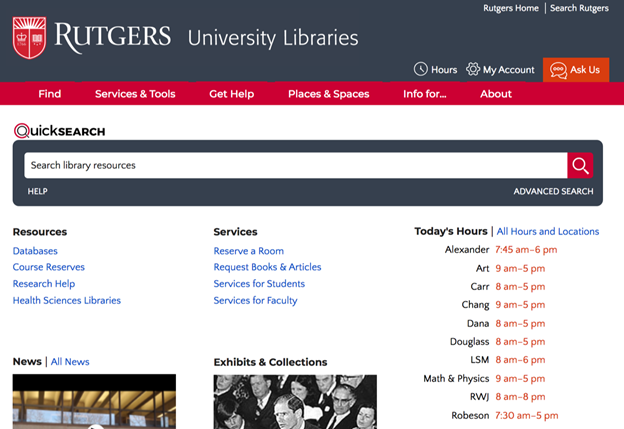
    We have finalized what the search box and website will look like at go-live. We are happy to share with you this sneak peek (see below). The decision was made to use a full-width single search box and you can see the QuickSearch logo in place.

    Please feel free to email the Implementation Team at exlibris@rutgers.libanswers.com for any questions. Thank you!

    Tao Yang and Abbey DiPaolo

  • Ex Libris Implementation Project Update – April 2018

    ExLibris graphicAlma Workshop 

    From March 13 to 15, an Ex Libris consultant came to the Libraries and facilitated a three-day workshop on Alma workflows. The first one and half days of the workshop were devoted to technical services topics, from ordering to receiving/activating to invoicing to cataloging. The second half of the workshop covered fulfillment issues, such as user management, circulation, requests, resource sharing, and course reserves. The participants of the workshop included the Implementation Team members, the working group members, and staff from technical, collection, and access services. The university librarian also attended most of the sessions. The feedback on the workshop was generally positive: The Ex Libris facilitator was very knowledgeable and well prepared. The demonstrations went smoothly. The discussions were both lively and calm, perhaps thanks to the puppy pictures the facilitator included throughout her presentation.  

    An important takeaway for everyone at the workshop is that we need to think about changing our workflows and sometimes policies to maximize the benefits of Alma, instead of simply trying to transfer our current practices in the Sirsi environment to Alma. This will guide the work of the team and working groups in the coming months. 

    Other Developments 

    Preparing for and participating in the Alma workshop was the main activity for the Implementation Team and working groups in March. All the working groups were also busy with both internal training and testing. The Implementation Team had four weekly training sessions with Ex Libris, two on Alma and two on Primo VE. On the migration front, the Data Migration and System Integration Group is currently working hard on third-party integration issues. 

    Submitted by Tao Yang and Abbey DiPaolo 

  • Ex Libris Implementation Project Update – March 2018

    Ex Libris Implementation Project Update – March 2018

    ExLibris graphicMigration Milestones in February

    The implementation project continued to move forward at a brisk pace. The Libraries’ Implementation Team finished the Alma configuration form and the Primo Central Index activation form. Ex Libris completed the Alma test data load and has released the Alma/Primo environments to us for data review and testing. Our Ex Libris consultants have given the library team very positive feedback: All of the tasks assigned to the Implementation Team have been completed on schedule or ahead of schedule. We are told that our data looks cleaner and has fewer problems than other libraries also migrating from Sirsi to Alma. The consultants are very confident about the successful launch of Alma and Primo on June 1st.

    Training for the Team and Working Groups

    In February, the Implementation Team continued the weekly training required by Ex Libris. All the working groups affiliated with the project were also engaged in extensive training in their functional areas. The considerable amount of time we are spending on internal training is paying off. Following a demo by two CTS staff on resource management at a training session, our Alma consultant remarked that she had never seen a client who could walk in at this stage of implementation and complete the tasks so smoothly!

    New Staffing Need

    As the implementation project progresses, we discovered an urgent need for an electronic resources librarian who has experience with Alma and Primo, so a new position was created and is being advertised. The new Electronic Resources Librarian will report to the Discovery Services Librarian and work closely with the CSRS staff responsible for licensing and renewing online journals and databases. In the past, we in the Libraries often talked about the need to increase staffing for e-resources management and support, since the library collections have shifted decisively from print to electronic. The new Electronic Resources Librarian position is an important step in that direction.

    Upcoming Workshop on Alma Workflows

    From March 13-15, an Ex Libris consultant will be onsite at Rutgers to conduct a three-day workshop on Alma. The primary goal of the workshop is to assist us with reviewing and defining major workflows using Alma. The format of the sessions will primarily be discussion as this is not a training exercise. The Implementation Team is working with Ex Libris to finalize the workshop agenda, which will likely include sessions on acquisitions, resource management, e-resources, and fulfillment. The working groups will decide who should attend the sessions in their respective areas.

    Plan for All Staff Trainings

    The Libraries’ working groups are also hard at work designing training and developing a related delivery plan to provide the training to our librarians and staff. As we reported last month, the all-staff training sessions will be conducted in person, by library staff, and with Rutgers data and configurations. Please stay tuned for more information about all staff training opportunities from the working groups.

    Tao Yang and Abbey DiPaolo

  • Ex Libris Implementation Project Update – February 2018

    New Milestones in January

    Throughout January, the Ex Libris Implementation Team focused on preparing for Symphony to Alma test load. Thanks to the hard work of Chris Sterback, Gracemary Smulewitz, and other team members, we successfully turned in the migration forms, the P2E (Physical to Electronic) files, and the Symphony data files to Ex Libris on time. The work has been very time-consuming and painstakingly detailed, but our team understands that it laid the foundation for the next steps of migration – test load configuration, integration

    with third party systems, cutover load, and go live. We continued to receive valuable feedback and support from Access, CTS, CSRS, and IIS staff.

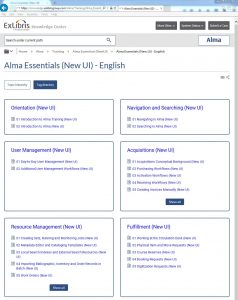
    The Implementation Team spent a lot of time in January going through an extensive training program using pre-recorded videos in the Alma Essentials (New UI) series.
    The Implementation Team spent a lot of time in January going through an extensive training program using pre-recorded videos in the Alma Essentials (New UI) series.
    Internal Training Becomes A Priority

    The Implementation Team also spent a lot of time in January on learning the functionalities of Alma. Guided by Ex Libris staffers, the team is going through an extensive training program using pre-recorded videos in the Alma Essentials (New UI) series. The Primo training series is forthcoming. Every week all the team members are required to watch videos on a certain topic, such as acquisitions, and then meet with the Ex Libris consultants for one hour via WebEx to perform sample tasks and discuss issues. The training program for the team will continue from January to March.

    Internal training is also a priority for all the affiliated working groups. With input from the lead members on the Implementation Team, each group is responsible for identifying relevant training materials and choosing the most appropriate format for internal training – self-study, group sessions, or a combination of both.

    Preliminary Timeline for All Staff Trainings

    The working groups are expected to design and deliver trainings specific to their roles for all the library faculty and staff. For instance, the Discovery Working Group will develop trainings on Primo discovery environment for all the public services librarians and staff. The all staff trainings will be conducted in person by library staff with Rutgers data and configurations, so the opportune time for these trainings will be after the Alma/Primo test environment has been set up with our own data and configurations, but before our June 1 go live date. This means an April to May timeline is most likely. As we get closer to April, the Implementation Team and working groups will provide more information on all staff training opportunities.

    Information You Can Use – Primo and Alma Fulfillment Videos

    We asked Joseph Deodato and Chris Sterback, the team liaisons to Discovery and Access groups, to recommend some introductory materials on Primo discovery environment and Alma circulation function. Joseph recommended two Primo videos for public services librarians: Using Primo and How Primo Works. Chris suggested that all Access Services staff watch these two user management and five fulfillment videos.

    Got Questions?

    Please feel free to contact us or reach out to the other members of the Implementation Team. The library also has a website for Alma/Primo implementation, on which you can get more information about the project or ask questions via the “Contact” form. Thank you for your interest!

    Tao Yang and Abbey DiPaolo

  • Ex Libris Implementation Project Update – January 2018

    Ex Libris Implementation Project Update – January 2018

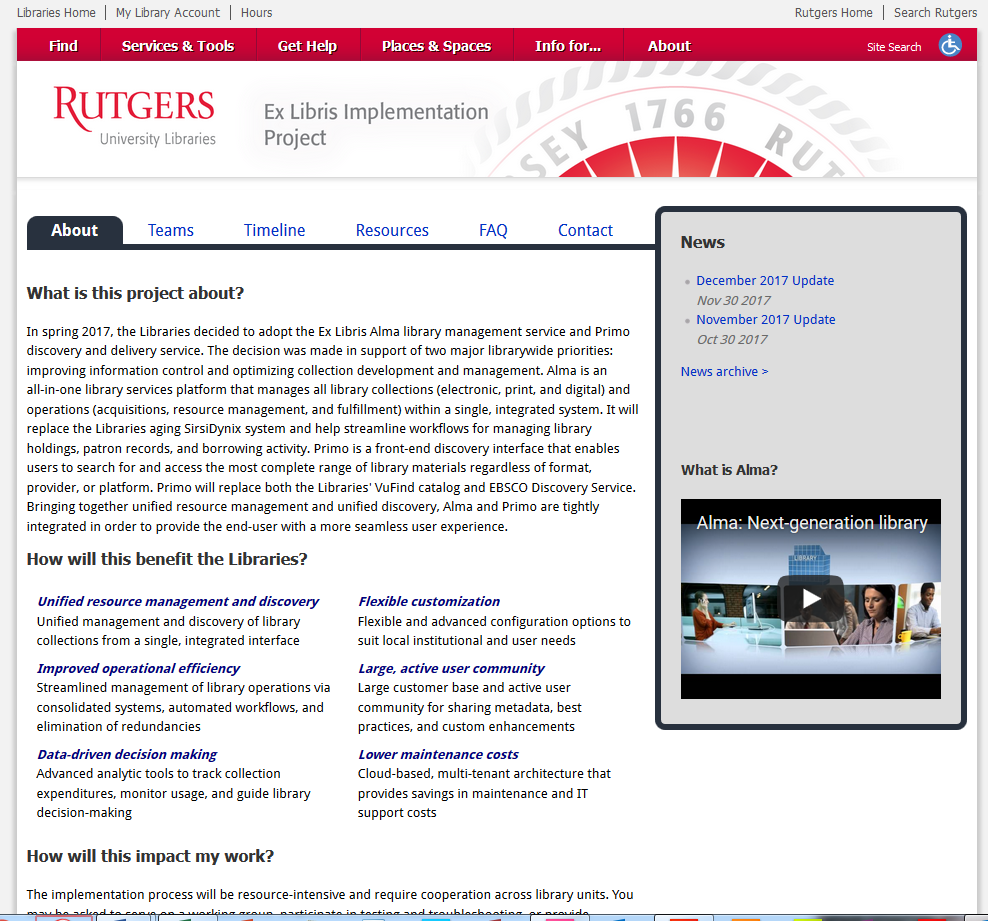
    Ex Libris website screenThe entire Ex Libris Implementation Team attended the State of the Libraries on December 6 and appreciated the opportunity to engage library faculty and staff there. We thank everyone who came to our table and talked to us about the project. Congratulations again to those lucky winners of prizes!

    This project update focuses on the major progress made in December. In our previous update, we described the three stages of implementing Alma and Primo–Define, Build, and Deploy. For the Libraries’ Implementation Team, the numerous tasks in those three stages generally fall into two categories: working on data migration and system integration in tandem with Ex Libris and developing two-way communication channels and training opportunities for the library (and eventually university) community. We are pleased to report that significant progress has been made on both fronts in December.

    Project Website

    In early December, we unveiled a new website for the Ex Libris Implementation Project, at http://exlibris.libraries.rutgers.edu. As the information hub for the project, the website includes the following pages:

    • About – Introduction to the project, benefits to the Libraries, and impact on library workers
    • Teams – Membership of the project team and responsibilities of the working groups
    • Timeline – Major milestones from the planning to the formal launch on June 1, 2018
    • Resources – Basic training resources, research & case studies, and team meeting minutes
    • FAQ – Answers to questions such as what is Alma and what is Primo
    • Contact – An online form for library faculty and staff to send questions and comments to the project team

    The site will grow significantly in scope and detail as the project progresses and more information becomes available. Please remember to check back from time to time to see what is new or use the contact form for questions and comments. We thank everyone who made this site possible, including members of the Implementation Team (especially Joseph Deodato and Chad Mills), Jessica Pellien, and the Web Team of IIS.

    Migration Forms

    As of this writing, the Implementation Team and several working groups are working tirelessly on completing the forms for Symphony (SIRSI) to Alma and EBSCO to Primo migrations. These lengthy forms define the test data load and take a lot of time and care to fill out. Our immediate objective is to turn in the forms on December 22 for our Ex Libris partners to review during the university’s holiday break. To meet this deadline, lately the Implementation Team has been meeting twice or three times a week on the forms. Some team members work late in the office and others take work home. We have also actively sought the input from colleagues in Access, Collection, and Technical Services, in addition to consulting with Ex Libris.

    The process of completing the migration forms exemplifies the spirit of teamwork. Besides two point persons for the forms—Chris Sterback and Gracemary Smulewitz, all the other team members have contributed time, energy, and expertise to the process. It is such an uplifting feeling to see colleagues from different departments of the Libraries working selflessly toward a common goal. We look forward to reporting new accomplishments from this wonderful team of colleagues in 2018.


    Tao Yang and Abbey DiPaolo

    Save