Category: Rutgers University–Newark

Faculty and staff news from the libraries at Rutgers University-Newark.

  • Quick Takes on Events & News – July 2016

    Critical Thinking & Creative Decision Making

    July 15. 2016
    9 a.m. – 12 p.m.
    This course is ideal for staff, managers, supervisors, and administrators who recognize the need to improve their ability to generate ideas, see old ideas in new light, and make decisions that are innovative yet founded on strong grounds.

    Location:  Pane Room, 1st floor, Alexander Library with teleconference to Smith Library, Dana Library and Robeson Library

    RSVP: Erica Parin on behalf of the Professional Development Committee

    Leading Staff through Change & Transition

    July 21. 2016
    9 a.m. – 12 p.m.
    This course is ideal for managers, supervisors, and administrators who are experiencing departmental change and would like insight, guidance, models, and tools to assist them in moving their departments forward.

    Location:  Pane Room, 1st floor, Alexander Library

    RSVP: Erica Parin on behalf of the Professional Development Committee

    Digital Humanities Summer Institute

    Bart Everts attended the Digital Humanities Summer Institute at the University of Victoria in Victoria, BC June 12-16th and participated in a week-long workshop titled Critical Pedagogy and Digital Praxis in the Humanities. The workshop “built an open course as a playground, letting participants experiment with critical digital pedagogy in a class-created online course that [they] co-designed, built, deployed, promoted, and assessed.” Learn more at the website they designed: http://www.digitalpedagogylab.com/dhsi2016/.

    Dana Library Media Services Department Restructure
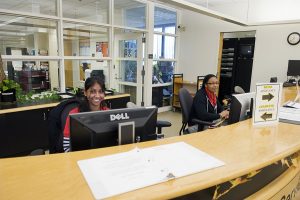
    The Dana Media Services department is transitioning from its location on the fourth to better concentrate on how today’s students access physical and online media. Photograph by Ed Berger.
    Photograph by Ed Berger.

    The fourth floor Dana Library Media Services Department is being restructured in recognition of how the library’s patrons access sound and video for education and entertainment. The transition will be completed by August 1 well in advance of the fall semester.

    Patrons will find a selection of some 1,700 DVDs, VHS tapes, and audio CDs currently available from Media Services publicly accessible on the lower level of the library, where the journals and bound periodicals are housed. Faculty requests to purchase new titles to support their teaching will continue to come through Dana’s department liaison librarians.

    Congratulations to Our Colleagues Who Worked on an Award-Winning Book!

    Rutgers: A 250th Anniversary Portrait received the Gold Award in the Circle of Excellence Awards given by the Council for Advancement and Support of Education (CASE).Many of our Libraries’ colleagues contributed to the success of this book: University archivist Tom Frusciano served as one of the primary authors, co-authoring the opening chapter on “History and Politics,” with GSE professor Benjamin Justice, constructing the extensive historical “Timeline” that appears in the back of the book, and writing—in partnership with archival associate Erika Gorder—many, many photo captions. This was a true group effort with dozens of contributors, including Gorder on musical concerts at Rutgers, archivist Fernanda Perrone on the activities of visiting Japanese students at Rutgers in the 1870s, David Fowler, an independent researcher with close ties to Special Collections and University Archives, on the life and impact of Henry Rutgers, and former university librarian Marianne Gaunt on, of course, the libraries themselves! Lastly, former associate director of the Institute of Jazz Studies Ed Berger contributed many photographs.

    Custom Buttons Now Available from the Communications Department

    Sample buttons v2
    Custom buttons are now available from the Communications Department.

    The Communications Department recently purchased a custom button maker and we are happy to now make buttons available to all of our colleagues for events or outreach activities. These 1.5 inch buttons feature a glossy, professional-quality finish and the designs can be customized to suit your needs. We are currently piloting a small “See You @ the Library” campaign for New Student Orientations in New Brunswick and welcome ideas for other ways to take advantage of this new equipment. Please contact us with project ideas or to request a sample.
  • Spring Sutras Artist Statement and Acknowledgments

    Spring Sutras Artist Statement and Acknowledgments

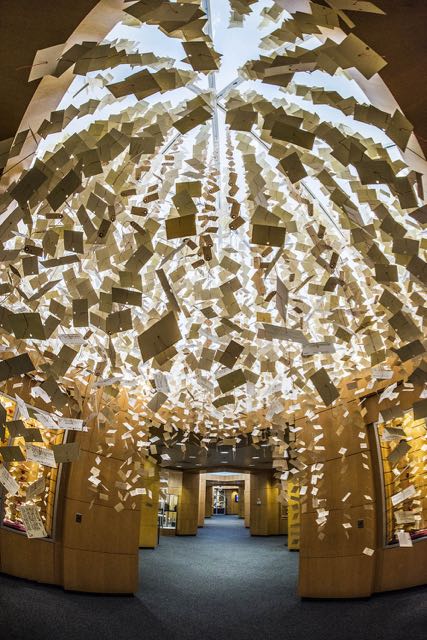
    Spring Sutras, an art installation by Karen Guancione that features thousands of recycled catalog cards from Rutgers libraries, officially launched on June 2 and is on display through the fall at Dana Library. The artist statement, remarks, and acknowledgments below are mounted on a poster accompanying the exhibition. Congratulations to all Libraries faculty and staff who helped make this installation a success!

    Spring Sutras
    Artist Statement

    “The Sanskrit word sutra literally means a thread, string or line that holds things together. It derives from the root siv- (to sew), and is related to suere in Latin, sew in English, and the medical term suture. It refers to Hindu or Buddhist texts, sometimes described as threads of wisdom or knowledge strung together.” (Wikipedia 2013)

    Spring Sutras, credit: Ed Berger
    Spring Sutras, credit: Ed Berger

    Sutra began in 2013 when I was caring for my ninety year old mother who suffered with severe dementia. Normally, it takes months and marathon days of work to make an installation for a public space, but I could not leave my mother’s living room; I was well into an endless, exhausting, all-consuming caregiving hell. With the help of Rutgers University librarians I obtained boxes and boxes of the long discarded and forgotten hand-typed catalogue cards that I wanted to recycle for an installation. While caregiving around the clock in the house where my mother had lived for sixty-five years, I was able to work near her and string together the thousands of pieces of paper—a repetitive, meditative act that enabled me to continue making art. I named the installation Sutra. Caregiving is a process that requires compassion and, like art, sometimes tests the limits of patience and endurance. As I sewed, I was reminded of the piecing together of segments of all people’s lives, who, depending on individual or social circumstance, may themselves become long discarded and forgotten. The first installation using catalogue cards was created for the Noyes Museum and prominently displayed from 2013 to 2015.

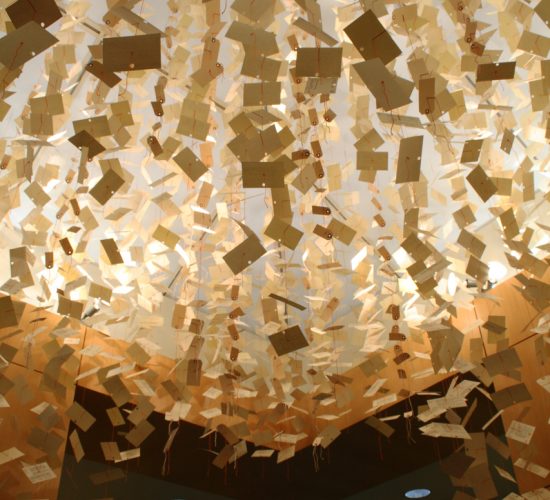
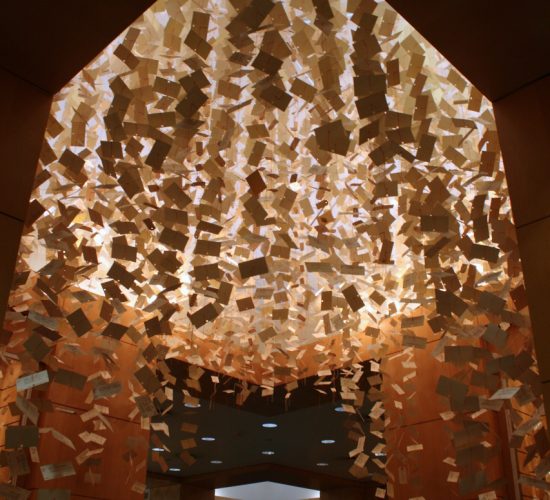
    In 2016 with the support of Rutgers University Libraries and Rutgers-Newark I was invited to create Spring Sutras, a site-specific installation in the John Cotton Dana Library. The public art project celebrates the nation’s largest and most varied collection of Japanese cherry trees in Newark’s Branch Brook Park and commemorates the city’s 350th anniversary. Thousands of recycled catalogue cards from Rutgers Libraries and hundreds of faux flowers were hand-sewn and suspended beneath a two-story-high skylight and throughout the fourth-floor space, which is also home to the Institute of Jazz Studies. Viewers are literally surrounded and touched by pieces of the hanging installation; the large-scale work transforms an entire area of the Dana Library.

    In an age of digital information I have relished holding in hand the many singular pieces of paper that once spoke of a vast and impressive array of accumulated knowledge. The strung flower garlands celebrate new life and honor the old and departed.

    Special thanks to librarians: Ann Watkins, Yoshiko Ishii, Michael Joseph and Grace Agnew for their help in procuring the cards from Dana Library, Alexander Library, Special Collections and Rutgers Law Library.

    Karen Guancione

    About the Artist

    Karen Guancione has been awarded a Mid Atlantic Arts Foundation Artists and Communities Grant, four New Jersey State Council on the Arts Fellowships, a Ford Foundation Grant, a Puffin Foundation Grant and an Arts and Culture Exhibition Grant from the Nathan Cummings Foundation. Her work has been exhibited worldwide and is in numerous public and private collections. Her interdisciplinary art includes large scale installations, public art projects, performance, sculpture, printmaking, papermaking, bookarts and video. She has curated many exhibitions, is an adjunct professor of art at the State University of New York (SUNY Purchase), Montclair State University and Middlesex County College and has been a visiting artist and lecturer at Pratt Institute, Rutgers University and numerous schools and institutions in the United States and abroad. For over a decade she has served as artistic director / guest curator of the annual New Jersey Book Arts Symposium and Exhibition. She is the first time recipient of the Erena Rae Award for Art and Social Justice. She collaborated on the critically acclaimed production of Cuatro Corridos, a multidisciplinary chamber opera about human trafficking that has been continually traveling throughout the USA and Mexico since 2013. She has just received a 2016 Fellowship from the New Jersey State Council on the Arts for Works on Paper.

    A Note on the Art of Karen Guancione

    An artist, educator, curator, and longtime Artistic Director of The New Jersey Book Arts Symposium, Karen Guancione has been making books for over fifty years, and collaborating with artists and workers all over the world on installations that adapt traditional book making techniques. Spring Sutras continues a thread of her work that investigates the seam between art and value, here working with discarded catalog cards and plastic flowers to reach toward a vision of ecstatic renewal. Intriguingly, within the work’s central assemblage, a mobile hung from the Dana Library atrium, the catalog cards suspended like leaves or stars have been assembled in roughly alphabetical order, preserving and transforming not only the librarian’s tools of organization, but the original library vision: it, too, changes and becomes part of what is renewed and endures.

    Michael Joseph

    Acknowledgments

    The artist gratefully acknowledges the support of Rutgers University Libraries and its staff for making this exhibition possible. This project was generously funded through a Rutgers-Newark Cultural Programming grant. Special thanks to Consuella Askew, Director, John Cotton Dana Library and Ann Watkins, Dana Arts Coordinator and Librarian for their administrative support and cultural commitment. A special note of appreciation to Jeff Baxter and Rutgers Physical Plant for expert installation assistance, Bob Nahory for technical advice, Bruce and Beverly Riccitelli for beautiful photography, Tad Hershorn for printing expertise, Mark Papianni and Yoshiko Ishii for lending a hand during installation, Michael Joseph for insightful writing and Roseann Reilly for help and comradery during many long sewing sessions.
    Heartfelt thanks to those who have contibuted to this project in many ways: Grace Agnew, Mary Apikos, Matt Badessa, Isaiah Beard, Donny Bruno, Asha Ganpat, Gary Guancione, Angela Hidalgo, Liz Koepplinger, Susan Narucki, Jessica Pellien, Suzanne Reiman, Carol Van Savage, Lauren Vitiello and Sally Willowbee. Sincere thanks to the skillful Rutgers-Newark Physical Plant workers: Tony Sharo, Rob Pellicone, Bob Conklin and Dave Barbara, the Dana Library Custodial staff, and Rugers-Newark Campus Security officers.


  • Guidelines for Libraries’ Use of Photography and Photos in and of Libraries’ Facilities, Events, and People

    Cabinet recently approved a new set of guidelines for the use of photography at the Libraries. These guidelines endorse and support the guidelines for the university as a whole, but also add a few tweaks specifically for the Libraries. If you are photographing events, people, or spaces of the Libraries, it is important that you familiarize yourself with thees guidelines and obtain all the necessary model releases. Three groups of subjects require special attention: children, Rutgers student athletes, and medical patients.

    Also, if you are in the position of having your photograph regularly taken at Library events and wish to avoid having to sign a new release each time, we have made available an extended model release for library faculty and staff only. If you would like to complete this one-time form, please right click and download the Extended Model Release Template RUL Faculty and Staff only (also available on the new central drive: T:\CENTRAL\Procedures and Resources\Communications\model releases for photography), complete, sign, and return to the communications department.

    The guidelines also cover how to handle videotaping and photographing events. If you are taking photos that might be useful to your colleagues or for publication on our website or in our print materials, please be sure to upload the photos and scanned copies of the signed model releases to the Photos and Media network location, too.

    There is a lot of confusion about when model releases are necessary. Some situations are clear–as when you are taking a photo of a single person or a group of people–but other scenarios aren’t as obvious.  A guiding mantra is that if you want to identify someone in the written caption for the photography, you will need a model release. Hopefully the examples below will help clarify how to deal with different types of situations.

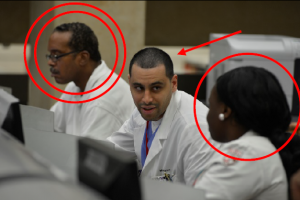
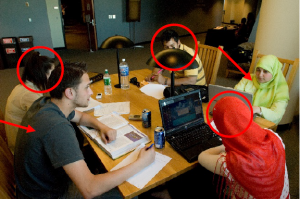
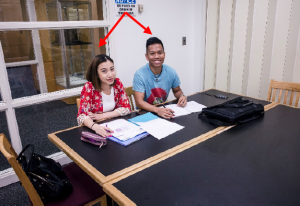
    Model Release Examples (arrows require model release, circles are optional depending on circumstance)

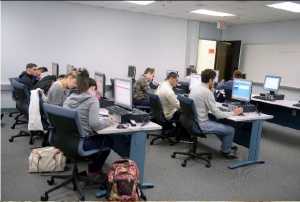
    1 No photo release would be necessary for this type of group photo as everyone is facing away.

    Before photographing this group, the photographer should announce that s/he is taking a photograph and provide time for people to move out of the frame if necessary.

    2 You would not need a photo release for a photo like this of a subject looking away and not identifiable.
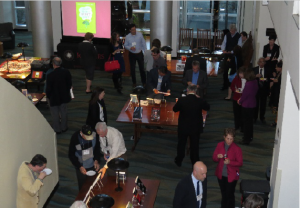
    3 Even though you might be able to pick out and identify individuals because you know them, this scene would not require any photo releases as there is no “subject” per se.

    However, there should be a notice in the program and a sign at the entrance indicating photography will take place and to notify the event staff if they don’t want to be included.

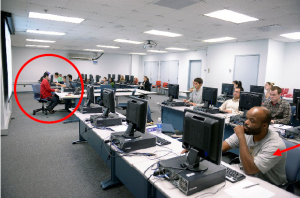
    4 You would get a model release from the gentleman in the foreground of the photo, but not from the others in the room. You would also need a model release if you want to mention the teacher by name.
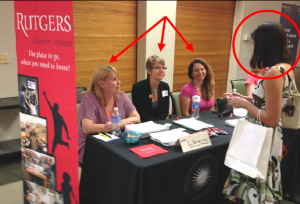
    5 In a photo like this, you would need releases from the library staff behind the table, but not from the standing person. However, this is a case, where you would likely want the name of the person for the caption, in which case you would need a release.
    6 The primary subject of the three is the man facing the camera. Even though the man in the back is blurred and facing sideways—a model release is required. The woman is facing away so a release is not required. If you planned to mention their names in the caption, then you would need model releases.
    7 This is a scenario where you would want to identify all subjects in the caption. So, even though only two people are identifiable and require a model release, you would want to get model releases from all five.
    8 A straightforward photograph that requires model releases even if these individuals work at the library or have given permission to use photographs on another occasion.


  • Announcing New Shared Drive – Central

    USA-NYC-Grand_Central_Terminal_Clock
    Image credit: IngfbrunoOwn work, CC BY-SA 3.0, https://commons.wikimedia.org/w/index.php?curid=27955753

    The Libraries now have a Central drive (T:\CENTRAL) where shared items of interest to all areas of the Libraries can be stored. The plan is to eventually store shared resources, information, procedures, and manuals in this location. Currently, it contains folders for Assessments, Collection Development and Management, Communications and Marketing, Photos and Media, Procedures and Resources, and Visual Identity, but more folders will be added as needed. Some of the folders are read-only, while others like Photos and Media are available to all for adding materials.

    Please take some time to peruse the folders:

    • Jeanne Boyle recently sent an invitation to view the LibQUAL+ survey results now stored in the Assessments folder.
    • Under Visual Identity, you will find resources that are useful if you are making flyers, advertisements, or website graphics, such as the colors, fonts, logos, and letterheads that are approved by University Communications and Marketing.
    • Photos and Media is a one-stop place to find images of our spaces, our events, and faculty & staff.
    • The communications department has also moved their folders from the ALEX drive to Central location Communications and Marketing.
    • Procedures and Resources currently holds the recent communications policies for photography and fielding requests to photograph in the Libraries, but will be populated with other materials, procedures, and FAQs in the future.

    These changes are partly philosophical–these are resources we all share and shouldn’t be housed on one of the unit server locations–but they are also intended to surface important materials and provide a single authoritative place to look for procedural information and guidance. If you have feedback, suggestions for how to further improve this shared drive, or materials you would like added to this drive, please speak with your unit director or supervisor.

  • Institute of Jazz Studies Archival Fellowship Program Participants Reflect on Their Experiences

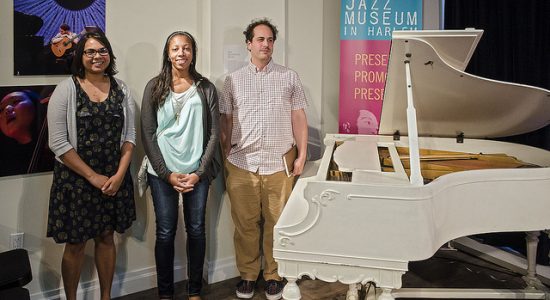
    The Institute of Jazz Studies Archival Fellowship Program was established in 2011 to support archival career development, as well as to promote diversity in the archival field. Each year, three Fellows are selected from among dozens of applicants, who are either currently enrolled in, or recent graduates of, an MLIS program, have a special interest in jazz and or African American culture, and aspire to careers as archivists. Fellows receive a stipend to cover travel, hotel, and miscellaneous expenses. The Fellowship Program is funded by longtime IJS supporter John Van Rens.

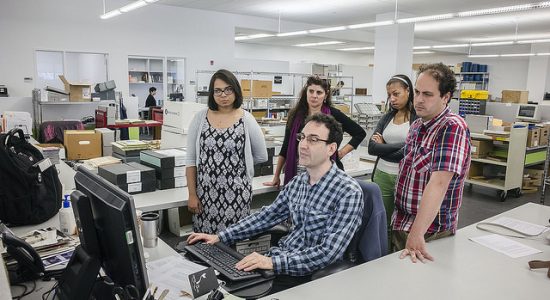
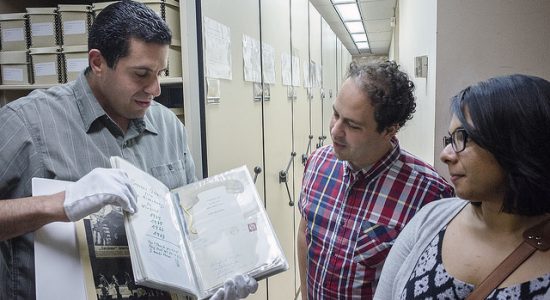
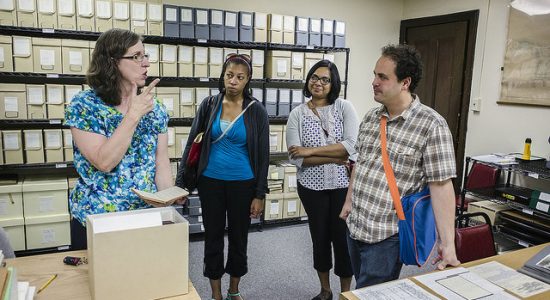
    The Fellows spend two weeks on campus working closely with IJS archivists and staff. Participants gain hands-on experience processing one of the Institute’s multi-faceted collections and preparing a related digital project that can be shared with colleagues and prospective employers. There are also seminars with RUL as well as Newark campus administrators, who provide an overview of Rutgers-Newark as the nation’s most diverse university, as well as role of an archive within an urban university library. The Program also involves two days of visits to other area archives and institutions, which have included the Schomburg Center for Research in Black Culture, The New York Public Library Archival Processing Center, the Louis Armstrong House Museum and Archive, the Jazz Museum in Harlem, the Carnegie Hall Archive, and the New York Philharmonic Archive at Lincoln Center. There are also several social gatherings with IJS staff and area librarians and archivists.

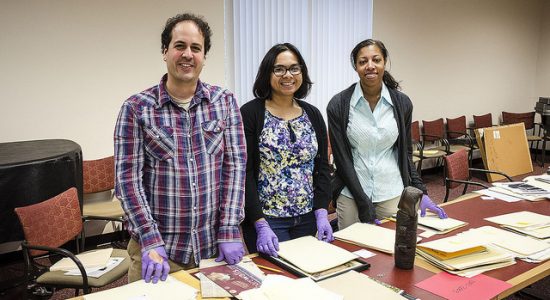
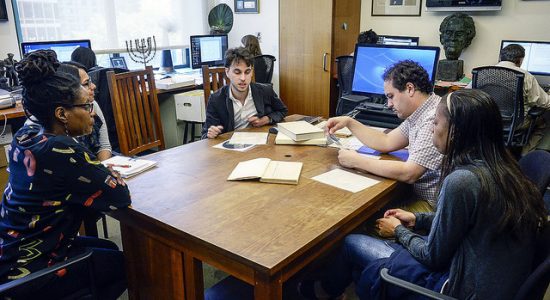
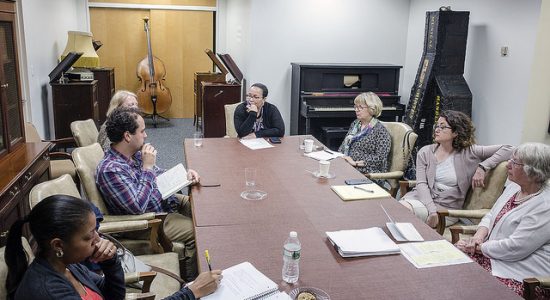
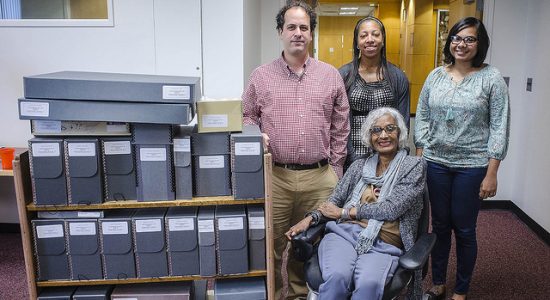
    This year’s fellows were Veronica Johnson (MLIS student at Wayne State Univ.), Treshani Perera (MLIS student at Univ. of Wisconsin-Milwaukee), and Brad San Martin (MLIS student at Univ. of North Carolina-Chapel Hill), who were on campus from June 6 to June 17. In collaboration with IJS archivists Elizabeth Surles, Angela Lawrence, and Tad Hershorn, and Digital Humanities Librarian Krista White, they processed the collection of pianist/composer and NEA Jazz Master Andrew Hill (1931-2007). Hill as both player and composer was a unique figure, who forged an original style that was at once part of the jazz tradition while extending its boundaries. On the last day of the fellowship program, Hill’s widow, Joanne, and donor of the collection, visited IJS to meet with the Fellows and to examine the newly processed collection she had donated as well as to view digital presentations by the fellows covering selected aspects of her husband’s distinguished career.

    Veronica Johnson, photo by Ed Berger.
    Veronica Johnson, photo by Ed Berger.

    VERONICA JOHNSON:

    Completing the IJS fellowship at Rutgers was an amazing experience and one that I will forever be grateful for. I learned so much about processing and the steps it takes to make a collection available to users. Working on the Andrew Hill Collection was great, and it really gave me the opportunity to process a larger collection, which I had never done before. I learned a lot about Hill and quickly became a fan of his work, which was very innovative. My favorite part of the program was learning about EAD and being able to create a finding aid using Oxygen. EAD was an area I did not have much experience in outside of school, so having Elizabeth and Angela show me how to use the software and create this awesome finding aid for the collection was very enlightening. I also really enjoyed visiting the other archives like the Jazz Museum of Harlem and the New York Philharmonic in order to see how other archives both large and small operate. The IJS Fellows program really gives graduate students the opportunity to be archivists for two weeks and get a real sense of the day to day tasks of the profession. The IJS staff is awesome and really made me feel welcome and a part of the team. I also developed some great friendships with the other fellows and am so thankful that I was able to take advantage of this great opportunity.

    Treshani Peterson, photo by Ed Berger.
    Treshani Perera, photo by Ed Berger.

    TRESHANI PERERA:

    I’m really thankful that I was chosen as a 2016 IJS Fellow. Throughout my two-week experience, I was so impressed with the work ethic and collegiality of the IJS staff, and their willingness to make every moment a teachable one during and outside of processing the collection. I was thrilled for the opportunity to process jazz pianist Andrew Hill’s collection, and discover his genius and creative thought captured in his music. The icing on the cake was meeting Mrs. Hill at the end of the experience, and talking to her about Mr. Hill as a musician and spouse. My favorite part of the experience was visiting music archives in the Greater New York area, and learning about how each archives does things differently. Throughout the two week internship, I was able to put into practice what I had learned in the classroom, and process the collection as a group, which was a unique experience. I’m truly grateful for this opportunity, and can honestly say that it was a transformative experience!

    Brad Martin, photo by Ed Berger.
    Brad San Martin, photo by Ed Berger.

    BRAD SAN MARTIN:

    The greatest strength of the Institute of Jazz Studies Fellowship was in the way it provided well-rounded insight into nearly all facets of an archives’ operations. While processing a collection at a fairly granular level (as we did with Andrew Hill’s papers) gave us invaluable experience in the most fundamental archivist tasks, our meetings and discussions with administrators, directors, historians, and even a donor offered much-needed perspective into archives role in the larger arts community – and the associated challenges entailed with maintaining and evolving that presence. It didn’t hurt that the people we met were all passionate, thoughtful, accomplished professionals who were willing to both share their time and speak candidly about the pleasures and pressures of the field. The two weeks flew by, and I’m sure that, when I look back, I’ll find my time at the IJS to have been a perfect (and much-needed) enrichment to my formal library and archive science studies.

    Photos by Ed Berger. More photos from the Fellowship Program are available here: https://www.flickr.com/photos/eebeephoto/sets/72157669425866802


  • Kicking off Annual Planning and Budget Process with LibQUAL+ Results

    Kicking off Annual Planning and Budget Process with LibQUAL+ Results

    Welcome to July!

    For me, summer has always been a time to catch up, tidy loose ends, reflect, and prepare for the upcoming academic year. As with so many other things, I am learning that at Rutgers things are different.

    As a cost-center, the summer is a time of planning. Our budgets and plans for the following fiscal year have to be ready by October. That means that our plans for 2018 have to be in place this summer. This month, there will be two Cabinet retreats to begin to establish priorities, look at potential projects, and consider budget requests. There will be many conversations in the coming months.

    As we move into planning, one of the most important issues that we will address is the LibQUAL+ results. I talked about these a bit at the Spring Town Hall, but since these will be at the heart of our planning efforts, it is worth spending more time studying these.

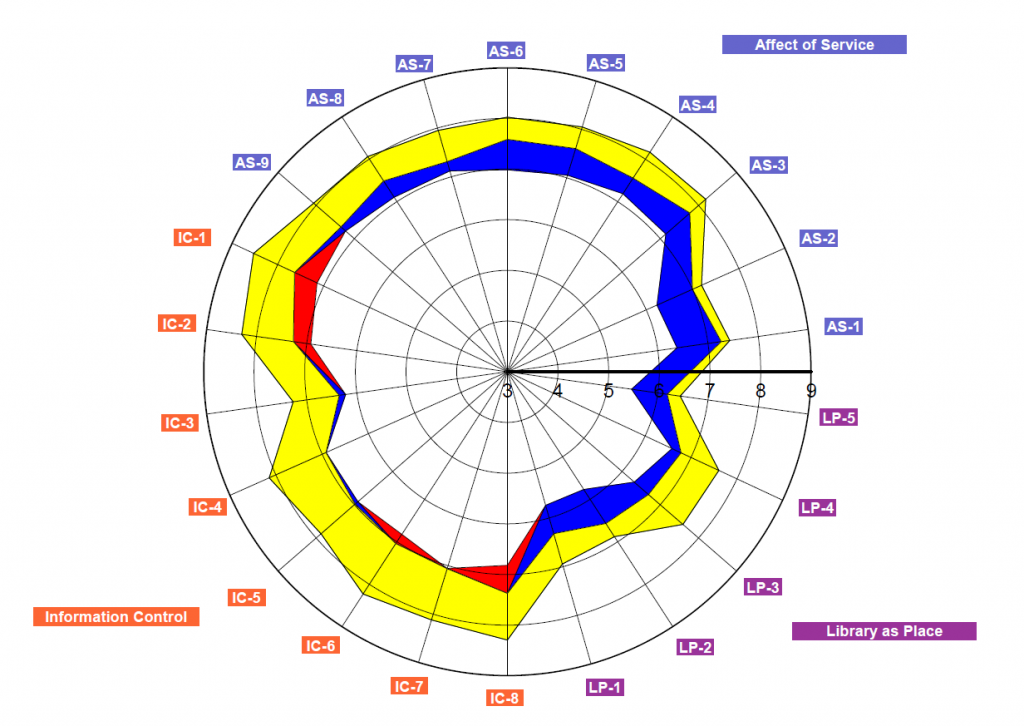
    Overall, our results were good. However, there was a consistent finding, across libraries and universities, that the Information Control dimension did not meet faculty expectations. This graph from the LibQUAL+ results shows the combined results for all 1,200 faculty respondents:

    lib qual survey graph
    This graph is from section 6.2 – Core Questions Summary for Faculty (page 73 of 13501-2 Rutgers University Libraries.pdf available on T:\CENTRAL\Assessments\LibQUAL 2016 Reports).

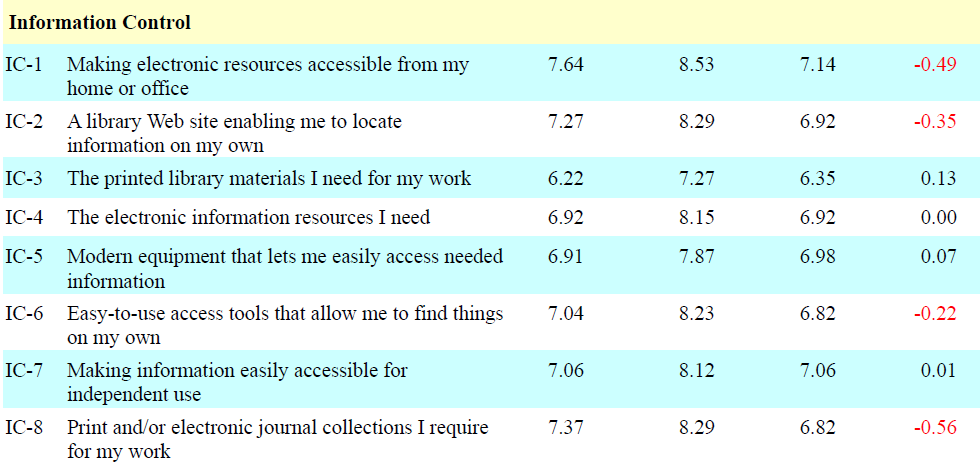
    Here is a table form of the same information:

    lib qual chart
    The first column represents the minimum mean, the second is the desired mean, the third is the perceived mean, and the fourth is the adequacy mean.

    But what does this mean? LibQUAL+ does a good job of showing us where we are doing well and where we might improve. However, LibQUAL+ doesn’t tell us why and understanding why is the first step in solving the problems.

    When we look at IC-1 and IC-8 together, it is not clear if the problem is lack of collections or difficulty finding the collections. How do the website (IC-2) and access tools (IC-6) contribute to the perception that our collections are below expectations? These are not problems that are simply solved by purchasing more collections or by making improvements to the search functions of our website. They require a multi-pronged approach that balance collections needs and ease of discovery.

    This year, using both one-time funding and new funding from the chancellors, we have made some substantial additions to our collections. These additions include:

    • SWANK Digital Campus subscription: 250 feature films selected by instructors
    • UpToDate: an evidence-based clinical resource
    • Sage Journals: Approximately 180 additional Social Sciences, Health Sciences and Science Journals
    • Wiley Journals: Approximately 880 Science, Technology, Medicine, Social Sciences and Humanities Journal
    • EBSCO e-books: 850 e-book titles selected by faculty and students
    • Springer e-books: Approximately 2300 Biomedical/Life Sciences, Engineering, and Medicine
    • American Institute of Physics (AIP) Digital Archive: Digital backfiles of 12 journals and conference proceedings
    • Oxford Journal Archive: Backfiles of about 150 Science and Medicine Journals
    • Wiley Journal: Digital backfiles of about 800 Science, Technology, Medicine, Social Sciences and Humanities Journals

    In addition, we eliminated the fees charged for requesting articles through ILL.

    In the coming year, we need to continue to make smart decisions about new collections and resources and I am confident that the Collection Analysis Group and the Selectors are moving in the right direction. But we must also look more deeply into our access infrastructure, making it easier for faculty to find the information they need. Moving in this direction will take a large amount of coordination, an effort kicked off by the new discovery working group charge.

    The LibQUAL+ results provide us with a tremendous amount of information and highlight opportunities for improvement. I expect that looking deeper at these issues will be a priority in the upcoming year and look forward to seeing what we can accomplish together.

    Save

  • Joyce Watson Retires from Dana Library

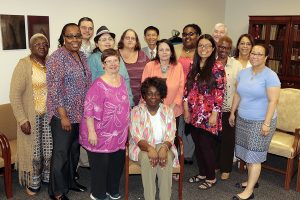
    Dana Library colleagues of longtime Circulation Desk supervisor Joyce Watson joined her in celebrating her retirement after 15 years with Rutgers University Libraries, effective June 30. From left: Maggie Harris-Clark, Alex and Doris Arencibia, Natalie Borisovetz (foreground), Andrea Lakios, Ka-Nang Au, Linda Becker, Joyce Watson (foreground, seated), Amber Judkins, Bonnie Fong, Robert Nahory, Dorothy Grauer, Janet Giorgio, and Library Director Consuella Askew. Photograph by Mark Papianni.
    Dana Library colleagues of longtime Circulation Desk supervisor Joyce Watson joined her in celebrating her retirement after 15 years with Rutgers University Libraries, effective June 30. From left: Maggie Harris-Clark, Alex and Doris Arencibia, Natalie Borisovetz (foreground), Andrea Lakios, Ka-Nang Au, Linda Becker, Joyce Watson (foreground, seated), Amber Judkins, Bonnie Fong, Robert Nahory, Dorothy Grauer, Janet Giorgio, and Library Director Consuella Askew. Photograph by Mark Papianni.

    The apple will not fall far from the tree after Joyce Watson retires from Dana Library on June 30 after 15 years of service. The longtime circulation desk supervisor expects to continue sharing her knowledge of libraries and information technology as a volunteer with the public libraries in Asbury Park and nearby Neptune, in addition to spending more time with family and church work.

    “For me, retirement means continuing to expand my level of knowledge and ability to encourage students’ desires to learn beyond their wildest dreams in libraries,” Watson said recently.

    Her first position with Rutgers University Libraries, in 2001, was with the Library of Science and Medicine in Piscataway before transferring to Dana. Passionate about working with students and technology–putting a world of knowledge at patrons’ fingertips–Joyce dug in as an adult learner to earn an MLIS at Rutgers between 2005 and 2009.

    Watson, a native of New Smyrna in central Florida, arrived in New Jersey in 1966 and spent nearly a decade and a half doing factory work in the pharmaceutical industry in New Brunswick. Along the way, she earned a journalism degree from Rutgers University. “I liked writing and wanted to tell stories,” she said. “Then I wanted to roam.”

    Her cross-country travels with daughter Tynyetta in tow over the next several years began in Florida and made their way to Atlanta, Houston, Denver, and Los Angeles, where she found work at colleges and universities. Her daughter made the trip as far as Los Angeles, where she has a long and successful career as a hair stylist and now resides with her family, including husband Joe, four sons, and two step-children. All combined, Joyce has nine grandchildren upon whom she can lavish her attention.

    Combining her backgrounds in storytelling, libraries, and archives, Joyce was the onetime historian for Mount Zion A.M.E Church in New Brunswick and currently is archivist for St. Stephen’s A.M.E. Church in Asbury Park.

    She cites former Dana Library director Lynn Mullins and current director Consuella Askew as “gems who encouraged me in all my endeavors.”

    Join us as we wish Joyce happiness and further intellectual “endeavors” in her retirement!

  • Rutgers University Libraries at the American Library Association Meeting

    ALA logo

    The American Library Association Meeting will take place later this month in Orlando, Florida. Here are highlights from the program that feature our colleagues:

    Research, Writing, and Publishing Fair

    June 25. 2016
    10:30 a.m. – 11:30 a.m.
    Are you interested in publishing? Would you like to learn about a variety of opportunities to publish, resources to help you get started with writing an article or a book, and tools that will make research and writing for publication better and easier? Please join us for the Research, Writing, and Publishing Fair, where you’ll have the opportunity to meet with ALCTS editors, the Library Research Round Table, learn about publishing mentoring opportunities in ALA, and more. Sponsored by ALCTS Leadership Development Committee. Co-Sponsored by ALA Library Research Round Table (LRRT), ALCTS New Members Interest Group (ANMIG), and ALA New Members Round Table (NMRT).

    Speaker: Mary Beth Weber (Rutgers University Libraries)

    ACRL Arts Publications and Research Committee Annual Discussion Forum

    June 25. 2016
    3:30 p.m. – 4:30 p.m.
    Join ACRL Arts Publications and Research Committee for their Annual Discussion Forum! This year’s forum will feature the following presentations:

    • “Artists as Scholars: The Research Behavior of Dance Faculty” by Shannon Marie Robinson (Drexel University)
    • “Building Bridges, Creating Partnerships and Elevating the Arts: the Rutgers University Art Library Exhibition Spaces” by Megan Lotts (Rutgers University Libraries)
    • “You Say Tomato, I Say Tomato: Collection Format Preference of Music Faculty” by A. Carey Huddlestun (Kennesaw State University)


    If there are additional Rutgers University Libraries highlights I should include here, leave a comment below or let me know.

  • “Spring Sutras” Exhibit at Dana Library

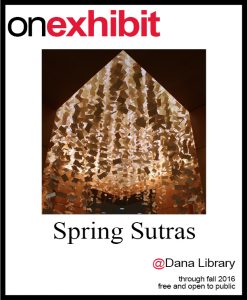
    spring sutras on exhibitSpring Sutras, a work of renewal and hope by installation and book artist Karen Guancione, took shape while she was caring for Mary Guancione, her elderly mother who was suffering from dementia.

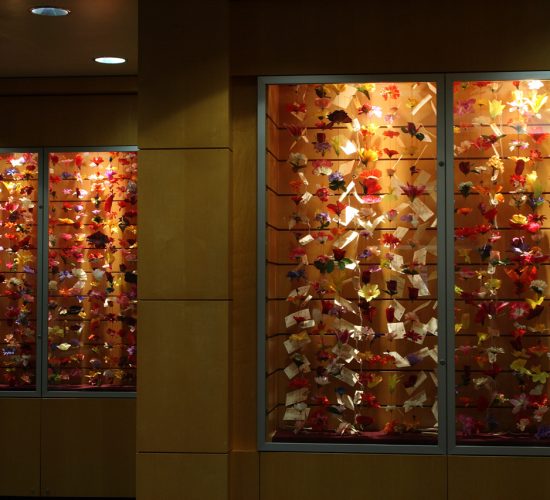
    On display now on the fourth floor of the John Cotton Dana Library at Rutgers University–Newark, Spring Sutras features thousands of recycled catalog cards that cascade in hand-sewn, brilliantly translucent strands from a two-story-high skylight, surrounding and touching viewers as they move through the space.  Hundreds of faux flowers suspended in the accompanying display cases fill the gallery with swaths of vibrant color.

    In stark contrast to the environment in which it was created—what Guancione described as “an endless, exhausting, all-consuming caregiving hell”—Spring Sutras exudes a sense of tranquility and solace. “While caregiving around the clock in the house where my mother had lived for 65 years, I was able to work near her and string together the thousands of pieces of paper—a repetitive, meditative act that enabled me to continue making art,” said Guancione, who was recently awarded a 2016 Individual Artist Fellowship from the New Jersey State Council on the Arts for Works on Paper.

    Funded by a Rutgers–Newark cultural programming grant, the exhibition is one of several projects commemorating the city’s 350th anniversary by drawing inspiration from the nation’s largest and most varied collection of Japanese cherry trees in Newark’s Branch Brook Park. Spring Sutras accompanies a display in the library’s lobby, on loan from the Essex County Parks Department, that details Branch Brook Park’s first planted trees; it is also a fitting prelude to Cherry Blossoms in Winter, a forthcoming multimedia public art project spearheaded by the Rutgers–Newark College of Arts and Sciences that will invite amateur and professional artists from throughout the region to install works in the bare branches of the park’s cherry trees.

    More than just a product of the artist’s personal struggles, the installation also celebrates bringing new life to things we discard or forget. Drawing upon the literal Sanskrit meaning of sutra, or a thread of knowledge sewn over time, Guancione chose to work with hand-typed catalog cards—a tool long since abandoned by libraries as a means of indexing their collections. “In an age of digital information, I have relished holding in hand the many singular pieces of paper that once spoke of a vast and impressive array of accumulated knowledge,” she said. “The strung flower garlands celebrate new life and honor the old and departed.”

    For Michael Joseph, rare book librarian at Rutgers University Libraries, Guancione’s installation celebrates the way in which libraries as institutions are able to constantly reinvent themselves. “Spring Sutras reaches toward a vision of ecstatic renewal,” explained Joseph. “Intriguingly, the catalog cards suspended like leaves or stars have been assembled in roughly alphabetical order, preserving and transforming not only the librarian’s tools of organization, but the original library vision: it, too, changes and becomes part of what is renewed and endures.”

    Spring Sutras runs through the fall. The exhibition is free and open to the public, and an opening reception will be held on Thursday, June 2, from 7-9 p.m. in the Dana Gallery on the fourth floor of the library.

  • Annual Celebrations for Staff and Faculty of Rutgers University Libraries (2016)

    Recently, the University convened two events to recognize faculty and staff who are celebrating a decade increment of employment at Rutgers. We are delighted to announce that more than 25 of our colleagues were included in the festivities and hope you join us in congratulating them on these accomplishments:


    10 Fay Austin (TAS)

    Ashwin Bijur (TAS)

    Kevin Conover (RIS)

    Eric Fizur (Robeson Library)

    Qun Luo (RIS)

    Holly Muller (RIS)

    Alfreda Richardson (RIS)

    Christopher Singh (Dana Library)

    Li Sun (TAS)

    William Torres (RIS)


    20 Stephanie Bartz (RIS)

    Barbara Grau (RIS)

    Charlene Houser (Central administration)

    Yoshiko Ishii (Dana Library)

    Mei Ling Lo (RIS)

    Andres Martinez (RIS)

    Fernanda Perrone (SC/UA)

    Julie Still (Robeson Library)


    30 Ka-Neng Au (Dana Library)

    Gary Golden (Robeson Library)

    David Hoover (TAS)

    Martin Kesselman (RIS)

    Kenneth Kuehl (Central administration)

    Linda Langschied (TAS)

    Julianna Ritter (TAS)

    James Robinson (RIS)


    40 Natalie Borisovets (Dana Library)


    Save