Category: Units

  • Teaching and Learning: LibGuides

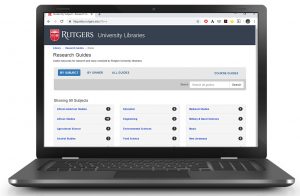
    Did you know that our LibGuides have been viewed over 240,000 times just in the fall 2019 semester? Keeping our LibGuides free of errors and up to date is an important part of our services at Rutgers University Libraries. With the help of some awesome student workers, we’ve made great progress in recent months to reduce the number of broken links from more than 4,600 to fewer than 1,800. As we move into the spring semester, now is a good time for LibGuide authors to make sure that your content is current and accurate! Taking the time to do some “spring cleaning” will make ongoing maintenance easier.

    Here are some suggestions to prepare your LibGuides for the start of the semester:

    LibGuide authors who have questions about LibGuides may contact Maria Breger at maria.breger@rutgers.edu

  • OAT Program Launches January 27

    The next cycle of the Open and Affordable Textbook Program will launch on January 27 and run through March 30, 2020. We’re excited to get started, but could use your help in spreading the word.

    How can you get involved?

    Thank you in advance for your help! We look forward to making this the best year yet. If you have any questions or suggestions about the OAT Program, please let me or your local team member know.

  • Looking Forward to 2020

    Welcome back! I hope you’re all feeling rested and rejuvenated from a well-deserved winter break.
    As I mentioned in my holiday email last month, I am so impressed by the amount of work we were able to accomplish last year. None of the achievements I chose to highlight was the result of a cookie-cutter project. Each of them required hard work, creative problem solving, and deep collaboration across the library system and with local campus partners. I know it isn’t always easy, but when these things come together, the impact is felt by students and faculty across the university. Thank you again for all your good work in 2019.

    As we turn our collective attention to 2020, I’d like to kick off the New Year by sharing some fantastic news. We have received our official FY21 budget awards and I am happy to report that we have received full support for salary increases and collection inflation, exceeding our expectations for funding in both these areas. Moreover, this funding is not representative of what was awarded to other cost pool units across the university. Simply put, this means that all our hard work is paying off. It’s a strong vote of confidence for the Libraries and the direction in which we’re headed, and I’m proud that we’ve received this recognition of our importance to Rutgers students and faculty.

    I’m glad that we will continue this momentum and hit the ground running this year with several impactful, large-scale projects. One such undertaking is the redesign of our website. While this project is still in its early stages, we have contracted with a vendor that will be performing the work. A web group is being convened to manage the project internally, establishing a timeline and benchmarks and communicating progress with the rest of our colleagues. The first step of the redesign is a discovery phase that includes surveying site visitors to learn more about their goals and experiences. This is another project that will draw on the expertise of many of us across the Libraries, and I look forward to following its progress as we continue to cater our services to meet the unique needs of our local communities.

    Another important project for us is Esploro. One of the priorities that arose from our last planning cycle was to implement an information management solution that will allow us to support the university’s open access policy in a sustainable manner, and Esploro represents a huge step toward meeting that goal. Esploro automates the management of research output—including capture and direct deposit—and helps streamline the process of depositing the results of scholarship into SOAR. It integrates directly with our library system and leverages one of the largest indexes of scholarly research available in order to ensure the broadest possible capture. Because it automatically harvests scholarly work done by Rutgers faculty, Esploro should give us a more comprehensive repository of Rutgers scholarship than we have with our current, purely manual deposit process. It will also help us better partner with the Office of Research & Economic Development by providing them with data on faculty output and productivity that can be used when pursuing research grants or steering potential industry partners toward relevant faculty experts. With projects like this, is it encouraging for me to see how the foundations we’ve laid over the last several years open up new possibilities for us moving forward. Adding a tool like Esploro builds on the work that groups like the Ex Libris Implementation Team have done in the past, and allows us to deliver value-added services that uplift the entire Rutgers community.

    Of course these are only a couple examples of the many exciting projects we have slated for 2020, but I hope they serve as compelling illustrations of all the progress we’re making. I look forward to another productive year ahead!

  • This Month in the Agenda – November 1990

    Hypercard Brown Bag Lunch, November 9, 1990
    Overdue Notice

    This note was recently received at Douglass Library accompanying a book that was overdue in 1963. The names have been changed to protect the innocent.

    TO WHOM IT MAY CONCERN:

    My malicious brother, John Doe, died recently and left us with a house full of books he had stolen from every library he ever lived near.

    The enclosed book appears to be yours. I am returning it with the hope it will still be of some value to you.

    On behalf of the entire family, I sincerely regret my brother’s action.

    Jane Doe

    The Agenda 12, no. 43 (November 4, 1990)

    Ruth on the Move

    On January 1, 1991, Ruth Simmons will begin a FASP leave and step down from her position of Director of Special Collections and Archives. At that time, she will become Senior Archivist and Curator of the Griffis Collection.

    The Agenda 12, no. 45 (November 25, 1990)

    Welcome!

    Personnel Changes – Staff

    Arrivals

    Natalie Delker, Library Assistant 3, LSM
    Dolores Evans, Secretarial Assistant II, Library Administration
    Helen Slim, Library Assistant 3, Camden Library
    Tracey Meyer, Library Supervisor III, TAS
    Joy Willinger, Senior Accounting Clerk, Library Administration

    The Agenda 12, no. 45 (November 25, 1990)

  • What’s Happening around Rutgers – November 2019

    “Top Girls” Theater Performance

    Friday, November 1, 7:30 p.m.
    Fine Arts Building, Walter K. Gordon Theater, Camden

    The Rutgers–Camden theater program presents Top Girls. Hilarious and haunting, Caryl Churchill’s feminist masterpiece set in Margaret Thatcher’s England is a wildly innovative play about a country divided by its own ambitions. Marlene has reached the pinnacle of success as the head of the Top Girls Employment Agency—but at what price? Purchase tickets. (Additional shows on Saturday and Sunday.)

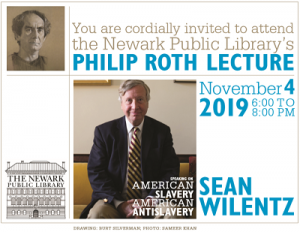
    Philip Roth Lecture: Sean Wilentz

    Monday, November 4, 6:00–8:00 p.m.
    Newark Public Library, Newark

    This year’s lecturer is Princeton’s Sean Wilentz. Mr. Wilentz is the author of a wide range of books including The Rise of American Democracy, No Property in Man, Slavery and Antislavery at the Nation’s Founding, and Bob Dylan in America.

    His lecture topic is American Slavery, American Anti-slavery. After retiring, Mr. Roth devoted most of his reading to the study of American history.

    Professor Wilentz was Roth’s guide, helping him to make book selections and engaging in discussions of the material.

    The event is free. Valet parking is available. Seating will be available on a first-come/first-served basis.

    RSVP here.

    Planetary Science Late Night

    Wednesday, November 6, 4:00–8:00 p.m.
    Rutgers Geology Museum, New Brunswick

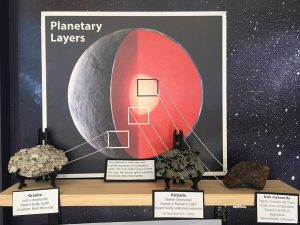
    Visit us on Wednesday, November 6th, and learn about our Solar System and all of its planetary bodies! Demonstrations, arts and crafts and educational activities will be set up around the museum for this event and people are welcome to come and go as they please. We encourage all ages to come participate and learn something new! More information.

  • Quick Takes on Events and News – November 2019

    SWPACA Call for Papers

    Proposals for papers and panels are now being accepted for the 41st annual Southwest Popular/American Culture Association conference! One of the nation’s largest interdisciplinary academic conferences, SWPACA offers nearly 70 subject areas, each typically featuring multiple panels. The deadline has been extended to November 20. Visit the SWPACA website for more information.

    Dan Morgenstern Named IJS Executive Director Emeritus

    The Institute of Jazz Studies (IJS) at Rutgers University–Newark has appointed Dan Morgenstern Executive Director Emeritus of IJS and has named a yearlong fellowship in his honor to celebrate his 90th birthday and significant contributions to jazz scholarship. Homage will continue in the spring with a symposium on Morgenstern’s life and legacy. Read all the details on the Rutgers–Newark news site.

    Electronic Music Ensemble of Wayne State
    On November 11 at Douglass Library, the Electronic Music Ensemble of Wayne State (EMEWS) will present live electronic music made for laptop orchestra, game controllers, smartphones, and drum machines. The event is part of the ensemble’s EMEWS to the East tour, and it is supported by New Music USA. This event is free and open to the public!

    Rutgers Football from the Vault Panel Discussion
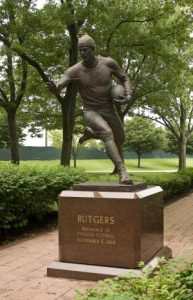
    Rutgers University is well known as the birthplace of intercollegiate football. On November 18, 2019, we will celebrate the 150th anniversary of the first football game with a panel of Rutgers historians. Thomas J. Frusciano was Rutgers University Archivist at Rutgers from 1989 to 2017 and the author of The Rutgers University Football Vault: History of the Scarlet Knights. Tom will provide an overview of Rutgers football history. Steve Greene is a 1979 graduate of Rutgers and the author of the forthcoming 1869 – American Football Kicks Off ! New Discoveries at the Birthplace of Intercollegiate Football. Finally, Stephen Dalina is a recent graduate of Rutgers University–Newark. Currently pursuing a Master of Arts degree in world history at Rutgers, he will reflect on his experience co-curating the exhibition Rutgers Football from the Vault: Celebrating 150 Years with Interim University Archivist Erika Gorder. Visit the events calendar for more information.

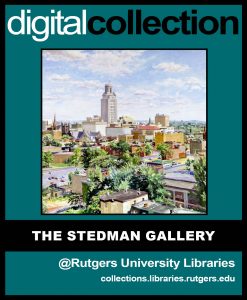
    Digital Collection Spotlight: The Stedman Gallery

    The Stedman Gallery Collection features works from the Stedman Art Gallery, which was established in 1975 and is located in the Fine Arts Center at Rutgers University–Camden.

    The digital collection includes a variety of artworks ranging from chalk and charcoal drawings, to acrylic and oil paintings, to 19th-century Ukiyo-e, a type of Japanese woodblock print depicting Kabuki actors and other scenes from daily life. For more information, visit the digital collection portal or the Steadman Gallery website.

    Alumni Association Graduation Tour

    Know a graduating senior? Make sure you let them know about the Rutgers Alumni Association’s annual graduation trip! This year’s grad trip explores classic Europe, including England, France, Italy, the Vatican City, and Greece. Visit the Alumni Association’s website for more information.

  • “Sticky Interdependence” and the BIG Collection

    Earlier this semester, my fellow BTAA library directors and I issued a joint statement publicly committing to an interdependent future and introducing the idea of the BIG Collection.

    This is a strategic and coordinated approach to sustaining the scholarly content held in our collections and enhancing our users’ path from discovery to delivery of that content. The initiative draws on the analysis of collective collection opportunities conducted by Lorcan Dempsey in the report Operationalizing the BIG Collective Collection: A Case Study of Consolidation vs Autonomy, which I have discussed in previous issues of the Agenda.

    Planning for this initiative is underway with the appointment of three committees to scope, plan, and realize the necessary programmatic components. These include the Content Committee, which will identify strategies for managing existing print collections and more strongly coordinating collections for optimal distribution; the Applications Committee, which is responsible for improving network fulfillment and creating unified and coherent discovery of BTAA collections; and the Enterprise (Steering) Committee, which works in the areas of strategy and policy and is responsible for oversight of the BIG Collection.

    As co-chair of the Applications Committee and a member of the Enterprise Committee, I am deeply invested in the success of the BIG Collection initiative and committed to the vision that it represents. This vision—“of a more codependent system in which research libraries pledge to preserve individual collection areas, allowing other institutions to allocate spending elsewhere”—as it was described in a recent article in the Chronicle of Higher Education—comes from the understanding that the time has come to move away from models based on non-productive competition. Throughout the BTAA, library directors have embraced the idea that you don’t get big by making someone else small, and it will take a real, lasting commitment to collaboration for us to successfully chart a course forward in the current information landscape. My colleague James Hilton at Michigan calls this idea “sticky interdependence” and I think this phrase captures nicely the imperative for us not just to work together, but to do so in a way that is sustainable in the long term.

    At Rutgers, we are well positioned to contribute to this sort of initiative because of our experience building interdependence between the four campuses. As you know, our planning process helps us determine the best ways to work together and how to leverage shared resources so that they have the greatest impact on the most users. It has also helped us understand how more purposeful coordination can lead to a more effective system overall. This is the experience that I plan to bring to my work on the BIG Collection committees.

    Simply put, in any networked environment, all members have to rise up together. Nobody can do it alone. This is as true for the libraries at Rutgers as it is for the institutions across the BTAA.

    In our statement on the BIG Collection, we emphasize the importance of intentional, collaborative action that advances a shared mission and ensures the collective good. We have learned this lesson first-hand at Rutgers, and now we are seeing the idea take hold at a larger scale. I believe very strongly that this cooperative, interdependent future is the best way forward—for Rutgers, for the Big Ten, and for all the students and scholars that our institutions collectively serve.

  • Harry Potter, Books We Read, Science Café – What’s Cooking at Chang?

    The fall 2019 semester has brought literature, science, and even a little magic to the Stephen and Lucy Chang Library on Cook Campus.

    In course papers on redesigning the Chang Science Library submitted for the Landscape Architecture course in 2018, students expressed their strong interest in events at the library that are “educational, entertaining, and competitive.” Inspired also by the revelation that Rutgers students not only read for fun, but enjoy a wide variety of genres and topics, the Chang Science Library took the challenge to meet the interests and expectations of the Rutgers community today.

    In the summer of 2019, we developed a group of new programs to promote recreational reading at the library under an umbrella initiative called Books We Read. The idea originated from library sessions in spring 2019 taught as part of a SEBS course called Portals to Academic Success (PASS), where students were tasked to find one of their favorite books in QuickSearch and, using a template, create a poster including the book’s title, its availability at the Libraries, an image, and the proper citation. A select group of posters were displayed at Chang Library after the course, but when students asked for a virtual home for the posters the Books We Read website was born. Galleries of these posters are still available on the site as examples of peer-to-peer book recommendations.

    Books We Read is exactly what the name suggests: an initiative to promote, highlight, and build communities around reading for pleasure at Rutgers. Hosted on the brand new Rutgers WordPress site, the Books We Read website aims to facilitate non-required reading through book suggestions from students for other students. It also links to a curated lists of books available at Rutgers Libraries in a LibGuide, updated frequently. The browsable collection showcasing books in American literature and recreational reading also includes titles for ESL (English as a Second Language) readers.

    Led by Nick Allred (MSt., Oxford), PhD candidate at the Rutgers English Department and Graduate Specialist at New Brunswick Libraries, a weekly short-fiction reading group has begun meeting on Wednesdays at Chang Science Library in the Fall semester to promote reading for fun. Students are invited to join as often as they like, and no preparation is required as we will be reading the pieces in session. Advertised as “like SPEED-DATING THE LIBRARY STACKS”, the program will allow students to encounter writers from classic to contemporary, discuss the experience with friends, and maybe even start a fling with a new favorite author or genre.

    The reading program, along with the web site, wishes to create a sustainable model of reading for pleasure individually or in a group setting, using the Libraries’ collection. It intends to connect students with library resources, while helping them learn about library research for their school assignments. By providing tips and resources, the sessions and the web site also empower students to create book clubs or reading groups of their own.

    The kick-off event on Tuesday, September 17 revolved around one of the most beloved recreational reads on Rutgers (or any) campus: J.K. Rowling’s Harry Potter series. SEBS faculty and students volunteered to read Harry Potter and the Sorcerer’s Stone aloud in shifts throughout the day, all while enjoying Harry Potter-themed outfits, activities, food, drinks (butterbeer, anyone?), and goodies. Over 30 readers participated, split evenly between faculty and students – the latter drawn largely from two dedicated student groups, READ, the Rutgers University Book Club and Muggle Mayhem (the Rutgers Chapter of Harry Potter Alliance). The competition aspect of the event involved Harry Potter trivia and spells managed by students and an international component to identify languages of book covers from the international editions. Thanks to art librarian Megan Lotts and archivist Tara Maharjan, participants also got a chance to make buttons and color in unusual (or magical!) archival images scanned from special collections.

    The event was extremely well received on the Cook Campus and the Libraries and SEBS social media. The success is based on Chang’s central location on campus and partnerships previously established with the SEBS Office of Academic Affairs and the SEBS International Office. The two new student group partners hopefully will strengthen ties with pleasure readers on other campuses.

    Another new initiative also shows a great promise for all parties. On September 18, the first Science Café was held at the Chang Science Library. A popular event on the Cook Campus, the Science Café series invites experts and laypeople to have coffee and chat about important issues in science. The successful event, entitled “Why We Need Pest Management”, will be followed by two more: on October 24, Oscar Schofield will discuss “Why Rutgers is Building a Global Ocean Observing a System and it is COOL!” and on November 14, Donna Fennell and Kevin Dixon will talk about how “Microbes are in the Atmosphere!”, both from 10 am to 11 am.


  • Library Reading Lists Created within Multiple LMSs

    Students in electronic classroomThe Ex Libris Leganto Reading List Management tool is now available for use in Blackboard, Canvas, and Sakai. The reading list tool can help instructors create impactful resource lists using library content and integrate a variety of materials into one, easy-to-use list. The tool is accessible from inside the learning management system, so students can access the reading list, along with other course resources. Instructors and librarians can collaboratively create and process reading lists for students from all types of resources.

    Because the reading lists tool is integrated in Blackboard, Canvas, and Sakai, access to materials is easy and streamlined for students.

    Here are some of the key features:

    • Instructors can create reading lists from books, articles, streaming media, and other resources held by the Libraries or add their own content. Reading lists integrate with the saved favorites feature on QuickSearch and lists can be used for multiple sections of a course or copied into new courses.
    • Reading lists can be divided into sections, by chronology, or by citation type.
    • Instructors and students can view information about each citation such as availability and status.
    • Instructors can collaborate with peers to enrich reading lists and keep them up to date.
    • Instructors can access usage data about their reading lists.

    The tool is now available in the external tools sections of the learning management systems. For more information, or if you have any questions, contact me at maria.breger@rutgers.edu.

  • Ex Libris Implementation Project Update – November 2019

    quicksearch logoThe project to append Rutgers Law Libraries’ Koha Catalog data to our instance of Alma and QuickSearch is picking up the pace. During the summer the Implementation Team and its working groups met with our counterparts at Law to review Alma configuration options and best practices for data cleanup and loading records. Then in September and October, Law supplied configuration and mapping forms and exported their full catalog of bibs and patrons to Ex Libris.

    Below is the tentative schedule for the remainder of the Law Append project:

    October 2019

    • Ex Libris performs test load and builds test system
    • Law starts using our ILLiad and redirects their users to our ILLiad form

    November 2019

    • Law and Libraries review results of test load
    • Libraries provide Alma training
    • Law stops lending under NJRLL (Law Camden) and RULAW (Law Newark) symbols in ILLiad
    • Law Exports Koha Catalog Titles to OCLC
    • OCLC attaches NjR symbol to Law titles in WorldCat

    December 2019

    • Continue Alma Training

    January 3, 2020

    • Law provides final version of configuration forms and extracts to Ex Libris

    January 4-8, 2020

    • Technical Services and Fulfillment Activities are frozen
    • Ex Libris appends Law data to our instance of Alma and QuickSearch

    January 9, 2020

    • Law Goes Live with Alma and QuickSearch

    January 10, 2020

    • Load Offline Circulation transactions

    January 2020

    • OCLC removes NJRLL and RULAW symbols from existing Law titles in WorldCat