Category: Units

  • ELUNA 2020 Goes Online for Annual Conference

    ELUNA 2020 logoThe annual Ex Libris Users of North America conference, ELUNA, scheduled for May was cancelled due to the pandemic. However, the planners of the annual conference have scheduled a set of free half-day webinars during the month of July to share product and working group updates. The webinars will be spread over seven days and each day’s session has a separate theme. Staff members are encouraged to review the conference schedule and sign up for the sessions of interest to you. If you are not able to attend or have a prior commitment, the webinars will be recorded and made available for later viewing.
    Please note that you need to register for each webinar that you would like to attend during the scheduled time or to access the recording.

    • Opening Session & Updates: Ex Libris & Alma. July 7, 2020. 1:00 pm – 4:00 pm eastern – Register Now!
    • Updates: Summon & Rosetta. July 8, 2020. 1:00 pm – 4:10 pm eastern – Register Now!
    • Updates: Learning, Research, and Resource Sharing, Leganto, and RapidILL. July 13, 2020. 1:00 pm – 4:25 pm eastern – Register Now!
    • Updates: Customer Success, Analytics and Interoperability, & Esploro. July 14, 2020. 1:00 pm – 4:10 pm eastern – Register Now!
    • Updates: Library of Experiences, CDI, Content, & SFX. July 16, 2020. 1:00 pm – 4:10 pm eastern – Register Now!
    • Updates: Voyager, Aleph, & Linked Data. July 20, 2020. 1:00 pm – 4:10 pm eastern – Register Now!
    • Updates: Primo, Keynote, & ELUNA Business Meeting. July 23, 2020. 1:00 pm – 4:00 pm eastern – Register Now!
  • Quick Takes on Events and News – May 2020

    NBL’s virtual stressbusters LibGuide.
    Real Stress, Virtual Busting

    In lieu of physical events this finals season, New Brunswick Libraries have developed a virtual stressbusters LibGuide. Visit it to check out their virtual escape rooms, puzzles, tours, crafting activities and much more! Kudos to Rose Barbalace for her work organizing this resource for our students during what is surely an extra stressful time.

    NBMSA Takes the Scene Online

    On their Facebook page, the New Brunswick Music Scene Archive will be featuring a series that invites donors and other supporters to share what music they’re listening to and/or performing during this time, what their favorite NBMSA item is, and if they wish, share a related photo. This is a way for us to stay connected with our community while SC/UA is closed and we can’t accept physical donations. Kicking off the series this week will be former SC/UA public history intern Rachel Ferrante, who as part of her internship helped maintain the NBMSA social media presence and solicited donations via her work at 90.3 The Core and involvement in the New Brunswick basement scene. She also designed the NBMSA Facebook page logo!

    Congrats Ying!

    Congratulations are in order for Yingting Zhang, who has been asked to serve on the Medical Library Association’s 2022 National Program Committee. Her three-year term begins June 1.

    Introducing New Jersey’s Historical Newspapers

    A round of applause to Jacob Paul for his work editing the New Jersey Digital Newspaper Project’s latest promotional video. Way to go, Jacob!

  • Uncovering Masks: Ritual, Fun, Transformation, and Protection

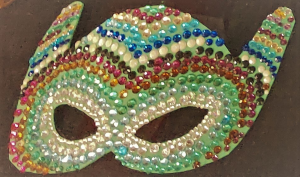
    A decorative mask crafted for the exhibit out of foam and beads.

    The Carr Library exhibit on masks was developed as a supplement to the Mid-Winter Mask Making student engagement event held on February 7, 2020 in partnership with the Friendship Fridays program organized by Rutgers Global. In the initial stages of development, masks were interpreted as objects from a more distant point of view. As the COVID-19 pandemic became a global health issue by March 2020 and began to impact day to day activities, masks quickly turned into a necessary and sought after object. The demand for masks as personal protective equipment skyrocketed and vendors continue to be overwhelmed with requests, and are unable to fulfill orders, or require an extended period of time for processing and shipping. This has also led to more creative and innovative outlets with people completing DIY masks and recycling different fabric materials to do so.  Masks are being made for personal use, as well as to donate to others in need to share this precautionary measure.

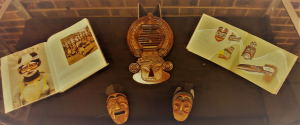
    The center case of the exhibit featured masks from India and Korea as well as books from the Libraries’ collection that revolved around the ritual and cultural uses of masks by different groups around the world.

    Requirements made by states throughout the U.S. for people to wear masks while out in public have also altered the way we prepare ourselves to leave our homes. There are new rituals of putting on gloves and a mask to help flatten the curve and prevent the spread of the virus. The way we see other people has changed, as eyes are the only facial features left exposed, and proper distance must be kept from others. Masks have now taken on a new meaning and significance, and will be enveloped into our attire and lifestyle for the foreseeable future.

    The exhibit explores the ways masks are constructed and how these objects serve larger purposes. Like the personal protective equipment masks made at home, masks can be made from nearby materials on hand. Whether these items are found in the natural environment such as wood, bone, and clay, or man-made products like plastic and beads. These materials are combined together to develop the structure of the mask and enhance the imagery of the object through design and decoration. Regardless of material type, masks are constructed with a use and purpose in mind.

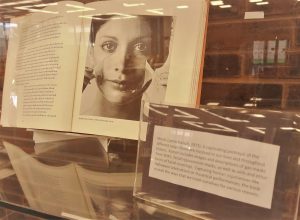
    The right-side case of the exhibit featured the book Masks by Jamie Shalleck–a captivating visual portrayal of the different ways masks are involved in our lives and throughout history.

    Widespread uses for masks were identified in the exhibit as relating to qualities of fun, ritual/culture, identity and protection. Most commonly, people associate masks with a form of costume or disguise. These celebrations make masks a fun accessory for Halloween or a masquerade and can allow the wearer to be creative with their appearance. The process of decorating the mask itself is entertaining and can be elaborately done to mimic something in nature, feature bold colors, or glisten with jewels and beads. The masks used in Mardi Gras parades and Venetian carnivals depict this celebratory nature of the objects and how they can be combined with an ensemble to develop a whole new appearance and costume.

    Masks have also been a prominent part of cultural and social rituals. These objects exist as ritual devices of transformation and storytelling. Whether it be part of an ensemble for a ritual dance, a way to connect religiously, or to initiate members into a group. The masks are made to follow a pattern set over time through ritualized experience. Masks not only add to the sense of excitement and theatrics, but also create a sense of solidarity and belonging through the group experience. The repetition of these rituals causes the masks to become a part of one’s identity as it relates to a culture’s way of life.

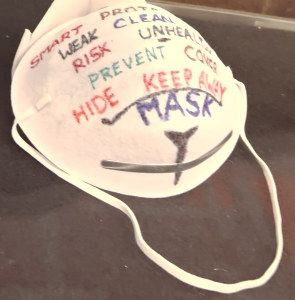
    A protective mask modified with associated words and expressions.

    In another sense, people can portray themselves a certain way to mask their identity and inner self from the outside world. Virtually, individuals can devise new identities and ways of representing themselves externally that differ from what lies behind their public profile. What kind of masks do we put on around others and how does this impact the way we view ourselves and others?

    Masks can serve people in these intangible ways, but also are physically important when implemented as tools of protection. Constructed of materials such as bone or metal, masks have been brought into warfare as a form of armor. Often-times masks feature important cultural symbols or meanings in the design and construction, which can act as social or political protection and power as well. Or in the case of recent events, masks are tools to fight against the spread of disease and illnesses by creating barriers between people and prevent contact. Giving the wearer protection from the external environment and a sense of security and safety.

    To expand on the ideas of the Masks exhibit, a libguide was created to offer a list of resources and other examples of how masks are present in society and used for various reasons. Books, articles, and images/videos related to the themes of fun, ritual/culture, identity, and protection are present on the page. Additionally, links to other exhibits on masks and how masks have been used in social movements and literary works are available. Discover more information about this topic in the libguide https://libguides.rutgers.edu/masks.

    Lauren Rossi and Triveni Kuchi


  • Rutgers Meets Japan

    The planned exhibit was converted to a digital exhibit, which will be mounted on the course website.

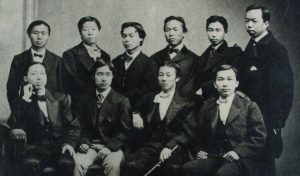
    In 1867, Kusakabe Tarō (1844-1870), a samurai from Fukui in the remote west of the country, left Japan to study at Rutgers. After his untimely death in 1870, his mentor and friend, William E. Griffis (1843-1928) of the Rutgers Class of 1869, was invited to teach Western-style education in rapidly modernizing Japan. Griffis would spend his life writing and speaking about Japan and collecting books and archival material. His collection came to Rutgers Special Collections and University Archives (SC/UA) after his death. This spring, Haruko Wakabayashi of the Department of Asian Languages and Cultures, is teaching “Rutgers Meets Japan: Revisiting Early U.S.-Japan Encounters,” an interdisciplinary honors seminar based on the Griffis Collection. This seminar examines this crucial moment of early U.S.-Japan relationship and cultural exchange as we commemorate the 150th year since William E. Griffis left for Japan. As curator of the William Elliot Griffis Collection at SC/UA, I am supporting the class through helping them access books, documents, and images from the collection. Assignments are based on primary sources and prints from the Griffis Collection and the Zimmerli Art Museum, which are posted on the course website. For the final project, students planned to curate an exhibition at the Alexander Library using materials from the Griffis Collection. The culmination of the course was meant to be a two-week field trip, “The Japan that Griffis Saw,” where the students along with Professor Wakabayashi and myself would visit in Fukui, Yokohama, and Tokyo.

    On March 10, the class visited SC/UA to use maps and city directories to try to envision what New Brunswick was like at the time Griffis and Kusakabe were students. When we learned the next day that all Rutgers courses were going online after spring break, we had to adapt quickly. The planned exhibit was converted to a digital exhibit, which will be mounted on the course website (https://sites.rutgers.edu/rutgers-meets-japan). The trip to Japan was postponed until January.

    Access to the Griffis Collection was an even more difficult problem. In 2000, the Griffis Collection was microfilmed through an agreement with Adam Matthew, a company in the U.K. In 2017, Rutgers contracted with Adam Matthew to digitize this material, with a stipulation that Rutgers would get free access. When it became apparent that we would have no physical access to the Libraries for the rest of the semester, I followed up with Adam Matthew Digital regarding the status of the project. Thanks to Jeff Carroll, Elizabeth York, and their teams, the digital version of the Griffis Collection is now available through the database Area Studies: Japan, enabling students to access digitized primary source documents from the collection. Class discussion now takes place on the Canvas site. According to student Raj Malhotra, SAS ’22, “The transition to this digital classroom environment has come with its expected difficulties, but has shown us how to stay connected through the vast digital libraries and resources available for class meetings and teachings.” All are looking forward to the trip, which we hope will still take place.

  • Creating Homemade PPE

    I would like to share my experience during these difficult days of our quarantine to fight against COVID-19.

    While all of us are working from home, the medical staff are on the front line fighting the virus while lacking the PPEs. This became a great concern in my family, when my daughter called me three weeks ago, and asked if I could make some masks and head covers for her husband, who is a doctor, and also her doctor friends who are taking care of COVID-19 patients.

    She did some research how to make safe cloth masks for medical staff to place over the N95 masks to make them last longer. Pretty quickly, we figured out how to make them out of cotton fabric and flannel while using different filters. I used any item possible at home: T-shirts, cotton sheets, cotton tablecloths, bags, baby wipes, laundry softeners, vacuum cleaner filters. I also made head covers out of shower curtains while sending her all transparent plastic available at home so she could use it to make face shields, helped by her friend who made parts of them by 3D printing. She was able to make 30 face shields.

    My daughter and I also started a campaign on social media, asking people to make masks and sharing the instructions, suggesting they donate them to the community. The social media network in New York, Connecticut, and New Jersey was able to make 350 masks and donated them to hospitals and friends. My daughter, who is also a doctor, for about a month never stopped raising awareness on social media that everyone needs to wear a mask when we go out.

    I shared my experience with the Smith Library access services staff and shared guidelines about how to make masks. I will continue to make cloth masks and head covers until the pandemic is over. Doing something good for the community helps me release the stress and be happy that I can do my little part to fight the pandemic.

    How to Sew a Medical Face Mask

    Materials

    • 2 pieces of 100% cotton fabric that measure about 7 inches by 9 inches—cotton T-shirts, dish towels and pillowcases are good options (make sure all fabric is washed and dry)
    • 2 pieces of cotton fabric that measure about 1.5 inches by 40 inches for the mask’s strap (in a pinch, you can use something like shoelaces, elastic 6 inch long or ribbon)
    • A ruler, sewing pins, a pair of scissors, thread, an iron and a sewing machine.

    Video Tutorials

    Instructions

    Step 1: Sew the two main rectangle pieces together with the “right” sides of the fabric—the side you want to see—facing each other. Sew almost all the way around the rectangles, leaving a small gap (a few inches) open on the long side.

    Step 2: Turn the rectangle right-side-out by reaching into the gap you left open and pulling the fabric through. Now your edges are on the inside and you have a neatly sewn two-sided rectangle. At the gap you left open, just tuck the edges inside for now; you’ll sew it closed later.

    Step 3: Make three evenly spaced pleats along both 7-inch sides of the fabric, making sure to keep all of your tucks facing in the same direction, and pin in place. One way to do this is by marking the spacing with pins: place one about 1.5 inches down the short side of the fabric; add the next 1 inch down from that, then the third ½ inch down from that, and keep alternating between 1 and ½ inches until you’ve used all six pins. To create the pleats, just bring the first pin down to meet the second, the third to meet the fourth, and the fifth to meet the sixth. Repeat on the other side.

    Step 4: Once the pleats are pinned, stitch all the way around the perimeter of the rectangle. This will sew the pleats into place and also close the gap you had left open in Step 1.

    Step 5: If you’re using a strip of fabric for your strap, fold and iron it in half lengthwise and then fold and iron the raw edges in. Find the centers of your straps and the centers of the long sides of your mask, and match them. Pin the straps in place along the long edges of the mask, so there is a strap on the top of the mask and one on the bottom, with equally long pieces coming out to the sides. If you’re using a strip of fabric, pin it so it’s wrapped around the edge of the rectangle.

    Step 6: Sew the strap to the mask by stitching all the way down each strap, catching the edges of the mask as you pass. (If you are using a strap that did not require folding, you can opt instead to stitch around the perimeter of the rectangle one more time.)


  • United We Stand against COVID-19

    Photo credit: New York Times.

    Since March 17, a few residents in Warren, Watchung, Green Brook, and Long Hills and I have organized a donation campaign and raised a total of $31,214.60 from the local Chinese American community to donate PPEs to Robert Wood Johnson Hospital and St. Peter’s Hospital in New Brunswick, Overlook Hospital in Summit, Somerset Medical Group in Somerset, and Morristown Medical Center in Morristown, as well as local EMT, police, and fire fighter units.

    I have worked many nights trying to allocate PPE resources in the United States. I used my online search skills and technical background to perform the due diligence process and verified all PPE sources for quality and safety based on ASTM standards and CDC/FDA guidelines. Up to April 6, the following PPEs have been purchased and sent to the above organizations:

    • 1,200 N95 masks
    • 1,400 KN95 masks
    • 8,800 surgical masks
    • 1,014 DuPont protection gowns
    • 472 3M safety googles
    • 6,400 gloves
    • 20 big boxes of wipes
    • 8 big bottles of hand sanitizer

    A few news media including the New York Times, Echoes-Sentinel, Bitpush News, and other local community newspapers have interviewed me and published articles about the effort.

    Editor’s note: Kudos to Connie on this amazing and inspiring work!!


  • Hosting Virtual Events with Webex

    Thinking of hosting a virtual event and don’t know how to?

    The COVID-19 pandemic has instantly changed how we work and interact with each other. It’s a challenging time for all of us. All in-person meetings, events, and training have been transformed to online, and there are several online collaboration tools available for Rutgers faculty and staff. This article describes how you can schedule an interactive online event using Webex.

    Webex is freely available to all Rutgers faculty and staff. Before you can start using Webex, you must activate your license. Once you have activated your license, you can start scheduling your online event. There are three different solutions available in Webex:

    Webex Meetings Center provides a simpler way to have a face-to-face meeting experience with your colleagues. You can present, share your screen, and collaborate on projects in a centralized space.

    Webex Events Center makes hosting an online event easy. Whether you are hosting a brown bag event or a webinar, you can deliver an interactive presentation with multimedia, along with Chat, Q&A, and polling, to engage your audience. Refer to OIT’s Getting Started with Cisco Webex Events for step-by-step instructions to schedule an event.

     Webex Training Center is suitable for lecture style classes. You can deliver live, interactive sessions to students anywhere, and keep them engaged with hands-on training, tests, and breakout sessions to enhance their learning.

    When you are hosting a Webex event, you can provide additional security by requiring a password. If you specify a password, attendees must provide it to join the event. Webex makes it possible for attendees and panelists to join an event without a license.

    Are you planning a virtual event but not sure how to choose the right solution? Take a look at this Webex Suite Comparison chart. If you still need assistance, please send an email to support@rulhelp.rutgers.edu and help will be on the way!

  • Library Instruction Continuity

    The Library Instruction Continuity Resources Guide.

    In light of our “new normal” circumstances, we have created a LibGuide that lists many helpful resources and documentation to support remote instruction.  The Library Instruction Continuity Resources LibGuide includes information on how to conduct live conferencing and record lectures that students may access on demand.  Additionally, it contains links to many helpful University-wide provisions such as direct links to Rutgers Emergency Preparedness for Synchronous/Asynchronous Instruction, and the Teaching and Learning with Technology department.  The guide also contains links to online resources by campus.

    Visit the LibGuide to view all of these valuable resources, and to see how to create and share instructional content in a remote instruction environment.

    For questions about the Library Instruction Continuity Resources LibGuide, contact Maria Breger at maria.breger@rutgers.edu

    View the complete list of the Libraries Teaching & Learning topics.

  • Website Redesign Project Update – May 2020

    Screenshot of NewCity discovery report
    The discovery report is available on the project team’s staff resources site.

    The Discovery phase of the website redesign project has officially concluded. Feel free to peruse NewCity’s Discovery Report, which outlines their findings from their onsite visit, one-on-one interviews with some key stakeholders, discussions with the core project team, an intercept survey, and analytics. They tease out some of the characteristics that make RUL’s different units unique, as well as what unites everyone, and what some of our biggest challenges will be as we move forward with this project.

    We’re excited to be starting audience research this month. Over the next ten weeks, NewCity and the RUL project team will be working with local teams and directors to survey and interview our user groups, define the brands and goals for each campus, and move toward a baseline understanding of what our users need and how they behave. While we’d love to be able to meet face-to-face with our users, we’re not letting COVID-19 slow our progress—we’re working with NewCity to develop a robust research plan that we can deploy entirely online.

    To help coordinate, conduct, and analyze this research, we’ve formed a Local Library Owners team, an augmented version of our core project team. We’re happy to welcome John Gibson, Samantha Kannegiser, Angela Lawrence, Amber Judkins, Christie Lutz, and Victoria Wagner to the project.

    Audience research doesn’t apply only to our external users; we’ll be working with the RUL audience as well. As we develop a web presence that has room for more “local flavor,” we need to be sure to empower local content editors to create and contribute content and design that works best for their units. Our new site will employ a component-based system that will allow local contributors flexibility and ease in creating and customizing local content while keeping the site sustainable for the central technical team.

    The project team continues to meet bi-weekly, with additional meetings now being added as we begin the next period of intense focus on audience research.

    You’re welcome to reach out anytime with questions or comments. Send us an email: webservices@rutgers.libanswers.com

  • Ex Libris Implementation Team Update – May 2020

    Rutgers students, faculty, and staff can now access over a million digitized texts available through HathiTrust’s Emergency Temporary Access Service (ETAS). In response to the current public health crisis, HathiTrust is providing member libraries with temporary access to digital versions of print titles that would otherwise be inaccessible due to library closures. As a result, the Rutgers community now has online access to over 1.2 million volumes previously only available in print. This is in addition to the more than 6 million public domain and Creative Commons-licensed works already accessible through HathiTrust.

    Rutgers users can search for these titles in QuickSearch or the HathiTrust Digital Library. Books available through ETAS include a note indicating temporary access.

    View in QuickSearch.
    View in HathiTrust.

    Terms of service

    • “Temporary Access” books require NetID login and can only be accessed by Rutgers students, staff, and faculty.
    • “Temporary Access” books can be read online only. Unlike “Full View” books in HathiTrust, they cannot be downloaded for offline reading.
    • “Temporary Access” books can be checked out for one hour. The banner at the top of the browser informs you how long the book is checked out to you. Your access to the book will automatically renew as long as you are actively reading it.
    • If the book you want is currently checked out, a message will display letting you know that the book is in use. Check back later to see if the book has been returned. Unfortunately, it is not possible to request or place a hold on a book. Because access is limited, users are encouraged to return books as soon as they are done using them.
    • “Temporary Access” books will only be available online until access to the Libraries’ print collection is restored.

    For more information, including instructions for accessing ETAS books on your mobile device, see https://www.hathitrust.org/ETAS-How-To