Category: Shared User Services

  • Library Tutorials Made Available in Multiple LMSs

    The NimblyWise courses on Communication, Critical Thinking, and Information Literacy are now available for use in Blackboard, Canvas, and Sakai.  A new Credo Reference course – Health Science – is in the process of being set up and soon will be available in Canvas.  As an easy way to reference these courses while conveying the wide range of library instruction topics, we refer to them as Library Tutorials.

    The Library Tutorials are for use by Rutgers University instructors on all campuses.  Librarians will be interested to know that the lessons are mapped to instructional standards including the AAC&U (American Association of Colleges and Universities) VALUE Rubrics (Information Literacy and others), the ACRL Framework for Information Literacy, and the ACRL Visual Literacy Standards.

    Here are some of the ways that instructors may use these lessons:

    • In a first-year or transition class, to help students appreciate the overall importance of information literacy, strong research and evaluation, and communication skills.
    • As a flipped classroom, assigning students to view a video or work through a lesson before they attend a specialized library instruction class.
    • At various points during a scaffolded assignment, courses are broken down into individual lessons so that they may be deployed to students at various points in their process.
    • At the beginning of a class project, the multimedia lessons cover topics essential to success in research, from choosing a topic to evaluating sources.
    • At point of need, the lessons and videos provide just-in-time learning resources that are available to students throughout the semester.

    Instructors who have questions about the Library Tutorials content, or who want to supplement the online instruction with in-person or other modes of library instruction, are being directed to contact their library liaison.  Library liaisons can also help instructors select the most relevant lessons for their course.

    Librarian liaisons who need information about the tutorials may contact Maria Breger at maria.breger@rutgers.edu.

  • Where in the World is SUS?

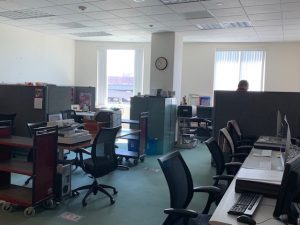
    The new SUS space on the third floor of Alexander Library.

    Shared User Services has moved, both spatially and virtually. In June, virtually all (pun intended) of the SUS employees relocated. Our email addresses and phone numbers are the same, but for those who value a spatial identifier, here is where you can find us:

    Technical Services Building
    • Amy Kimura
    • Cathy Pecoraro
    • Elizabeth York
    • Joseph Deodato
    • Michele Best

    Alexander Library 3rd floor (Library Admin suite)
    • Isaiah Beard
    • Marty Barnett
    • NJEDL project staff and students
    • Rhonda Marker

    Alexander Library 4th floor
    • Laura Costello

    SUS has also moved their staff resources information to the “new” staff resources page. You can find information about a variety of digital projects, discovery services, electronic resources, virtual reference, and Web Improvement Team at https://staff.libraries.rutgers.edu/sus. We will soon be expanding our Teaching and Learning section here, too. We’re excited to be the first unit to officially move over to this new site.

  • Designing Storage Architectures for Digital Collections

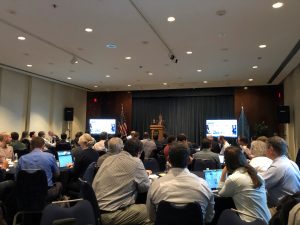
    Digital storage meeting at the Library of CongressStoring and preserving digital content continues to be a significant expectation of libraries and cultural centers around the country. To better understand these needs, as well to see what digital archivists around the country are doing to meet this challenge, the Library of Congress holds an annual meeting called “Designing Storage Architectures for Digital Collections.” The DSA meeting brings together technical and industry experts, IT and subject matter experts, government specialists with an interest in preservation, decision-makers from a wide range of organizations with digital preservation requirements, and recognized authorities and practitioners of digital preservation. The meeting is by invitation only, and for the past two years Rutgers has been invited to take part in the conversation. The most recent meeting was held on September 17 and 18.

    The first thing glaringly clear from our discussions was the increasing need for digital storage across all of our peers. From the few terabytes of data that Rutgers Libraries store in our repository, to the dozen or so petabytes stored by the Library of Congress, our digital collections continue to grow, and the demands for storage increase. This is driven by an increasing appetite for digital data from our patrons, but is also the effect of researchers and artists having greater access to digital authoring tools. We are now in the age where smartphones and tablets already in the hands of our user base can capture images, documents, and video in stunning quality—but with a cost in terms of larger file sizes.

    To meet this challenge, storage makers continue in the short term to refine the technologies we are already familiar with. Reasonably-priced tablets and laptops are now shipping with solid state drives reaching a terabyte in capacity. Fourteen-TB traditional hard drives are now hitting the market. And for long-term backups, tape continues to rule, with 30TB tape cartridges costing about $200 each. At the institutional level, libraries are beginning to cooperate and pool resources to distribute their storage needs across multiple datacenters, for redundancy and additional capacity.

    The not-too-distant future holds some different approaches, as well. In particular, research is ongoing to move beyond hard drives and tapes, and to begin storing data at the molecular level, using polymer chains. Even DNA sequencing is showing significant promise as a long-term method for archiving and preserving data.

  • Simplifying Routine Digital Projects

    poster
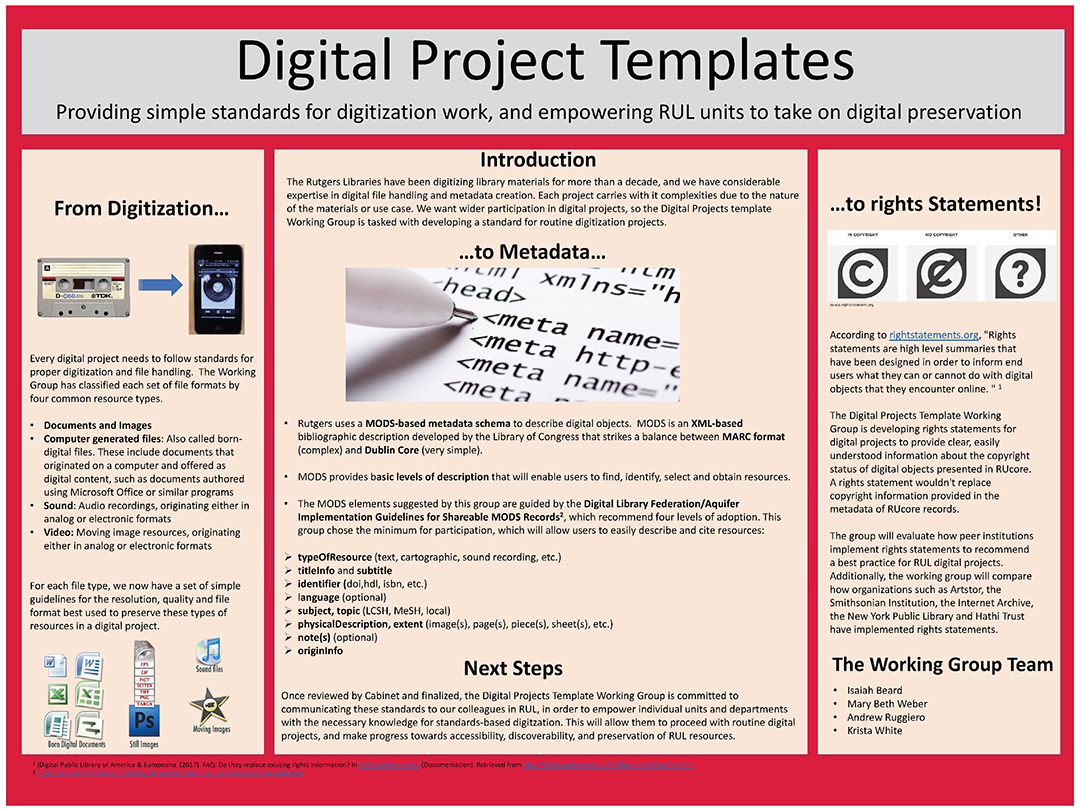
    The Digital Projects Template Working Group presented an interim report poster at the last State of the Libraries.

    Digital projects have been an integral part of the services that Rutgers University Libraries have provided over the past decade. Making some of our resources available online adds to the discovery and accessibility of those holdings, providing a valuable service to our patrons. The digitization of physical items also provides an additional layer of preservation, protecting the original item from additional wear, while ensuring the content lives on.

    In light of this, the Digital Projects Template Working Group was formed in September 2017 to streamline and simplify the process for individual units, empowering them with the knowledge to embark on their own routine digital projects as their resources permit.  We’ve worked hard during this time to document what types of items and collections make up a potential “routine” project; provide technical information on file formats and digitization standards; offer up minimum required descriptive metadata; and provide recommendations on rights statements. With this simplification documentation, we hope that there will be less of a bottleneck for routine digitization projects.

    While the Digital Projects Template Working Group has completed their work, we realize that libraries also need guidance about the process to begin carrying out this work. Cabinet determined that a group will develop a workflow for routine digital projects.  That effort is already under discussion.

    Central units will provide support for these routine digital projects in the areas of digital preservation assessment, accessibility, and search portal and website creation. Shared User Services can consult with directors and project managers to answer questions about whether a digital project is routine, or perhaps more complex. We encourage everyone to visit our website and review the recommended guidelines for digital projects.

  • Where in the World is Shared User Services?

    Where in the World is Shared User Services?

    Nearly a year ago, the Libraries reorganized to form a central user services unit, Shared User Services. While we are still building, major structures are coming together. Here’s a progress report to let you know who we are, where you can find us, and some of the things we are up to.

    SUS began with several people in the former Scholarly Communication Center department: Isaiah Beard (Digital Data Curator), Ron Jantz (Digital Library Architect), Peter Konin (Digital Project Coordinator), and Rhonda Marker (Director of Shared User Services). Marty Barnett (Digital Library Applications Specialist) moved from IIS to join us. This summer, Joseph Deodado (Digital User Services Librarian) and Amy Kimura (Web Services Librarian) came on board. We are currently recruiting for a new Virtual Reference Services Librarian.

    Our physical work home is in Alexander Library on the 4th floor. Our online home is on the Staff Resources pages of the Libraries website. We have an up to date SUS Contacts list where you can see who to contact, from digital curation and digital file questions (Isaiah Beard) to virtual reference services (currently, Joseph Deodato and Natalie Borisovets). No, Natalie has not moved to SUS. She is still at Dana Library, where she has been the glue holding together the chat reference schedule across all of RUL. When we hire the new Virtual Reference Services Librarian, we’ll update our contacts list.

    SUS coordinates discovery, the shared components of reference (chat, email), and the public-facing libraries website. We also have a coordinating role for digital projects – but that story will have to wait for a future issue of The Agenda. Two working groups that support improvements to discovery of library resources, the Discovery Working Group and the Library Catalog Committee, report to the Head of Shared User Services. Their minutes and other useful information are now located on the SUS web pages of Staff Resources. Cabinet recently charged the Web Improvement Team, which is ambitiously meeting on the first day of the fall semester. We are all looking forward to seeing the fruits of their labors – and you will be able to read all about it on the SUS web pages.

    From time to time, the Libraries identify other services that call for a central user services role. This was the case for the modernization of our library hours information. Staff in SUS and IIS collaborated on configuring the information in LibCal (from SpringShare) and worked with many people in all our library locations to assemble the details of buildings, service points, and shifting calendars. We could not have done it without you. We are still adding details and features so that this new way of presenting our library hours gives our users the information they need. Ongoing support for library hours resides in SUS (Marty Barnett).

    There is a lot more that we are doing, and we are excited about the work ahead of us. Most of all we look forward to working with all of you in the Libraries. If you ever want to chat, now you know where to find us!

    Save

  • Welcome to the New Shared User Services Department

    Welcome to the New Shared User Services Department

    Krisellen Maloney, Vice President for Information Services and University Librarian

    I recently announced the formation of the Shared User Services Department, headed by Rhonda Marker as director of shared user services. This month, I want to provide a bit more context for this shift and how it fits into the priorities for the Libraries.

    To begin, it is best to look at the budgetary issues and priorities that we discussed at the State of Libraries in 2015, what we have learned, and how what we have learned is shaping our actions and the priorities for this year.

    A major priority—because it is at the heart of everything that we do—has been to clarify decision-making within the libraries. At the State of the Libraries, we talked about several ways in which we would do this, but the two that are most relevant to this discussion are the roles and decision-making authority of the AULs and directors and improving budget transparency.

    Throughout the year, as we began to define roles, it became apparent that having the coordinating function for shared public services and the leadership of the New Brunswick Libraries combined under one AUL was causing confusion. This is the same structural problem that the University addressed when they separated the executive vice president for academic affairs position into two positions: a senior vice president for academic affairs and the chancellor of Rutgers–New Brunswick. Following the university structure, we knew that we needed to separate the coordinating function and the leadership of New Brunswick Libraries.

    Budget transparency is also a driver for clearly defining central and university functions. We are now in the thick of the RCM budget process, and we know that the four chief financial officers expect us to accurately report expenses. A clearly defined central unit would bring more clarity to our accounting. The RCM budget model and our funding levels brought in another factor. With no funds available to create a new unit, the function of an existing unit would need to be modified.

    Two more priorities from the State of the Libraries provided us with ideas of how we could redefine our central units to support the changing university environment: the need to better understand and imporove our collections and the need to clearly articulate our vision for advanced research support, including scholarly communication.

    This year, we have begun to address collection management and development. We’ve used central and New Brunswick reserves to make large purchases that fill some holes in our collection. However, the results from our recent LibQUAL+ survey indicate that the negative perceptions of our collections are linked to discovery issues and problems with the website. Based on these findings, we have set a new priority for this year to improve information control which we will discuss more fully at the 2016 State of the Libraries.

    We are pioneers in the areas of advanced research support and scholarly communication, but internally we lack the infrastructure—organizational structure, connection to Cabinet, clear sources of funding—to support a path forward. This is something that we will study over the next year.

    With a need for improved information control and a lack of direction for scholarly communication priorities, we looked at the Scholarly Communications Center to see if there was an opportunity to restructure. Over many weeks this summer, I worked with a team to tease out the various functions of the Scholarly Communications Center, assessing each responsibility and aligning it with the appropriate unit or department. These were not easy decisions because advanced research support and discovery are complex aspects of what we do as a library system.

    Our goal was to create a department that could play a central coordinating role and be a single point of entry to access ongoing scholarly communications projects and to bring new projects into the fold.  The Shared User Services Department will also coordinate discovery, the website, and the shared components of reference. The Libraries have put a great emphasis on transparency and accountability over the previous year and SUS will work closely with University Library Directors and Cabinet to prioritize projects and communicate with infrastructure units to make sure that resources are available and requirements are clear. In essence, they will be the one-stop shop for project management on these larger initiatives.

    I noted this in my earlier announcement, but it is worth reiterating that this transition also involves significant changes in the role of the directors, IIS and RIS.  I will explore each of these in upcoming issues of the Agenda.

    These are exciting changes for the Libraries and I anticipate the work of the SUS department will further shift and mold our priorities over the coming year. During this period of transition and change, I encourage you to speak with the directors and AULs if you have concerns, suggestions, and ideas that will help us move forward in a smart, efficient way.


    Save

  • Announcing the Discovery Working Group

    Announcing the Discovery Working Group

    discoveryThe Discovery Working Group was charged by the University Librarian in early July 2016 to improve identification and access to materials in our collections. Key to the group’s charge is the guiding principle, “Create a comprehensive digital environment that is based on user need, optimizing navigation to ensure successful search, identification, and retrieval.”

    Fortunately, the Working Group has access to a powerful key indicator of user need in the form of the LibQUAL+survey results. Among the tasks the group has taken on, they have read thousands of comments left on the survey that relate to discovery (search, website, library catalog, interlibrary loan, and resources). The Working Group has also devoted time to understanding the current architecture of our systems in order to best incorporate the influx of new resources (predominantly e-books) which have been recently acquired.

    Chaired by Joseph Deodato, the group is comprised of members from all of the universities and Technical and Automated Services. Judy Cohn is the cabinet liaison to the group. The Working Group looks forward to sending an interim report to cabinet at the end of October. The charge and complete list of members is available at the Working Group’s website in Staff Resources – University Librarian – Committees and Task Forces.  http://www.libraries.rutgers.edu/rul/staff/admin/committees.shtml.

    Save