Audio reels and digital audio tapes from the Jazz from the Archives collection will soon be digitized to support teaching, learning, and research at Rutgers.
The Institute of Jazz Studies, Rutgers University Libraries, began work this fall on a grant-funded project to digitize the Jazz from the Archives collection. This vital work is possible through a $36,837 Recordings at Risk grant from the Council on Library and Information Resources (CLIR).
Spanning 1979–2006, the Jazz from the Archives collection includes approximately 650 open reels and digital audio tapes (DATs) produced by Newark’s WBGO-FM and co-produced by the Institute of Jazz Studies.
These recordings capture rare alternate takes and feature in-depth interviews with renowned musicians, bandleaders, producers, and managers. Far more than a typical radio program, Jazz from the Archives offered a rich educational experience, making it a vital resource for Rutgers students and faculty, as well as scholars worldwide, students of all ages, and the public.
The collection has broad research value for those studying jazz, music, civil rights, American history, and the history of radio. Digitization will both preserve this at-risk material and expand access, ensuring that it can continue to inform teaching, learning, and scholarship for years to come. The digitized radio programs will be accessible through the Rutgers University Libraries digital repository (RUcore).
Jazz Jam Sessions is directed by pianist and bandleader James Austin Jr. and feature some of the Garden State’s finest jazz musicians. Musicians and singers of all levels are encouraged to jam and improvise with the professional band throughout the night.
Admission is free, but guests must RSVP to attend. For more information, please visit this link. Follow IJS on Facebook to watch live streams of the jam sessions and on Eventbrite to stay up to date with the latest performances.
Upcoming Schedule
• Thursday, March 16, 2023: RSVP
• Thursday, April 20, 2023: RSVP
• Thursday, May 18, 2023: RSVP
• Thursday, June 15, 2023: RSVP
A native of Red Bank, New Jersey, William James “Count” Basie (1904–1984) was one of the giants of jazz, a global icon, and still one of the most influential, popular, and recognized figures in American music. The Institute acquired Basie’s papers and artifacts in 2018 and is responsible for ensuring its long-term preservation. The roughly 200-cubic-foot collection, consisting of more than 1,000 items, is unparalleled in its size and thorough documentation of Basie’s life and career, as well as those of his wife, Catherine, and daughter, Diane.
Basie family photo album (photo courtesy of the Conservation Center for Art & Historic Artifacts).Basie news clippings album (photo courtesy of the Conservation Center for Art & Historic Artifacts).Basie photo album with musical performance pictures (photo courtesy of the Conservation Center for Art & Historic Artifacts).
The papers portion of his collection is now available to the public for research and enjoyment. The artifacts and the remainder of the collection will be accessible in mid-2023. Please visit libraries.rutgers.edu/basie to access the finding aid.
Martin Luther King Jr.’s telegram to Catherine Basie, 1962.Baseball great Jackie Robinson’s telegram to Catherine Basie, 1963.Count Basie’s telegram to Catherine Basie on their anniversary (signed “Bill”; 1963).
About the Collection
The Basie Family Papers and Artifacts document the vast impact of Count Basie’s enduring and storied career in jazz and American history and provide an unparalleled view of his family and private life. The collection is an essential resource for researchers in jazz, music, post-war American history, and American culture, especially black American culture. It is also critical for scholars, educators, writers, filmmakers, students, and the general public because of its breadth and depth.
Count Basie with his daughter, Diane.
The collection contains extensive primary sources and objects ranging from Basie’s earliest years in Kansas City until his death. One-of-a-kind artifacts comprise approximately half of the items, including Basie’s piano and organ, select home furnishings, artwork, apparel, and accessories. Although the materials cover the entirety of Basie’s lifetime, the artifacts represent the latter years of his life and career particularly well, including many accolades, awards, honorary degrees, and proclamations he received during that period. Unique archival materials never before available to researchers comprise about one-third of the collection, including personal papers, business records, photographs, clippings, scrapbooks, ephemera, correspondence, and audio and moving image recordings.
Catherine Basie (left) with legendary jazz singer Sarah Vaughan.
Catherine Basie’s life and accomplishments are also well documented in the collection, including her extensive civic and charity work (for which she was recognized by the major leaders of the day), her background as a dancer and singer, her social network, and the centrality of family in her home life.
The Institute of Jazz Studies is the world’s foremost archives and research library exclusively dedicated to jazz, an American art form that has transformed the world. Founded in 1952 by pioneer jazz scholar Marshall Stearns (1908–1966), IJS has been a leading institution in the preservation and access of jazz heritage. The Institute relocated from Stearns’ apartment to Rutgers University–Newark in 1966 and is part of the Rutgers University Libraries. In 1994, IJS moved to spacious new quarters on the fourth floor of the John Cotton Dana Library at Rutgers–Newark.
The Institute of Jazz Studies (IJS) is excited to announce that it published its 200th finding aid on the Archives and Special Collections at Rutgers website. For many decades, the IJS’s world-renowned collections had many access tools and inventories ranging from spreadsheets to typed lists on binders, reflecting the evolution of archival description over the past 60 years. Since installing ArchivesSpace (the engine behind the website) and having a central location for finding aids on the website, Rutgers University Libraries is moving towards facilitating researchers’ use of all the unique collections that make our libraries shine. This tool allows the user to search across all finding aids within the Institute.
“A long time in the making, publishing the 200th finding aid to ArchivesSpace is a great milestone for the Institute,” said IJS Metadata Archivist Diane Biunno, who works behind the scenes to update the finding aids. “I am proud to have been part of the collaborative effort at IJS to improve the discoverability of and access to our archival holdings.”
These access tools are a mix of some legacy “old-fashioned” finding aids and newly created ones. The work that went into making this happen was a team effort first started by IJS Archivist Elizabeth Surles. In 2014, she developed and led a collections-wide survey to ascertain the collections’ provenance and pin down exact locations for different materials. Building on this work, the IJS now has intellectual and physical control of the collections under its care and is looking ahead to growing our descriptive footprint. These 200 finding aids are only the tip of the iceberg, as the IJS continues to create access tools for holdings such as the William “Count” Basie and Mary Lou Williams papers, two of its most robust and extensive collections.
The Institute of Jazz Studies has been working diligently to inventory the Basie family papers as part of the project funded by a $433,500 Save America’s Treasures Grant, awarded to the Institute in late 2020. Ben Houtman started in his position as Project Coordinator in January 2021 and quickly facilitated the safe transport of the collection to Dana Library for the inventory. After the inventory is complete, the Institute will send unstable and damaged artifacts and archival materials from the collection to a team of conservators for treatment. Finally, with support from a $23,500 New Jersey Historical Commission grant, the Institute will arrange and describe the archival materials in the collection to open it for use in 2022.
14k gold money clip, inscribed from Jerry Lewis to the “Count”Hohner soprano melodica
Photo album pageEbony Lifetime Achievement Award to Count Basie
In early October the Society of American Archivists (SAA) and the Music Library Association (MLA) co-published a new open-access ebook, Archival Description of Notated Music (ADNM), co-authored by the MLA Working Group for Archival Description of Music Materials, which I had the pleasure of co-chairing with Dr. John Bewley, a Rutgers alumnus and the retired associate librarian/archivist at the University at Buffalo Music Library. Working Group members also included Sofía Becerra-Licha, lead archivist at the John F. Kennedy Center for the Performing Arts; Maristella Feustle, music special collections librarian at the University of North Texas; Vincent J. Novara, head of the Acquisitions and Processing Section in the Music Division at the Library of Congress; Matthew Snyder, archivist at the New York Public Library; and Karen Spicher, manuscript cataloger and processing archivist at the Beinecke Rare Book and Manuscript Library at Yale University.
ADNM provides guidance intended for a wide readership and is helpful for experienced archivists with limited knowledge of music, music librarians with limited knowledge of archival practice, students in MLIS and archival studies programs, and others with responsibility for archival collections with notated music. The book includes discussion of fundamental archival principles as applied to collections with notated music, recommendations for descriptive approaches based on the musical and non-musical content of a collection, a glossary, and an annotated resource list. In addition, included as an appendix are the Guidelines for Archival Description of Notated Music, which provide a standard for archival description of notated music and represent the first subject-specific supplement to Describing Archives: A Content Standard (DACS). The Guidelines were endorsed by the SAA Council as an external standard at the end of 2019. Both the Guidelines and ADNM are available via MLA’s Humanities Commons repository. ADNM may also be downloaded free-of-charge from the SAA Bookstore.
The Working Group started the project in 2016, and none of us expected it to become a full-length book and professionally-endorsed standard, much less require four years and countless hours of meetings to complete. We took a collective approach to authorship: one or two group members drafted each section of the book, which we then revised and edited as a group. Although this approach was time-consuming, the final publications represent our consensus agreement on standardized archival practice and the full range of group members’ considerable expertise. We also solicited and incorporated feedback from colleagues in other music libraries and archives and collaborated closely with SAA’s Technical Subcommittee on DACS, which contributed to SAA’s endorsement of the Guidelines. This cross-organizational collaboration was essential to the successful outcome and will hopefully serve as a model for future DACS supplements.
Diane Biunno is metadata archivist for the Institute of Jazz Studies.
Diane Biunno joined the Libraries as metadata archivist for the Institute of Jazz Studies back in February. Here, we catch up with her to learn more about her experience and what she has been working on since the shift to online-only service.
Tell us a bit about your background prior to coming to Rutgers.
Prior to joining the team at the Institute of Jazz Studies in February 2020, I served as a project archivist at the Historical Society of Pennsylvania (HSP) in Philadelphia. At HSP I worked on several projects including the Hidden Collections Initiative which was a grant funded project to improve the accessibility and discoverability of archival collections housed at Philadelphia-area small repositories. As part of the initiative, I helped staff and volunteers at local historical societies, ethnic organizations, and religious institutions better arrange, describe, and care for their collections. I enjoyed working on this project because it gave me an opportunity to get to know members of the local archival community and their amazing collections.
Before coming to Rutgers, I also worked on several innovative digital projects that were focused on improving the discoverability of archival and special collections materials. For example, I served as a digital project assistant at Penn Libraries for the Bibliotheca Philadelphiensis project, an initiative to digitize and make freely available all the known medieval manuscripts in the Philadelphia region. In addition, I was a digital project associate for the Historical Images, New Technologies Project, which explored how to better describe archival visual materials using TEI (Text Encoding Initiative) markup. Through working on these projects, I learned a great deal about metadata standards and formats, as well as, digital preservation and digital project management best practices.
I received my B.A and Ph.D. in Italian from Rutgers University and my Master’s in Library & Information Science from Drexel University in Philadelphia, Pennsylvania.
What have you been working on during the quarantine?
I’ve been working with my colleagues at IJS to copyedit and publish the approximately 200 finding aids that the IJS created last year. A finding aid is document that describes an archival collection and helps guide researchers in using the collection. The IJS finding aids will be published online and made accessible to the general public and researchers, with the goal of helping our patrons better understand our collections and how our materials can meet their research needs.
What does the process look like?
Before beginning the process of copyediting the finding aids, we quickly realized that we needed a style guide to ensure that all finding aids would be edited according to the same capitalization, punctuation, and grammatical guidelines. Unfortunately, there isn’t a standard style guide for archivists, so we decided to create our own and base it on the Chicago Manual of Style, a style guide widely used in academic publishing.
Next, we created project workflows, as well as spreadsheets for keeping track of the project’s progress. We made sure to keep the project style guide, spreadsheets, and other documentation in a shared folder that was easily accessible to everyone working on the project. Most importantly, used software tools that allow us to easily track changes to documents and to view the edits of our coworkers in real time.
How far along are you and what are the next steps?
At this point, we are halfway through the project and have published approximately 110 finding aids. We’re moving at a steady pace and hope to wrap up the project in a few weeks.
While working on the project, I began thinking about how the IJS might use Wikipedia to help guide researchers and the general public to our collections. Because patrons use Wikipedia as a starting point to find general information on a topic, as well as, additional resources, I’ve begun adding links to the institute’s finding aids in the “External Link” section located at the bottom of Wikipedia entries. For example, at the bottom of the Benny Goodman Wikipedia entry, I’ve added a link to the IJS finding aid for the D. Russell Connor collection of Benny Goodman audio recordings. Moving forward, I hope to add additional links to our collections and explore other ways to make our finding aids and collections more broadly accessible to the public.
The SAA workshops provided free training on archival basics to non-professionals who work or volunteer at institutions that cannot afford to employ professional archivists.
In November and December 2018, Dana Library and the Institute of Jazz Studies hosted a series of five workshops presented by the Society of American Archivists (SAA) via SAA’s “Lone Arranger” Section. The workshops provided free training on archival basics to non-professionals who work or volunteer at institutions that cannot afford to employ professional archivists. The overall goal was to help preserve and provide access to archival collections in New Jersey, hidden due to limited access to information on professional archival practice. Similar workshops were held across the state in Atlantic City, Trenton, and Chester, including one led by the Libraries’ Tara Maharjan. Special thanks to Adriana Cuervo for arranging for refreshments and to Mark Papianni for setting up the workshop space.
Chantel Harris (l.) at the ceremony honoring her great-great grandmother, Ethel Hedgeman Lyle, who founded the Alpha Kappa Alpha sorority.
Chantel Harris, library associate and student coordinator at the Paul Robeson Library, Rutgers–Camden, was a special guest at the ceremonial dedication and unveiling of a school bench at Charles Sumner High School in St. Louis, Missouri, in honor of her great-great-grandmother, Ethel Hedgeman Lyle. Lyle was the originator and founder of Alpha Kappa Alpha Sorority, Incorporated (AKA). Chantel received a proclamation from the mayor of St. Louis, as well as a resolution from the Board of Aldermen naming April 5, 2018 “Ethel Hedgeman Lyle Day.”
Lyle graduated from Sumner High School in 1904 and founded AKA in 1908 at Howard University. Chantel is pictured with the sorority’s international president, Dr. Dorothy Buckhanan Wilson, central regional director Kathy Walker-Steele, and members of the Board of Directors.
The USPS is considering an Ethel Hedgeman Lyle 2019-2020 USPS Forever Postage Stamp.
IJS founder Marshall Stearns and Quincy Jones at the Acropolis.
A new PBS documentary featuring archival material from the Institute of Jazz Studies is slated to premiere at 10 p.m. on Friday, May 4. Here’s a quick synopsis from PBS.org:
“The Cold War and civil rights collide in this remarkable story of music, diplomacy and race. Beginning in 1955, when America asked its greatest jazz artists to travel the world as cultural ambassadors, Louis Armstrong, Dizzy Gillespie, Duke Ellington and their racially diverse band members faced a painful dilemma: How could they represent a country that still practiced Jim Crow segregation?”
Congratulations to Tad Hershorn, Adriana Cuervo, and all of our IJS colleagues who contributed to this project. We can’t wait to see the premiere!
Special Collections News Roundup
Helene van Rossum’s new children’s book is titled “The Best Mom in the Universe.”
Lots of great news coming out of Special Collections and University Archives lately:
The finding aid for the New Brunswick Music Scene Archive is now live. The collection continues to grow, and the finding aid will be updated periodically.
Speaking of which, the New Brunswick Music Scene Archive has a brand new Facebook page! Be sure to head over and give them a like.
A new finding aid is also available for the New Brunswick Vertical File in the Sinclair New Jersey collection. This collection of primarily printed material documents a vast array of aspects of New Brunswick history, mostly between 1935 and 1960 and arranged by subject. Special thanks go to School of Communication & Information graduate student Louise Lobello for her work on the finding aid.
The latest children’s picture book by public services and outreach archivist Helene van Rossum has just been published. Written in Dutch, it’s titled The Best Mom in the Universe. Check it out (along with her other children’s books) over on Helene’s blog.
Busting Students’ Stress
New Stressbusters flyer templates are available from the Communications Department.
It’s finals week, which of course means that #STRESSBUSTERS are back at libraries across Rutgers–New Brunswick. But Rutgers–Camden is joining in the fun this semester, too, with the first-ever pet therapy session at Paul Robeson Library slated for Friday, May 4. Good luck to our colleagues at Robeson! Hopefully this is the beginning of a long and successful tradition.
Are you planning your own stress-relieving finals activities? The Communications Department has created new flyer templates to help promote your events. Check them out here: T:\CENTRAL\Templates\Signage Templates\stressbusters\word templates
The Douglass Century will be published by Rutgers University Press next month. Check out the March Agenda for your chance to win a free copy!
Celebrating the Douglass Century
Congratulations are in order for our colleagues Kayo Denda and Fernanda Perrone, who, along with Mary Hawkesworth of the departments of Political Science and Women’s and Gender Studies, have penned a history of Douglass Residential College entitled The Douglass Century: Transformation of the Women’s College at Rutgers University. The book will be published by Rutgers University Press next month. From the press:
“The Douglass Century celebrates the college’s longevity and diversity as distinctive accomplishments, and analyzes the contributions of Douglass administrators, alumnae, and students to its survival, while also investigating multiple challenges that threatened its existence. This book demonstrates how changing historical circumstances altered the possibilities for women and the content of higher education, comparing the Jazz Age, the Great Depression, the Second World War, the post-war Civil Rights era, and the resurgence of feminism in the 1970s and 1980s. Concluding in the present day, the authors highlight the college’s ongoing commitment to Mabel Smith Douglass’ founding vision, “to bring about an intellectual quickening, a cultural broadening in connection with specific training so that women may go out into the world fitted…for leadership…in the economic, political, and intellectual life of this nation.” In addition to providing a comprehensive history of the college, the book brings its subjects to life with eighty full-color images from the Special Collections and University Archives, Rutgers University Libraries.”
But wait—there’s more! March’s issue of the Agenda will include a contest for a free copy of The Douglass Century, so tune in next month for your chance to win.
There will be ample opportunity to meet health sciences librarians and learn about the resources, tools, study spaces, and collections that are available on Busch campus.
Refreshments will be served and complimentary retractable ID card holders will be available while supplies last.
Watch: State of the Libraries
A video of Krisellen Maloney’s State of the Libraries presentation is now available on our YouTube channel.
Krisellen’s presentation from State of the Libraries is now available on our YouTube channel. It includes an introduction of new employees, an overview of the Ex Libris implementation, and a discussion of the budget. Kudos to Rich Sandler for his work on the video. And in case you missed it, a video playlist of the poster sessions from State of the Libraries was posted in last month’s issue of the Agenda.
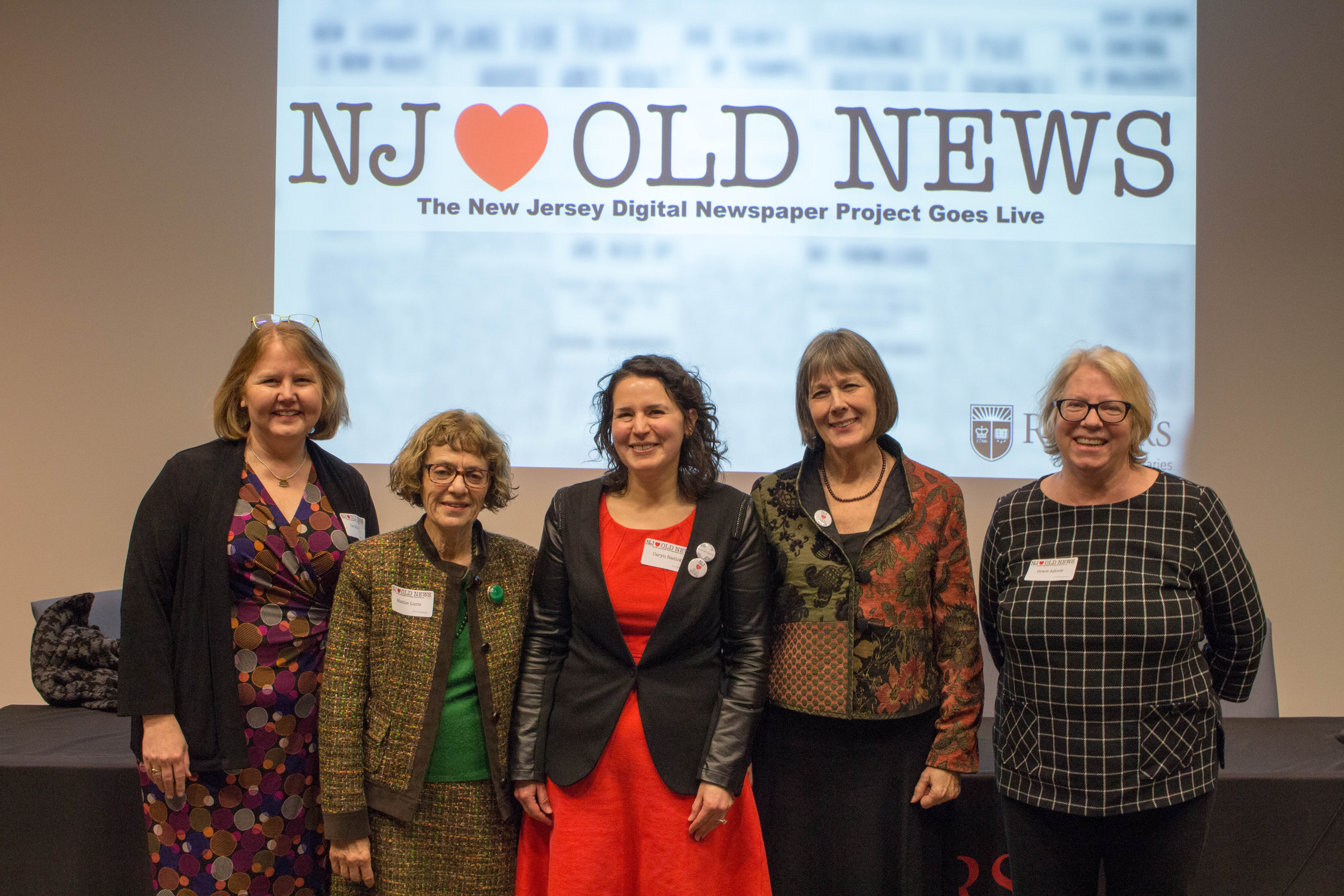
The New Jersey Digital Newspaper Project Goes Live
The New Jersey Digital Newspaper project celebrated a major milestone last month when the first batch of pages from the Perth Amboy Evening News became available to the public via the Library of Congress website Chronicling America. Colleagues from the Libraries, the New Jersey State Library, New Jersey State Archives, and the New Jersey research community gathered at Alexander Library to commemorate the occasion with presentations, tours of the project facilities, and of course—cupcakes!
Dee Magnoni, Maxine Lurie, Caryn Radick, Mary Chute, and Grace Agnew at the NJDNP launch celebration.
A nice crowd was on hand to learn about the project’s public launch.
Giovanna Ligato-Pugliese and Jacob Paul were happy to give attendees tours of the project office and demonstrations of equipment.
A case display illustrated the source material for the digital versions of the newspapers now available online.
The cupcakes were “black, white, and read all over!”
During the proceedings, state librarian Mary Chute read a letter on behalf of Congressman Frank Pallone, which said in part: “I would like to commend the New Jersey State Library, Rutgers University Libraries and the New Jersey State Archives for undertaking this important project. Here in New Jersey we have a rich history and innumerable contributions in science, innovation, politics and the humanities. The digitization of these newspapers will provide user friendly access of these historical records to all individuals across the globe. I am proud that The Perth Amboy Evening News is the first New Jersey newspaper available through this invaluable project.”
Paul Robeson Library’s John Maxymuk has authored over a dozen books about the history of the NFL in addition to an entry on professional football in the Encyclopedia of Greater Philadelphia? In advance of Super Bowl LII this weekend, we caught up with John to discuss his love of football and penchant for research—and, of course, whether the Eagles stand a chance against Tom Brady and the Patriots.
A New Look for the IJS
The new IJS logo.
The Institute of Jazz Studies recently unveiled a new logotype, which you can view on our visual identity resources website. Congrats to our colleagues at the IJS for adopting this fresh new look!
What’s Happening is the Libraries’ monthly events enewsletter.
Do You Know What’s Happening?
Did you know we publish a monthly enewsletter of events happening around the Libraries? If not, check out this month’s edition to see what you’ve been missing and feel free to subscribe!
Do you have an upcoming exhibit, workshop, or other event that you’d like the world to know about? Submit it at https://www.libraries.rutgers.edu/events and we’ll include it in forthcoming issues of the newsletter.
The Jersey Collective exhibit at Robeson Library. Credit: John Powell.
Closing Soon: Catch These Displays while You Still Can!


 In early October the Society of American Archivists (SAA) and the Music Library Association (MLA) co-published a new open-access ebook, Archival Description of Notated Music (ADNM), co-authored by the MLA Working Group for Archival Description of Music Materials, which I had the pleasure of co-chairing with Dr. John Bewley, a Rutgers alumnus and the retired associate librarian/archivist at the University at Buffalo Music Library. Working Group members also included Sofía Becerra-Licha, lead archivist at the John F. Kennedy Center for the Performing Arts; Maristella Feustle, music special collections librarian at the University of North Texas; Vincent J. Novara, head of the Acquisitions and Processing Section in the Music Division at the Library of Congress; Matthew Snyder, archivist at the New York Public Library; and Karen Spicher, manuscript cataloger and processing archivist at the Beinecke Rare Book and Manuscript Library at Yale University.