Category: Posters

  • Teach and Tell: Access Services’ Role in the Big Picture [MLA Poster]

    Author: Yini Zhu
    Author: Yini Zhu

    Objectives

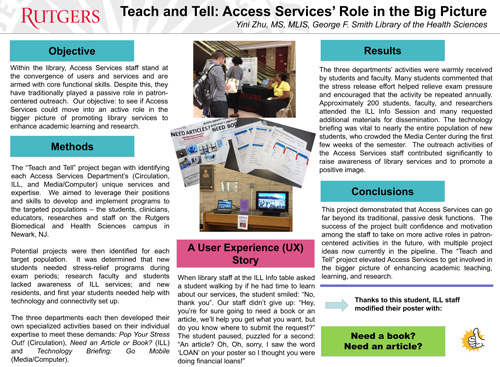
    Within the library, Access Services staff stand at the convergence of users and services and are armed with core functional skills. Despite this, they have traditionally played a passive role in patron-centered outreach. Our objective: to see if Access Services could move into an active role in the bigger picture of promoting library services to enhance academic learning and research.

    Methods

    The “Teach and Tell” project began with identifying each Access Services Department’s (Circulation, ILL, and Media/Computer) unique services and expertise. We aimed to leverage their positions and skills to develop and implement programs to the targeted populations – the faculty, students, clinicians, educators, and staff on the Rutgers Biomedical and Health Sciences campus in Newark, NJ.

    Potential projects were then identified for each target population. It was determined that new students needed stress-relief programs during exam periods; research faculty and students lacked awareness of ILL services; and new residents, and first year students needed help with technology and connectivity set up.

    The three departments each then developed their own specialized activities based on their individual expertise to meet these demands: Pop Your Stress Out! (Circulation), Need an Article or Book? (ILL) and Technology Briefing: Go Mobile (Media/Computer).

    Results

    The three departments’ activities were warmly received by students and faculty. Many students commented that the stress release effort helped relieve exam pressure and encouraged that the activity be repeated annually. Approximately 200 students, faculty, and researchers attended the ILL Info session and many requested additional materials for dissemination. The technology briefing was vital to nearly the entire population of new students and crowded the Media Center during the first few weeks of the semester. Via these outreach activities, the Access Services staff contributed significantly to raising awareness of library services and promoting a positive library image.

    Conclusions

    This project demonstrated that Access Services can go far beyond its traditional, passive desk functions. The success of the project built confidence and motivation among the staff to take on more active roles in patron-centered activities in the future, with multiple project ideas now currently in the pipeline. The “Teach and Tell” project elevated Access Services to get involved in the bigger picture of enhancing academic teaching, learning, and researching.

  • Adding More Tiles to the Mosaic: The Library and EBM in a Time of Curriculum Revision [MLA Poster]

    Authors: Margaret Rush Dreker, Roberta Bronson Fitzpatrick
    Authors: Margaret Rush Dreker, Roberta Bronson Fitzpatrick

    Objectives
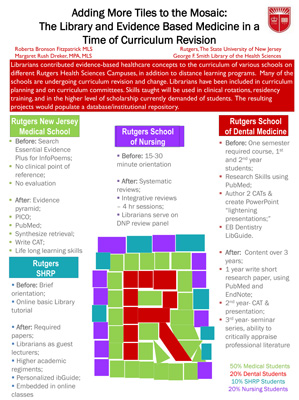
    Librarians contributed evidence-based medicine curriculum. The CATs project provides instruction on basic EBM concepts: the evidence pyramid and levels of evidence, formulating a searchable clinical question, using the PICO format, searching PubMEd. Articles were read, synthesized, and turned into a CAT. These skills will be used in clinical rotations and residency. The resulting CATs would populate a database/institutional repository.

    Methods
    Medical students enrolled in their “Foundations” course were simultaneously enrolled in an “Evidence Based Medicine” Moodle course. Module 2 covers developing searchable clinical questions, breaking them into a PICO format and selecting from among the available library resources when conducting a search. Librarians have embedded exercises within the course. Students are divided into small groups and paired with a partner. The small groups convene in the library for one hour for more focused training on searching PubMed, as well as a quick review of concepts covered in the Moodle course. Students work with their partner to write a focused clinical question, break it down into PICO, connect to PubMed, execute a search, identify at least four relevant articles. They obtain the articles, read and synthesize them, and write a CAT with a clinical bottom line.

    Results
    An online form was developed and is used to write the CATs, which are submitted directly to the library and to the course director. The completed CATs are presented by each pair to their small group and preceptor. Medical school faculty preceptors have commented on the quality of scholarship exhibited, students’ facility with PubMed, and their understanding of article types and the PICO format exhibited during small group discussions. The library developed a relational database to house the completed CATs but is in discussion to import them into RUCore, the institutional repository.

    Conclusions
    There is a high degree of interest in this project. Students feel that they are developing a skill that has application for the duration of their career. Faculty and administrators are enthusiastic about the fact that this is not EBM in a vacuum, but for lifelong learners.

  • Counting the Colorful: The Events Assessment Task Force [MLA Poster]

    Authors: Roberta Bronson Fitzpatrick, Leslin Charles, Ann Watkins, Zara Wilkinson, Megan Lotts
    Authors: Roberta Bronson Fitzpatrick, Leslin Charles, Ann Watkins, Zara Wilkinson, Megan Lotts

    Objectives
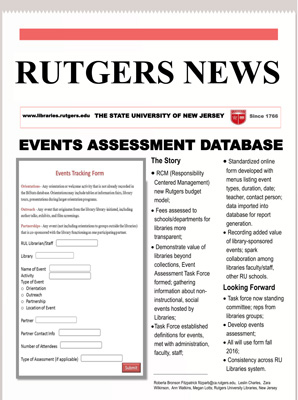
    With the advent of RCM, Responsibility Center Management, as a new financial/budgeting model, fees assessed to schools or departments are more transparent. To demonstrate the value of the libraries beyond collections, an Events Assessment Task Force was formed to gather information about the non-instructional, more social, events hosted by the university libraries.

    Methods
    The Task Force began by establishing definitions for what constituted an “event”. Members solicited suggestions for event types, such as art shows, Lego building contents, book clubs, exhibits, guest lectures, health information fairs, stress buster activities, and more. There was discussion about the information that was useful to capture for each event, such as number attending, co-sponsorship with another group, time/date/location. An online form was developed. It has drop-down menus which list event types, duration, and other common elements, which make recording easier. The data will be imported into a database capable of report generation. The database is modeled after one currently in use for collecting bibliographic instruction data and reflects both AAHSL and ARL needs At each step of the process, Task Force members solicited comments from library faculty and staff who were involved with various events.

    Results
    As of this writing, the Events Assessment Task Force presented both the data collection form and the events database to USC, the User Support Council. Both were approved. The next step is to conduct local training sessions to familiarize library faculty and staff with the form and the database in order to acquaint them with all involved procedures and to gain their participation in the data collection.

    Conclusions
    In the process of developing the online data collection form and the database, it was interesting to note the many types of events hosted by Rutgers University Libraries. By recording the added value that the libraries bring to the university, it may spark more collaborative ventures among members of the libraries staff and with other schools/departments within the university.


  • Library Services and Cultural Competency in Health Professions Education and Patient Care [MLA Poster]

    Authors: Misa Mi, Yingting Zhang
    Authors: Misa Mi, Yingting Zhang

    Objectives

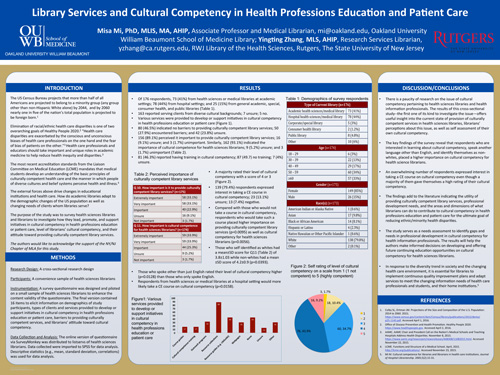
    This study investigated how health sciences libraries provide services to lead, promote, and support initiatives in cultural competence in health professions education or patient care and to examine health sciences librarians’ opinions on cultural competence in relation to library services and professional development. The study serves as needs assessment for our goal to develop a continuing education course on cultural competency for health sciences librarians.

    Methods

    This is a quantitative research design. Data has been collected with a survey questionnaire including eliciting demographic information, addressing health sciences libraries’ status in provision of culturally competent services and librarians’ perceptions of the importance of cultural competence. The questionnaire was pilot tested with a convenience sample of health sciences librarians to enhance the validity and then administered via SurveyMonkey to MEDLIB-L subscribers of the Medical Library Association. Descriptive statistics were used to analyze the collected data.

    Results

    The survey results revealed that most of respondents (156, 89.1%) indicated the importance of provision of culturally competent library services. The majority of respondents (162, 93.1%) perceived the importance of cultural competence for health sciences librarians. 81 (46.3%) respondents reported to have training and 87 (49.7) indicated no past training experience in cultural competence. When asked if they were interested to take a CE course in cultural competence, 139 (79.4%) expressed their interest.

    Conclusion

    The research findings contributed to our understanding what types of library services are provided to develop or support cultural competency initiatives and how health sciences librarians perceive cultural competence for librarians. The results are useful for developing future continuing education courses.

  • SHARE the Info: Spreading Health Awareness with Resources and Education: A National Network of Libraries of Medicine-Funded Program [MLA Poster]

    Authors: Yini Zhu, Mina Ghajar, Ermira Mitre
    Authors: Yini Zhu, Mina Ghajar, Ermira Mitre

    Objective

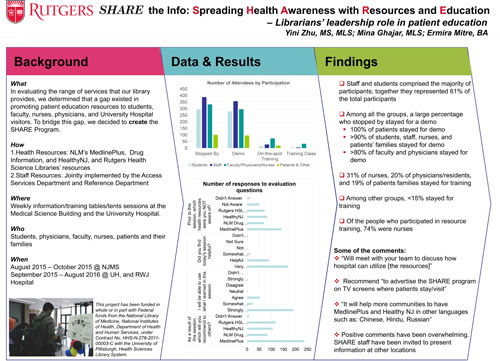
    Despite the availability of various online patient education resources, the majority of physicians have not incorporated them into practice. The SHARE Program’s objective is to reach out to physicians, faculty, students, nurses, patients and their families to raise the awareness of consumer health information resources available through the National Library of Medicine and the Health Sciences Libraries at Rutgers University.

    Methods

    In evaluating our library services, we determined that a gap existed in promoting patient education resources. To bridge this, we decided to create the SHARE Program (Spreading Heath Awareness with Resources and Education).

    First, we determined that this program should be jointly implemented by the Access Services and Reference departments due to their respective strengths in knowledge of library services and research instruction. Next, we agreed that our efforts should focus on promoting NLM’s MedlinePlus health and Drug Information, and HealthyNJ due to their comprehensive and authoritative information.

    Finally we determined the format for SHARE would be weekly tables/tents at the Medical School and the University Hospital where we would conduct demonstrations and trainings and distribute specially designed SHARE Card, instructional and health literacy materials. Evaluation form and log sheet would be collected for program assessment and analysis.

    Results

    SHARE launched on August 26, 2015 and is slated to end on August 30, 2016. Evaluation forms and log sheets are being collected at each session to assess participant feedback and the resulting data are being analyzed and evaluated as they are collected. A detailed program report will be submitted to the NN/LM Grant Review Committee before May 14, 2016, and, if this topic is selected for MLA 2016, the results will also be submitted and included on the poster.

    Conclusion

    As this is an ongoing project, a conclusion is not available at this time. All collected data will be analyzed prior to MLA 2016, and a conclusion will be drawn by then.

  • Introducing EBM Concepts to Academic Librarians: A New Model for Instruction [MLA Poster]

    Authors: Roberta Bronson Fitzpatrick, Margaret Rush Dreker
    Authors: Roberta Bronson Fitzpatrick, Margaret Rush Dreker

    Objectives
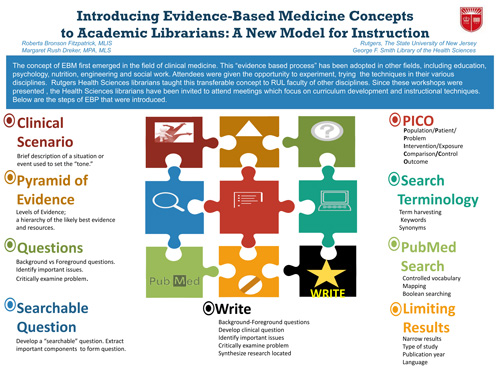
    A poster describing a CAT-writing project was presented at the Rutgers University “State of the Libraries” meeting in 2014. It gained the attention of the Chancellor. At the conclusion of the discussion, he urged that transferrable concepts be taught to other RU librarians and incorporated within their instructional programs. A workshop was designed and presented in June and November 2015.

    Methods
    Specific elements of the CATs sessions were deemed to be transferrable to those providing instruction to students in the sciences and social sciences, as well as education and other disciplines. These include: foreground/background questions; writing a focused question; breaking a search question into the PICO format to assist with term generation, and the evidence pyramid. The workshop covered the CATs project as an example of a type of complete assessment, in that students must use the component skills to write their own CAT (Critically-Appraised Topic). Each of the noted transferrable concepts was covered. Attendees had time to come up with an example which would fit their subject audience and there a general discussion portion where ideas were exchanged on how to best incorporate these new skills into instructional programs.

    Results
    The workshops resulted in offers to teach collaboratively outside of our home campus. All attendees identified concepts which could be used directly so slightly modified to fit various disciplines. For example, article types listed in the evidence pyramid did not fit every discipline but librarians considered other types of resources, such as dissertations/theses and web sites/pages were listed in this format.

    Conclusions
    Rutgers University had few health sciences programs prior to 2013. Teaching the workshops was a good vehicle for informing our new colleagues about how instructional sessions are approached in the health sciences. It also allowed us to become part of the cadre of instructors and to be invited to attend meetings which focus on curriculum development and instructional techniques.

  • Librarian Participation in “Hands-On” Evidence-Based Medicine Rounds with Pediatric Residents [MLA poster]

    Author: Pamela Hargwood
    Author: Pamela Hargwood

    Objectives:

    To describe the successful implementation of a project to increase the ability of pediatric residents at a medical school to practice evidence based medicine (EBM) in real time; examine if patient care is supported or changed based on the resident’s findings; and discuss the role of the medical school librarian in this process.

    Methods:

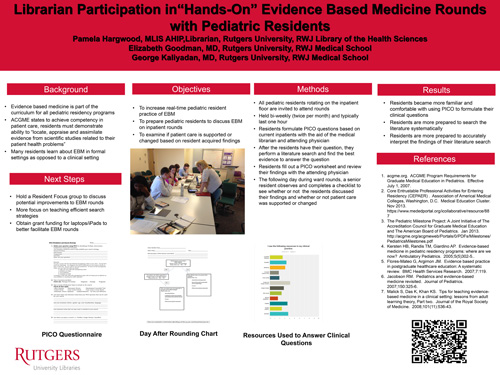
    In July 2014, the Department of Pediatrics implemented “hands-on ” inpatient EBM rounds to help pediatric residents learn how to better formulate clinical questions, locate relevant literature, and apply their EBM findings to patient care in “real time”. These hour long rounds take place bi-weekly and are held on inpatient wards. All pediatric residents rotating on the inpatient team are invited to attend the EBM rounds. The medial librarian and two pediatric faculty members assist the residents with formulating clinical questions based on the inpatients they are currently following and searching for an answer to their question. The residents summarize their search and findings using a PICO worksheet. The following day the residents are evaluated on whether or not they presented their EBM findings on attending rounds and if patient care was supported or changed based on these findings.

    Results:

    The pediatric residents became more familiar and comfortable with using PICO to formulate their clinical questions. They also are more prepared to search the literature systematically and interpret the findings of their literature search.

  • Reflective Practice for Professional Development through a Collaborative Systematic Review Project [MLA poster]

    Authors: Misa Mi, Jie Li, Lin Wu, Wendy Wu, Yingting Zhang
    Authors: Misa Mi, Jie Li, Lin Wu, Wendy Wu, Yingting Zhang

    Objectives

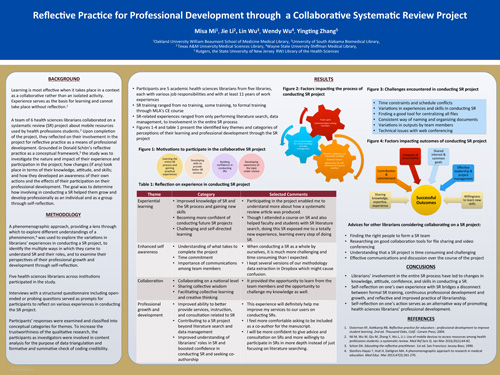
    Learning is most effective when it takes place in a context as a collaborative rather than an isolated activity. Experience serves as the basis for learning and cannot take place without reflection. We formed a team of 6 health sciences librarians to conduct a collaborative systematic review (SR) project. Upon completion of the project, we reflected on our involvement in the project for reflective practice as a process of professional development. Grounded in Donald Schön’s reflective practice as a conceptual framework, the research study is to investigate the nature, impact of our participation in the project, how we came to understand our behavior, and how we developed an awareness of our own actions and the effects of our participation on our professional development. The goal is to understand what was involved in conducting a SR so that we can better understand how researchers would undertake a SR and hence serve them better.

    Methods
    A phenomenographic approach, which provides a lens through which to explore different understandings of a phenomenon, was used to explore the variations in which we experienced with the SR project, the multiple ways in which we came to understand SR, and the different roles we took in the process. Five health sciences librarians across different library settings participated in the study. Interviews were conducted with a structured questionnaire including open-ended or probing questions serving as prompts for participants to reflect on various experiences in the SR project. Participants’ responses will be analyzed with a qualitative approach to explore and capture a range of possible ways of conceptualizing and understanding what it took to undertake a SR. Responses will be classified into conceptual categories. To increase the trustworthiness of the research, the participants will be involved in the phenomenological analysis for the purpose of investigator triangulation.

    Results
    The participants have learned the entire SR process, and gained practical experiences with conducting a SR project. They have developed ability to provide better SR services, built confidence and developed awareness of the topic under review. They have also learned the importance of communications and collaborations among team members, sharing collective wisdom, and time commitment. In addition, they have improved understanding of librarians’ roles in SR and boosted confidence in conducting SR and seeking co-authorship.

    Conclusions
    Librarians’ involvement in the entire SR process have led to changes in knowledge, attitude, confidence, and skills in conducting a SR. Self-reflection on one’s own experience with SR bridges a disconnect between formal SR training, continuous professional development and growth, and reflective and improved practice of librarianship. Self-reflection on one’s action serves as an alternative way of promoting health sciences librarians’ professional development.