Ed conducted an annual Snapshot Day to document the people and activities of the library.
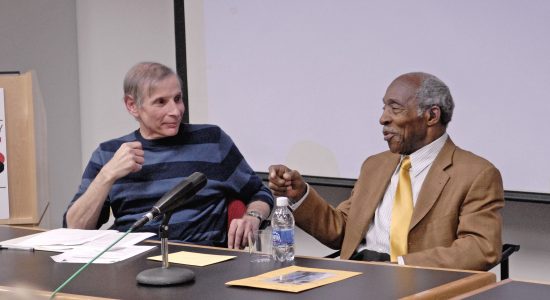
Ed and Joe Wilder participate in an IJS Roundtable in 2007.
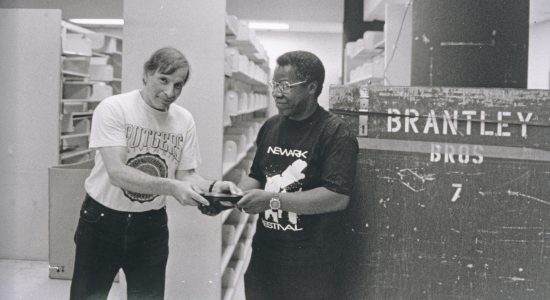
Ed (sporting some Rutgers gear!) and long-time colleague Vincent Pelote help move the IJS location in 1994.
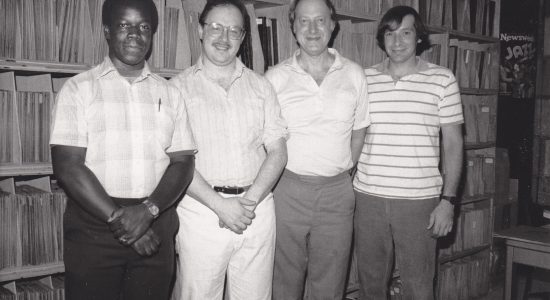
L-R: Vinny, Loren Schoenberg (of the National Jazz Museum in Harlem), Dan Morgenstern (former IJS Director), and Ed Berger, circa 1984.
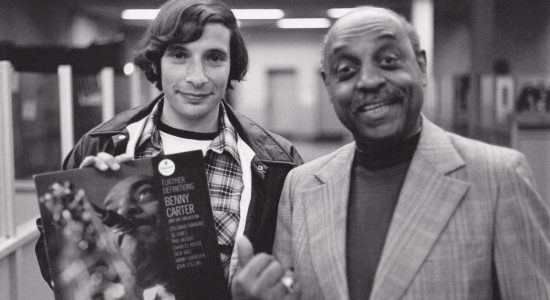
Throughout his time at IJS, Ed had a very close relationship with Benny Carter.
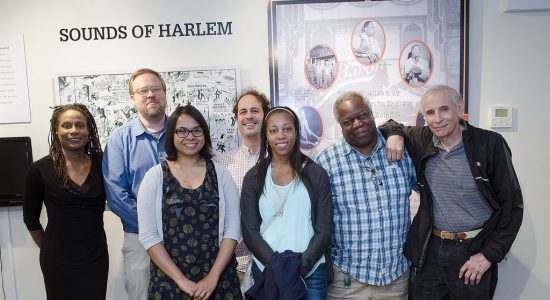
Ed poses with his colleagues and the 2016 Jazz Archives Fellows.
Recently Consuella Askew and Wayne Winborne sent around a note announcing that our colleague Ed Berger passed away suddenly and quite unexpectedly in January. Ed was a wonderful photographer and spent many hours documenting the spaces and faces of Dana Library and the Institute of Jazz Studies. Many of his photographs are posted on his Flickr site. Here, we take a moment to turn the camera back toward the photographer and offer a glimpse into his time and the people who he called colleagues and friends at the Institute of Jazz Studies.
Ed played a vital role in the growth and development of the Rutgers Institute of Jazz Studies where he filled a number of positions for nearly four decades. He was also an award-winning jazz writer and accomplished photographer, teacher, producer, and road manager.
A graduate of Indiana University with an M.L.S. from Rutgers, his most recent book was Softly, With Feeling: Joe Wilder and the Breaking of Barriers in American Music (Temple University Press, 2014), which received the Association for Recorded Sound Collections’ Award for Best Historical Research in Recorded Jazz in 2015. He was a frequent contributor to Jazz Times as writer and photographer and for many years served as co-editor of the Journal of Jazz Studies.
Berger taught at Jazz at Lincoln Center’s Swing University, and from 1979 to 2014 was co-host of Jazz from the Archives on WBGO-FM. He enjoyed a long association with jazz master Benny Carter, serving as Carter’s road manager for nearly two decades, as well as producing two Grammy-winning recordings for the saxophonist. Berger’s other publications include Free Verse and Photos in the Key of Jazz (2015, with Gloria Krolak); Benny Carter: A Life in American Music (2002, with Morroe Berger and James Patrick); Basically Speaking: An Oral History of George Duvivier (1993); and Reminiscing in Tempo: The Life and Times of a Jazz Hustler (1990, with Teddy Reig).
He was a beloved friend, colleague, mentor, raconteur, and a true lover of jazz and jazz musicians. His loss is devastating to all of us at the IJS and to the broader jazz community across the globe.
A public celebration of Ed’s life is being planned and will be announced at a later date.
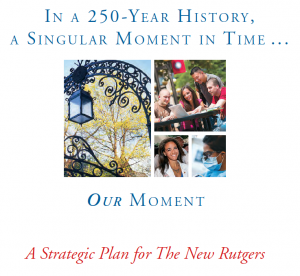
For the last few months, I’ve written about changes in the organizational structure of the Libraries as we clearly distinguish central vs. local functions, most recently talking about the role of the library directors in coordinating local services. It is easy to get lost in the details, so I think it is worth taking a step back and looking at what is driving this change. The 2014 Strategic Plan describes a vision for the University in the following way:
As one Rutgers, all of our campuses and units share common values, features, resources, and administrative and other centralized services. As distinct entities, however, the campuses and RBHS each have differentiated missions and future visions that emanate from this unified core. An important outcome of our planning process has been each campus’s and RBHS’s articulation of its own sense of self, each with unique elements of mission and future direction.
We are in the process of implementing this vision by developing an organization—structure, function, decision-making, communication, etc.—with a unified core that is responsive to distinct missions.
Something that has been clear to many of you, and is becoming clearer to me each day is that we—the Libraries—are a microcosm of the broader university. Just as the former executive vice president for academic affairs was responsible for New Brunswick and many of the central functions of the university, the former associate university librarian for research and instructional services was responsible for New Brunswick and many of the central functions of the Libraries. I could be wrong, but I think that the Libraries are the only academic unit that has central and local functions and, by extension, the only unit that is experiencing the full breadth and depth of these changes in roles, responsibilities, and culture.
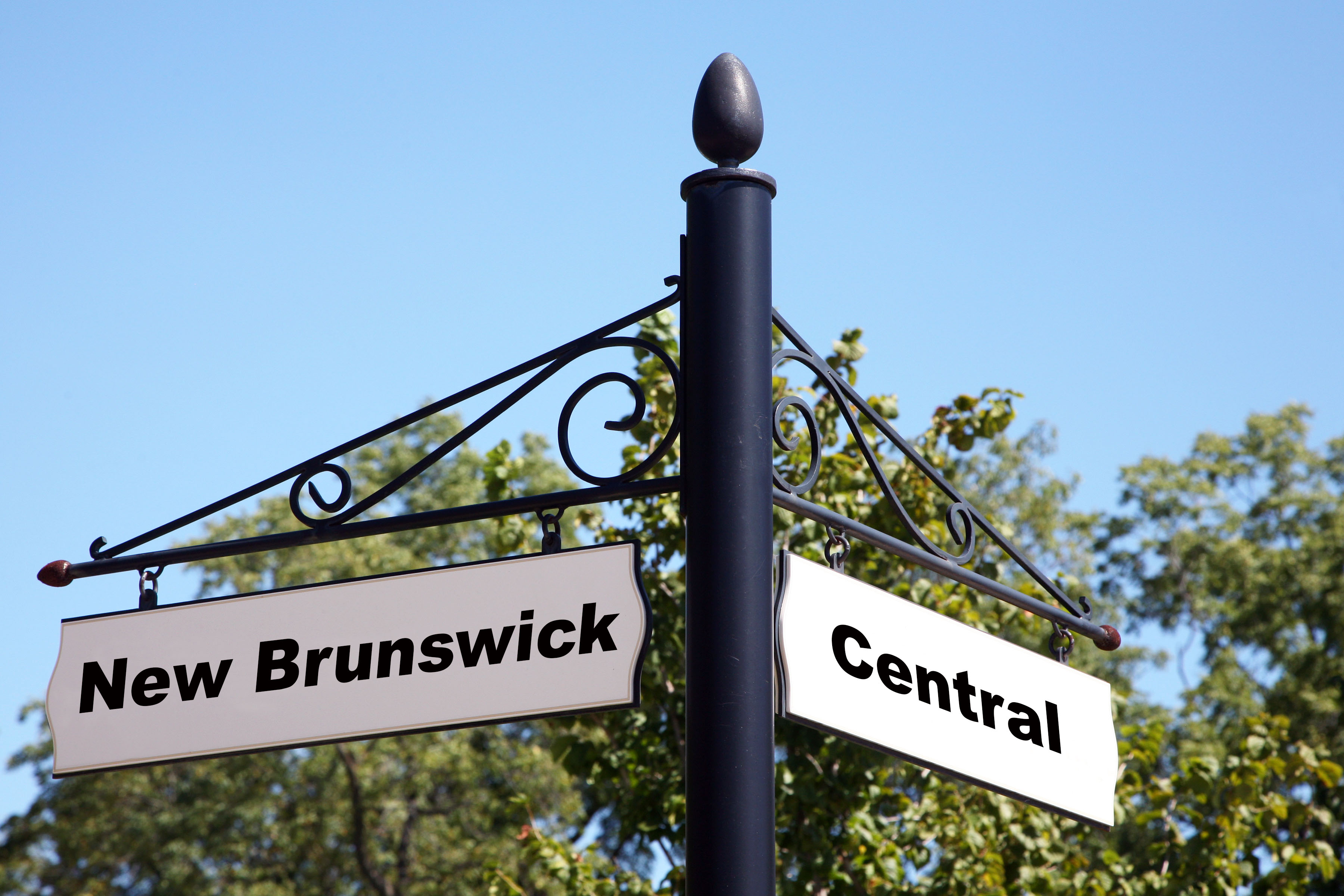
Recently, I had a day with an interesting sequence of meetings that highlights the parallel structure of University and Libraries and underscores how profound the organizational changes are. In the morning, I attended a meeting of the Rutgers–New Brunswick chancellor search committee. In the afternoon, I met with the AVP/director of New Brunswick Libraries search committee.
Throughout the chancellor search meeting, conversations returned to two main themes. The first broadly addressed the relationship between the chancellor and the central units. Members of the chancellor’s search committee spent time discussing the relatively new (and narrower) scope of the position. It was clear that search committee, primarily comprised of Rutgers–New Brunswick faculty, had not had a chance to internalize the implications of this change for decision-making. Throughout the meeting, the question, “Is that New Brunswick or is it central?”, was raised repeatedly as discussion returned to the role of the chancellor within the University. Several of the search committee members asked detailed questions about the relationship between the chancellor and central services such as the Office of Information Technology, the Libraries, and Facilities, and wondered aloud how the new chancellor would get things done if key elements of the infrastructure were not a part of the position’s portfolio.
These questions struck a chord for me because they are the same questions we’ve been circling and addressing in recent months as we carefully separated Research and Instructional Services and New Brunswick functions. We have created structures, most notably the Shared User Services department and the Library Directors Group, to coordinate work across the campuses. Even with all of this progress, there are some details that we will need to resolve. Just as the New Brunswick faculty expressed concern related to the ability of the new chancellor to affect change, I think there are still questions that need to be resolved about how each of our library directors gets things done for their campuses.
I already see the transformation. Chancellors and other stakeholders on campuses are working directly with library directors to request specialized services, resources, and partnerships. As this shift occurs, we need to be sure that our central services can respond. Some questions this raises for me include: How do we create clear lines of communication and accountability between central services (Collections, Technical and Automated Services, Budget and Finance, Communications, Development) and the library directors? What is the relationship between coordinating bodies (e.g., Collections Analysis Group, Discovery Task Force) and the library directors? What does this shift mean for our decision-making regarding the structure of the website, the function of discovery, the collection allocation process, and more?
Although we have made an immense amount of progress is establishing clearer lines of responsibility within the Libraries, I am not certain that we have all of the infrastructure in place to enable library directors to effectively address the unique needs of the campuses. In recent weeks, Cabinet has worked on a planning calendar to help us all schedule and better understand major milestones throughout the year. In providing a cross-departmental look at what is happening each month, the planning calendar identifies activities that rely on this infrastructure. It also highlights activities that require feedback and information from financial and administrative contacts at the universities. Hopefully this will improve workflow and empower the library directors to anticipate and troubleshoot issues that may arise.
This is about to change. Rutgers–New Brunswick recently announced a new identity, using the tagline of “America converges here,” drawn from President Obama’s historical commencement speech last year. The new chancellor will have to formalize and strengthen an identity for New Brunswick. Given the parallel structures of the libraries and the university, it is not surprising, therefore, that our new AVP/director of New Brunswick Libraries will face a similar challenge to establish an identity for the New Brunswick Libraries.
While I am on the topic, I want to spend a minute clarifying an issue that I know has cause substantial confusion. These changes are not happening becauseof RCM. RCM is the new budget model that is being established because of these changes. The definition of Rutgers’ special version of RCM, helps to operationalize the vision of four distinct entities that emanate from a unified core of values, features, and services.
That is a lot of simultaneous change! Needless to say, interesting days lay ahead for us all.
Our librarians are out there every year, making presentations, leading panels, writing articles – and it really does make a difference. Sometimes it’s a contribution to the field and sometimes the impact is much more personal.
In 2010, Connie Wu gave a talk in titled: “From a Patent Examiner to an Academic Librarian,” at Life Beyond Patent Information Session of International Patent Information User Group 2010 Annual Conference in Washington, DC. Six years have now passed, but she received the following letter in January:
Hi Connie,
I am a fellow PIUG member. I just wanted to let you know how much you inspired me when you gave a talk at a PIUG meeting about being a librarian. I think that was in 2009 or 2010. I was so inspired that I enrolled in Kent State University’s program in 2010. Since I work full-time at LexisNexis, it took me 6 years to complete the program plus an additional program in Information Architecture. I graduated from Kent State on December 16, 2016 with a dual MLIS and M.Sc. in Information Architecture degree.
Thanks very much! I hope to thank you in person someday.
The un-named Sender is a Global Content and Project Specialist for Copyright, E-Commerce, Patent, Trademark, Trade Secret at LexisNexis.
When I arrived at Rutgers, I was charged with clarifying central vs. local functions. In the October and November issues of The Agenda, I talked about changes in the organizational structure that (among other things) moved central and shared librarieswide functions from purview of the AUL for Research and Instruction to central units.
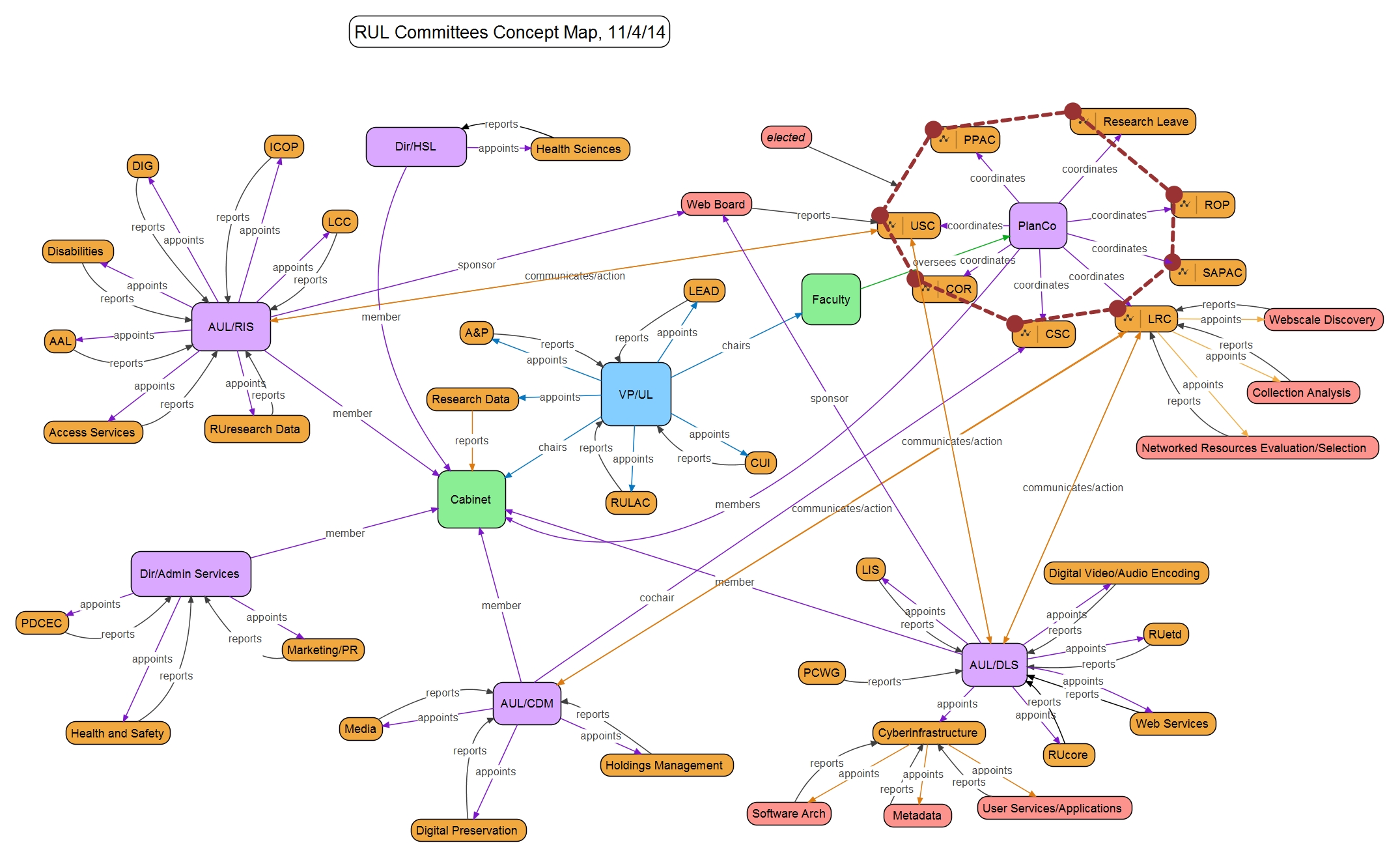
In December, Cabinet reviewed the Committee Concept Map—a now historical document developed in late 2014 to better understand decision-making responsibilities and flows in the libraries. The diagram showed many different types of groups, including committees, working groups, taskforces, etc. and their reporting relationships. During the review process, we discussed each group—what work it was assigned, whether that work was complete, where it falls within the current organization’s footprint, and who ultimately is responsible for the output of the group. As a result of this work, some groups were sunsetted or moved to new reporting structures. These outcomes were already communicated via the cabinet minutes.
Finalizing the review of the Committee Concept Map enabled us (among other things) to clarify a few more areas where the lines between central and local responsibility were not clear—especially in the area of public services. Coordination of shared public services—LCC, Ask a Librarian, and Webscale Discovery—were all moved to Shared User Services (SUS). An additional 3 groups on the Committee Concept Map—Access Services, Disabilities, and ICOP—did not fit under the SUS umbrella. Instead, the work of these groups needs some level of central coordination even though their functions are local and the responsibility of the library director.
Access Services, for example, used to report to the AUL for research and instruction in her central coordinating role, even though they were addressing local policies (e.g., bulletin boards). While the committee itself has representatives from many locations, this reporting structure essentially meant that central was creating policies to govern local services and spaces (a perception further complicated by the former structure where the AUL for research and instruction was also the director of New Brunswick Libraries).
Under the new system, Access Services, along with Disabilities and ICOP, will report to a newly formed Directors Group that is composed of the library directors—Consuella Askew, Katie Anderson (in her role as interim director of Robeson Library), Judy Cohn, and Jeanne Boyle (in her role as interim director of New Brunswick Libraries)—and Rhonda Marker, the director of shared user services. This will align the important work of these committees more closely with their local units and clarify the director’s role in decision-making, while ensuring two-way flow of information about the needs and resources required for the work.
Since I know there have been a lot of questions, it is worth spending a little more time talking about the purpose and goals of the Directors Group. The directors convene to address local concerns, discuss shared issues and how they can work together to establish best practices and avoid duplicating effort. This group does not extend the responsibility or authority of the Library directors. Instead, it provides a means for Library directors to work together collectively to solve problems and to benefit from each other’s experience. Ultimately, each Library director is responsible for providing the vision, leadership, and management necessary to deliver collections, services, and spaces that are tailored for their local community.
Some of the comments that I heard noted that the Directors Group seemed to have taken on many of the responsibilities that USC used to have. As I think about the changes that are occurring at the University-level, and of my charge to clarify local vs. central function, I realize that the comments accurately reflect the changes in the libraries. In the past, decisions related to public services occurred centrally with a goal of developing the most cost-effective library system possible. Rutgers Libraries had a long history of successful internal collaboration. Now, each campus expects services that are tailored to meet local needs. Directors are being held accountable on their campuses for ensuring that the library system provides services (and collections) that directly support local initiatives and programs. The shift from a large, representative decision-making body to a more federated model that favors local decision-making is necessary to support the changes within the broader University context.
Before ending, I do want to acknowledge the hard work that went into finalizing the Committee Concept Map. We originally worked from a single-page document with over 40 administrative and faculty groups. On the administrative side, we now have a structured list 17 active committees, taskforces, and working groups with clearly defined “homes” in the Libraries. The faculty have also made substantial progress refining their committee structure. This project required a lot of heavy lifting and input from our colleagues, so please accept my thanks for your efforts.
If you have additional questions about these changes, please speak with your AUL or Director.
During the Fall 2016 semester, the Art Library distributed a unique coloring book to introduce students to the library’s services and spaces. Drawing on her fine art and graphic design skills, Megan Lotts illustrated and wrote the Art Library Coloring Book to connect in a creative and fun way with students and to educate individuals about the resources and possibilities available at the Art Library. I touched base with Megan about the inspiration behind this project and the response so far.
Jessica Pellien: What inspired you to start this project?
Megan Lotts: There are several reasons I undertook this project: I’m always looking for ways to connect with the departments that I liaise, and 3/4 of the individuals that I liaise to are makers, so this is a great way to connect with them. I’ve also been researching a fair amount about play and how to incorporate playing educational experiences inside and outside of the classroom. I would also say that I LOVE to color. I’m an only child, so I’ve spent a lot of time coloring, making, etc. And lastly, I’m tired of hearing students talk about how boring their one shot bibliography session was. I’ve never heard anyone walk away from a library session saying, man life is going to be great now that I know to use the EBSCOhost database. I believe it’s important to share in a conceptual way what the libraries are about & what can happen in a library.
JP: What was the process like to create the coloring book?
ML: I came up with an idea of what I thought patrons should know about the Art Library. Then I began making drawings, based on the space. After the initial drawings I worked with a variety of individuals, including faculty, students, and staff at Rutgers, as well as colleagues from other universities to fine tune the coloring book. I also worked with New Brunswick libraries administration to get approval and funding for the project and with the communications department on proofreading and the placement of the Libraries’ logo.
JP: How did your background in art help you?
ML: I’ve been an artist for over 20 years, trained as a painter, but I would consider myself a conceptual or installation artist, because I generally make site specific works, or conceptual projects that engage the user. In the case of the Art Library coloring book, the viewer or participant add the color to the artworks.
JP: Did this project require any special skills or resources?
ML: I used, pen, paper, and when needed I referred to images of the library I had taken or to the physical space. To put the book together, I used Microsoft publisher, because that was a program that I knew the Libraries’ printing department would be able to work with.
JP: How did you promote the coloring book to your users?
ML: All total, we printed 500 booklets and we also purchased small crayon packets which I labeled with stickers. We hosted a free, public pop-up making event in October at which we handed out coloring books and crayons. We also had some snacks to further entice people to participate. We encouraged users to share their coloring with us on social media, using the hashtag #RutgersColoring. We posted pages from coloring books, as well. Rutgers Today made a video about the coloring book and there were a lot of positive responses on social media from other Rutgers and library groups.
JP: How has the response been so far?
ML: I work in a very organic fashion and I never assume that a project I undertake will have a positive impact. However, I can report, that since I started this project I have had nothing but positive feedback from faculty, staff, and students. Many individuals have indicated they would like a similar coloring book for their library or campus department and have asked me how they would go about making one.
If you have a unique project to share, please let us know. We’d love to feature it in an upcoming issue of The Agenda.
The Libraries’ Digital Humanities Working Group, with the support of Integrated Information Systems, just launched an informal digital publishing service offering two popular open source platforms: WordPress and Omeka. Both are relatively easy to learn, and allow users to develop digital publishing skills, such as the integration of texts, images, and multimedia, digital citation practices, and digital collaboration on course projects and informal research in an online environment.
WordPress and Omeka are both used for digital publishing, although they have different strengths. WordPress is widely known as a blogging platform. As the name implies, it is a text-centric application, even if themes and plugins greatly extend its appearance and functionality. Omeka excels at the presentation of small to medium-sized digital collections, which can then be curated to create digital exhibits integrating text and media. Dublin Core metadata connect items to their presentation in collections and exhibits, ensuring that context and provenance are not lost. Omeka was created by the Center for History and New Media at George Mason University.
Libraries faculty and staff and Rutgers graduate students and faculty in humanities and adjacent fields (meaning interdisciplinary research with a humanist twist) may request a site in WordPress, Omeka, or both. Potential users should contact their Digital Humanities library liaison to request a site. The liaison for Camden is Zara Wilkinson; for New Brunswick, Francesca Giannetti; and for Newark, Krista White (for Rutgers-Newark) and Bob Vietrogoski (for RBHS). In the first phase of this service, priority will be given to users whose projects integrate Libraries resources.
Many Rutgers librarians already use one or both of these applications. Laura Palumbo shares news on important resources in scientific disciplines at ChemInformer. Ryan Womack posts regular reflections on the data librarianship profession at RyanData. Kayo Denda created the blog of the Margery Somers Foster Center to provide an informal publication venue for student interns. Christie Lutz and other Special Collections colleagues write about rare and unique New Jerseyana at What Exit? And The Agenda newsletter itself is published in WordPress! The following three case studies demonstrate how these platforms can be used in support of library and scholarly work.
Pedagogy and Professionalization
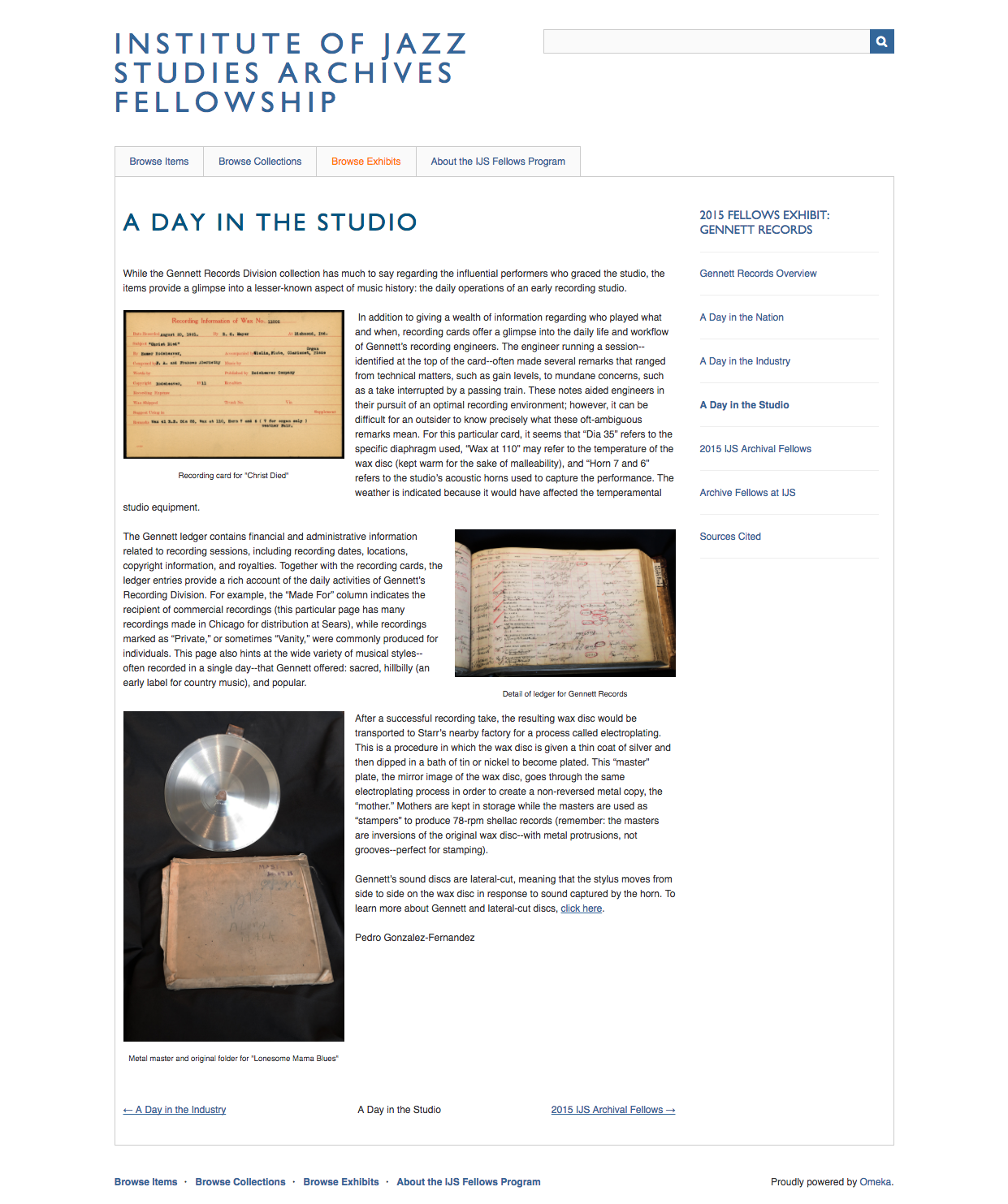
A section of the exhibit on Gennett Records on the IJS Archives Fellowship site.
The Institute of Jazz Studies Archival Fellowship Program, instituted in 2010, supports the professional development of early career archivists and is dedicated to promoting diversity in the field of archives. The Institute of Jazz Studies (IJS) has its home in the John Cotton Dana Library at Rutgers–Newark. Krista White, the digital humanities librarian at the Dana Library, works beside IJS archivists Elizabeth Surles, Angela Lawrence, and Tad Hershorn; IJS Fellowship Program coordinator Ed Berger; and current associate director Adriana Cuervo in mentoring the IJS Archives Fellows through the process of archiving a single, small collection each year.
Krista White spearheads a digital project for the fellows each year and has used Omeka for the last two years. White chose Omeka because it is free and open source. Many archives and cultural institutions need to establish an online presence, but may not have the resources to produce expensive digital exhibits. By using Omeka as a learning tool, the fellows gained hands-on experience designing digital exhibits, evaluating copyright and intellectual property issues, and administrating metadata for public display in an online environment. Furthermore, exposure to open source tools provides a way for IJS Archives Fellows to build value-added expertise in creative digital solutions.
Project Outreach and Communication
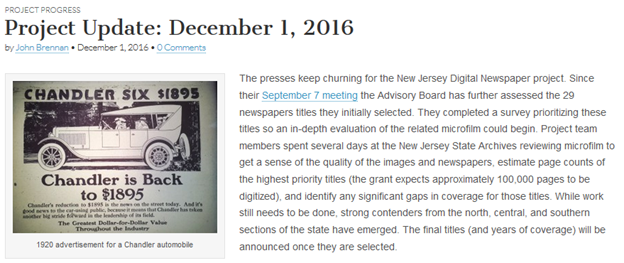
A project update on the New Jersey Digital Newspaper Project blog.
In late July, Rutgers University Libraries learned that they, the New Jersey State Library, and the New Jersey State Archives had been awarded a National Endowment for the Humanities grant to digitize New Jersey newspapers as part of the National Digital Newspaper Program. The project team wanted to quickly establish a presence for the project and did so by starting the “New Jersey Digital Newspaper Project” blog using WordPress. The blog is administered by Isaiah Beard, John Brennan, and Caryn Radick and includes content provided by project team members.
The blog format lets the project team provide different types of information in one place including status updates, information about the partners, project staff, and advisory board, and provides a contact form for readers. Using a WordPress blog also allowed the project team to share password protected information with the Newspaper Project Advisory Board, who have helped guide the selection process.
First and foremost, the blog serves as a way to share news of the project. Currently, the partners are working to identify newspapers and learning the processes and procedures of the work involved in digitizing these newspapers for the Library of Congress Chronicling America Project. The blog has detailed various trips and meetings for getting these underway. As the newspapers are digitized, the blog will also let the project team share stories of interest from New Jersey history and provide further updates about progress.
Digital Editing and Reconstruction
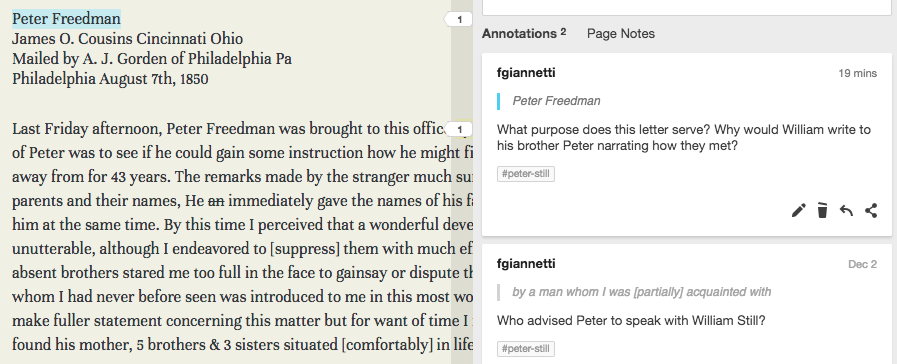
Digital annotations to William Still’s letter, dated August 7, 1850.
Francesca Giannetti is creating a digital edition of the Peter Still Papers, a small manuscript collection held in Special Collections and University Archives. These manuscript letters have already been published in RUcore; a primary goal of the digital edition is to provide digital full text transcriptions. Giannetti is working with Aresty research assistants to transcribe and encode the letters using the Text Encoding Initiative (TEI) framework of XML. The TEI allows keyword searchability across the letters, and also provides structured data that will allow future researchers to query the letters for names, places, and dates. This Omeka site will include lightly edited HTML transcriptions of the letters, while a link included in the relation field takes the reader to a more diplomatic style transcription with original spellings and line breaks preserved, and presented alongside expandable thumbnails of the page images. The Omeka site also features a hypothes.is annotation layer (right sidebar), which could serve as the basis of group digital annotation exercises in a digital or public history course. A next step for this project will involve finding faculty collaborators in history and American studies to bring these primary documents into the classroom for study and further research.
If you have questions about how to get started using WordPress or Omeka in your work, or have comments on any of the projects mentioned in these case studies, please write to the Digital Humanities Working Group.
-Francesca Giannetti, Caryn Radick, Krista White, Bob Vietrogoski, Zara Wilkinson, Ron Jantz, Fengzhi Fan, and Tibor Purger
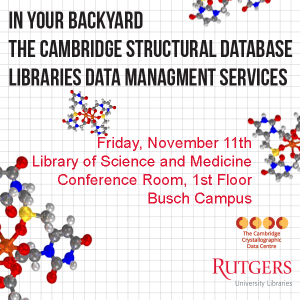
The New Brunswick Libraries Data Outreach Team held a successful workshop for students and faculty on Data Management Services available through the Libraries, and introduced users to the Cambridge Structural Database, a database of crystal structures curated by the Cambridge Crystallographic Data Centre (CCDC). The workshop took place at the Library of Science and Medicine, and was attended by students and faculty from the Chemistry and Chemical Biology department, the Center for Integrative Proteomics Research, several Engineering departments, and the School of Pharmacy. Presentations were given by Dr. Amy Sarjeant, a crystallographer and Education and Outreach Manager for the CCDC, and Laura Palumbo, who represented the NBL Data Outreach Team. The workshop was a collaboration between the New Brunswick Libraries and the CCDC, who generously provided lunch for the attendees. Feedback from the session was positive, with attendees citing new knowledge of the Libraries data services and resources.
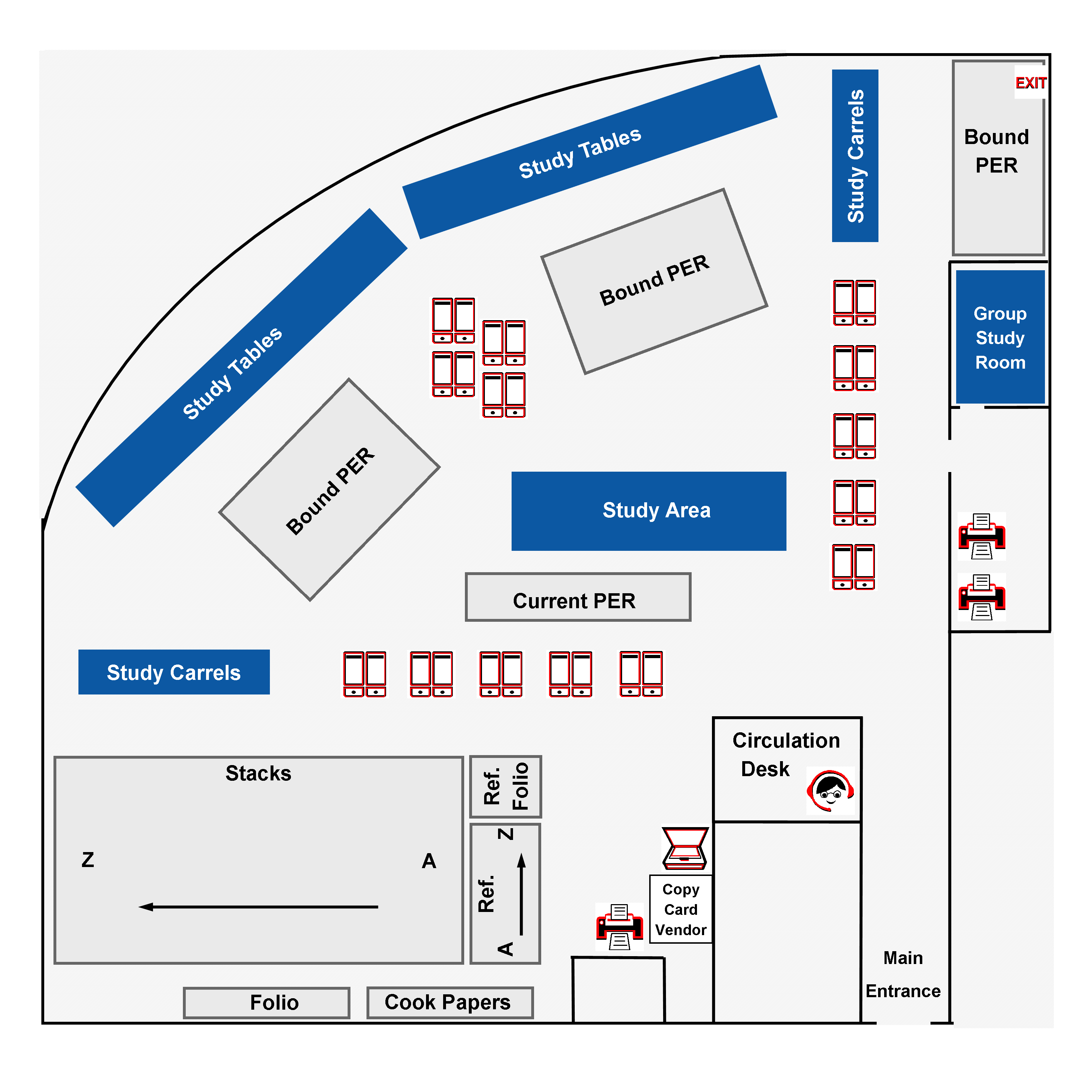
What Library is this?
New Up-to-date Maps for Every Library
Thanks to some incredible teamwork led by Robert Krack, designer Mary Ann Koruth, Devin Gingery, Soo Lee, and Sam McDonald, we now have online maps for every Rutgers library available on both our main website and our mobile site. Access these maps at http://www.libraries.rutgers.edu/maps_directions.
In Case You Missed It…
What an exciting and energizing time to be a librarian with the swearing-in of Dr. Patty Brennan as Director of the National Library of Medicine and the subsequent swearing-in of Dr. Carla Hayden as the Librarian of Congress earlier this fall. If you weren’t able to view the ceremonies live, the archived versions of the webcasts are available here.
My message this month is simple. I wish you all the happiest of holidays and the joy of the New Year as we enter this festive season.
As you all know, 2016 has been an incredibly productive and busy year and I am grateful for all of your efforts in moving the Libraries plans and priorities forward. In a few weeks, we will circulate our annual report which paints a vibrant picture of our accomplishments of the last 12 months. The theme of the annual report is “Transform,” which is a nod to the internal changes the Libraries have undertaken in 2016, as well as a reflection of the transformative effect our activities have on our students, faculty, and the university at large. We have truly made a difference this year and our good work will continue in the coming months.
I hope you enjoy time with your family and friends this month and look forward to seeing all the good things 2017 brings our way.
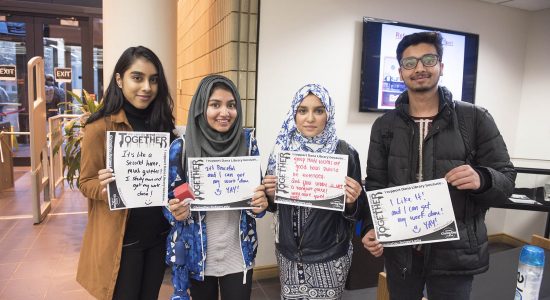
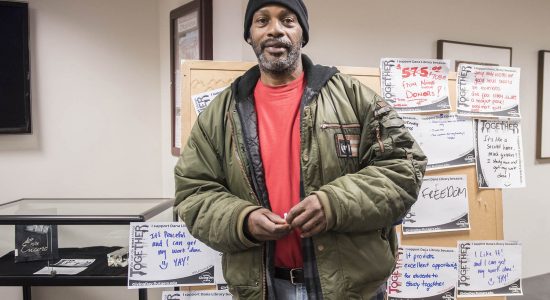
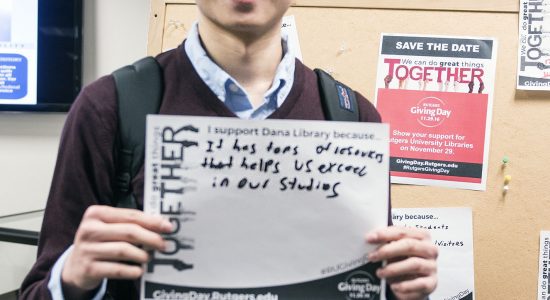
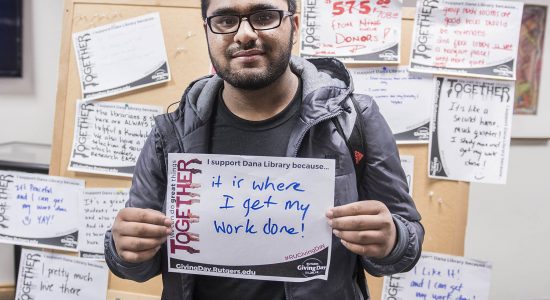
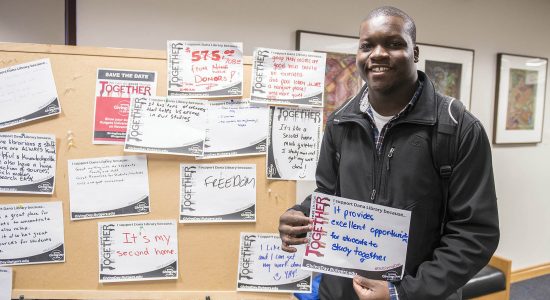
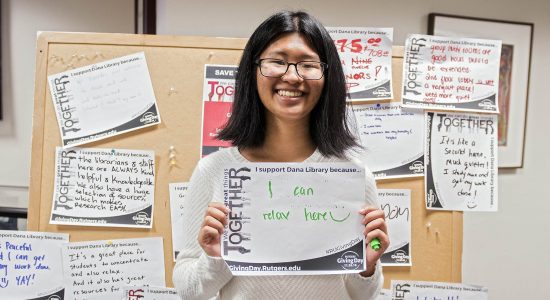
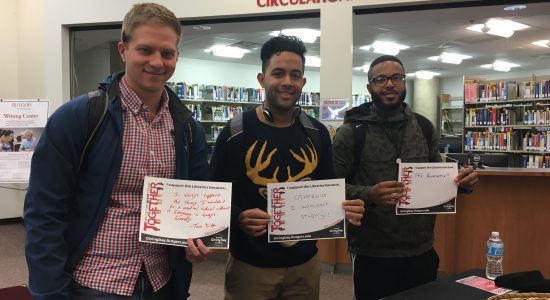
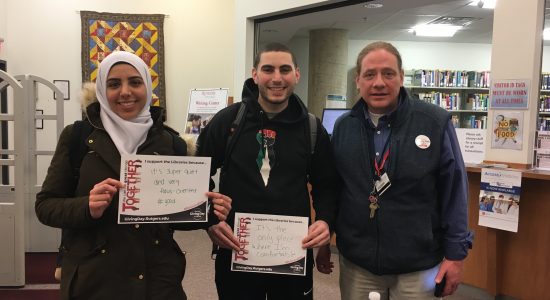
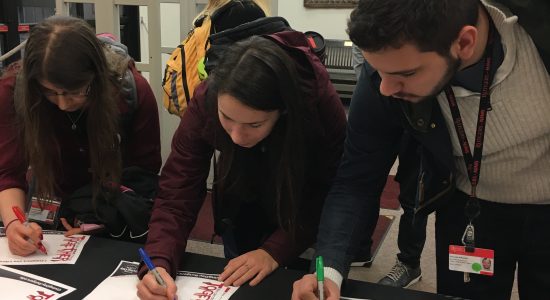
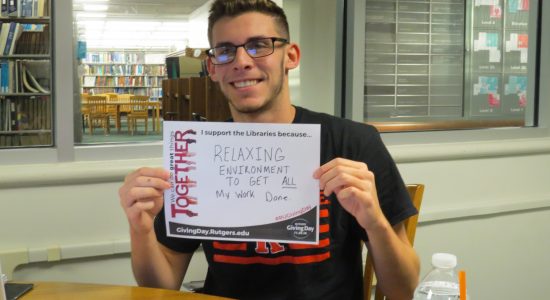
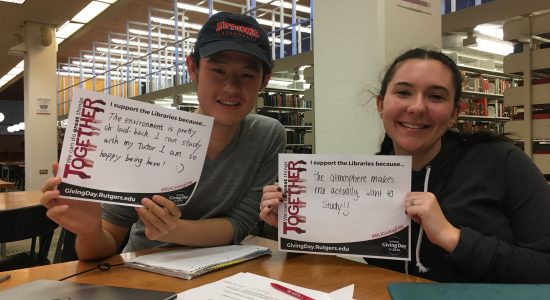
Rutgers-Newark students show their support for Dana Library. Credit: Ed Berger.
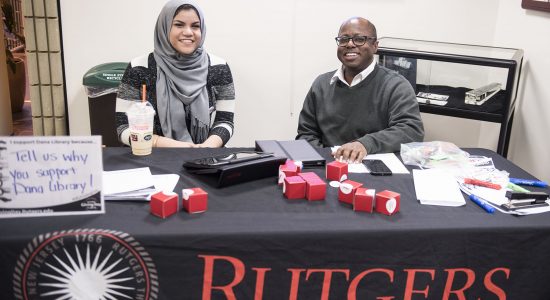
Dana Library had some little red boxes from the Giving Day planning team to distribute. Credit: Ed Berger.
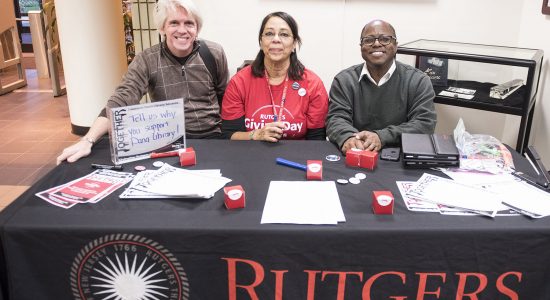
Dana Library had a table set aside for Giving Day activities. Credit: Ed Berger.
Dana Library had a lot of support throughout the day. Credit: Ed Berger.
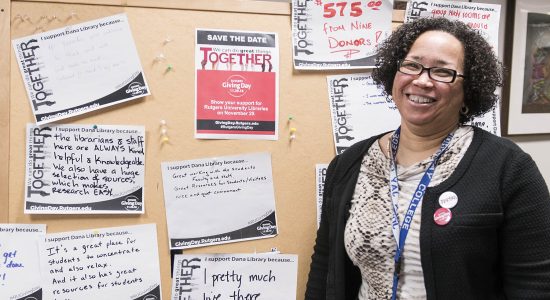
Consuella Askew stands in front of the Giving Day board where Dana Library tracked their leaderboard stats. Credit: Ed Berger.
One last student support sheet photo from Dana Library. Credit Ed Berger.
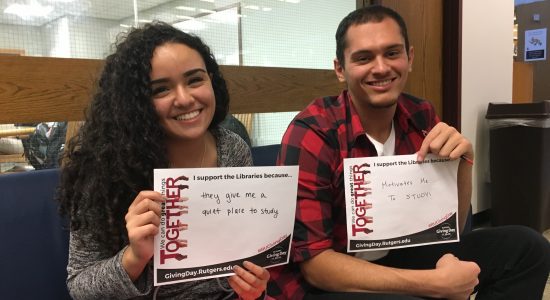
We couldn’t agree more — Dana Library is a place to get stuff done! Credit: Ed Berger.
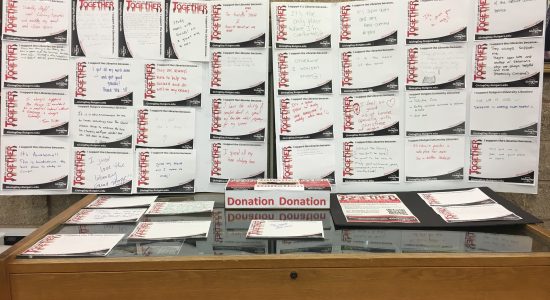
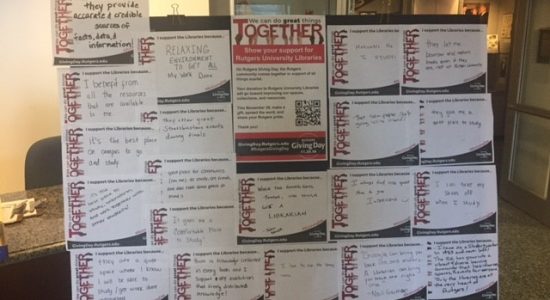
An informal bulletin board showcased all the support sheets. credit: Ed Berger.
Dana Library gathered support sheets from students. credit: Ed Berger.
More medical students showing their support for the RBHS Libraries!
Smith Library had steady traffic throughout Giving Day.
The table at Smith Library was in a prominent location right near the front door which made it hard to miss!
What a great display for the support sheets and a self-serve station.
The display of support sheets in Alexander Library’s lobby.
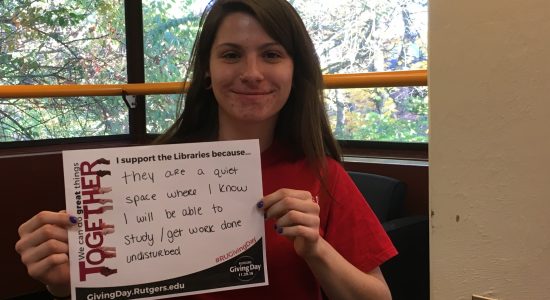
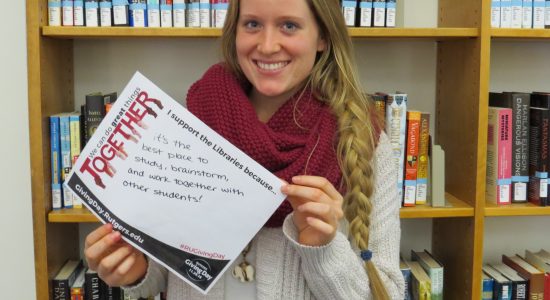
Prior to Giving Day, we got these photos for our social media campaign to show donors what they are giving to support.
Prior to Giving Day, we got these photos for our social media campaign to show donors what they are giving to support.
Prior to Giving Day, we got these photos for our social media campaign to show donors what they are giving to support.
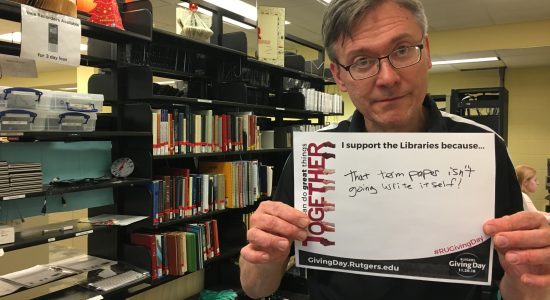
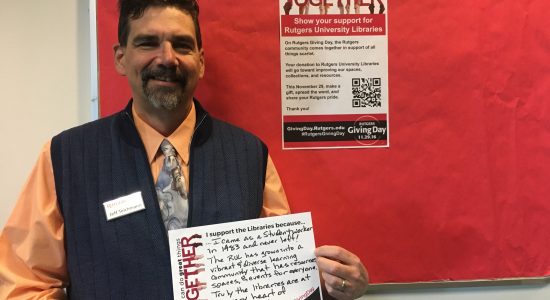
Nice to see our faculty and staff lending a hand to make Giving Day a success!
Nice to see our faculty and staff lending a hand to make Giving Day a success!
Nice to see our faculty and staff lending a hand to make Giving Day a success!
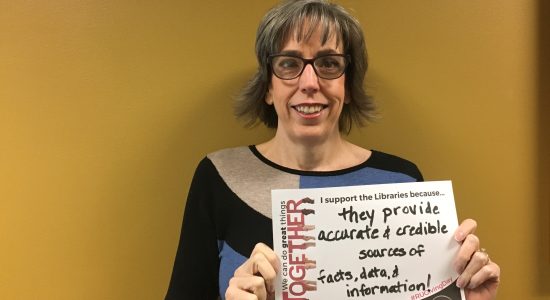
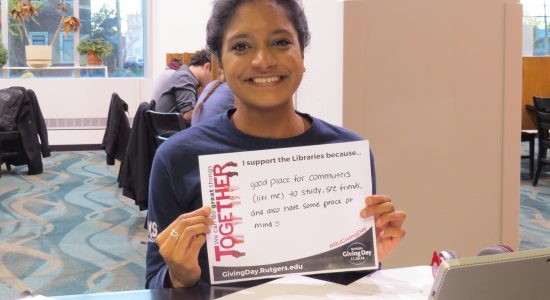
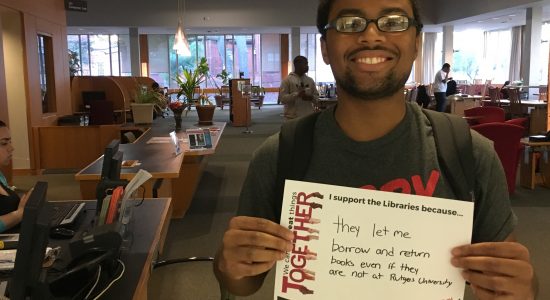
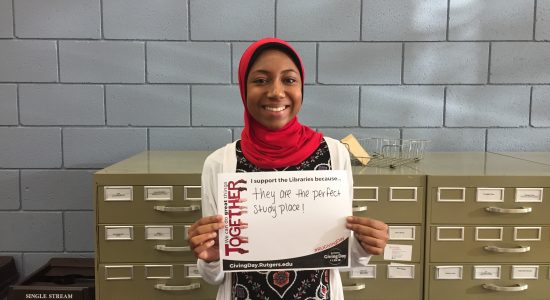
We had dozens of photos of students showing why they care about the Libraries!
We had dozens of photos of students showing why they care about the Libraries!
We had dozens of photos of students showing why they care about the Libraries!
We had dozens of photos of students showing why they care about the Libraries!
We had dozens of photos of students showing why they care about the Libraries!
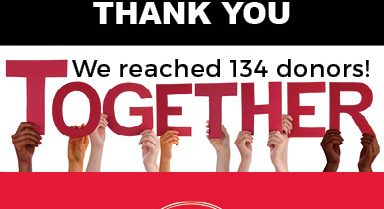
Thanks to all of your efforts and support, the Libraries greatly exceeded our goals for Giving Day this year. Last year, we had 22 donors and our goal this year was to slightly more than double this with 50 donors. We blew our goal out of the water with 134 donors and the Libraries are on the Top Ten leaderboards for both Rutgers-Newark and Rutgers-New Brunswick. We raised a total of $13,375.00. Here are the specifics for each location:
#11 – RBHS Libraries, 6 donations, $300.00
#12 – Camden Libraries, 10 donations, $170.00
#7 – Newark Libraries, 18 donations, $1433.00
#9 – New Brunswick Libraries, 100 donations, $11,472.00
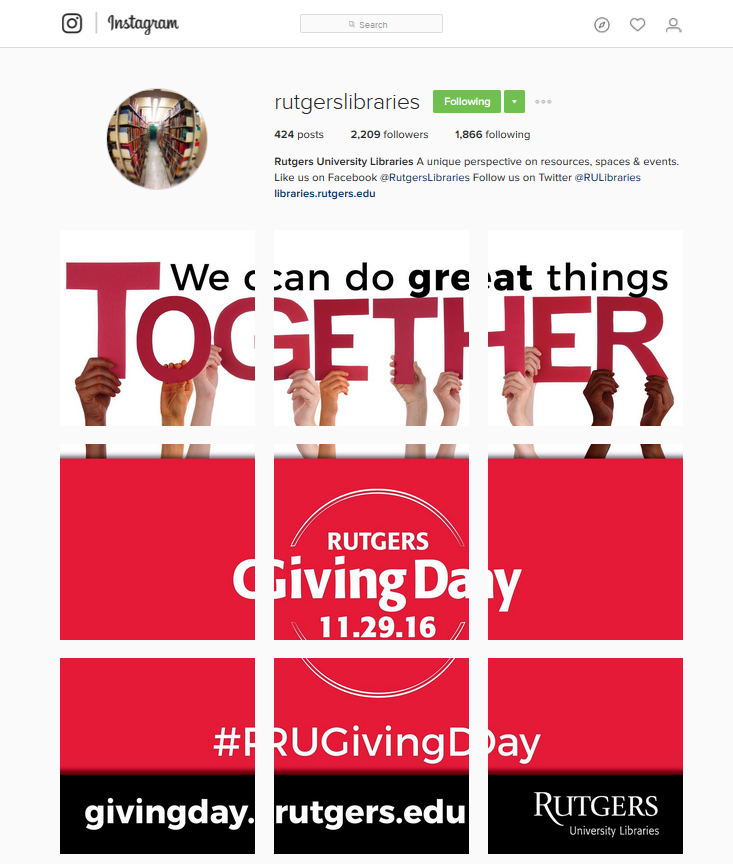
This banner ran on Instagram on Giving Day.
The figures above may shift slightly as the Foundation does their final accounting, but clearly, we did a great job!
Thank you to everyone who took time to set up donation computer stations or to sit at tables and solicit support sheets and donations in their libraries. I hope you all had a chance to see the fantastic social media campaign we ran on Twitter, using many photos of our real students and colleagues sounding off on matters most to them. Matt Badessa also created our first Instagram banner/photo grid.
If you have photos of Giving Day at your location, send them to jessica.pellien@rutgers.edu and I’ll add them to the slideshow!

 Ed captured this self-portrait last year.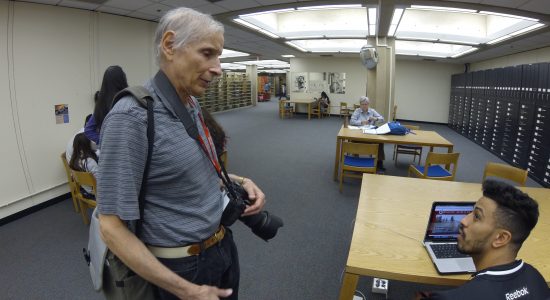





 Hello all –