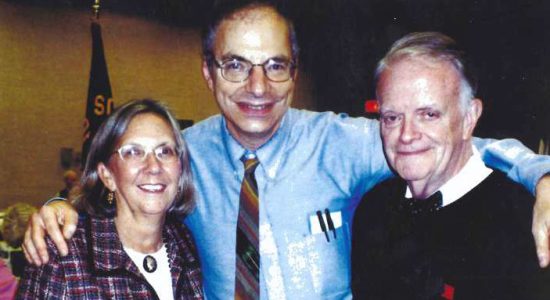
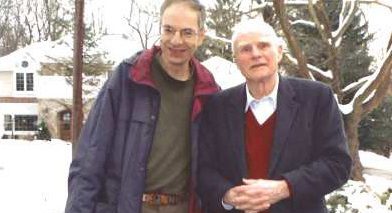
Ron with Paul Stellhorn, New Jersey Committee for the Humanities.
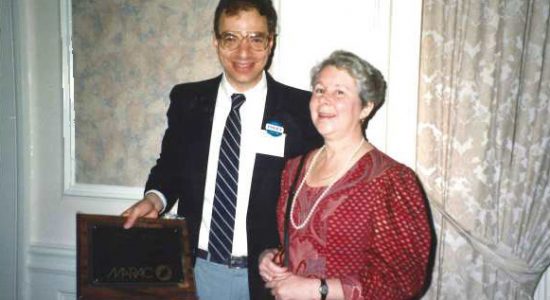
Ron receiving the Mid-Atlantic Regional Archives Conference Distinguished Service Award.
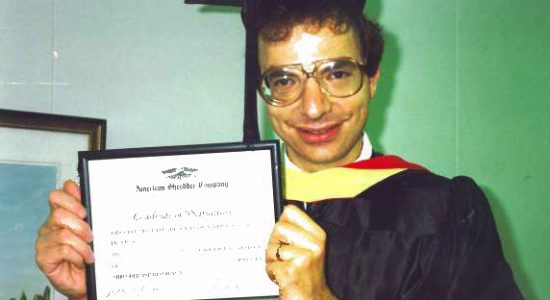
Ron displaying his “Certificate of Destruction” after shredding duplicate materials from a congressional collection.
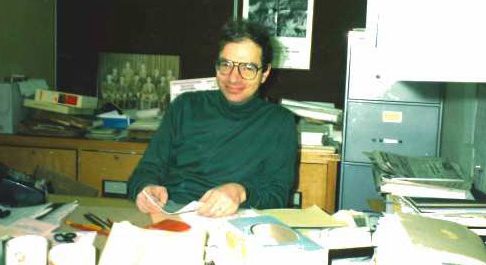
Ron in his temporary office during library renovations in 1990.
Ron with Libraries’ HR director Sandy Troy after an exhibition opening ca. 2000.
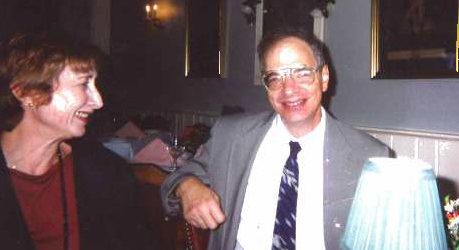
Ron sporting one of his famous NJ ties, which he has in multiple colors!
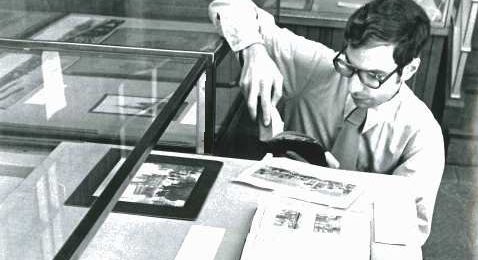
Ron installing an exhibition in 1979.
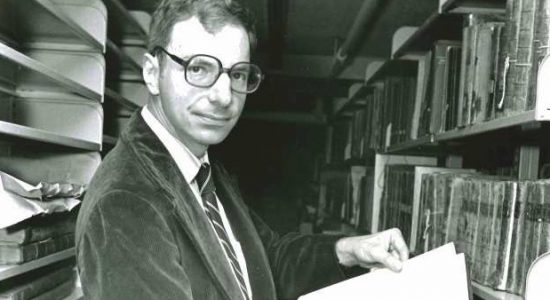
Ron in the rare book stacks in 1986.
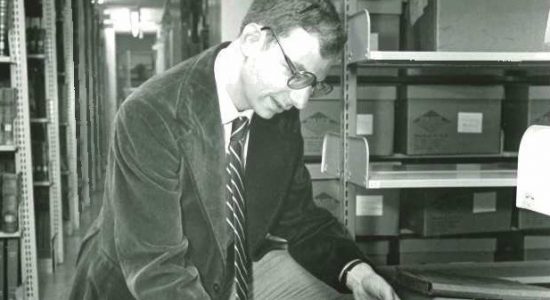
Ron in the stacks examining an acquisition in 1986.
Ron with the director of the Newark Public Library’s NJ Division, Charles Cummings.
Ron with Governor Brendan Byrne in 2005.
Ron Becker will retire from the Libraries at the end of the semester after 43 years of service, the last 25 of which were spent as head of Special Collections and University Archives. During this time, Ron oversaw a period of unprecedented growth for the library and helped it become the largest repository of New Jersey history and culture and one of the largest regional history collections in the nation.
Ron is a “loyal son” of Rutgers who has spent almost the entirety of his career at the Libraries, bridging several generations of students, scholars, donors, and the public. Throughout this time, he has been heavily invested in library and faculty governance as well as fundraising, having procured millions of dollars in grants and donations for the university.
“More than any other that I had been affiliated with or knew about at the time, Rutgers struck me from day one as a unique library whose stacks were open to everyone and whose Special Collections and University Archives encouraged younger students and the public to use and become engaged with its materials,” he recalls. “I am so happy that now nearly all archival repositories have become like Rutgers and that I have played a small role in that coming about.”
Ron has also been a tireless champion for New Jersey history through lobbying efforts including testimony at legislative hearings and meetings with New Jersey’s congressional delegation.
“Rutgers has given me the opportunity to meet and engage with an incredibly diverse group of individuals and organizations to help document all of the unique contributions that New Jersey has made to our nation and the world. Hopefully, the materials that we have collected and made available to the public have an impact in bringing these contributions to light.”
Ron has held offices in over a dozen professional, state and county government, and historical organizations; is a frequent speaker at historical and archival conferences; and has won numerous awards for his contributions. But all things considered, he notes that three things above all else have given him the most pride.
“One is working with so many distinguished and caring colleagues throughout the Libraries and the university; another is that so many young people that we have mentored as students in the field have gone on to professional careers and significant accomplishments; and finally is that we have encouraged and helped develop K-12 students’ appreciation and use of historical materials, which I know will result in a better informed citizenry in the future.”
Ron will miss the day-to-day activities and comradery at the Libraries but eagerly anticipates spending more time with his family and at his second home in Florida “with the goal of never seeing ice and snow in person again.” He also looks forward to completing publication projects and engaging in new historical and community endeavors that have long been planned but have yet to be acted on.
Ron has enrolled in Rutgers’ faculty transition to retirement program and will be present often during the summer and fall semesters in 2017 and 2018.
Please join us in thanking Ron for his service and wishing him all the best in his next chapter!
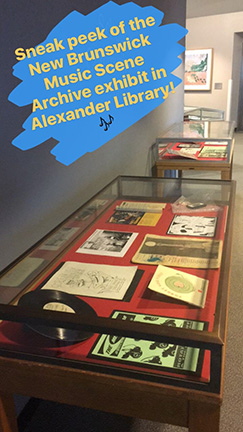
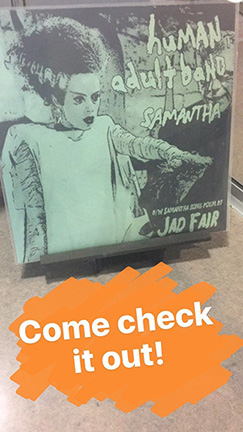
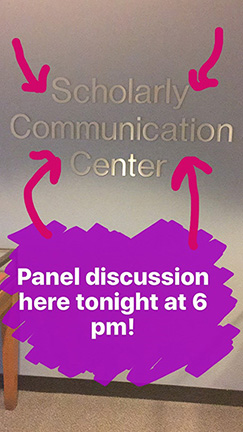
Back in August, Instagram announced a new feature called Stories. Similar to their counterparts on Snapchat, Instagram stories allow users to create a “slideshow” of images and/or videos that is viewable for 24 hours before disappearing.
As is suggested by their name, stories allow you to shape a narrative around your subject in a way that a single image or video may not.
Much like Snapchat stories, Instagram stories are well-suited to capturing action as it is happening. This allows you to leverage the “fear of missing out” to generate excitement around your programming.
When you post or update a story, your account appears in a list that runs across top of others’ Instagram feeds. This extra visibility is a welcome boon given recent changes to the platform’s timeline algorithm.
You can experiment with the story-based approach to social media without having to build a new audience from scratch on a different platform.
Cons
While you can download your story content to your camera roll as it is published, the preferred portrait orientation makes it difficult to repurpose your content elsewhere. Shooting in landscape orientation requires your viewers to either turn their heads awkwardly or rotate their phones, an inconvenience that puts your content at risk of being skipped over.
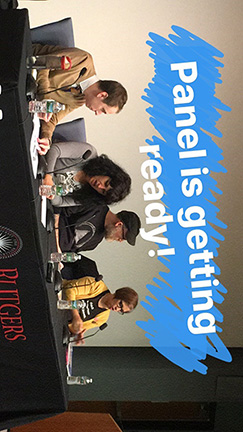
The 10 second limit on video clips presents some challenges. For example, a speaker’s comments can easily run over and get cut off, necessitating additional takes.
Viewing statistics disappear along with the image or video they are attached to, complicating assessment.
Instagram’s story editing tools (basic text and drawing) are limited compared to Snapchat’s, especially its robust filter system.
Next Steps
Identifying more story opportunities to allow for additional testing. (If you have any ideas, please get in touch!)
Incorporating stories into the Instagram content schedule.
Formalizing the procedure for recording and reporting story viewing statistics.
The Rutgers University Libraries Faculty and Staff Appreciation Picnic will be held on Friday, October 21 from noon–4 p.m. at the Log Cabin and Pavilion in Rutgers Gardens (140 Log Cabin Road, North Brunswick). There will be food, music, games, and other surprises.
Please let us know if you plan to attend by filling out the form below. We can’t wait to see you there!
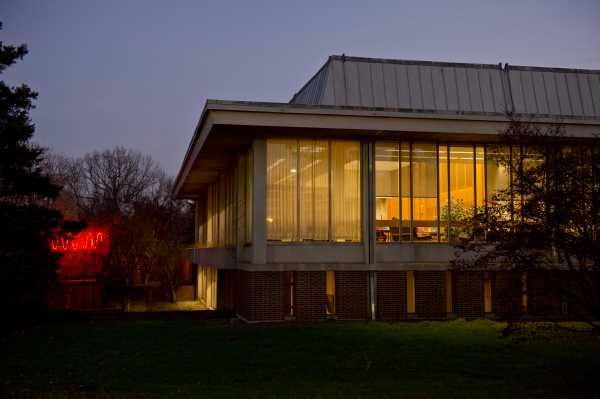
A recent policy change means that high resolution images from the Rutgers University Photo Gallery are now available free of charge for Rutgers projects.
Douglass Library. Nick Romanenko/Rutgers University
The gallery offers access to professional images of Rutgers buildings, faculty, staff, and students. Previously, low resolution images (72 dots per inch, suitable for projects such as PowerPoint presentations, email newsletters, and webpages) were available for free download, while high resolution images (300 dots per inch, suitable for print projects such as flyers, posters, and brochures) had to be purchased for $20 each. Now, however, because of changes due to RCM, the high resolution images are also available at no cost to the Rutgers community.
Finding the perfect image for your project is as simple as following these three easy steps:
Log in to the gallery using your NetID and password.
Browse through the categories to identify a photo you like.
For low resolution images, read and accept the terms and conditions to download the image immediately; or, for high resolution images, contact photo archivist Jane Hart with the file name and how you intend to use the photo.
In the event that you can’t find an image you like in the gallery, you may request access to the University Communications and Marketing Photo Archive, which contains thousands of additional photos for your perusal. Contact Jane for access to the archive.
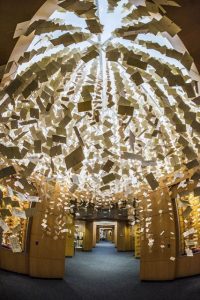
Spring Sutras, an art installation by Karen Guancione that features thousands of recycled catalog cards from Rutgers libraries, officially launched on June 2 and is on display through the fall at Dana Library. The artist statement, remarks, and acknowledgments below are mounted on a poster accompanying the exhibition. Congratulations to all Libraries faculty and staff who helped make this installation a success!
Spring Sutras
Artist Statement
“The Sanskrit word sutra literally means a thread, string or line that holds things together. It derives from the root siv- (to sew), and is related to suere in Latin, sew in English, and the medical term suture. It refers to Hindu or Buddhist texts, sometimes described as threads of wisdom or knowledge strung together.” (Wikipedia 2013)
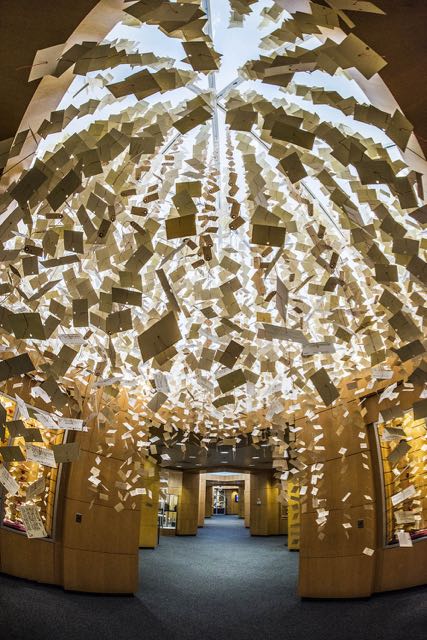
Spring Sutras, credit: Ed Berger
Sutra began in 2013 when I was caring for my ninety year old mother who suffered with severe dementia. Normally, it takes months and marathon days of work to make an installation for a public space, but I could not leave my mother’s living room; I was well into an endless, exhausting, all-consuming caregiving hell. With the help of Rutgers University librarians I obtained boxes and boxes of the long discarded and forgotten hand-typed catalogue cards that I wanted to recycle for an installation. While caregiving around the clock in the house where my mother had lived for sixty-five years, I was able to work near her and string together the thousands of pieces of paper—a repetitive, meditative act that enabled me to continue making art. I named the installation Sutra. Caregiving is a process that requires compassion and, like art, sometimes tests the limits of patience and endurance. As I sewed, I was reminded of the piecing together of segments of all people’s lives, who, depending on individual or social circumstance, may themselves become long discarded and forgotten. The first installation using catalogue cards was created for the Noyes Museum and prominently displayed from 2013 to 2015.
In 2016 with the support of Rutgers University Libraries and Rutgers-Newark I was invited to create Spring Sutras, a site-specific installation in the John Cotton Dana Library. The public art project celebrates the nation’s largest and most varied collection of Japanese cherry trees in Newark’s Branch Brook Park and commemorates the city’s 350th anniversary. Thousands of recycled catalogue cards from Rutgers Libraries and hundreds of faux flowers were hand-sewn and suspended beneath a two-story-high skylight and throughout the fourth-floor space, which is also home to the Institute of Jazz Studies. Viewers are literally surrounded and touched by pieces of the hanging installation; the large-scale work transforms an entire area of the Dana Library.
In an age of digital information I have relished holding in hand the many singular pieces of paper that once spoke of a vast and impressive array of accumulated knowledge. The strung flower garlands celebrate new life and honor the old and departed.
Special thanks to librarians: Ann Watkins, Yoshiko Ishii, Michael Joseph and Grace Agnew for their help in procuring the cards from Dana Library, Alexander Library, Special Collections and Rutgers Law Library.
Karen Guancione
About the Artist
Karen Guancione has been awarded a Mid Atlantic Arts Foundation Artists and Communities Grant, four New Jersey State Council on the Arts Fellowships, a Ford Foundation Grant, a Puffin Foundation Grant and an Arts and Culture Exhibition Grant from the Nathan Cummings Foundation. Her work has been exhibited worldwide and is in numerous public and private collections. Her interdisciplinary art includes large scale installations, public art projects, performance, sculpture, printmaking, papermaking, bookarts and video. She has curated many exhibitions, is an adjunct professor of art at the State University of New York (SUNY Purchase), Montclair State University and Middlesex County College and has been a visiting artist and lecturer at Pratt Institute, Rutgers University and numerous schools and institutions in the United States and abroad. For over a decade she has served as artistic director / guest curator of the annual New Jersey Book Arts Symposium and Exhibition. She is the first time recipient of the Erena Rae Award for Art and Social Justice. She collaborated on the critically acclaimed production of Cuatro Corridos, a multidisciplinary chamber opera about human trafficking that has been continually traveling throughout the USA and Mexico since 2013. She has just received a 2016 Fellowship from the New Jersey State Council on the Arts for Works on Paper.
A Note on the Art of Karen Guancione
An artist, educator, curator, and longtime Artistic Director of The New Jersey Book Arts Symposium, Karen Guancione has been making books for over fifty years, and collaborating with artists and workers all over the world on installations that adapt traditional book making techniques. Spring Sutras continues a thread of her work that investigates the seam between art and value, here working with discarded catalog cards and plastic flowers to reach toward a vision of ecstatic renewal. Intriguingly, within the work’s central assemblage, a mobile hung from the Dana Library atrium, the catalog cards suspended like leaves or stars have been assembled in roughly alphabetical order, preserving and transforming not only the librarian’s tools of organization, but the original library vision: it, too, changes and becomes part of what is renewed and endures.
Michael Joseph
Acknowledgments
The artist gratefully acknowledges the support of Rutgers University Libraries and its staff for making this exhibition possible. This project was generously funded through a Rutgers-Newark Cultural Programming grant. Special thanks to Consuella Askew, Director, John Cotton Dana Library and Ann Watkins, Dana Arts Coordinator and Librarian for their administrative support and cultural commitment. A special note of appreciation to Jeff Baxter and Rutgers Physical Plant for expert installation assistance, Bob Nahory for technical advice, Bruce and Beverly Riccitelli for beautiful photography, Tad Hershorn for printing expertise, Mark Papianni and Yoshiko Ishii for lending a hand during installation, Michael Joseph for insightful writing and Roseann Reilly for help and comradery during many long sewing sessions.
Heartfelt thanks to those who have contibuted to this project in many ways: Grace Agnew, Mary Apikos, Matt Badessa, Isaiah Beard, Donny Bruno, Asha Ganpat, Gary Guancione, Angela Hidalgo, Liz Koepplinger, Susan Narucki, Jessica Pellien, Suzanne Reiman, Carol Van Savage, Lauren Vitiello and Sally Willowbee. Sincere thanks to the skillful Rutgers-Newark Physical Plant workers: Tony Sharo, Rob Pellicone, Bob Conklin and Dave Barbara, the Dana Library Custodial staff, and Rugers-Newark Campus Security officers.

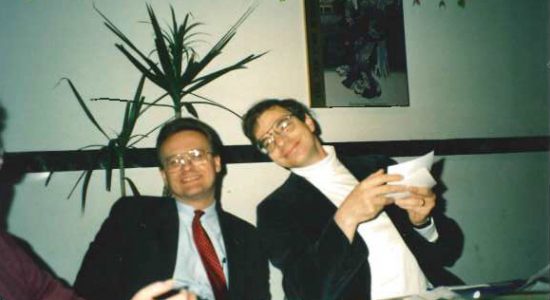 Ron with Paul Stellhorn, New Jersey Committee for the Humanities.