Author: Abigail DiPaolo

  • Ex Libris Implementation Project Update – May 2019

    quicksearch logo

    Rutgers Law Libraries to Join Alma/Primo

    The Rutgers Law Libraries are joining our Alma and Primo instances in January 2020! Project planning for appending the Law libraries catalog has begun. We are currently participating in bi-weekly planning meetings with Ex Libris and the Law libraries. Progress will be communicated through the Ex Libris Implementation team. This is an exciting opportunity for us and the faculty and students that we serve. 

    Leganto Update

    The Leganto implementation team is preparing to go live with 16 pilot courses from the School of Social Work. This summer, social work graduate students will be able to access their course reserves, including electronic course reserves, live links to the physical reserves holdings, and access to our journal and database subscription content, directly from their course in Canvas. The team is planning a soft launch for fall, so if you know of a department that would be interested in this comprehensive course reserves solution, please contact your campus representative to the Leganto team or the Ex Libris Team at exlibris@rutgers.libanswers.com 

    FRBRization disabled for music materials 

    FRBRization refers to the process by which different versions of the same work are grouped together. Generally speaking, FRBRization is a useful feature that allows researchers to easily find and identify related works (e.g., different editions of the same book). However, in some cases, unrelated works are mistakenly grouped together, which causes confusion and makes these resources more difficult to find. This is especially true for musical scores and audio recordings where heavy use of generic titles, complex statements of responsibility, and variations of performance can lead to erroneous matches. Accordingly, FRBRization has been disabled for these materials. This decision was made in consultation with and based on feedback from experts in public services, cataloging, and the music department. The exemption applies to scores and audio recordings only. All other types of materials will continue to be FRBRized.

    Improved metadata for Academic Video Online (AVON)

    Academic Video Online (AVON) is a large streaming video collection of documentaries, interviews, performances, and feature films spanning a wide variety of subjects. However, the metadata provided by Ex Libris for this collection suffered from a number of limitations impacting its discoverability in QuickSearch. Accordingly, these records have been replaced with vendor-supplied MARC records. The new records are not only of higher quality but also offer more reliable linking, less duplication, and improved result filtering. However, in order to keep the collection up-to-date, the records must be reloaded every six months. Since record permalinks will change every time the records are reloaded, it is recommended that librarians and instructors who wish to link to this content use direct links to the platform rather than link to the record in QuickSearch. To do this, simply click “Embed/Link” below the video player in AVON (see screenshot).

    Where did all the ISSNs go?

    Standard identifiers such as ISBN, ISSN, and OCLC number are currently not being displayed in QuickSearch. This information typically appears in the “Identifier” field of the detailed record. Although this data is still searchable, it is currently not being displayed to the public. The issue has been confirmed by Ex Libris to be related to a known defect that is scheduled to be fixed in the July 2019 release. Until a fix is released, the only way to view this information in QuickSearch is to click the “View Source Record” link at the bottom of the record and look for it in the appropriate MARC field.

    Primo 2019 Roadmap

    Related reading? Citation trails? Enhanced personalization? Want to know what new features and functionality are coming to Primo this year? Check out the 2019 Primo Roadmap.


  • Ex Libris Implementation Project Update – July 2018

    quicksearch logo
    The team is planning to visit each campus where we will hold open Q&A sessions. This will be an open forum where you can bring any questions or concerns you have about QuickSearch, Alma, or related processes.

    After much planning and preparation from all of the Libraries, QuickSearch and Alma went live on June 5. It’s so hard to believe that we are already almost four weeks past go live! The implementation team would like to thank everyone for your hard work in making go live a success. Each and every person in the Libraries has helped move us forward, be it by serving on a working group, attending a training, or by submitting a help ticket to point out a concern. We couldn’t have done it without you!

    Of course, we also continue to experience bumps along the way, but this is expected with an implementation this large. The team has spent much of the time since our last post focused on those bumps… addressing critical post-go live activities, implementing fixes, and responding to help tickets. In addition, we are reviewing our lists of known issues and possible future improvements in order to prioritize items for completion. The website will be updated with this information as soon as the process is complete.

    The team is also planning to visit each campus where we will hold open Q&A sessions. This will be an open forum where you can bring any questions or concerns you have about QuickSearch, Alma, or related processes. Be on the lookout for an announcement about dates in the very near future. Your feedback is critical and we really hope that you will join us.

    Lastly, as Tao steps away from the team, I would like to thank him for his contributions to the group and to the project. I know that we will all miss working with him as we continue to forge ahead.

    Abbey

  • Ex Libris Implementation Project Update – December 2017

    Ex Libris Implementation Project Update – December 2017

    In this second update on the Ex Libris Implementation Project, we report on a major milestone achieved in November – the completion of organizational planning. In early December the project will transition from the pre-implementation to implementation stage, so this update also introduces the timeline from December to June, focusing on the three key phases of implementation – Define, Build, and Deploy.

    Completion of Organizational Planning

    Cabinet recently approved a proposal to form several working groups connected to the Implementation Team, marking the completion of organizational planning for the project. As reported last month, the Implementation Team was created in late September and includes seven members from the infrastructure units of the Libraries. Reporting directly to the University Librarian, the team functions as the coordinating body of the project. The working groups will provide expert input to the Implementation Team, organize workflow reviews, testing, and training in their focus areas, and involve library faculty and staff in the implementation process. The team appoints team members to liaise with the working groups to facilitate two-way communications.

    Here is a list of working groups and their membership:

    Working Group Implementation Team Liaison(s) Membership
    Acquisitions Abbey DiPaolo Dominique Dixon, Megan O’Connor/Kati Ritter, Cathy Pecoraro/Rita Wells, Gracemary Smulewitz, Lucy Vidal, Mary Beth Weber
    Data Migration and System Integration Chris Sterback & Chad Mills (co-liaisons) Fengzhi Fan, Dave Hoover, Bob Warwick
    Digital Chad Mills Isaiah Beard, Kalaivani Ananthan, Jane Otto
    Discovery Joseph Deodato Discovery Working Group*
    E-Resources Gracemary Smulewitz Michelle Best, Paul Cabelli, Cathy Pecoraro, Lucy Vidal, Geoff Wood, Tao Yang
    Fulfillment Chris Sterback Access Services Committee*
    Interlibrary Loan Gracemary Smulewitz Abbey DiPaolo, Orla Mejia, Glenn Sandberg
    Resource Management Mary Beth Weber Colin Bitter, Jamie Smith, Geoff Wood, Tao Yang

    (* indicating existing groups)

    The Discovery Working Group and Access Services Committee are existing groups, and the others are newly established. All of the groups have members from multiple departments or units of the Libraries.

    While approving the working groups, Cabinet also made two important points:

    1. The Ex Libris Implementation Project is a top priority that must be completed within the established timeframe. Members of the Implementation Team and working groups are taking on a significant amount of work, so it may be necessary for everyone to adjust the expectations for them in areas unrelated to implementation.
    2. Communicating with library users about potential service interruptions (and enhancements) is an essential component of the implementation project. The Implementation Team will work with the Director of Communications to develop an external communications plan.

    The Implementation Team has also made significant progress on creating a project website and performing data preparation and validation. We hope to describe them in more details at the poster session of the State of the Libraries or in the next monthly update.

    Overview of Implementation Timeline (December – June)

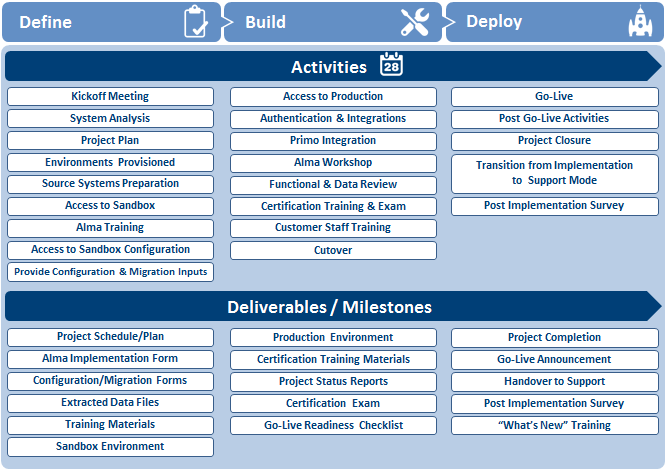
    Ex Libris divides the Alma/Primo implementation process into three phases: Define, Build, and Deploy. During the Define phase for Rutgers (December – early February), the Implementation Team gains access to the standard Alma sandbox environment including standard Ex Libris data and configuration, takes Alma training (including configuration training) via pre-recorded sessions, and then configures the sandbox environment. At the same time, the Libraries continue with data extraction and validation and deliver the data from source systems (Symphony and EDS) based on the Ex Libris specifications for migration to Alma. The Define phase ends with Ex Libris completing the configuration of the Alma production environment with the input from the Rutgers team and a test load of the migrated data.

    During the Build phase (late February – May), the Libraries receive access to both the Alma production environment and Primo environment for functionality review and data testing. Both environments use Rutgers data and configurations and we need to document any necessary modifications for the cutover data load. The Implementation Team works with Ex Libris to define a list of third-party integrations (such as the ILL and Central Authentication Systems). Ex Libris conducts onsite workshops to explain the workflows of the new system. The Implementation Team and working groups also prepare and perform internal staff training. This phase completes with a “freeze” of the source systems (Symphony and EDS). Ex Libris then performs the cutover data load.

    Alma and Primo are scheduled to go live at Rutgers on June 1, which is the Day 1 of the Deploy phase. From June to July, the Implementation Team works closely with Ex Libris to address any issues and support library faculty and staff through their first steps with Alma and Primo in production.

    Additional information about the three phases can be found in this chart published by Ex Libris:

    We look forward to the opportunities to discuss the project with you at the State of the Libraries and other venues. Please do not hesitate to contact us or other Implementation Team members if you have any questions or comments. Thank you!


    Tao Yang & Abbey DiPaolo

    Save

  • Transforming the Way We Work at Rutgers

    cornertstoneThe new administrative information systems under Cornerstone are scheduled to go live over the next week. Cornerstone is the University’s strategic approach to unify, upgrade, and streamline its administrative information systems for Finance, Human Resources and Payroll, Procurement, etc. Upgrading and improving these systems will significantly improve how we work and collaborate across the university. These projects are also particularly exciting to the library because they will enable all of our units to finally utilize the same systems for administrative functions.

    Be on the look-out for future announcements about process updates and training opportunities related to this implementation. If you have any questions about how the new systems may or may not impact you, please see your local business staff.

    Save