Tag: website

  • Website Redesign Project Update – May 2020

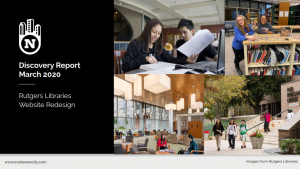
    Screenshot of NewCity discovery report
    The discovery report is available on the project team’s staff resources site.

    The Discovery phase of the website redesign project has officially concluded. Feel free to peruse NewCity’s Discovery Report, which outlines their findings from their onsite visit, one-on-one interviews with some key stakeholders, discussions with the core project team, an intercept survey, and analytics. They tease out some of the characteristics that make RUL’s different units unique, as well as what unites everyone, and what some of our biggest challenges will be as we move forward with this project.

    We’re excited to be starting audience research this month. Over the next ten weeks, NewCity and the RUL project team will be working with local teams and directors to survey and interview our user groups, define the brands and goals for each campus, and move toward a baseline understanding of what our users need and how they behave. While we’d love to be able to meet face-to-face with our users, we’re not letting COVID-19 slow our progress—we’re working with NewCity to develop a robust research plan that we can deploy entirely online.

    To help coordinate, conduct, and analyze this research, we’ve formed a Local Library Owners team, an augmented version of our core project team. We’re happy to welcome John Gibson, Samantha Kannegiser, Angela Lawrence, Amber Judkins, Christie Lutz, and Victoria Wagner to the project.

    Audience research doesn’t apply only to our external users; we’ll be working with the RUL audience as well. As we develop a web presence that has room for more “local flavor,” we need to be sure to empower local content editors to create and contribute content and design that works best for their units. Our new site will employ a component-based system that will allow local contributors flexibility and ease in creating and customizing local content while keeping the site sustainable for the central technical team.

    The project team continues to meet bi-weekly, with additional meetings now being added as we begin the next period of intense focus on audience research.

    You’re welcome to reach out anytime with questions or comments. Send us an email: webservices@rutgers.libanswers.com
  • Web Improvement Team Update

    Web Improvement Team Update

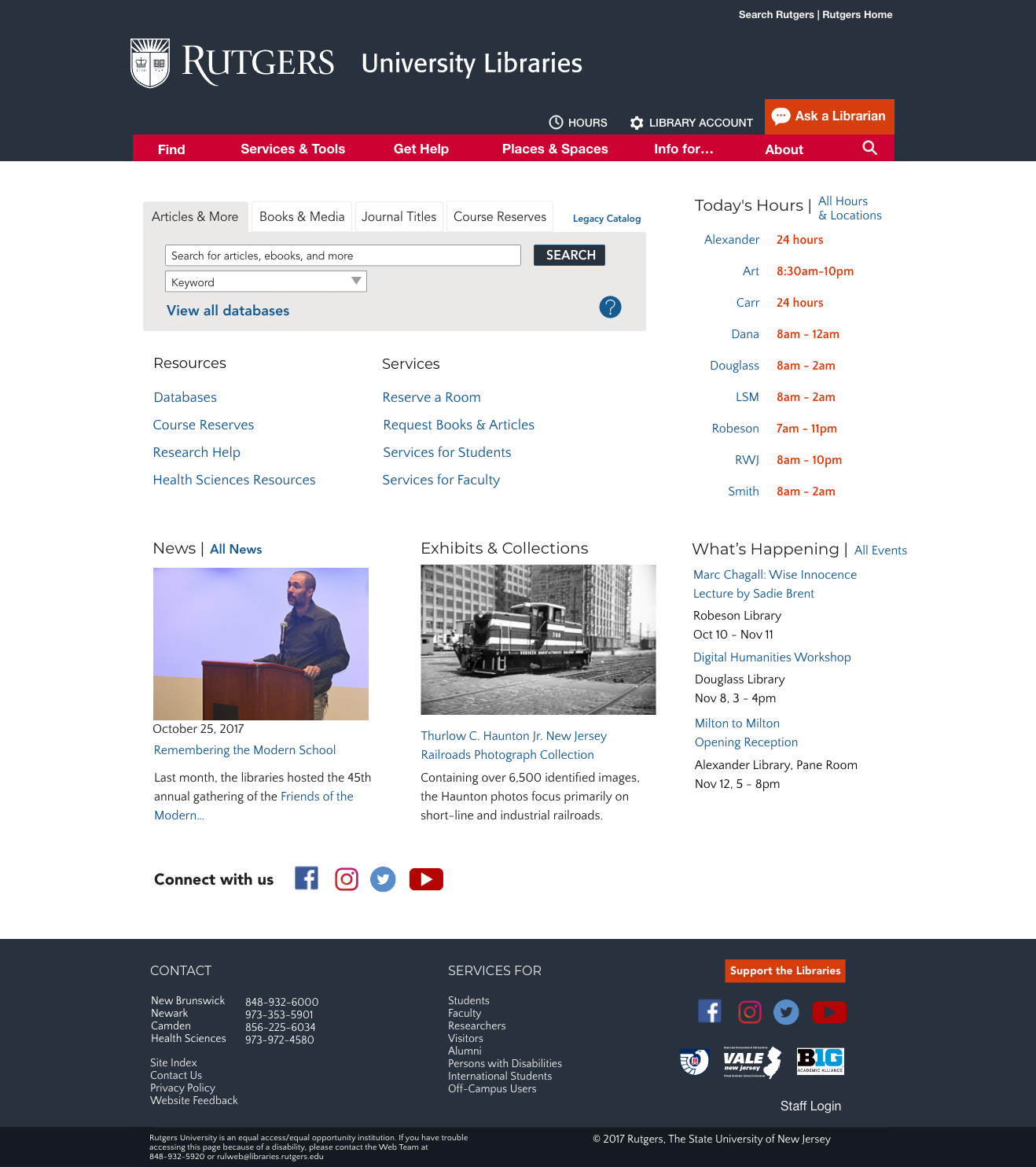
    sample of website refresh
    Click to view larger file.

    The Web Improvement Team (WIT) is excited to announce some changes coming soon to the Rutgers University Libraries website. Since September, we’ve been speaking with our users (students, faculty, and staff) and analyzing survey and usage data to determine how we can begin to improve our website user experience. We’ve been exploring best practices for user-centered design, content strategy, responsive design, and accessibility. Through one-on-one conversations, focus groups, and data analysis, we have learned more about our users’ essential tasks and resources, pain points in the current design, and user preferences.

    Here are some of the takeaways from our first round of user research:

    • Users are very task-oriented, and generally come to the site knowing what they want; the scope of their use is quite narrow
    • The current homepage was thought to be too busy and complex
    • Pages are hard to read, with small text and too much content
    • Users spend very little time on most pages, and rarely scroll below “the fold”
    • A relatively small number of resources are especially heavily used (hours, room booking, A-Z database list, ILL, library account)

    We based our first round of changes on these findings. Our goals became to:

    • Surface and prioritize the most frequently used resources and services
    • Freshen up the look and feel: reduce visual clutter on the homepage, enlarge fonts for sitewide readability
    • Refine the presentation and content for a few key pages
    • Minimize initial disruption to lower-level pages

    Our overall approach is one of incremental change over radical redesign. Making incremental modifications based on user data ensures that those modifications are genuine improvements (as opposed to change for the sake of change, or change based on guesses or assumptions). If we’re proven wrong, smaller changes are easily reversed or refined. Although change can be uncomfortable at times, a continuous cycle of improvement and evaluation builds a sustainable, usable website that delivers a positive user experience.

    You’ll also notice that a lot of things haven’t changed: the red navigation bar, most of the underlying content, the mobile presence. These, too, will change in time, but require considerable user research, usability testing, and content control. There will be opportunities for students, staff, and faculty to get involved in future research.

    The new website is expected to be in place by late December, in time to greet students in the new semester.

    Stop by our poster at the State of the Libraries if you want to learn more!

    Save

    Save