Category: Universitywide

  • Quick Takes on Events and News – February 2018

    Quick Takes on Events and News – February 2018

    The Douglass Century will be published by Rutgers University Press next month.
    The Douglass Century will be published by Rutgers University Press next month. Check out the March Agenda for your chance to win a free copy!
    Celebrating the Douglass Century

    Congratulations are in order for our colleagues Kayo Denda and Fernanda Perrone, who, along with Mary Hawkesworth of the departments of Political Science and Women’s and Gender Studies, have penned a history of Douglass Residential College entitled The Douglass Century: Transformation of the Women’s College at Rutgers University.  The book will be published by Rutgers University Press next month. From the press:

    The Douglass Century celebrates the college’s longevity and diversity as distinctive accomplishments, and analyzes the contributions of Douglass administrators, alumnae, and students to its survival, while also investigating multiple challenges that threatened its existence. This book demonstrates how changing historical circumstances altered the possibilities for women and the content of higher education, comparing the Jazz Age, the Great Depression, the Second World War, the post-war Civil Rights era, and the resurgence of feminism in the 1970s and 1980s. Concluding in the present day, the authors highlight the college’s ongoing commitment to Mabel Smith Douglass’ founding vision, “to bring about an intellectual quickening, a cultural broadening in connection with specific training so that women may go out into the world fitted…for leadership…in the economic, political, and intellectual life of this nation.” In addition to providing a comprehensive history of the college, the book brings its subjects to life with eighty full-color images from the Special Collections and University Archives, Rutgers University Libraries.”

    But wait—there’s more! March’s issue of the Agenda will include a contest for a free copy of The Douglass Century, so tune in next month for your chance to win.
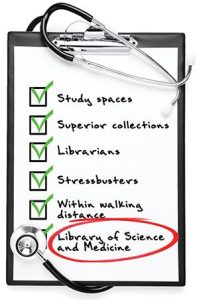
    LSM opens house on February 13.
    LSM open house on February 13.
    LSM Open House

    Spread the word! The Library of Science and Medicine will open its doors to Robert Wood Johnson Medical School students and faculty on Tuesday, February 13 at 4 p.m.

    There will be ample opportunity to meet health sciences librarians and learn about the resources, tools, study spaces, and collections that are available on Busch campus.

    Refreshments will be served and complimentary retractable ID card holders will be available while supplies last.

    Watch: State of the Libraries
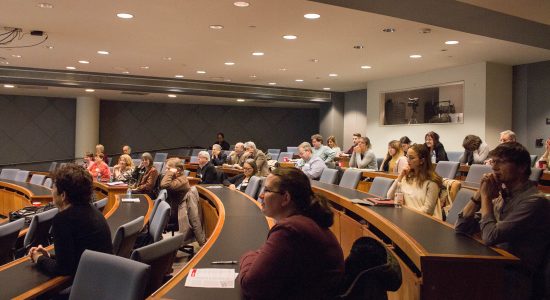
    Krisellen Maloney presents at State of the Libraries.
    A video of Krisellen Maloney’s State of the Libraries presentation is now available on our YouTube channel.

    Krisellen’s presentation from State of the Libraries is now available on our YouTube channel. It includes an introduction of new employees, an overview of the Ex Libris implementation, and a discussion of the budget. Kudos to Rich Sandler for his work on the video. And in case you missed it, a video playlist of the poster sessions from State of the Libraries was posted in last month’s issue of the Agenda.

    The New Jersey Digital Newspaper Project Goes Live

    The New Jersey Digital Newspaper project celebrated a major milestone last month when the first batch of pages from the Perth Amboy Evening News became available to the public via the Library of Congress website Chronicling America. Colleagues from the Libraries, the New Jersey State Library, New Jersey State Archives, and the New Jersey research community gathered at Alexander Library to commemorate the occasion with presentations, tours of the project facilities, and of course—cupcakes!
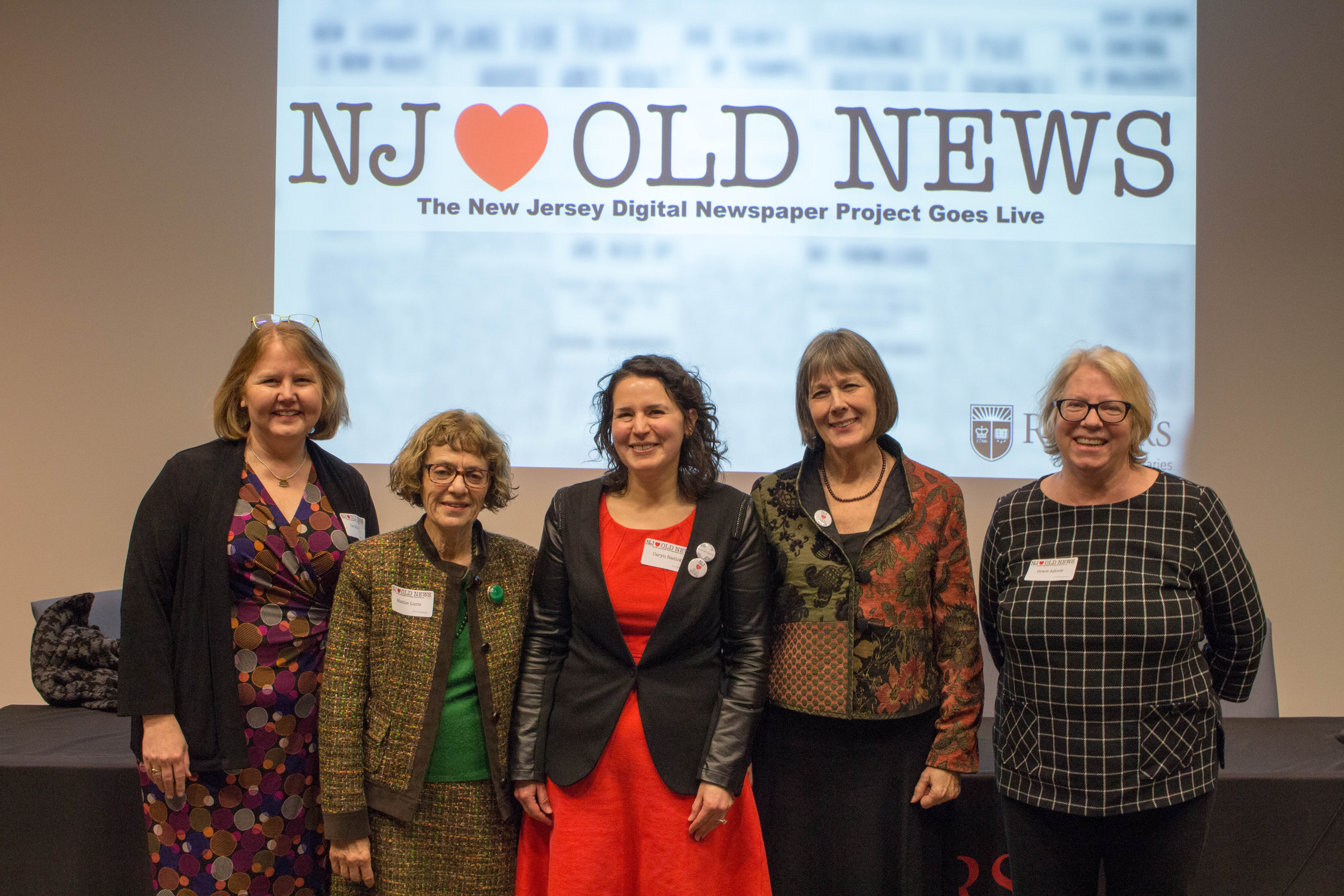
    • Dee Magnoni, Maxine Lurie, Caryn Radick, Mary Chute, and Grace Agnew at the NJDNP launch celebration.
      Dee Magnoni, Maxine Lurie, Caryn Radick, Mary Chute, and Grace Agnew at the NJDNP launch celebration.

    During the proceedings, state librarian Mary Chute read a letter on behalf of Congressman Frank Pallone, which said in part: “I would like to commend the New Jersey State Library, Rutgers University Libraries and the New Jersey State Archives for undertaking this important project. Here in New Jersey we have a rich history and innumerable contributions in science, innovation, politics and the humanities. The digitization of these newspapers will provide user friendly access of these historical records to all individuals across the globe. I am proud that The Perth Amboy Evening News is the first New Jersey newspaper available through this invaluable project.”

    Read more about the project in our press release.
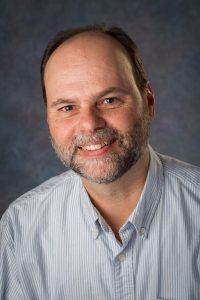
    Robeson Library's John Maxymuk has authored more than a dozen books on professional football.
    John Maxymuk.
    Catching up with the Libraries’ NFL Expert

    Paul Robeson Library’s John Maxymuk has authored over a dozen books about the history of the NFL in addition to an entry on professional football in the Encyclopedia of Greater Philadelphia? In advance of Super Bowl LII this weekend, we caught up with John to discuss his love of football and penchant for research—and, of course, whether the Eagles stand a chance against Tom Brady and the Patriots.

    A New Look for the IJS
    The new IJS logo.
    The new IJS logo.

    The Institute of Jazz Studies recently unveiled a new logotype, which you can view on our visual identity resources website. Congrats to our colleagues at the IJS for adopting this fresh new look!

    What’s Happening is the Libraries’ monthly events enewsletter.
    Do You Know What’s Happening?

    Did you know we publish a monthly enewsletter of events happening around the Libraries? If not, check out this month’s edition to see what you’ve been missing and feel free to subscribe!

    Do you have an upcoming exhibit, workshop, or other event that you’d like the world to know about? Submit it at https://www.libraries.rutgers.edu/events and we’ll include it in forthcoming issues of the newsletter.
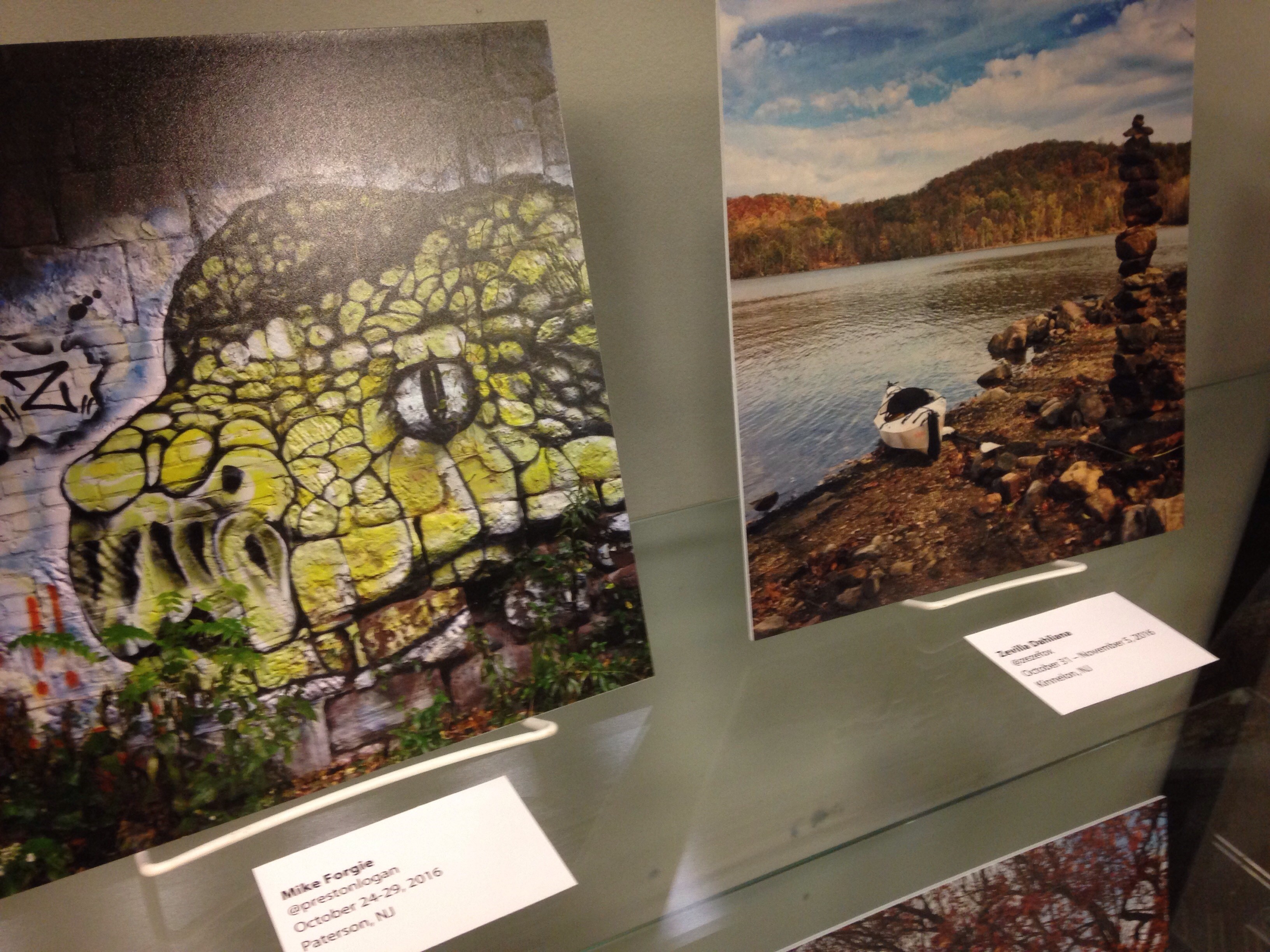
    The Jersey Collective exhibit at Robeson Library. Credit: John Powell.
    The Jersey Collective exhibit at Robeson Library. Credit: John Powell.
    Closing Soon: Catch These Displays while You Still Can!

    Jersey Collective: The Third Year @ Robeson Library through February 9

    Milton to Milton: The Legacy of J. Milton French @ Alexander Library through February 28

    Save

    Save

  • What’s Happening around Rutgers? February 2018

    M.K. Asante, author of the critically acclaimed Buck: A Memoir, will present the Ida B. Wells-Barnett keynote lecture on February 1 as part of Rutgers–Camden's Black History Month celebration.
    M.K. Asante, author of the critically acclaimed Buck: A Memoir, will present the Ida B. Wells-Barnett keynote lecture on February 1 as part of Rutgers–Camden’s Black History Month celebration.
    Celebrate Black History Month at Rutgers–Camden

    A series of activities will celebrate cultural diversity at Rutgers University–Camden throughout Black History Month in February.

    Thursday, February 1 The Africana Studies Program will kick off Black History Month 2018 with a presentation by Sandra Turner-Barnes titled “Critical, Little Known Truths, Regarding African Enslavement within the State of New Jersey,” in the Multi-Purpose Room, located on the main level of the Campus Center. Turner-Barnes serves as executive director of the Camden County Cultural and Heritage Commission.

    M.K. Asante, author of the critically acclaimed Buck: A Memoir, will present the Ida B. Wells-Barnett keynote lecture at 6 p.m. in the Multi-Purpose Room, located on the main level of the Campus Center. Asante is a bestselling author, award-winning filmmaker, recording artist, and professor whom CNN calls “a master storyteller and major creative force.” Registration is encouraged. For more information or to register, visit go.rutgers.edu/nd4842au

    Sunday, February 11

    The Black Catholics and Cultural Diversity Ministry will host the “Tri-State Catholic Gospel Concert featuring Choirs from Delaware, Pennsylvania, and New Jersey” at 3 p.m. in the Walter K. Gordon Theater, located in the Fine Arts Complex. To reserve a seat, visit rudioceseconcert.eventbrite.com or contact James Andrews at (856) 583-2907 or Rev. Richard Owens at (215) 587-3541.

    Monday, February 12

    The Africana Studies Program will host a screening and discussion of the film Timbuktu at 6 p.m. in the Viewing Room, located on the lower level of the Campus Center.

    All events are free of charge and open to the public. For more information, visit the Camden News Now website.

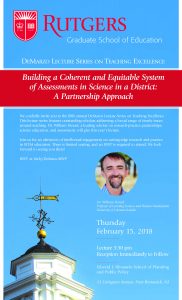
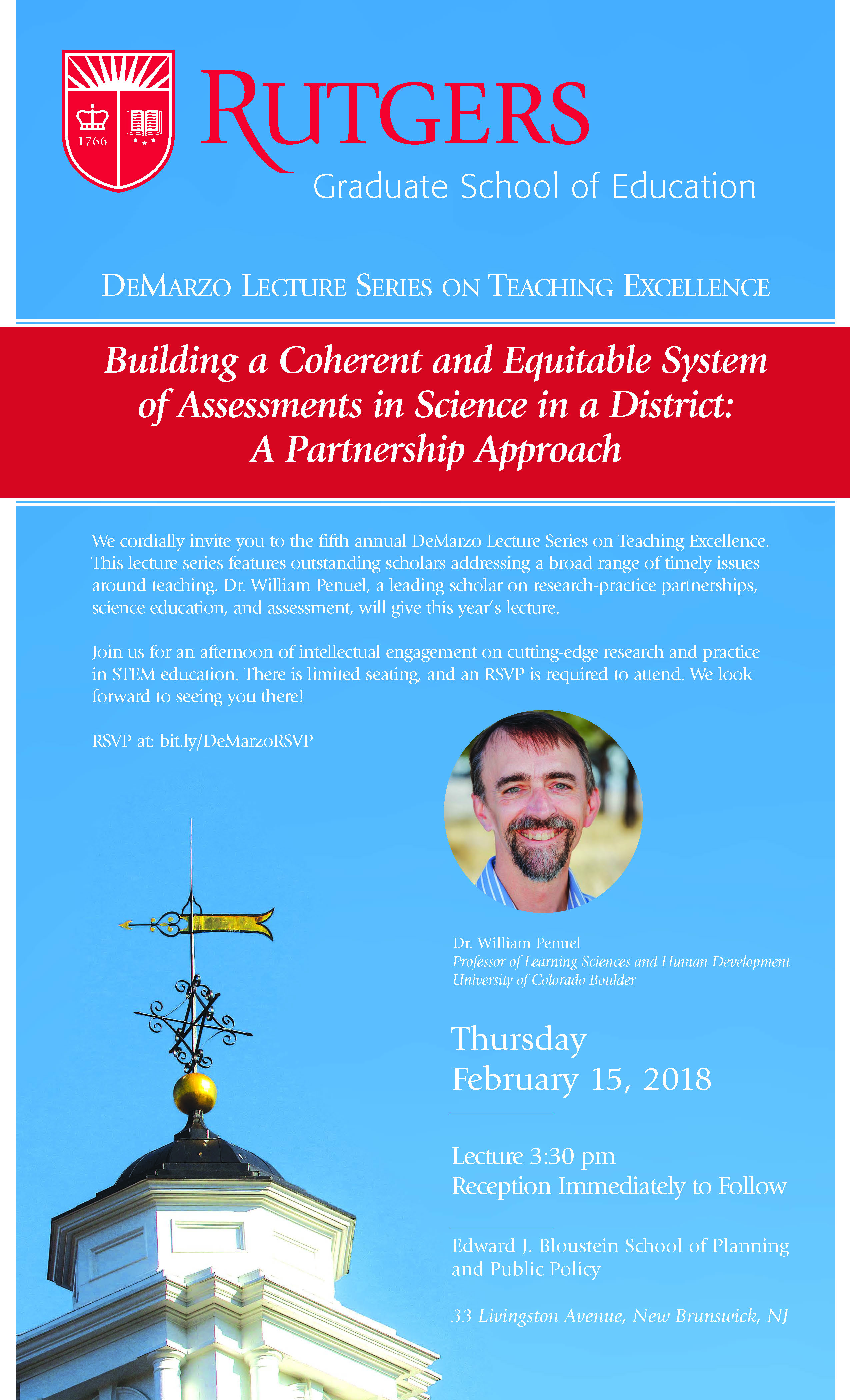
    Join the Graduate School of Education for the DeMarzo Lecture on Teaching Excellence on February 15.
    Join the Graduate School of Education for the DeMarzo Lecture on Teaching Excellence on February 15.
    Building a Coherent and Equitable System of Assessments in Science in a District: A Partnership Approach

    Thursday, February 15
    3:30–5:30 p.m.
    Bloustein School, Rutgers–New Brunswick

    The Graduate School of Education cordially invites you to the fifth annual DeMarzo Lecture Series on Teaching Excellence. This lecture series features outstanding scholars addressing a broad range of issues around teaching. Dr. William Penuel, professor of Learning Sciences and Human Development in the School of Education at the University of Colorado Boulder, will give this year’s lecture.

    In this talk, Professor Penuel will describe the ongoing efforts of a research-practice partnership between Denver Public Schools and the University of Colorado Boulder to create a more coherent and equitable system of classroom and district-based assessments of students in science.

    Seats are limited, so if you plan to attend, please visit the Graduate School of Education’s website to RSVP.

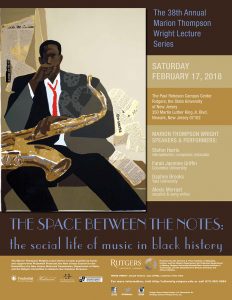
    The 38th annual Marion Thompson Wright Lecture will be held at Rutgers–Newark on February 17.
    The 38th annual Marion Thompson Wright Lecture will be held at Rutgers–Newark on February 17.
    The Space Between the Notes: The Social Life of Music in Black History

    Saturday, February 17
    9:30 a.m. – 3:30 p.m.
    Paul Robeson Campus Center, Rutgers–Newark

    The 38th entry in the Marion Thompson Wright Lecture Series weaves together the academic and the artistic to explore the social roles of music in black history. Speakers and performers will delve into the history and current state of music in the black diaspora from a variety of angles. At a time when artistic production is so closely interwoven with Newark’s continued development, we seek to draw lessons from music’s history of helping imagine and create a more inclusive and just city, nation, and world. Together, the featured speakers and performers will offer a profound demonstration of music’s power to forge community, provide refuge in troubled times, and move us toward better futures. This year, we have an amazing lineup of speakers including: Stefon Harris, Farah Jasmine Griffin, Daphne Brooks, and performance by Alexis Jessica Morrast. Admission is free and open to the public. For more information, visit the Newark College of Arts and Sciences website.

    Douglass Library is the locus for the States of Incarceration conference, which starts on February 28 and draws in partners from across Rutgers–New Brunswick.
    Douglass Library is the locus for the States of Incarceration conference, which starts on February 28 and draws in partners from across Rutgers–New Brunswick.
    States of Incarceration Conference

    Wednesday, February 28–March 2
    Rutgers Cinema, Douglass Library
    Rutgers–New Brunswick

    States of Incarceration is an exhibition and series of programs created by over 500 students and community partners in 17 states, including participants from Rutgers University–New Brunswick and Rutgers University–Newark. The exhibit explores the roots of mass incarceration in the United States through local case studies and opens a dialogue on what must happen next.

    Conference events and programming explore themes related to the different components of the States of Incarceration exhibit. In particular, they highlight subjects connected to the history of Seabrook Farms, the focus of Rutgers–New Brunswick students’ contribution to the exhibit.

    A frozen-foods agribusiness in Cumberland County, New Jersey, during World War II Seabrook Farms recruited 2,500 incarcerated Japanese Americans released on parole from so-called internment camps in the western interior of the United States. Seabrook Farms would also employ guestworkers from the British West Indies, migrant workers from the United States South, Japanese Peruvians imprisoned by the United States, and, after the war, Estonian refugees from displaced persons camps in Germany.

    Events and panels seek to explore not only the history of Seabrook Farms and Japanese Americans’ incarceration, but also the issues that agricultural workers—who are mainly immigrants—face today.

    The schedule includes a screening/director Q&A of documentary film Resistance at Tule Lake; tours of the States of Incarceration exhibit; a production of the play The Castle; panel discussions on agricultural workers and incarceration; and a plenary by John Seabrook, grandson of the founder of Seabrook Farms.

    The conference is free and open to the public. For more information or to register, visit the States of Incarceration website.

  • State of the Libraries Recap

    State of the Libraries Recap

    This month, I just want to express my gratitude once again to everyone who helped make State of the Libraries so special. From the major events committee to the poster presenters to those of you in the audience–our colleagues are what make this a great event. For 2017, we experimented with the format of the event in several ways, introducing new elements while also retaining what makes this such a special event. In a significant departure, we invited an external speaker to visit us and discuss unconscious bias works and what we can do to mitigate its influence in the Libraries. Calvin Lai’s presentation was as entertaining as it was informative, and it is my sincerest hope that it helps us to better appreciate and accommodate diversity and inclusion in what we do.

    I hope everyone who attended had a chance to tour the always-popular poster session. It is fitting that at the close of the year, we get to survey the many great activities and initiatives underway at the Libraries. From Libraries-wide initiatives like ORCID and the Open and Affordable Textbook Program to the exhibits program at Robeson and the enhanced coin scanning project from the Digital Humanities Lab–these posters are a reminder of the positive impact we have on the university and the work of the Libraries. For those who were unable to attend or did not make it around to see all the posters, the communications team has recorded short videos with the presenters that can be viewed on YouTube (see below). Also, a special note of thanks to Dee Magnoni and James Hartstein who provided professional quality printing for the posters. They looked great!

    There will be much more to say in the coming months, but for now, I want to wish you all a happy New Year! We have so much to look forward to in 2018.


  • Ex Libris Implementation Project Update – January 2018

    Ex Libris Implementation Project Update – January 2018

    Ex Libris website screenThe entire Ex Libris Implementation Team attended the State of the Libraries on December 6 and appreciated the opportunity to engage library faculty and staff there. We thank everyone who came to our table and talked to us about the project. Congratulations again to those lucky winners of prizes!

    This project update focuses on the major progress made in December. In our previous update, we described the three stages of implementing Alma and Primo–Define, Build, and Deploy. For the Libraries’ Implementation Team, the numerous tasks in those three stages generally fall into two categories: working on data migration and system integration in tandem with Ex Libris and developing two-way communication channels and training opportunities for the library (and eventually university) community. We are pleased to report that significant progress has been made on both fronts in December.

    Project Website

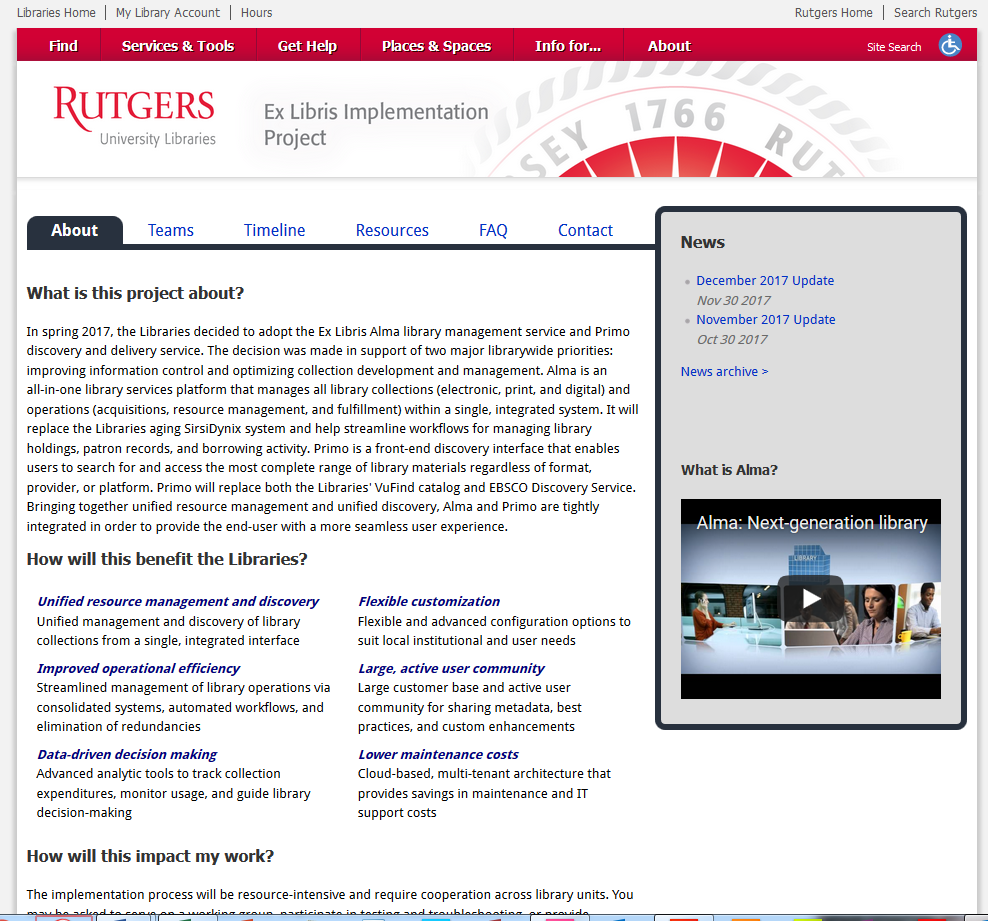
    In early December, we unveiled a new website for the Ex Libris Implementation Project, at http://exlibris.libraries.rutgers.edu. As the information hub for the project, the website includes the following pages:

    • About – Introduction to the project, benefits to the Libraries, and impact on library workers
    • Teams – Membership of the project team and responsibilities of the working groups
    • Timeline – Major milestones from the planning to the formal launch on June 1, 2018
    • Resources – Basic training resources, research & case studies, and team meeting minutes
    • FAQ – Answers to questions such as what is Alma and what is Primo
    • Contact – An online form for library faculty and staff to send questions and comments to the project team

    The site will grow significantly in scope and detail as the project progresses and more information becomes available. Please remember to check back from time to time to see what is new or use the contact form for questions and comments. We thank everyone who made this site possible, including members of the Implementation Team (especially Joseph Deodato and Chad Mills), Jessica Pellien, and the Web Team of IIS.

    Migration Forms

    As of this writing, the Implementation Team and several working groups are working tirelessly on completing the forms for Symphony (SIRSI) to Alma and EBSCO to Primo migrations. These lengthy forms define the test data load and take a lot of time and care to fill out. Our immediate objective is to turn in the forms on December 22 for our Ex Libris partners to review during the university’s holiday break. To meet this deadline, lately the Implementation Team has been meeting twice or three times a week on the forms. Some team members work late in the office and others take work home. We have also actively sought the input from colleagues in Access, Collection, and Technical Services, in addition to consulting with Ex Libris.

    The process of completing the migration forms exemplifies the spirit of teamwork. Besides two point persons for the forms—Chris Sterback and Gracemary Smulewitz, all the other team members have contributed time, energy, and expertise to the process. It is such an uplifting feeling to see colleagues from different departments of the Libraries working selflessly toward a common goal. We look forward to reporting new accomplishments from this wonderful team of colleagues in 2018.


    Tao Yang and Abbey DiPaolo

    Save

  • What’s Happening around Rutgers? January 2018

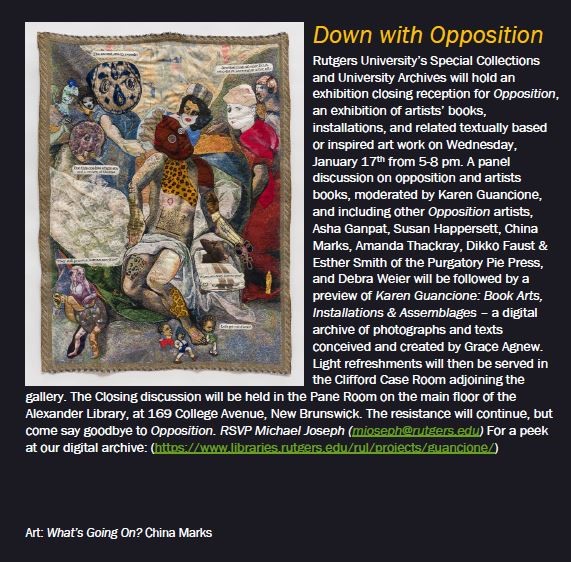
    The closing reception for the Opposition book arts exhibition is slated for January 17.
    The closing reception for the Opposition book arts exhibition is slated for January 17.
    The Opposition Lives On

    Wednesday, January 17
    5:00–7:00 p.m.
    Alexander Library, Rutgers–New Brunswick

    Rutgers University’s Special Collections and University Archives will hold an exhibition closing reception for Opposition, an exhibition of artists’ books, installations, and related textually based or inspired artwork on Wednesday, January 17 from 5 to 7 p.m. Following a panel discussion moderated by Karen Guancione with other Opposition artists including Asha Ganpat, Susan Happersett, China Marks, and Dikko Faust and Esther Smith of the Purgatory Pie Press, and a premiere of Karen Guancione: Book Arts, Installations & Assemblages, a digital archive of photographs and texts conceived by Grace Agnew, we will serve light refreshments in a room adjoining the gallery. The Closing discussion will be held in the Pane Room on the main floor of the Alexander Library, at 169 College Avenue, New Brunswick. The resistance will continue, but come say goodbye to Opposition. RSVP to Michael Joseph (mjoseph@rutgers.edu). For a peek at our digital archive visit https://www.libraries.rutgers.edu/rul/projects/guancione/.

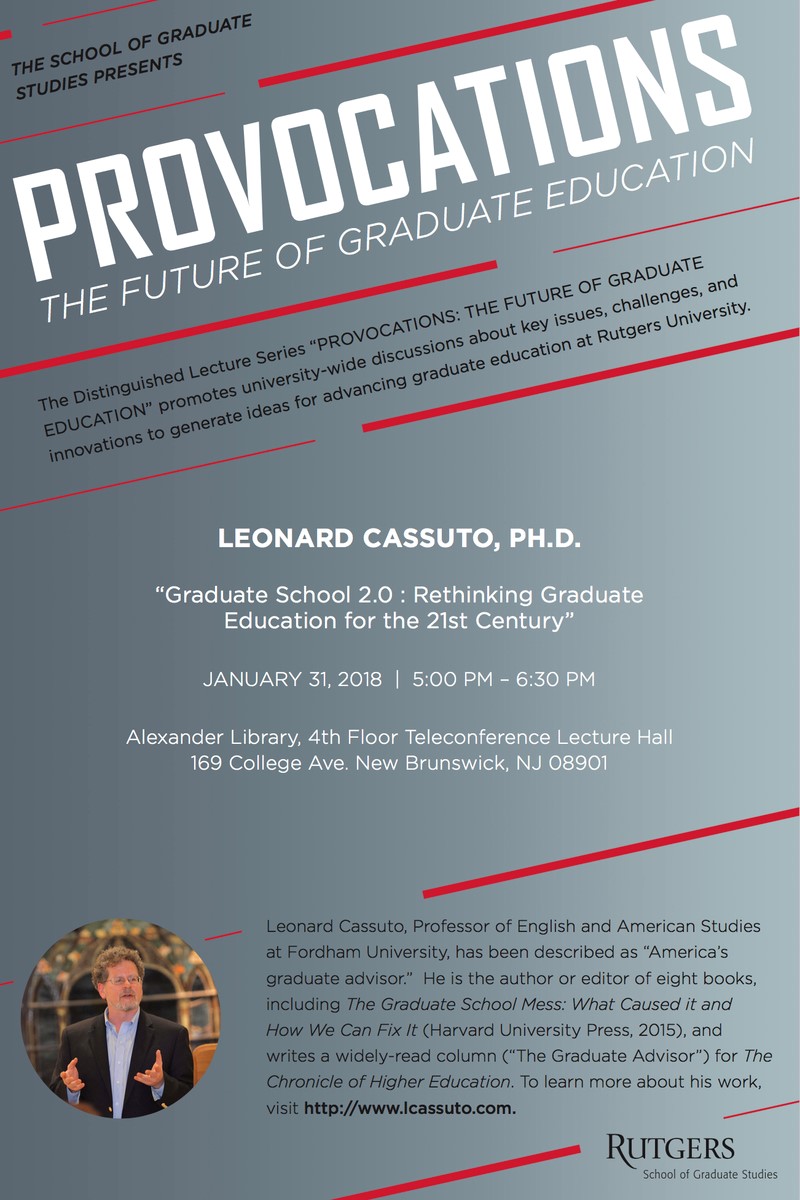
    Lenoard Cassuto will discuss 21st century graduate education on January 31.
    Lenoard Cassuto will discuss 21st century graduate education on January 31.
    The Future of Graduate Education

    Wednesday, January 31
    5:00–6:30 p.m.
    Alexander Library, Rutgers–New Brunswick

    This semester, the School of Graduate Studies is inaugurating a new lecture series titled Provocations: The Future of Graduate Education to promote universitywide discussions about key issues, challenges, and innovations to generate ideas for advancing graduate education at Rutgers. Leonard Cassuto, professor of English and American studies at Fordham University, will present a talk titled “Graduate School 2.0: Rethinking Graduate Education for the 21st Century.” This will be an interdisciplinary discussion open to all students, faculty, and staff at Rutgers.

    On Campus over Break? So Is the Zimmerli!

    Tuesdays through Fridays: 10 a.m. to 4:30 p.m.
    Saturdays and Sundays: Noon to 5 p.m.
    First Tuesday of each moth: 10 a.m. to 9 p.m.
    Zimmerli Art Museum, Rutgers–New Brunswick

    Visit the exhibitions Subjective Objective: A Century of Social Photography, On the Prowl: Cats and Dogs in French Prints, and Absence and Trace: The Dematerialized Image in Contemporary Art before they close on January 7.

    Looking for a preview? Place on Stone: Nineteenth-Century Landscape Lithographs is set to open on January 13. For more information, visit the Zimmerli Art Museum website.

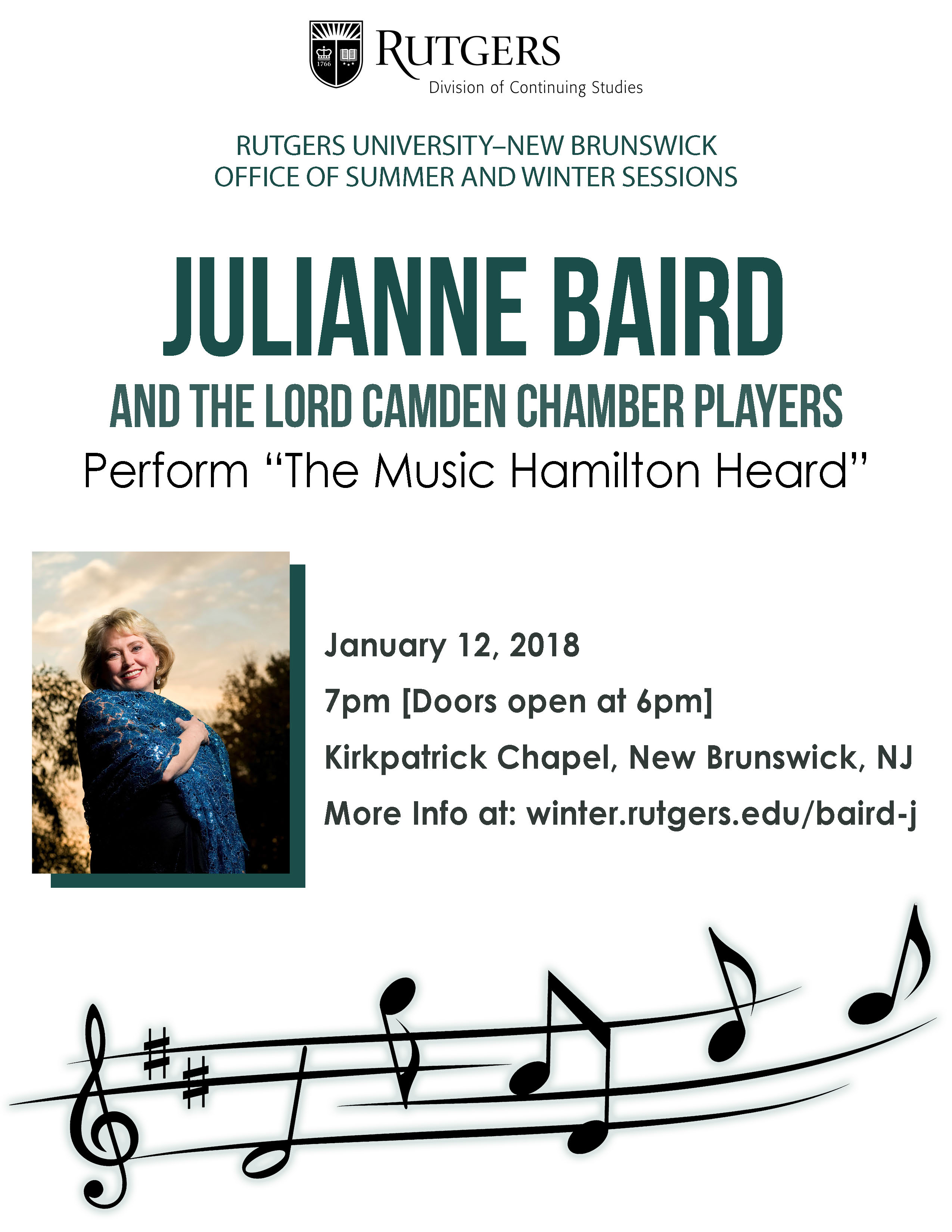
    Rutgers–Camden's Julianne Baird will lead a special performance of "The Music Hamilton Heard" at Kirkpatrick Chapel on January 12.
    Rutgers–Camden’s Julianne Baird will lead a special performance of “The Music Hamilton Heard” at Kirkpatrick Chapel on January 12.
    The Music Hamilton Heard

    Friday, January 12
    7:00 p.m.
    Kirkpatrick Chapel, Rutgers–New Brunswick

    Join Rutgers’ Division of Continuing Studies at Kirkpatrick Chapel for a special concert with internationally renowned soprano and Rutgers–Camden Distinguished Professor of Music Julianne Baird and the Lord Camden Chamber Players as they perform the pieces enjoyed by the Founding Fathers of the United States.

    Led by Dr. Baird, the Lord Camden Chamber Players will perform the music that our great founder actually enjoyed. As the United States embarked on its first steps into the world of nations, its composers and artists began to express what Ben Franklin called, “the American Muse.”

    Tickets are $10 for Rutgers students, $15 for Rutgers faculty and staff, and $20 for the public. Visit the Division of Continuing Studies website for more information.

    Lemony Snicket’s Bewildering Circumstances: An Evening with Daniel Handler
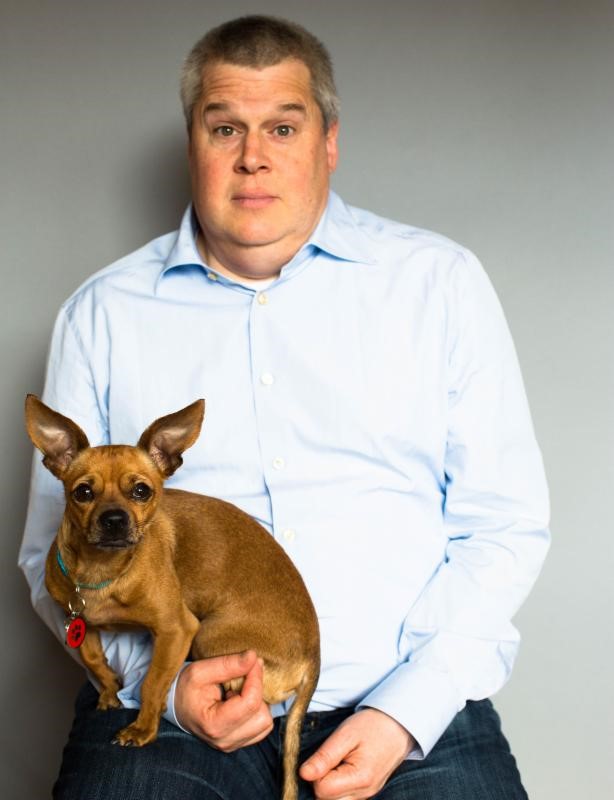
    Daniel Handler aka Lemony Snicket comes to Rutgers–New Brunswick on Saturday, January 13.
    Daniel Handler aka Lemony Snicket comes to Rutgers–New Brunswick on Saturday, January 13.

    Saturday, January 13
    6:00 p.m.
    College Avenue Student Center, Rutgers–New Brunswick

    Novelist Daniel Handler, known to despairing readers everywhere as Lemony Snicket, attempts to chart a course from the troubling questions of his childhood to the literary success of his adult life, with the sinking feeling that these are actually the same thing. How do the questions that haunt us as children lead us into our supposed adulthood? Mr. Handler will either answer this question or explain why he can’t.

    Tickets are $10 for Rutgers students and come with a free book! $15 for Rutgers faculty or staff; $20 for general public. For more information, visit the Division of Continuing Studies website.

    The Big Read Lecture Series: School of Nursing Faculty

    Wednesday, January 31
    5–7 p.m.
    Location TBD, Rutgers–Camden

    A cross-section of School of Nursing faculty researchers will discuss health equity through the lens of Citizen: An American Lyric. Panelists include: Patricia Supplee, PhD, RNC-OB studies maternal health in low-income urban communities and the healthcare needs of African-American women and families; Rashida Atkins, PhD, APNc studies depression in black single mothers, healthcare disparities, and develops evidence-based interventions; and Bonnie Jerome-D’Emilia PhD, MPH, RN studies health disparities associated with breast cancer screening, diagnoses and treatment. For the latest information, visit the Rutgers–Camden Center for the Arts website.

    Join the Graduate School of Education for the DeMarzo Lecture on Teaching Excellence on February 15.
    Join the Graduate School of Education for the DeMarzo Lecture on Teaching Excellence on February 15.
    Building a Coherent and Equitable System of Assessments in Science in a District: A Partnership Approach

    Thursday, February 15
    3:30–5:30 p.m.
    Bloustein School, Rutgers–New Brunswick

    The Graduate School of Education cordially invites you to the fifth annual DeMarzo Lecture Series on Teaching Excellence. This lecture series features outstanding scholars addressing a broad range of issues around teaching. Dr. William Penuel, professor of Learning Sciences and Human Development in the School of Education at the University of Colorado Boulder, will give this year’s lecture.

    In this talk, Professor Penuel will describe the ongoing efforts of a research-practice partnership between Denver Public Schools and the University of Colorado Boulder to create a more coherent and equitable system of classroom and district-based assessments of students in science.

    Seats are limited, so if you plan to attend, please visit the Graduate School of Education’s website to RSVP.

  • This month in the Agenda: January 1998

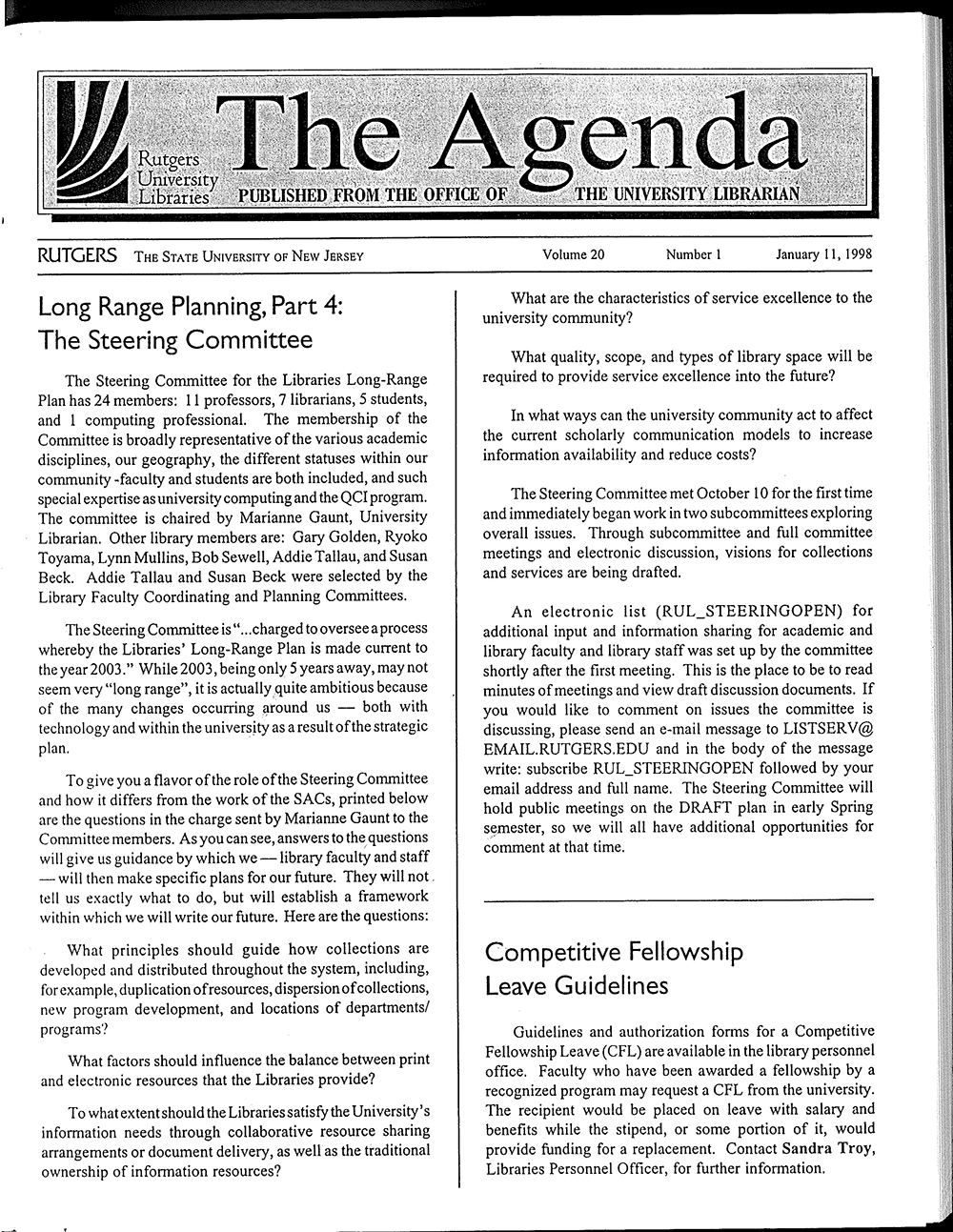
    The January 11, 1998 edition of the Agenda.
    The January 11, 1998 edition of the Agenda.

    This month, we go back two decades in the Agenda’s history to January 1998. The median household income was about $38,000; the world was ramping up for the Winter Olympics in Nagano, Japan; and we’d see blockbusters Armageddon, Titanic, and Saving Private Ryan all hit the box office over the course of the year. How did we ring in the New Year at the Libraries?

    Asking the Big Questions

    [P]rinted below are the questions in the charge [of the Steering Committee for the Libraries Long-Range Plan]…. As you can see, answers to the questions will give us guidance by which we—library faculty and staff—will then make specific plans for our future….

    What principles should guide how collections are developed and distributed throughout the system, including, for example, duplication of resources, dispersion of collections, new program development, and locations of departments/programs?

    What factors should influence the balance between print and electronic resources that the Libraries provide?

    To what extent should the Libraries satisfy the University’s information needs through collaborative resource sharing arrangements or document delivery, as well as the traditional ownership of information resources?

    What are the characteristics of service excellence to the university community?

    What quality, scope, and types of library space will be required to provide service excellence into the future?

    In what ways can the university community act to affect the current scholarly communication models to increase information availability and reduce costs?

    – The Agenda 20, no. 1 (January 11, 1998)

    Authority Is Constructed and Contextual

    At long last, the Rutgers library catalog will have full authority control for all name and series headings. The recently established LIS-Authority Committee is now investigating Sirsi policies for the implementation of authority functions and beginning a search for the vendor which will provide the best services. It will be writing an RFP (Request for Proposal) for authority control processing this spring, with an eye toward selecting a vendor in the early summer. The Committee, chaired by Rhonda Marker of TAS, welcomes all suggestions, wish-lists, and caveats from the library community regarding either vendors or online authority work.

    – The Agenda 20, no. 1 (January 11, 1998)

    Freshening Up

    The Libraries have recently received an allocation from University VP Joseph Seneca of $92,695 to upgrade academic facilities as part of the “Reinvesting in Rutgers” initiative the President announced in his state of the university message.

    The Libraries submitted a proposal as part of the academic facilities upgrade component of this initiative. The specific projects that were funded include upgrading the Mathematical Sciences library facilities (carpeting, draperies, acoustical buffers, etc.); replacing the telephone and wiring infrastructure at the Kilmer Library; and upgrading voice wiring at Douglass.

    In addition, Media Services was allocated $1.7 million to upgrade the smart classrooms on the New Brunswick campus and to improve the Kilmer Library media classrooms.

    Decisions regarding programs to be funded on the Newark and Camden campuses facilities are being handled through their respective provosts, who have not yet reported.

    – The Agenda 20, no. 2 (January 25, 1998)


  • We Are Not Alone – Thoughts on the BTAA Meeting

    We Are Not Alone – Thoughts on the BTAA Meeting

    I know that we spend a lot of time focused on building infrastructure. Our top priorities involve undergraduate success and strengthening information control to ensure that our users have efficient, reliable access to information resources.

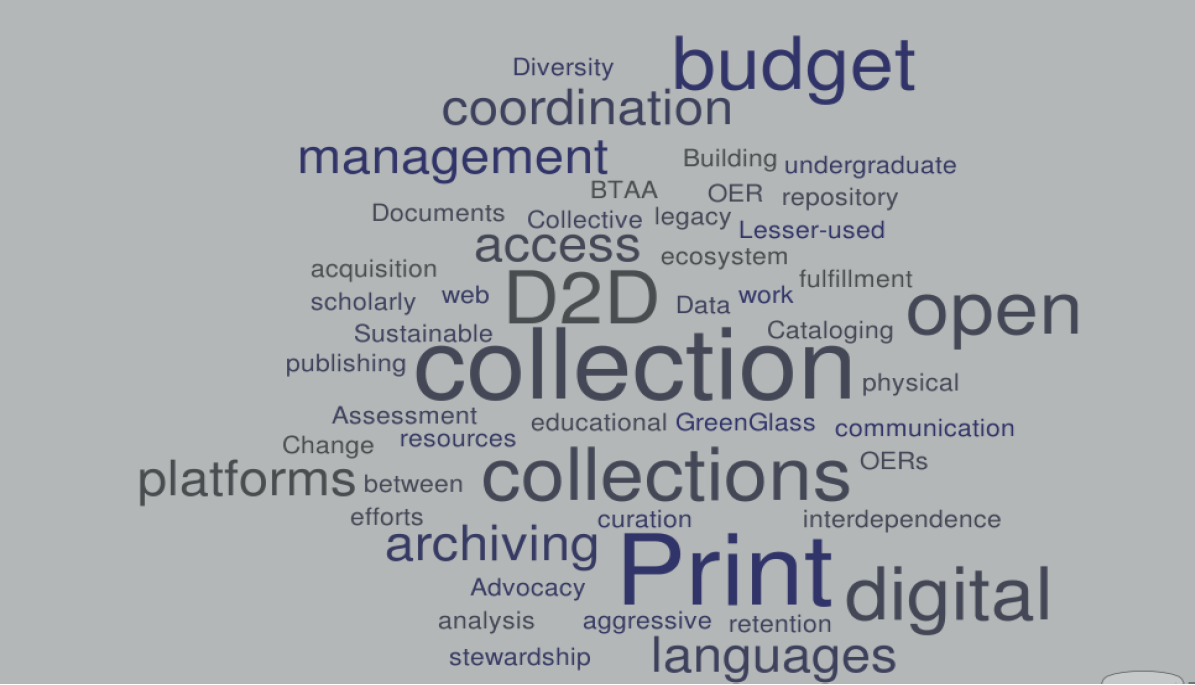
    I just got back from a Big10 meeting at Purdue. At the meeting, we reviewed the results of a survey of the BTAA library directors’ top priorities for future collaborative activities. Each director picked three areas of interest. The results:

    • Collection Management 54%
    • Student Success Measures 46%
    • OER 46%
    • Data Management/Curation 38%
    • Analytics/Assessment 38%
    • Open Access 15%

    The remaining four items: Special Collections, Professional Development, Digital Humanities, and Library Publishing all were 8%.

    In another part of the survey, the directors listed the most important BTAA initiatives as Discovery to Delivery, Collections Infrastructure and Management, and Student Success.

    Although these priorities and initiatives do not represent the most important work of the libraries, the selections do say something about initiatives that are most effective when done ‘at scale’ with the broader community. As I listened to my colleagues share their experiences and challenges, it struck me that we are not the only research library that is focusing on basics.

    In a meeting back here at Rutgers, Judy Cohn brought up the NMC Horizon Report: 2017 Library Edition. This report from the New Media Consortium looks at trends in libraries, technology, and education to imagine what is on the five-year horizon for academic and research libraries. It is produced in collaboration with University of Applied Sciences (HTW) Chur, Technische Informationsbibliothek (TIB), ETH Library, and the Association of College & Research Libraries (ACRL). It identifies trends, challenges, and developments in technology that will impact how libraries plan to meet the needs of their users, how we function day to day and year to year, and the services that will be in highest demand. The first of the top 10 highlights listed was:

    Libraries remain the gatekeepers to rich tapestries of information and knowledge. As the volume of we resources increases, libraries are charged with finding new ways to organize and disseminate research to make it easier to discover, digest, and track.

    It was surprised to see that improving ‘information control’ was featured so prominently in the report. It seems that academic and research libraries have a renewed focus on the fundamentals and are redesigning infrastructure so that it better meets the changes in the environment. I know there are times when we feel like we are behind; however, it appears that we are actually in sync with many of our peers.

    Over the next week, we will have meetings with Office of Information Technology and the Office of Research and Economic Development to discuss potential collaboration on research and digital humanities infrastructure. This will move us closer to another one of our priorities: identifying and communicating our role in the broader research environment of Rutgers. We are making progress!

    While we are moving fast, our activities continue to be guided by the expertise and research of our colleagues. There are several examples of this that come to mind, all with librarywide participation. The Discovery Working Group has offered a model of how to harness data and best practices to make impactful changes in how our users discover and access collections via our website. Their work continues to propel us forward, even as the Ex Libris Implementation Team works to create nimble and knowledgeable teams to accommodate the anticipated workload over the next 7 months. And the Website Improvement Team is rolling out an impressive, incremental website refresh derived from extensive user research and analytics. The work that we are doing now will pay off in the coming years with flexible and easy to manage systems. It is my hope that these changes will make it easier for you to do the important work that you do.

    As we move into the holiday season, I would like to thank you for your dedication and patience. It has been a difficult few years of change in response to the new environment, but, thanks to your efforts, these challenges continue to be met with creativity, hard work, and shared purpose. Your dedication to Rutgers, our students, and our faculty is impressive and collectively, we are creating libraries—digital and physical—that encourage learning and exploration and support to the success of our users. I am very grateful to count you all as my colleagues and I wish you and your families the happiest of holidays and all the best for the New Year!

    Save

    Save

  • Web Improvement Team Update

    Web Improvement Team Update

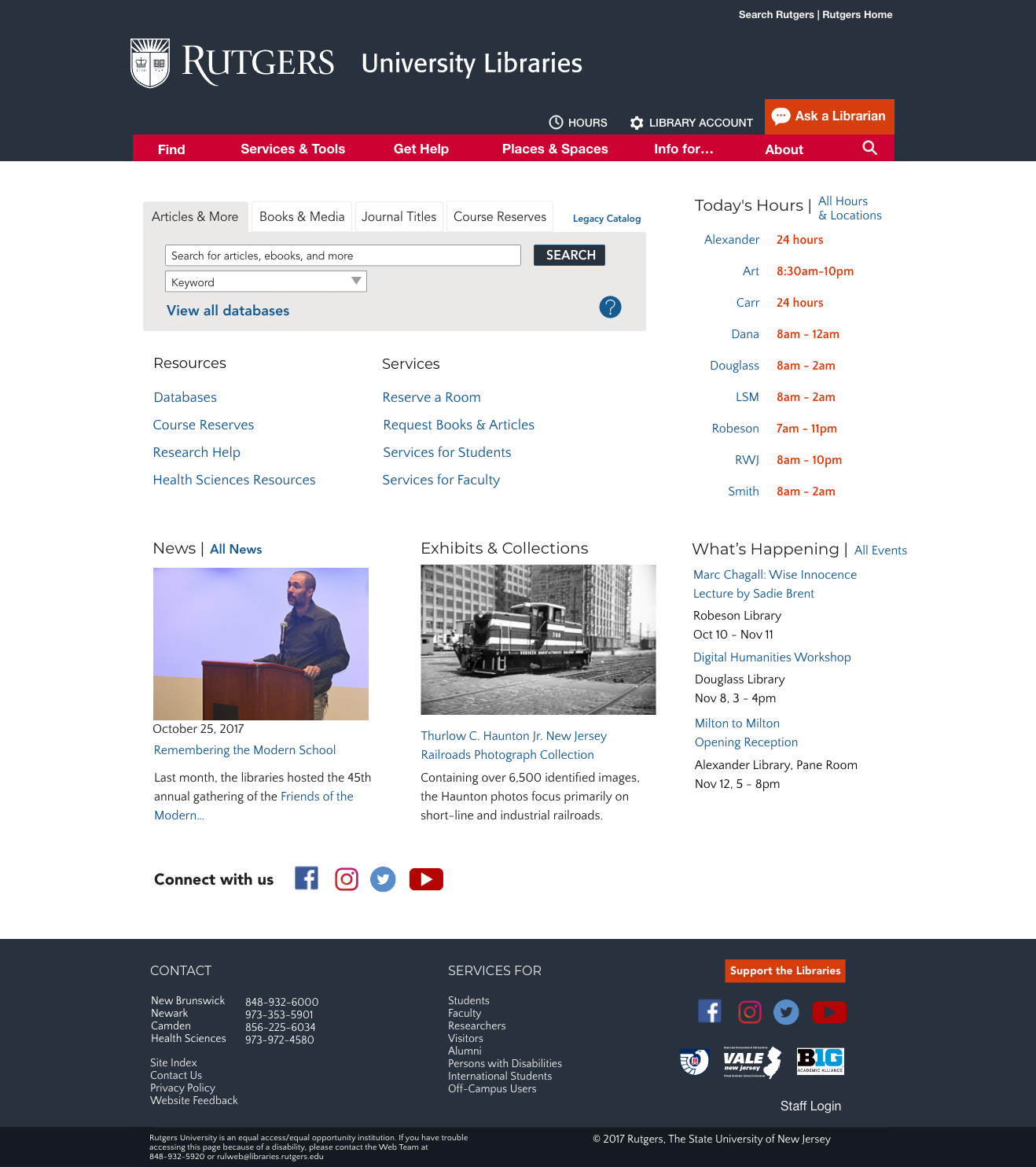
    sample of website refresh
    Click to view larger file.

    The Web Improvement Team (WIT) is excited to announce some changes coming soon to the Rutgers University Libraries website. Since September, we’ve been speaking with our users (students, faculty, and staff) and analyzing survey and usage data to determine how we can begin to improve our website user experience. We’ve been exploring best practices for user-centered design, content strategy, responsive design, and accessibility. Through one-on-one conversations, focus groups, and data analysis, we have learned more about our users’ essential tasks and resources, pain points in the current design, and user preferences.

    Here are some of the takeaways from our first round of user research:

    • Users are very task-oriented, and generally come to the site knowing what they want; the scope of their use is quite narrow
    • The current homepage was thought to be too busy and complex
    • Pages are hard to read, with small text and too much content
    • Users spend very little time on most pages, and rarely scroll below “the fold”
    • A relatively small number of resources are especially heavily used (hours, room booking, A-Z database list, ILL, library account)

    We based our first round of changes on these findings. Our goals became to:

    • Surface and prioritize the most frequently used resources and services
    • Freshen up the look and feel: reduce visual clutter on the homepage, enlarge fonts for sitewide readability
    • Refine the presentation and content for a few key pages
    • Minimize initial disruption to lower-level pages

    Our overall approach is one of incremental change over radical redesign. Making incremental modifications based on user data ensures that those modifications are genuine improvements (as opposed to change for the sake of change, or change based on guesses or assumptions). If we’re proven wrong, smaller changes are easily reversed or refined. Although change can be uncomfortable at times, a continuous cycle of improvement and evaluation builds a sustainable, usable website that delivers a positive user experience.

    You’ll also notice that a lot of things haven’t changed: the red navigation bar, most of the underlying content, the mobile presence. These, too, will change in time, but require considerable user research, usability testing, and content control. There will be opportunities for students, staff, and faculty to get involved in future research.

    The new website is expected to be in place by late December, in time to greet students in the new semester.

    Stop by our poster at the State of the Libraries if you want to learn more!

    Save

    Save

  • Ex Libris Implementation Project Update – December 2017

    Ex Libris Implementation Project Update – December 2017

    In this second update on the Ex Libris Implementation Project, we report on a major milestone achieved in November – the completion of organizational planning. In early December the project will transition from the pre-implementation to implementation stage, so this update also introduces the timeline from December to June, focusing on the three key phases of implementation – Define, Build, and Deploy.

    Completion of Organizational Planning

    Cabinet recently approved a proposal to form several working groups connected to the Implementation Team, marking the completion of organizational planning for the project. As reported last month, the Implementation Team was created in late September and includes seven members from the infrastructure units of the Libraries. Reporting directly to the University Librarian, the team functions as the coordinating body of the project. The working groups will provide expert input to the Implementation Team, organize workflow reviews, testing, and training in their focus areas, and involve library faculty and staff in the implementation process. The team appoints team members to liaise with the working groups to facilitate two-way communications.

    Here is a list of working groups and their membership:

    Working Group Implementation Team Liaison(s) Membership
    Acquisitions Abbey DiPaolo Dominique Dixon, Megan O’Connor/Kati Ritter, Cathy Pecoraro/Rita Wells, Gracemary Smulewitz, Lucy Vidal, Mary Beth Weber
    Data Migration and System Integration Chris Sterback & Chad Mills (co-liaisons) Fengzhi Fan, Dave Hoover, Bob Warwick
    Digital Chad Mills Isaiah Beard, Kalaivani Ananthan, Jane Otto
    Discovery Joseph Deodato Discovery Working Group*
    E-Resources Gracemary Smulewitz Michelle Best, Paul Cabelli, Cathy Pecoraro, Lucy Vidal, Geoff Wood, Tao Yang
    Fulfillment Chris Sterback Access Services Committee*
    Interlibrary Loan Gracemary Smulewitz Abbey DiPaolo, Orla Mejia, Glenn Sandberg
    Resource Management Mary Beth Weber Colin Bitter, Jamie Smith, Geoff Wood, Tao Yang

    (* indicating existing groups)

    The Discovery Working Group and Access Services Committee are existing groups, and the others are newly established. All of the groups have members from multiple departments or units of the Libraries.

    While approving the working groups, Cabinet also made two important points:

    1. The Ex Libris Implementation Project is a top priority that must be completed within the established timeframe. Members of the Implementation Team and working groups are taking on a significant amount of work, so it may be necessary for everyone to adjust the expectations for them in areas unrelated to implementation.
    2. Communicating with library users about potential service interruptions (and enhancements) is an essential component of the implementation project. The Implementation Team will work with the Director of Communications to develop an external communications plan.

    The Implementation Team has also made significant progress on creating a project website and performing data preparation and validation. We hope to describe them in more details at the poster session of the State of the Libraries or in the next monthly update.

    Overview of Implementation Timeline (December – June)

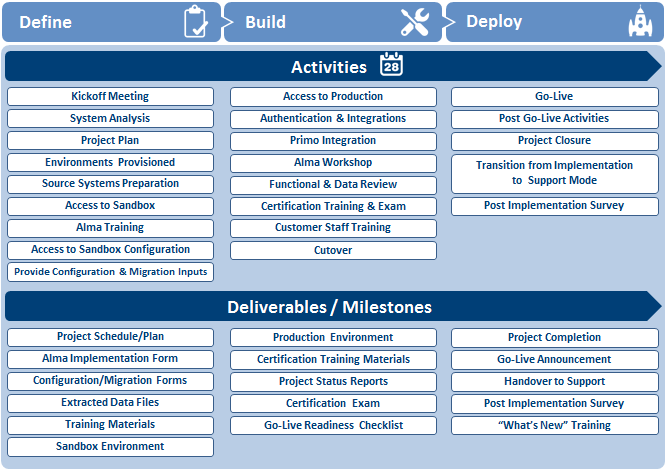
    Ex Libris divides the Alma/Primo implementation process into three phases: Define, Build, and Deploy. During the Define phase for Rutgers (December – early February), the Implementation Team gains access to the standard Alma sandbox environment including standard Ex Libris data and configuration, takes Alma training (including configuration training) via pre-recorded sessions, and then configures the sandbox environment. At the same time, the Libraries continue with data extraction and validation and deliver the data from source systems (Symphony and EDS) based on the Ex Libris specifications for migration to Alma. The Define phase ends with Ex Libris completing the configuration of the Alma production environment with the input from the Rutgers team and a test load of the migrated data.

    During the Build phase (late February – May), the Libraries receive access to both the Alma production environment and Primo environment for functionality review and data testing. Both environments use Rutgers data and configurations and we need to document any necessary modifications for the cutover data load. The Implementation Team works with Ex Libris to define a list of third-party integrations (such as the ILL and Central Authentication Systems). Ex Libris conducts onsite workshops to explain the workflows of the new system. The Implementation Team and working groups also prepare and perform internal staff training. This phase completes with a “freeze” of the source systems (Symphony and EDS). Ex Libris then performs the cutover data load.

    Alma and Primo are scheduled to go live at Rutgers on June 1, which is the Day 1 of the Deploy phase. From June to July, the Implementation Team works closely with Ex Libris to address any issues and support library faculty and staff through their first steps with Alma and Primo in production.

    Additional information about the three phases can be found in this chart published by Ex Libris:

    We look forward to the opportunities to discuss the project with you at the State of the Libraries and other venues. Please do not hesitate to contact us or other Implementation Team members if you have any questions or comments. Thank you!


    Tao Yang & Abbey DiPaolo

    Save

  • Retirement and YOU!

    Retirement and YOU!

    A new year is approaching! If you are thinking about retirement and what is involved in the process you should check out the important on-line links below that offer key information to help you prepare.

    ABP Retirement: Welcome to the Alternate Benefit Program Retirement Seminar Presentation [PDF].

    PERS Retirement: Welcome to the Public Employees’ Retirement System (PERS) Retirement Seminar Presentation [PDF].

    Additionally, UHR offers seminars to both ABP and PERS members contemplating retirement.  If you are interested in attending a seminar, please check the Learning and Development Course Registration System under Employee Benefit and Work-Life Programs managed by University Human Resources.

    Please note: Employees will need to submit an intent to retire letter to their supervisors to advise of the effective date of retirement once they have fully committed to retire.


    Save

    Save

    Save

    Save