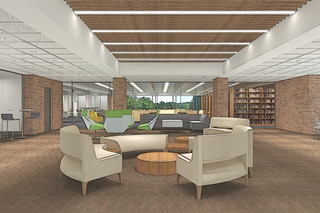
An architect’s rendering of what the new space in LSM.
New Brunswick (NB) and Rutgers Biomedical and Health Sciences (RBHS) are collaborating to upgrade spaces and publicize library services to our users, in particular those from RBHS schools (Robert Wood Johnson Medical School (RWJMS), School of Public Health, Ernest Mario School of Pharmacy, Graduate School of Biomedical Sciences, the Physician Assistants program in the School of Health Professions), in Piscataway. One of the goals in recent draftsof the Libraries master plan for the Library of Science and Medicine (LSM) is to “create a science-focused atmosphere and establish a connection with RBHS.” In addition, the plan includes creating both “dedicated graduate study space,” and “dedicated RBHS study space” within the library.
A plan is in place to encourage RBHS students to identify and use LSM and its resources. Survey data from RWJMS reveals that medical students do not currently identify with the library. The upcoming accreditation at RWJMS (March 5-7, 2018), spurred a feasibility study to upgrade study space and librarian support space at LSM to better serve the needs of graduate students in the health and life sciences on the Piscataway campus. Students from Pharmacy and Public Health are also in close proximity to LSM. Even though Pharmacy has recently opened their beautifully renovated building, LSM is still a very popular destination for Pharmacy students seeking serious study space.
An open house for RWJMS students was held at LSM on Tuesday, February 13, to re-introduce students to LSM, view potential floor plans, the phased design for renovating space on the third floor, and view the location of the recently relocated MED-TEXT collection, approximately 1000 books recently relocated from the medical school to LSM. Approximately 100 medical students attended the event, which was positively received. Victoria Wagner and the librarians from Robert Wood Johnson Library of the Health Sciences (RWJ), along with faculty and staff from LSM, interacted with RWJMS students and faculty in attendance.
The completed feasibility study, along with proposed floor plans, renderings, phasing plan and cost are nearing completion. Presenting and socializing the plan to stakeholders (RBHS schools and NB life sciences schools) and funders is a critical next step toward potential implementation. Mei Ling Lo has taken the lead on planning for the weeding of the bound journal collections on the north side of the LSM third floor. Journals are labeled for relocation to the Annex or discard, and a company will start moving items on April 2nd.
An office, previously occupied by DTS on the LSM third floor, will provide the space for the RWJ librarians, who will begin providing services to students from that location in early March.
A full meeting LSM and RWJ libraries took place on Friday, February 23rd at LSM. Plans were on display, updates were provided by Dee Magnoni and Judy Cohn, and then the 20 plus attendees broke into groups focused on space, access services, and deepening collaboration. One listserv for all LSM and RWJ librarians and staff was proposed to enhance communication. Other recorded recommendations are being transcribed to share back with the full group, which agreed to meet again in 2 months.
These are exciting plans! We look forward to gaining momentum to fund this project.
Last November, the Libraries participated in Giving Tuesday at Rutgers University. This is an annual event that follows the consumer traditions of Black Friday, Small Business Saturday, and Cyber Monday, to encourage individuals to support their favorite non-profits and charities.
This year, Rutgers University received $174,483.19 in Giving Tuesday donations and we are happy to announce that the Libraries received over $6,500 in donations from 18 donors. This is excellent and actually places us 8th at the university overall in terms of total dollars raised. This outcome shows we are are supported and valued by our users and colleagues. These funds will help us do a lot of good at the Libraries.
Giving Tuesday is far from a solo or even a departmental effort. We owe many thank yous — thank yous to colleagues who made donations in support of the Libraries and thank yous to faculty and staff who shared our Giving Day initiative and promoted it via your communications channels. This type of success is a group effort, and it is not possible without your help!
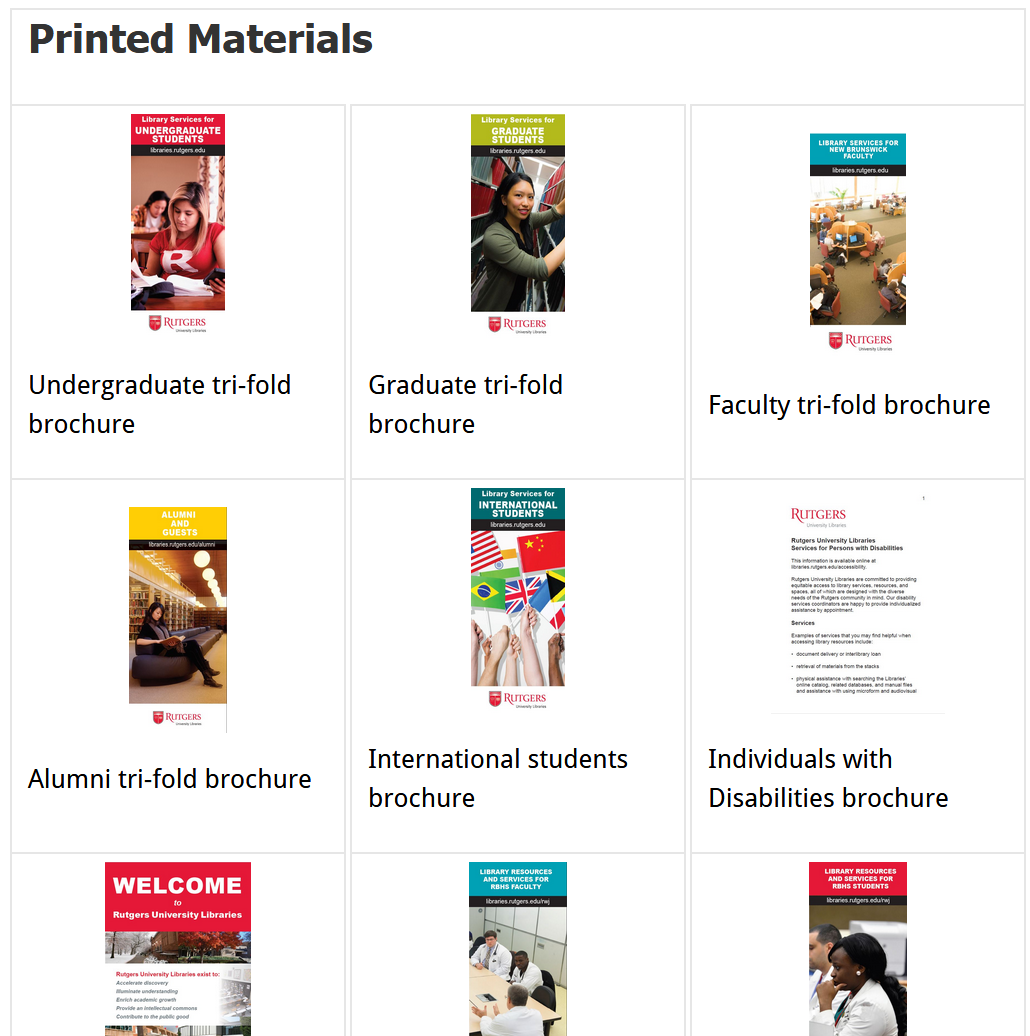
The Communications Department shared our new website at the State of the Libraries poster session. We have been actively updating the site with more resources and materials that may be of use to you. Our most recent additions are:
Sample of the brochures available via the Communications Department.
Here you can find resources and tips and tricks for using social media at the Libraries. The social media guidelines, process for requesting a new social media account, and the social media manual are stored here. But you can also find information about joining the Libraries’ social media list serv (useful if you are managing any library social media account) and our social media directory. Eventually, I hope to move the social media directory to a more visible, public site as part of a refresh of the news and communications sites on the Libraries’ website. In the meantime, if you have a social media account that is not listed here, please let us know.
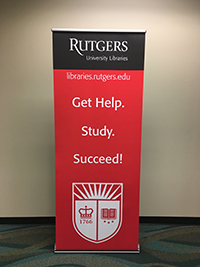
This retractable banner is available for your events.
New Retractable Banner
We placed an order for a new retractable banner and this is available for loan if you need it. For more information on this and to see other items we have available for event support, please visit Loanable Equipment A/V and Events.
Project Outreach Materials
You can find project outreach materials for both ORCID and Open and Affordable Textbooks Program. Here you will find PDF copies of promotional brochures, powerpoint presentations for faculty outreach, and more. If you have other projects for which this type of resource center would be useful, let us know.
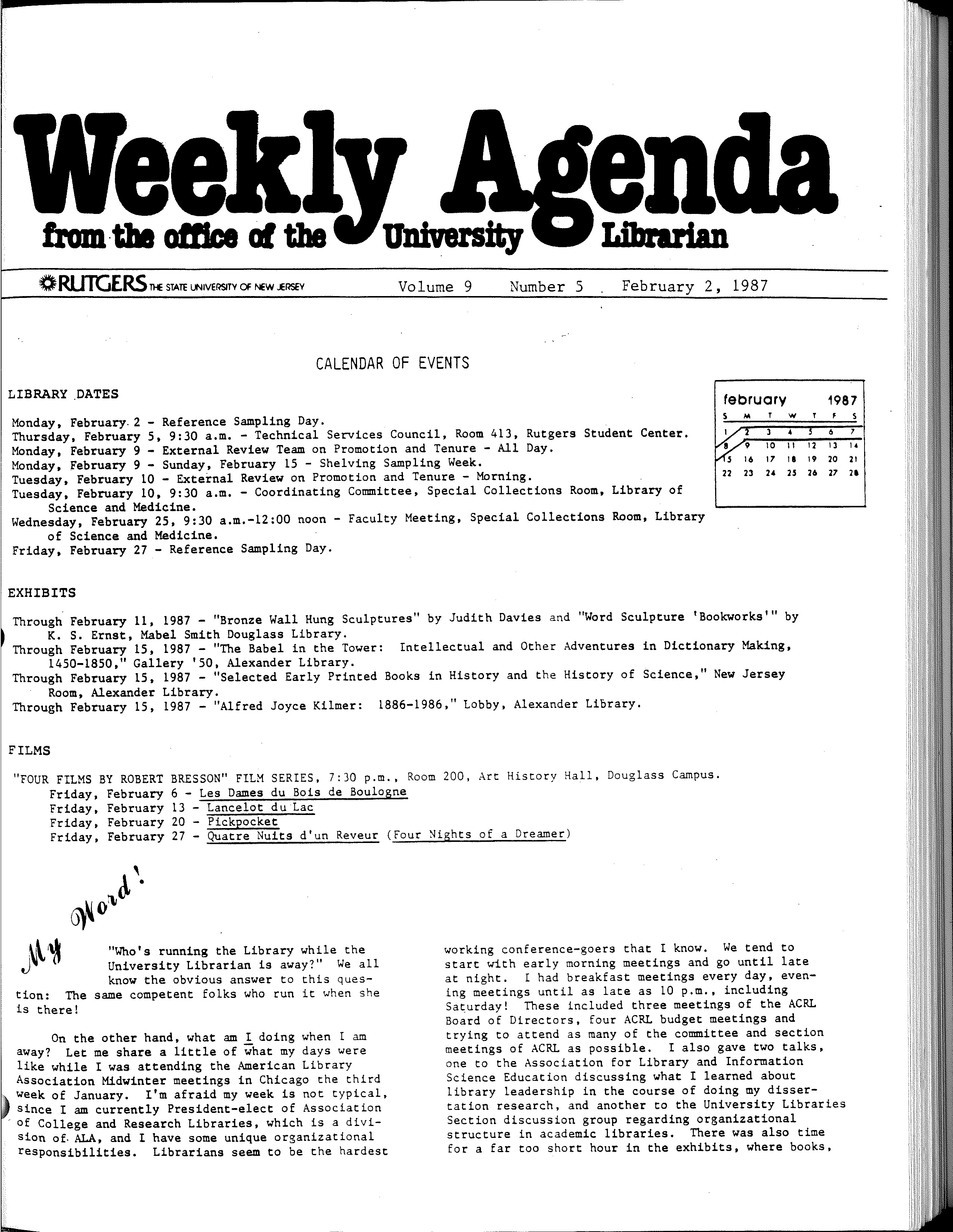
It’s 1987: a Ford Escort costs just under $7,000, Full House debuts on TGIF prime-time, and the Dominion of Fiji is preparing to proclaim itself as a republic. What was happening at the Libraries?
Cinephiles Rejoice!
Media Services has announced a film series on works by director Robert Bresson. Bresson explores themes in his work which are similar to those Bergman addresses. The films focus on philosophical and human problems, dealing with issues of freedom and constraint, love or its lack, life and death, and affirmation or denial.
….
The films will be shown on Fridays at 7:30 p.m. in Room 200 of Art History Hall on the Douglass Campus.
February 6 Les Dames du Bois De Boulogne February 13 Lancelot du Lac February 20 Pickpocket February 27 Quatre Nuits d’un Reveur (Four Nights of a Dreamer)
The Agenda 9, no. 5 (February 2, 1987)
IRIS Insights
IRIS Update for the week ending February 1, 1987.
RLIN records produced on or before January 23, 1987 were added to IRIS.
MRMS:
New records added: 2,322
Circulation:
New records: 2,717
Records updated: 6,033
New items added: 3,138
Circulation Notices produced and mailed: 3,138
The Agenda 9, no. 6 (February 9, 1987)
Just Say No… to Food
The Rutgers University Libraries will begin an Anti-Food Campaign during March 1987. The purpose of the campaign is to draw the attention of both patrons and staff to the dangers that food and beverages present to the preservation of our library collections, the maintenance of our furnishings and equipment and the appearance of our buildings.
….
Among items planned for the campaign are exhibits in each of the major libraries, and all campus mailing from the University Librarian’s office, articles in the campus newspapers, announcements on the campus radio station, bookmarks, posters, and notices. Each library will be holding a meeting to discuss the campaign and ways that library staff can help support it.
It seems that in every aspect of the work of academic libraries, there is an increased interest in frameworks. For example, in response to the ”rapidly changing higher education environment,” the ACRL Information Literacy Competency Standards for Higher Education transitioned to the Framework for Information Literacy in Higher Education. I am involved in a Big Ten initiative to develop a Framework for Discovery-to-Fulfillment Systems. Rutgers is also not immune to the charms of developing frameworks. Internally, there is a Libraries group developing a framework to describe the technical infrastructure and architecture of special collections (charge | minutes).
The framework presented in OCLC’s Realities of Research Data Management report may be useful as we think about the categories and framework we could use to describe our services.
Frameworks provide a way to divide complex goals and processes into manageable chunks while retaining information about relationships and dependencies between the components. Frameworks allow organizations to map multiple approaches to a goal and to tailor these pathways based on context. We have discussed the need to develop a better understanding of central and local services and responsibilities. We also need to develop infrastructure and services that advance the missions of our three campuses and a statewide health system. It seems that we would benefit from a framework that describes our services and illustrates the relationships and interdependencies between central and local units.
I have been following the OCLC Research Library Partnership Reports on the Realities of Research Data Management. This is a “four-part series that explores how research universities are addressing the challenge of managing research data throughout the research lifecycle.” The first three parts are now available and are quite good, digging a little below the surface to discover underlying drivers that influence practices. This topic alone is worthy of quite a bit of conversation that is beyond the scope of this post; however, I mention it here because, in Part One of the series, OCLC develops a framework for describing categories of services related to Research Data Management that may be useful as we think about the categories and framework we could use to describe our services. These are not going to map directly onto the needs of Rutgers University Libraries as a whole, but they demonstrate a way of thinking about these issues that will be valuable.
The categories of services included in Part One: A Tour of the Research Data Management (RDM) Service Space are:
Education—educating researchers and other stakeholders on the importance, and in some cases, the necessity, of responsibly managing their data and making arrangements for its long-term curation
Expertise—providing decision support and customized solutions for researchers working through specific research data management problems
Curation—supplying technical infrastructure and related services that support data management throughout the research cycle
It seems to me that by generalizing and extending these concepts, we could develop service categories that would help us plan and implement new services. In recent years, we have been reacting to extensive changes occurring in the university, but with the larger environment stabilizing, we can start thinking more about the structure that will best support campus missions and begin to develop a common vocabulary to discuss planning and priorities. There will be more on this in the coming months, but I encourage you to visit the links in this post and start thinking about how these ideas can be applied to our work.
Throughout January, the Ex Libris Implementation Team focused on preparing for Symphony to Alma test load. Thanks to the hard work of Chris Sterback, Gracemary Smulewitz, and other team members, we successfully turned in the migration forms, the P2E (Physical to Electronic) files, and the Symphony data files to Ex Libris on time. The work has been very time-consuming and painstakingly detailed, but our team understands that it laid the foundation for the next steps of migration – test load configuration, integration
with third party systems, cutover load, and go live. We continued to receive valuable feedback and support from Access, CTS, CSRS, and IIS staff.
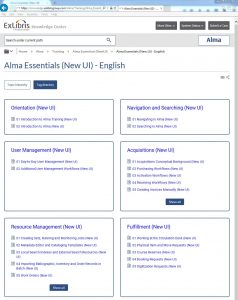
The Implementation Team spent a lot of time in January going through an extensive training program using pre-recorded videos in the Alma Essentials (New UI) series.
Internal Training Becomes A Priority
The Implementation Team also spent a lot of time in January on learning the functionalities of Alma. Guided by Ex Libris staffers, the team is going through an extensive training program using pre-recorded videos in the Alma Essentials (New UI) series. The Primo training series is forthcoming. Every week all the team members are required to watch videos on a certain topic, such as acquisitions, and then meet with the Ex Libris consultants for one hour via WebEx to perform sample tasks and discuss issues. The training program for the team will continue from January to March.
Internal training is also a priority for all the affiliated working groups. With input from the lead members on the Implementation Team, each group is responsible for identifying relevant training materials and choosing the most appropriate format for internal training – self-study, group sessions, or a combination of both.
Preliminary Timeline for All Staff Trainings
The working groups are expected to design and deliver trainings specific to their roles for all the library faculty and staff. For instance, the Discovery Working Group will develop trainings on Primo discovery environment for all the public services librarians and staff. The all staff trainings will be conducted in person by library staff with Rutgers data and configurations, so the opportune time for these trainings will be after the Alma/Primo test environment has been set up with our own data and configurations, but before our June 1 go live date. This means an April to May timeline is most likely. As we get closer to April, the Implementation Team and working groups will provide more information on all staff training opportunities.
Information You Can Use – Primo and Alma Fulfillment Videos
We asked Joseph Deodato and Chris Sterback, the team liaisons to Discovery and Access groups, to recommend some introductory materials on Primo discovery environment and Alma circulation function. Joseph recommended two Primo videos for public services librarians: Using Primo and How Primo Works. Chris suggested that all Access Services staff watch these two user management and five fulfillment videos.
Got Questions?
Please feel free to contact us or reach out to the other members of the Implementation Team. The library also has a website for Alma/Primo implementation, on which you can get more information about the project or ask questions via the “Contact” form. Thank you for your interest!
The Douglass Century will be published by Rutgers University Press next month. Check out the March Agenda for your chance to win a free copy!
Celebrating the Douglass Century
Congratulations are in order for our colleagues Kayo Denda and Fernanda Perrone, who, along with Mary Hawkesworth of the departments of Political Science and Women’s and Gender Studies, have penned a history of Douglass Residential College entitled The Douglass Century: Transformation of the Women’s College at Rutgers University. The book will be published by Rutgers University Press next month. From the press:
“The Douglass Century celebrates the college’s longevity and diversity as distinctive accomplishments, and analyzes the contributions of Douglass administrators, alumnae, and students to its survival, while also investigating multiple challenges that threatened its existence. This book demonstrates how changing historical circumstances altered the possibilities for women and the content of higher education, comparing the Jazz Age, the Great Depression, the Second World War, the post-war Civil Rights era, and the resurgence of feminism in the 1970s and 1980s. Concluding in the present day, the authors highlight the college’s ongoing commitment to Mabel Smith Douglass’ founding vision, “to bring about an intellectual quickening, a cultural broadening in connection with specific training so that women may go out into the world fitted…for leadership…in the economic, political, and intellectual life of this nation.” In addition to providing a comprehensive history of the college, the book brings its subjects to life with eighty full-color images from the Special Collections and University Archives, Rutgers University Libraries.”
But wait—there’s more! March’s issue of the Agenda will include a contest for a free copy of The Douglass Century, so tune in next month for your chance to win.
There will be ample opportunity to meet health sciences librarians and learn about the resources, tools, study spaces, and collections that are available on Busch campus.
Refreshments will be served and complimentary retractable ID card holders will be available while supplies last.
Watch: State of the Libraries
A video of Krisellen Maloney’s State of the Libraries presentation is now available on our YouTube channel.
Krisellen’s presentation from State of the Libraries is now available on our YouTube channel. It includes an introduction of new employees, an overview of the Ex Libris implementation, and a discussion of the budget. Kudos to Rich Sandler for his work on the video. And in case you missed it, a video playlist of the poster sessions from State of the Libraries was posted in last month’s issue of the Agenda.
The New Jersey Digital Newspaper Project Goes Live
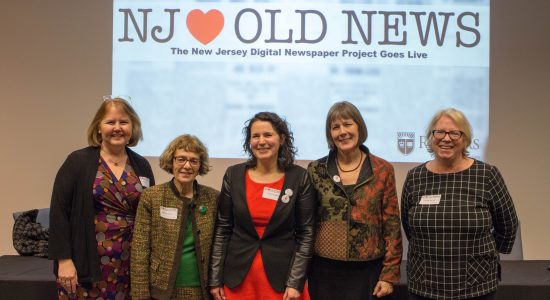
The New Jersey Digital Newspaper project celebrated a major milestone last month when the first batch of pages from the Perth Amboy Evening News became available to the public via the Library of Congress website Chronicling America. Colleagues from the Libraries, the New Jersey State Library, New Jersey State Archives, and the New Jersey research community gathered at Alexander Library to commemorate the occasion with presentations, tours of the project facilities, and of course—cupcakes!
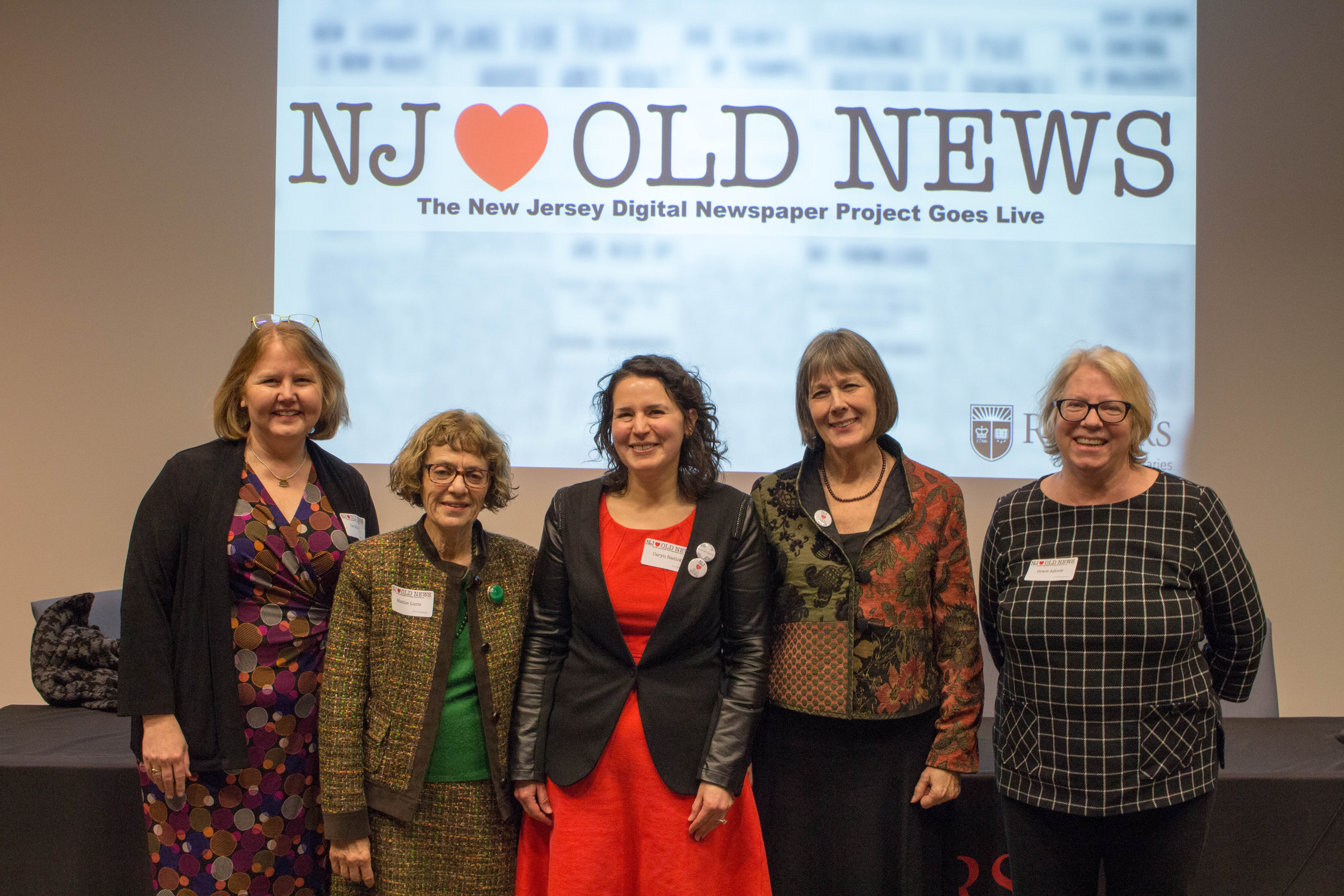
Dee Magnoni, Maxine Lurie, Caryn Radick, Mary Chute, and Grace Agnew at the NJDNP launch celebration.
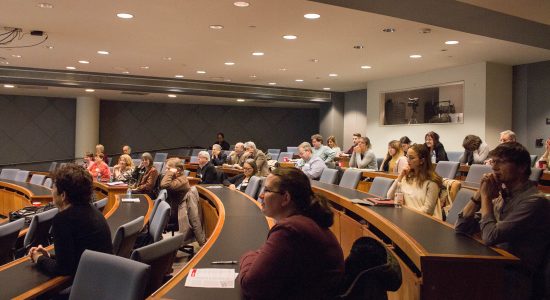
A nice crowd was on hand to learn about the project’s public launch.
Giovanna Ligato-Pugliese and Jacob Paul were happy to give attendees tours of the project office and demonstrations of equipment.
A case display illustrated the source material for the digital versions of the newspapers now available online.
The cupcakes were “black, white, and read all over!”
During the proceedings, state librarian Mary Chute read a letter on behalf of Congressman Frank Pallone, which said in part: “I would like to commend the New Jersey State Library, Rutgers University Libraries and the New Jersey State Archives for undertaking this important project. Here in New Jersey we have a rich history and innumerable contributions in science, innovation, politics and the humanities. The digitization of these newspapers will provide user friendly access of these historical records to all individuals across the globe. I am proud that The Perth Amboy Evening News is the first New Jersey newspaper available through this invaluable project.”
Paul Robeson Library’s John Maxymuk has authored over a dozen books about the history of the NFL in addition to an entry on professional football in the Encyclopedia of Greater Philadelphia? In advance of Super Bowl LII this weekend, we caught up with John to discuss his love of football and penchant for research—and, of course, whether the Eagles stand a chance against Tom Brady and the Patriots.
A New Look for the IJS
The new IJS logo.
The Institute of Jazz Studies recently unveiled a new logotype, which you can view on our visual identity resources website. Congrats to our colleagues at the IJS for adopting this fresh new look!
What’s Happening is the Libraries’ monthly events enewsletter.
Do You Know What’s Happening?
Did you know we publish a monthly enewsletter of events happening around the Libraries? If not, check out this month’s edition to see what you’ve been missing and feel free to subscribe!
Do you have an upcoming exhibit, workshop, or other event that you’d like the world to know about? Submit it at https://www.libraries.rutgers.edu/events and we’ll include it in forthcoming issues of the newsletter.
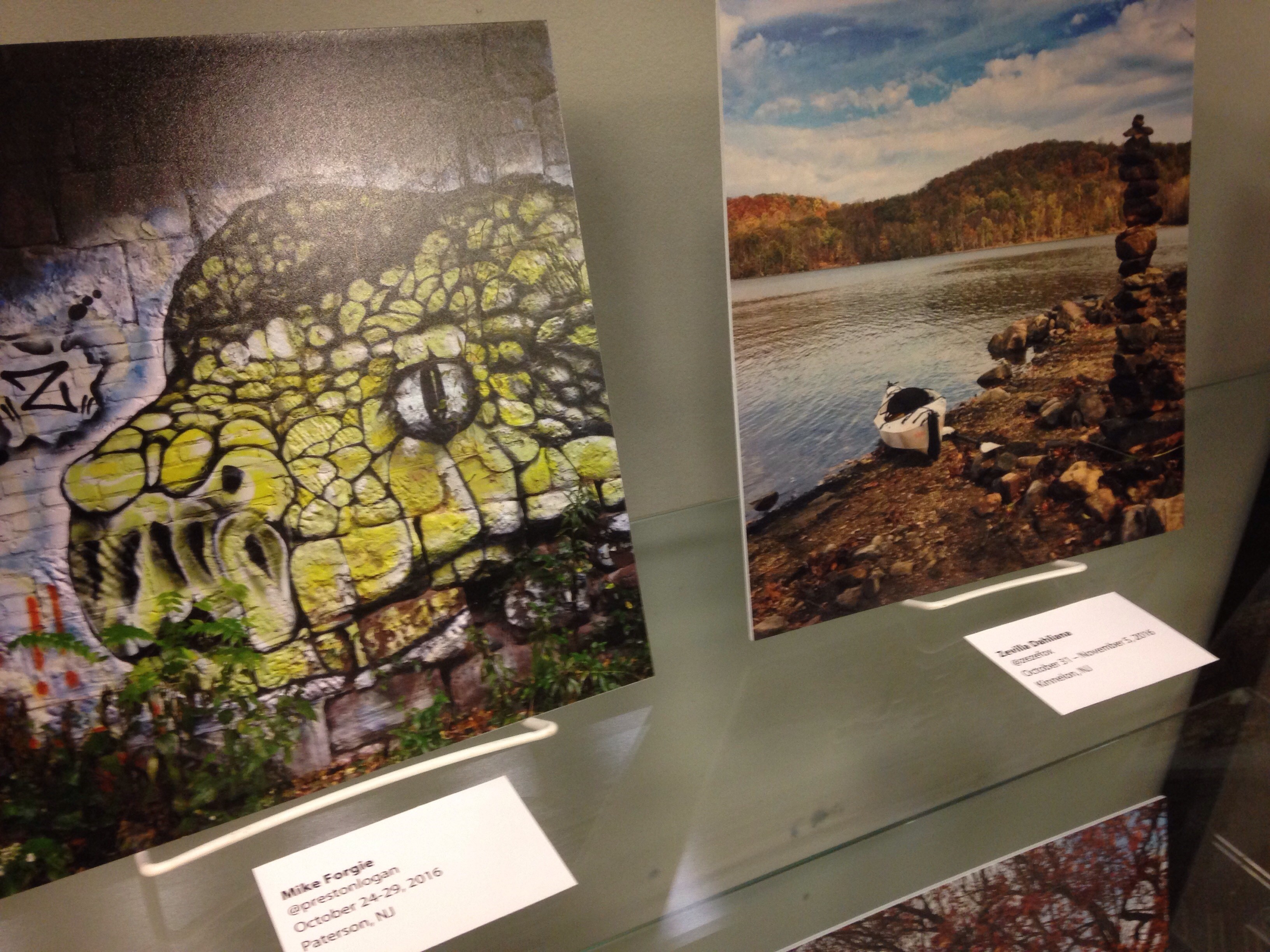
The Jersey Collective exhibit at Robeson Library. Credit: John Powell.
Closing Soon: Catch These Displays while You Still Can!
M.K. Asante, author of the critically acclaimed Buck: A Memoir, will present the Ida B. Wells-Barnett keynote lecture on February 1 as part of Rutgers–Camden’s Black History Month celebration.
Celebrate Black History Month at Rutgers–Camden
A series of activities will celebrate cultural diversity at Rutgers University–Camden throughout Black History Month in February.
Thursday, February 1 The Africana Studies Program will kick off Black History Month 2018 with a presentation by Sandra Turner-Barnes titled “Critical, Little Known Truths, Regarding African Enslavement within the State of New Jersey,” in the Multi-Purpose Room, located on the main level of the Campus Center. Turner-Barnes serves as executive director of the Camden County Cultural and Heritage Commission.
M.K. Asante, author of the critically acclaimed Buck: A Memoir, will present the Ida B. Wells-Barnett keynote lecture at 6 p.m. in the Multi-Purpose Room, located on the main level of the Campus Center. Asante is a bestselling author, award-winning filmmaker, recording artist, and professor whom CNN calls “a master storyteller and major creative force.” Registration is encouraged. For more information or to register, visit go.rutgers.edu/nd4842au
Sunday, February 11
The Black Catholics and Cultural Diversity Ministry will host the “Tri-State Catholic Gospel Concert featuring Choirs from Delaware, Pennsylvania, and New Jersey” at 3 p.m. in the Walter K. Gordon Theater, located in the Fine Arts Complex. To reserve a seat, visit rudioceseconcert.eventbrite.com or contact James Andrews at (856) 583-2907 or Rev. Richard Owens at (215) 587-3541.
Monday, February 12
The Africana Studies Program will host a screening and discussion of the film Timbuktu at 6 p.m. in the Viewing Room, located on the lower level of the Campus Center.
All events are free of charge and open to the public. For more information, visit the Camden News Now website.
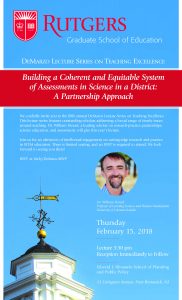
Join the Graduate School of Education for the DeMarzo Lecture on Teaching Excellence on February 15.
Building a Coherent and Equitable System of Assessments in Science in a District: A Partnership Approach
Thursday, February 15 3:30–5:30 p.m. Bloustein School, Rutgers–New Brunswick
The Graduate School of Education cordially invites you to the fifth annual DeMarzo Lecture Series on Teaching Excellence. This lecture series features outstanding scholars addressing a broad range of issues around teaching. Dr. William Penuel, professor of Learning Sciences and Human Development in the School of Education at the University of Colorado Boulder, will give this year’s lecture.
In this talk, Professor Penuel will describe the ongoing efforts of a research-practice partnership between Denver Public Schools and the University of Colorado Boulder to create a more coherent and equitable system of classroom and district-based assessments of students in science.
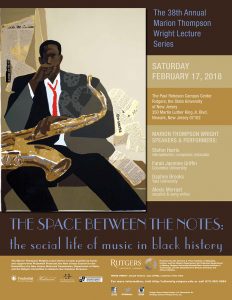
The 38th annual Marion Thompson Wright Lecture will be held at Rutgers–Newark on February 17.
The Space Between the Notes: The Social Life of Music in Black History
Saturday, February 17 9:30 a.m. – 3:30 p.m. Paul Robeson Campus Center, Rutgers–Newark
The 38th entry in the Marion Thompson Wright Lecture Series weaves together the academic and the artistic to explore the social roles of music in black history. Speakers and performers will delve into the history and current state of music in the black diaspora from a variety of angles. At a time when artistic production is so closely interwoven with Newark’s continued development, we seek to draw lessons from music’s history of helping imagine and create a more inclusive and just city, nation, and world. Together, the featured speakers and performers will offer a profound demonstration of music’s power to forge community, provide refuge in troubled times, and move us toward better futures. This year, we have an amazing lineup of speakers including: Stefon Harris, Farah Jasmine Griffin, Daphne Brooks, and performance by Alexis Jessica Morrast. Admission is free and open to the public. For more information, visit the Newark College of Arts and Sciences website.
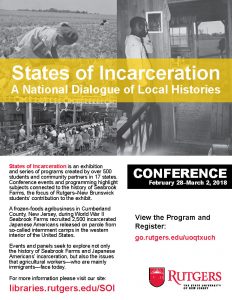
Douglass Library is the locus for the States of Incarceration conference, which starts on February 28 and draws in partners from across Rutgers–New Brunswick.
States of Incarceration Conference
Wednesday, February 28–March 2 Rutgers Cinema, Douglass Library Rutgers–New Brunswick
States of Incarceration is an exhibition and series of programs created by over 500 students and community partners in 17 states, including participants from Rutgers University–New Brunswick and Rutgers University–Newark. The exhibit explores the roots of mass incarceration in the United States through local case studies and opens a dialogue on what must happen next.
Conference events and programming explore themes related to the different components of the States of Incarceration exhibit. In particular, they highlight subjects connected to the history of Seabrook Farms, the focus of Rutgers–New Brunswick students’ contribution to the exhibit.
A frozen-foods agribusiness in Cumberland County, New Jersey, during World War II Seabrook Farms recruited 2,500 incarcerated Japanese Americans released on parole from so-called internment camps in the western interior of the United States. Seabrook Farms would also employ guestworkers from the British West Indies, migrant workers from the United States South, Japanese Peruvians imprisoned by the United States, and, after the war, Estonian refugees from displaced persons camps in Germany.
Events and panels seek to explore not only the history of Seabrook Farms and Japanese Americans’ incarceration, but also the issues that agricultural workers—who are mainly immigrants—face today.
The schedule includes a screening/director Q&A of documentary film Resistance at Tule Lake; tours of the States of Incarceration exhibit; a production of the play The Castle; panel discussions on agricultural workers and incarceration; and a plenary by John Seabrook, grandson of the founder of Seabrook Farms.
The conference is free and open to the public. For more information or to register, visit the States of Incarceration website.
This month, I just want to express my gratitude once again to everyone who helped make State of the Libraries so special. From the major events committee to the poster presenters to those of you in the audience–our colleagues are what make this a great event. For 2017, we experimented with the format of the event in several ways, introducing new elements while also retaining what makes this such a special event. In a significant departure, we invited an external speaker to visit us and discuss unconscious bias works and what we can do to mitigate its influence in the Libraries. Calvin Lai’s presentation was as entertaining as it was informative, and it is my sincerest hope that it helps us to better appreciate and accommodate diversity and inclusion in what we do.
I hope everyone who attended had a chance to tour the always-popular poster session. It is fitting that at the close of the year, we get to survey the many great activities and initiatives underway at the Libraries. From Libraries-wide initiatives like ORCID and the Open and Affordable Textbook Program to the exhibits program at Robeson and the enhanced coin scanning project from the Digital Humanities Lab–these posters are a reminder of the positive impact we have on the university and the work of the Libraries. For those who were unable to attend or did not make it around to see all the posters, the communications team has recorded short videos with the presenters that can be viewed on YouTube (see below). Also, a special note of thanks to Dee Magnoni and James Hartstein who provided professional quality printing for the posters. They looked great!
There will be much more to say in the coming months, but for now, I want to wish you all a happy New Year! We have so much to look forward to in 2018.