Category: Health Sciences Libraries

  • Health Sciences Libraries Publishes November Issue of Impact Newsletter

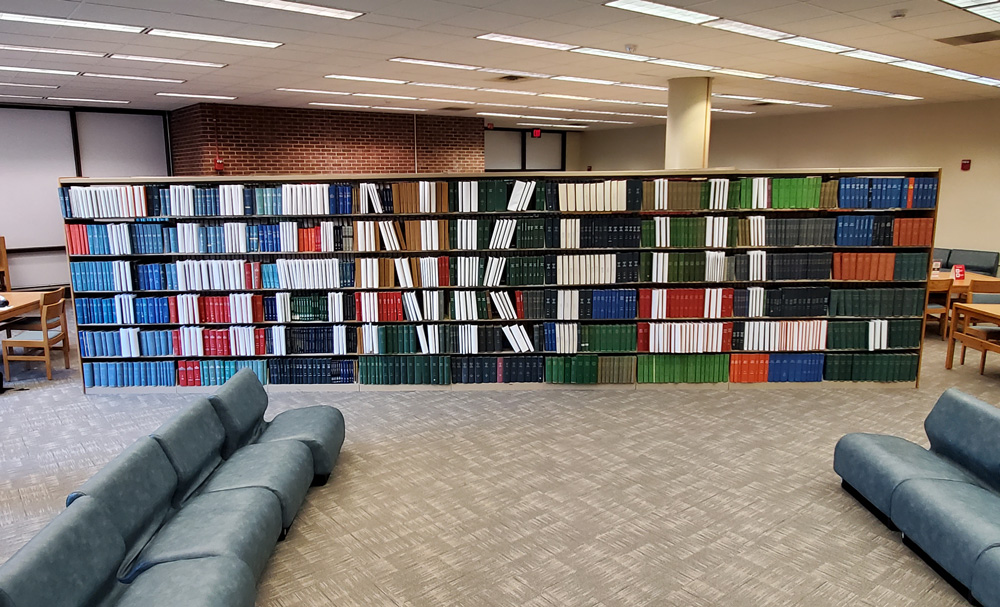
    RWJ Library "thankful" book billboard.
    RWJ Library’s “thankful” book billboard.

    Rutgers Health Sciences Libraries (HSL) is pleased to announce the November issue of its Impact e-newsletter. Please click this link to read the latest HSL news, events, and features, including:

    • New journals: Behavioral Medicine and Annals of LGBTQ Public and Population Health
    • New video tutorial on finding journals
    • Welcome to our new work/study students

    Subscribe today to get Impact delivered to your inbox!

  • Health Sciences Libraries Publish Inaugural Issue of “Impact”

    Impact e-newsletter masthead.

    Rutgers Health Sciences Libraries (HSL) is pleased to announce the inaugural issue of Impact, its new monthly e-newsletter. Please visit go.rutgers.edu/xn910gjj to read the latest HSL news, events, and features:

    • Save Time: Make an Appointment!
    • Medical Education Review Blog Celebrates 10th Birthday with 300th Post
    • Quick Access to PubMed and UpToDate

    The next issue will reveal exciting news about EMBASE. Subscribe today to get Impact delivered to your inbox!

  • Creating Homemade PPE

    I would like to share my experience during these difficult days of our quarantine to fight against COVID-19.

    While all of us are working from home, the medical staff are on the front line fighting the virus while lacking the PPEs. This became a great concern in my family, when my daughter called me three weeks ago, and asked if I could make some masks and head covers for her husband, who is a doctor, and also her doctor friends who are taking care of COVID-19 patients.

    She did some research how to make safe cloth masks for medical staff to place over the N95 masks to make them last longer. Pretty quickly, we figured out how to make them out of cotton fabric and flannel while using different filters. I used any item possible at home: T-shirts, cotton sheets, cotton tablecloths, bags, baby wipes, laundry softeners, vacuum cleaner filters. I also made head covers out of shower curtains while sending her all transparent plastic available at home so she could use it to make face shields, helped by her friend who made parts of them by 3D printing. She was able to make 30 face shields.

    My daughter and I also started a campaign on social media, asking people to make masks and sharing the instructions, suggesting they donate them to the community. The social media network in New York, Connecticut, and New Jersey was able to make 350 masks and donated them to hospitals and friends. My daughter, who is also a doctor, for about a month never stopped raising awareness on social media that everyone needs to wear a mask when we go out.

    I shared my experience with the Smith Library access services staff and shared guidelines about how to make masks. I will continue to make cloth masks and head covers until the pandemic is over. Doing something good for the community helps me release the stress and be happy that I can do my little part to fight the pandemic.

    How to Sew a Medical Face Mask

    Materials

    • 2 pieces of 100% cotton fabric that measure about 7 inches by 9 inches—cotton T-shirts, dish towels and pillowcases are good options (make sure all fabric is washed and dry)
    • 2 pieces of cotton fabric that measure about 1.5 inches by 40 inches for the mask’s strap (in a pinch, you can use something like shoelaces, elastic 6 inch long or ribbon)
    • A ruler, sewing pins, a pair of scissors, thread, an iron and a sewing machine.

    Video Tutorials

    Instructions

    Step 1: Sew the two main rectangle pieces together with the “right” sides of the fabric—the side you want to see—facing each other. Sew almost all the way around the rectangles, leaving a small gap (a few inches) open on the long side.

    Step 2: Turn the rectangle right-side-out by reaching into the gap you left open and pulling the fabric through. Now your edges are on the inside and you have a neatly sewn two-sided rectangle. At the gap you left open, just tuck the edges inside for now; you’ll sew it closed later.

    Step 3: Make three evenly spaced pleats along both 7-inch sides of the fabric, making sure to keep all of your tucks facing in the same direction, and pin in place. One way to do this is by marking the spacing with pins: place one about 1.5 inches down the short side of the fabric; add the next 1 inch down from that, then the third ½ inch down from that, and keep alternating between 1 and ½ inches until you’ve used all six pins. To create the pleats, just bring the first pin down to meet the second, the third to meet the fourth, and the fifth to meet the sixth. Repeat on the other side.

    Step 4: Once the pleats are pinned, stitch all the way around the perimeter of the rectangle. This will sew the pleats into place and also close the gap you had left open in Step 1.

    Step 5: If you’re using a strip of fabric for your strap, fold and iron it in half lengthwise and then fold and iron the raw edges in. Find the centers of your straps and the centers of the long sides of your mask, and match them. Pin the straps in place along the long edges of the mask, so there is a strap on the top of the mask and one on the bottom, with equally long pieces coming out to the sides. If you’re using a strip of fabric, pin it so it’s wrapped around the edge of the rectangle.

    Step 6: Sew the strap to the mask by stitching all the way down each strap, catching the edges of the mask as you pass. (If you are using a strap that did not require folding, you can opt instead to stitch around the perimeter of the rectangle one more time.)

     

  • Introducing the Rutgers Health Sciences Libraries on Social Media

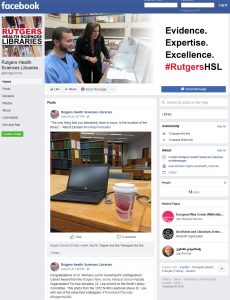
    Facebook page
    The @RutgersHSL Facebook page.

    Matthew Bridgeman and Sarah Jewell are leading the teams behind the new Facebook and Instagram pages representing the Rutgers Health Sciences Libraries. Matthew Bridgeman, an information and education librarian at Robert Wood Johnson, has both professional and personal experiences with Instagram. He began the Instagram account at Middlesex County College. In two years he grew the library’s presence and even had a post shared by the New York Public Library. The NYPL also has a great article on creating Instagram posts to be engaging called 20 Ways to Make People Fall in Love with your Instagram. He sees Instagram as a way to begin a discussion with students and faculty with creative photography.

    Sarah Jewell, an information and education librarian at the George F. Smith Library of the Health Sciences, primarily has experience doing social media for organizations outside the professional sphere. In the past, she has volunteered to do Facebook, Instagram, and WordPress work with writing and meditation-based organizations. “I see social media as a great vehicle for expressing passion about important work,” Sarah says. “When you express enthusiasm through this media, it is contagious, and it gets others excited about the work to be done.”

    Instagram
    The @RutgersHSL Instagram page.

    Some resources that Sarah uses to guide her social media efforts include the Rutgers Libraries Social Media Resources (which she helped create) and Young and Rossmann’s book titled Using Social Media to Build Library Communities. As the Rutgers Health Sciences Libraries staff is just getting the Facebook and Instagram accounts off the ground, she has been reaching out to her regular contacts to spread the word about the new way to communicate with the libraries. She was thrilled to see the Rutgers School of Public Health post on both Facebook and Instagram a promotion of the Rutgers Health Sciences Libraries pages.

    The primary goals of the Facebook and Instagram accounts are to promote library resources, services, and events to the Rutgers University community and to engage with the students, faculty, and staff of the seven schools under RBHS. The new Rutgers Health Sciences Libraries Facebook and Instagram accounts are off to a running start. The accounts’ plans are to keep a constant scheduled flow of content celebrating the students, faculty, and libraries from the schools of Rutgers Biomedical and Health Sciences. If you have not already followed them, connect with them now as they begin this adventure.

    Matthew Bridgeman and Sarah Jewell

  • Humanism in Medicine: Teaching Poetry to Residents

    I serve as the clinical medical librarian for the Internal Medicine department at Rutgers New Jersey Medical School in Newark. This means I attend the residents’ morning reports every Thursday and Friday at 8 a.m. as they discuss patient cases to help them learn how to diagnose and treat the patients they serve. When a question comes up which can be answered by an article, I look up the answer in the medical literature and the chief residents share the results with the others via Sakai. I also train the residents in searching techniques in various databases such as PubMed, Scopus, or VisualDx.
    Dr. Mirela Feurdean, internal medicine residency program director at New Jersey Medical School, approached me in September 2017 about doing something a bit different with the residents. “I know you’re a poet,” she said to me. “Would you be interested in teaching a poetry workshop to the residents?” In my personal life, I’m a published poet who teaches a weekly workshop in Jersey City, and I just published my first chapbook this year. So of course, I said yes.

    The first workshop was held at noon on September 22, alongside free pizza for the residents. The residents were a bit shy, but 11 (out of 20 or so) ended up participating. I shared handouts with them that included a poem written by an award-winning internal medicine doctor, Rafael Campo, as well as a patient. I also shared a couple articles about how to use metaphors effectively when explaining science to patients. For example, research has shown that breast cancer patients who use battle or war metaphors to describe their experience with cancer have a higher incidence of depression than those who use positive words like “challenge” or “journey.” The words we use matter. The residents wrote poems employing medical metaphors, and some even submitted their finished poems to Ars Literarium, the literary journal of Rutgers New Jersey Medical School and other RBHS Schools.

    The chief residents asked me to return the following month, and on October 20, we focused on short poems, learning a bit about the form haiku. This time, virtually all 20 or so residents participated. Even if they weren’t writing themselves, they snapped their fingers or clapped their hands to celebrate each other’s work as they started to share their writing. Dr. Ahmad Al Turk was inspired to write a clever quatrain, Odgen Nash-style.

    NSAIDs work for all
    Conditions that end with –itis,
    Summer, spring, or fall,
    But don’t get fooled with gastritis!

    By Ahmad Al Turk, MD

    The medical “joke” of the poem, for those without the medical background, is that NSAIDs (non-steroidal anti-inflammatory drugs like aspirin or ibuprofen) can irritate the stomach and cause gastritis.

    However, not all the poems were strictly linked to medicine, and some of the doctors wrote about other aspects of their lives. One resident was inspired to share a rap he had previously written, and he nervously approached the front of the conference room. As he closed his rap, which shared a story about a patient who survived a dire medical situation, he encouraged his fellow doctors not to “go numb” as they continue their work as physicians. His fellow doctors cheered and clapped, and there were tears in the eyes of many.

    I look forward to continuing these workshops to my residents, as I hope to help them de-stress during a hectic time of their lives.

    Save

  • Quick Takes on Events and News – October 2017

    Chicago-Bound for Research Data Summit

    Congratulations to Yingting Zhang whose application for the Association of Academic Health Sciences Libraries’ Data Scholarship has been accepted. The award will support Yingting’s participation in the Research Data Access and Preservation Summit next year in Chicago. We look forward to hearing Yingting’s report from the conference!

    Fight the Flu. Get Your Shot!

    Don’t forget that Occupational Health will be providing flu shots for employees on Wednesday, October 4 from 11 a.m. to noon in the Pane Room of Alexander Library.

    Please RSVP to Michele Petosa at petosa@rutgers.edu by October 2. Be sure to download the consent form at http://occhealth.rutgers.edu/FluVaccine2017.html, print, complete, and bring it with you.

    It’s a Bird, It’s a Plane, It’s—The Artists’ Bookmobile!
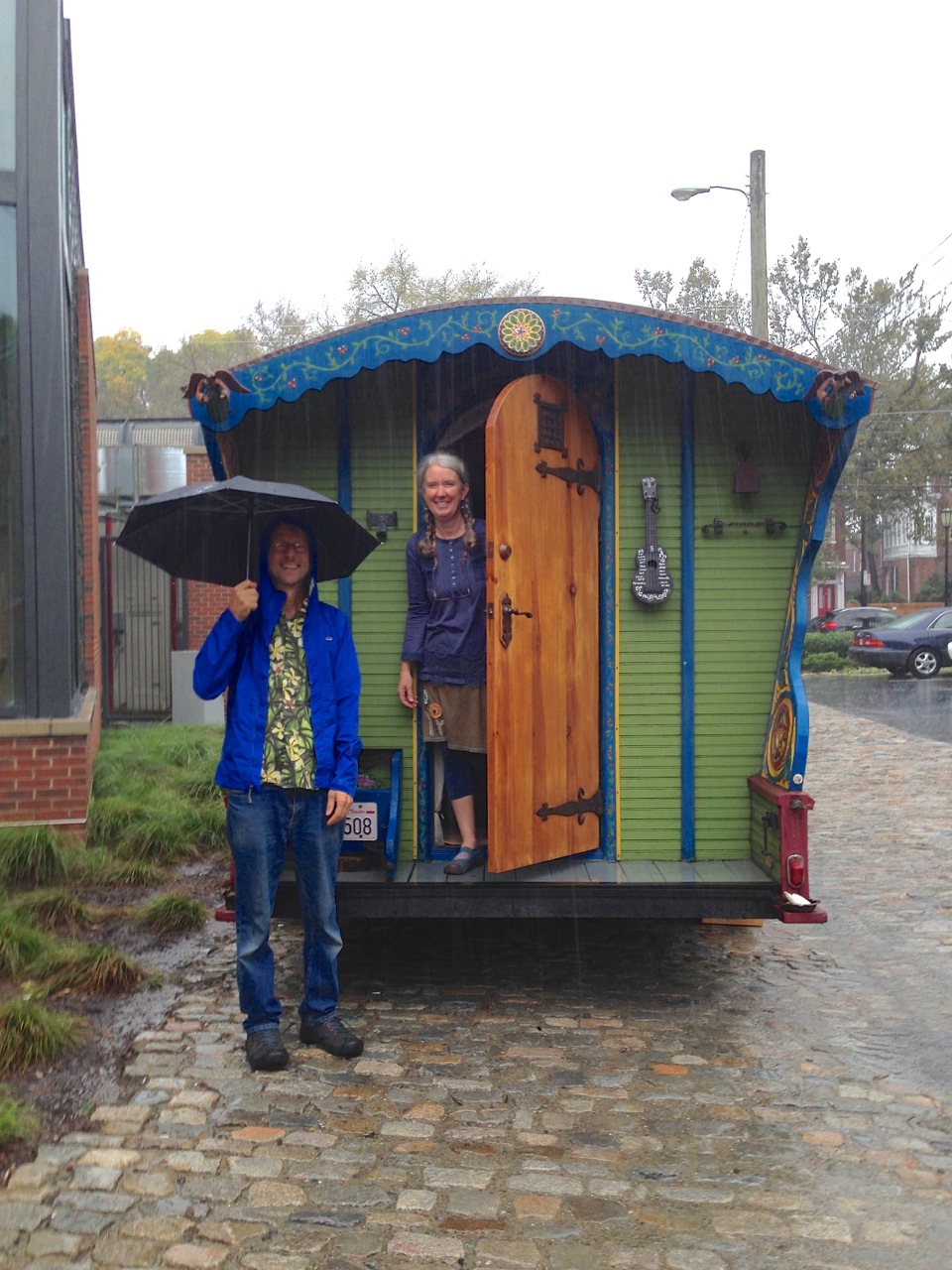
    Peter and Donna Thomas return to Rutgers with their Artists’ Bookmobile on October 4.

    Rutgers University Libraries and art librarian Megan Lotts are delighted to welcome Peter and Donna Thomas and their traveling Artists’ Bookmobile back to Rutgers. Peter and Donna are known for their workshops in paper and book arts. Visit the Artists’ Bookmobile—a self-contained exhibit of book arts—and learn how they make their books. Join in a book arts sing along at 3 p.m. featuring a ukulele book.

    The Bookmobile will be parked outside Alexander Library on October 4 from 2 to 3:30 p.m. See you there!

    Carr is Cutting the Ribbon

    Join us on Tuesday, October 17 at 10 a.m. as we dedicate the James Dickson Carr Library in honor of Rutgers University’s first African American graduate. The program includes remarks by Rutgers–New Brunswick chancellor Debasish Dutta, an exhibit of materials about Carr and the history of the former Kilmer Library, as well as a reception. Please register to attend at https://www.eventbrite.com/e/carr-library-dedication-ceremony-registration-38281939311.

    #RutgersDana50 Kicks Off on a High Note

    Dana Library kicked off its 50th anniversary celebration with a birthday bash during Rutgers–Newark’s Fall Fest in September. The festivities included cupcakes and a live performance by hip-hop/jazz fusion band Nickel and Dime OPS. Check out a clip of the band courtesy of @RUNewark_Dana on Twitter.

    Exploring the Wonderful World of Illusions

    Thomas V. Papathomas, director of the Rutgers Laboratory of Vision Research, visited the Library of Science and Medicine last week for a special presentation on optical illusions, how our minds process perspective, and even how illusions can be used as accurate measures of schizophrenia.

    Aiding the Relief Effort in Puerto Rico

    Alexander and Dana Libraries hosted open data editathons last week in response to the Red Cross’s request for geospatial data to help with their relief operations on the island. Participants mapped from pre-hurricane imagery to give those involved in the relief efforts an operating picture of the island before the storm made impact. Kudos to our colleagues Francesca Giannetti and Krista White for their part in bringing this program together so quickly!

    New Video for Banned Books Week

    Save

  • Rutgers Launches Rutgers Health – Here’s What It Means for the Libraries

    Rutgers Launches Rutgers Health – Here’s What It Means for the Libraries

    What is Rutgers Health?

    “Rutgers Health is the clinical arm of Rutgers–the areas of Rutgers Biomedical and Health Sciences and other Rutgers units devoted to caring for patients. A single brand for all of Rutgers’ patient care and services.” (from: www.rutgershealth.org/about-rutgers-health/rutgers-health-structure)

    The Rutgers Health Group will serve as a single faculty practice, unifying existing specialties and clinical practices, comprising approximately 1,000 Rutgers-employed health care professionals. Members of the faculty practice will be from New Jersey Medical School, Robert Wood Johnson Medical School, and other RBHS and Rutgers schools–dentists, nurses, pharmacists, social workers and psychologists, and other health care professionals working in clinical settings throughout New Jersey.

    The Rutgers Health Network will be an integrated network of Rutgers’ affiliated hospitals, community clinics, medical groups, wellness centers, and other affiliates collaborating to provide value-based care to patient populations across the state.

    How will the Rutgers University Libraries support Rutgers Health?

    There are two major user groups with full access to library resources–members of the RBHS faculty, students, and staff and members of the clinical (voluntary) faculty who oversee students and residents in affiliated hospitals and clinics throughout New Jersey.

    As Rutgers Health launches, it is challenging to predict how utilization and demand for libraries-licensed high quality clinical and patient care resources will grow. Should you encounter questions about Rutgers Health which impact the libraries, please contact your colleagues at the RBHS Libraries.


    Contributed by Judy Cohn and Victoria Wagner

    Judy CohnSave

    Save

    Save

    Save