Category: Digital Humanities

  • Latino New Jersey History Project

    New Jersey has a remarkably diverse, though largely understudied, Latino population.  In 2016, according to the American Community Survey, people who identify as Hispanic or Latino were estimated to number over 1.7 million making them nearly 20 percent of all New Jersey residents.  Yet we know very little about their roots. Who are the Garden State’s Latinos? What is their history? This summer, seven Rutgers undergraduates and history Ph.D. student Carie Rael worked with Lilia Fernandez, Henry Rutgers Term Chair in Latino & Caribbean Studies and History, to find out as part of the Latino New Jersey History Project.  Their goal was to research, document, and record the history of New Jersey’s diverse Latino populations. Along the way, they received important assistance on digital tools and platforms from New Brunswick Libraries personnel Stacey Carton, Jan Reinhardt, and Francesca Giannetti.

    The students used a variety of sources and methods. They gathered census data, for example, to produce maps and tables enumerating Latinos throughout the state, its counties, and its main cities and towns. Some were surprised at what they learned. While we might expect Newark, Elizabeth, and Paterson to have large Latino enclaves, few realized that New Brunswick is 56 percent Hispanic and West New York is 78 percent Hispanic (both as of 2016).  The town of Bridgeton in South Jersey has one of the largest concentrations of Mexican immigrants in the state. Census data revealed unexpected trends and unlikely settlement destinations.
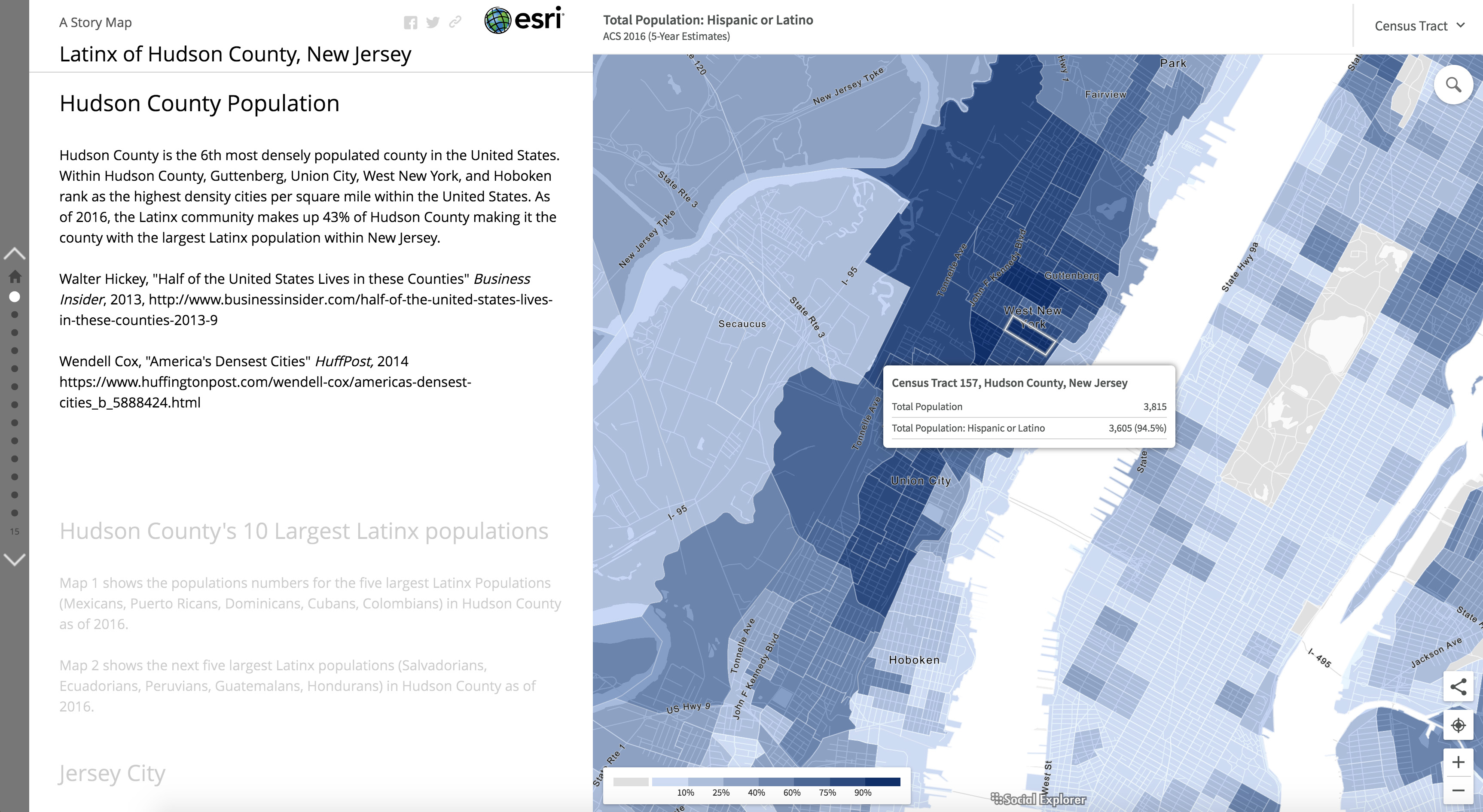
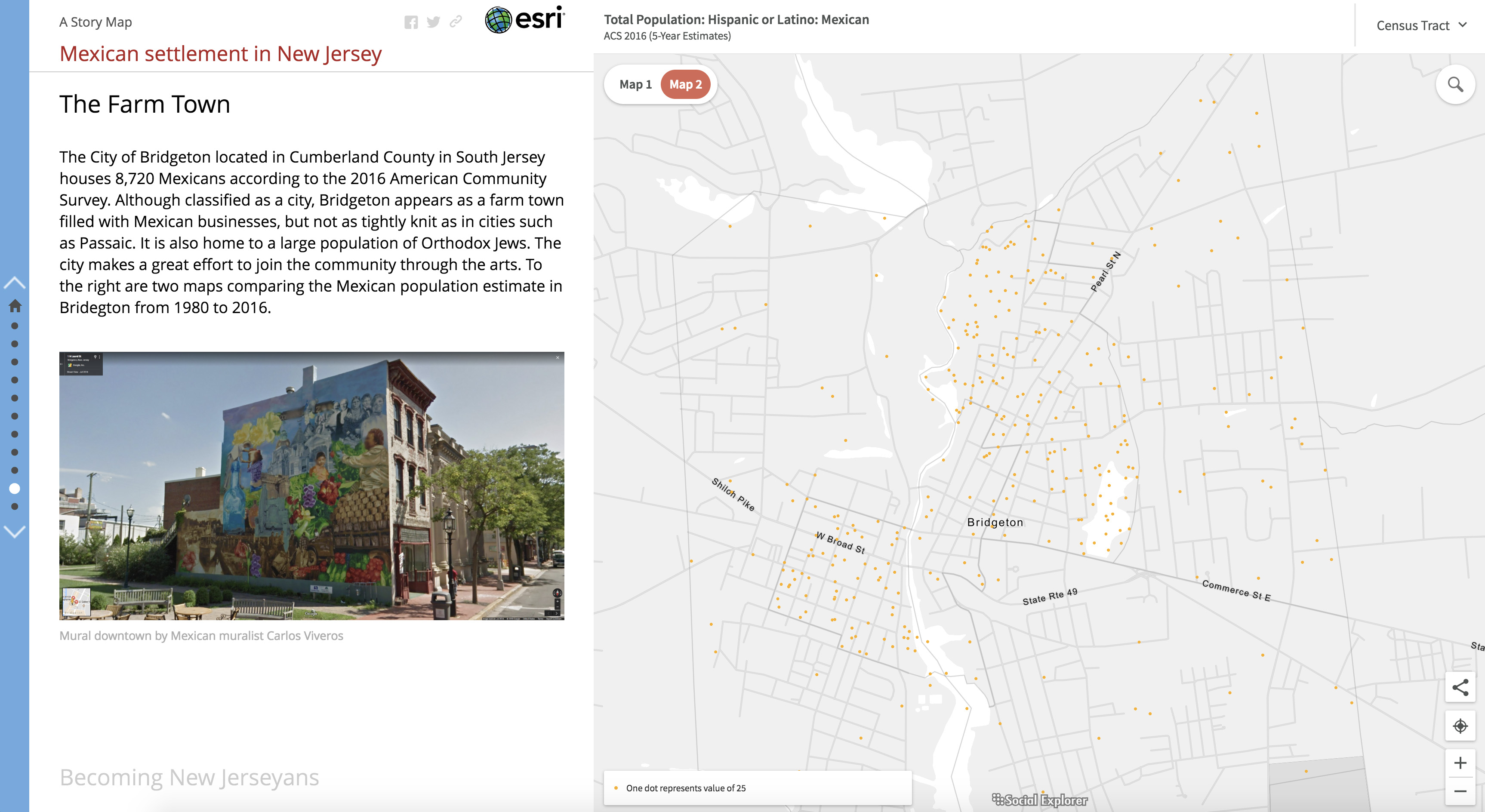
    Hudson county map

    With training from Francesca Giannetti, digital humanities librarian, students learned how to create thematic maps in Social Explorer and multimedia narratives integrating images, text, and multimedia embeds in ArcGIS’s Story Maps.  They learned about theories of place and space in spatial narratives, as well as elements of data and visual literacy through the strategic exploration of Social Explorer’s data sources, spatial geometries, and visualization types. Through the students’ mapmaking efforts, they were able to trace demographic changes over time, settlement patterns, and the migration stories of individuals and entire communities.
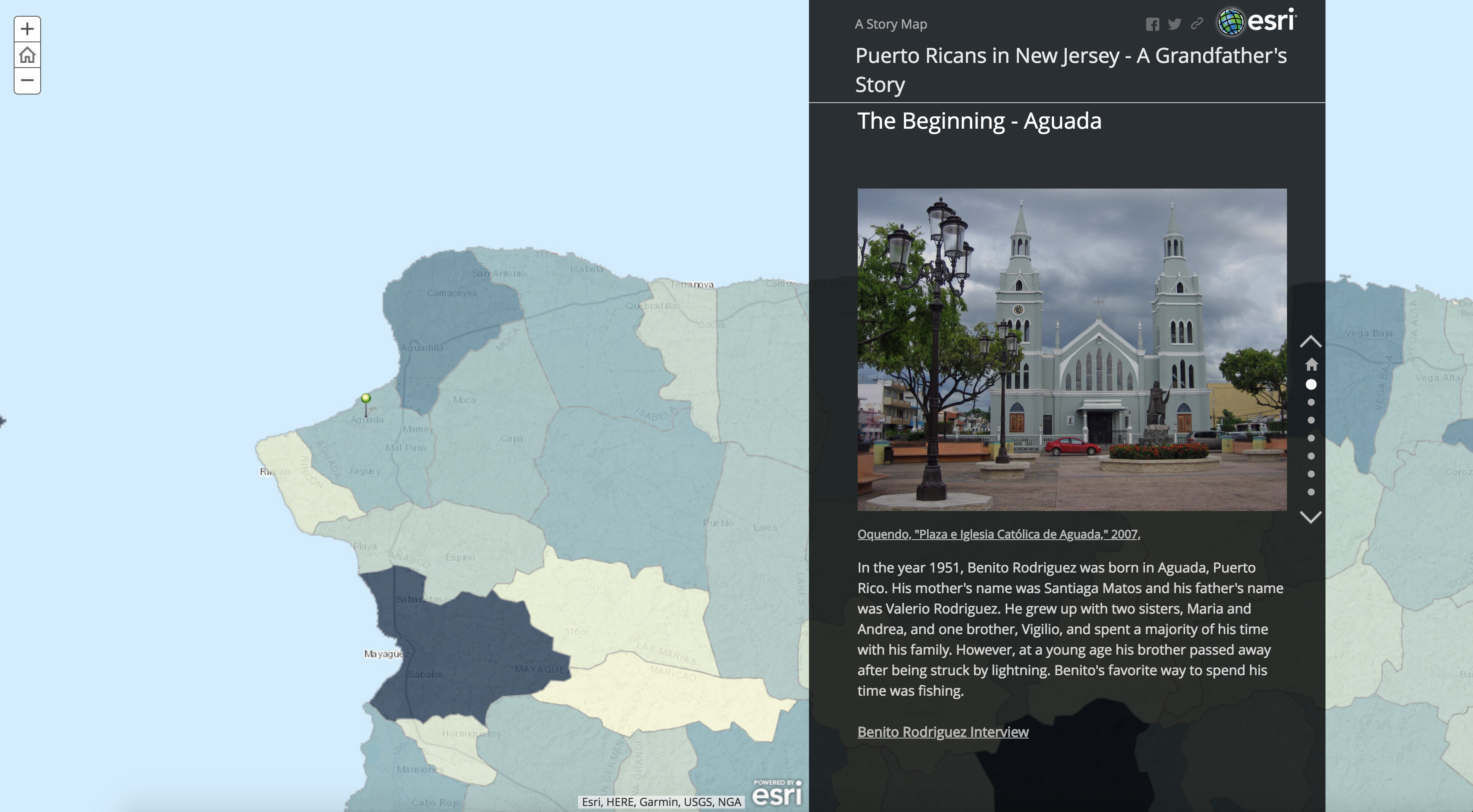
    Aguada

    Students also visited the Puerto Rican Community Archives (PRCA) at the Newark Public Library to learn about how the PRCA has collected more than one hundred oral histories over the past two decades and has gathered many archives and records of New Jersey’s Puerto Rican communities.

    Perhaps the most exciting part of the summer was completing oral histories with local residents. Shaun Illingworth and Kathryn Rizzi of the Rutgers Oral History Archives (ROHA) provided training and guidance on ethical and practical considerations in conducting oral histories.  After extensive training, background research, and preparation, students went out and recorded oral history interviews with various Latino residents and community leaders. Some were able to interview members of their own communities, while others interviewed important figures like Board of Governors member and Rutgers alum Martin Perez, or Irving Linares, the publisher of a Spanish language newspaper in Newark for the past 40 years.

    Since the group created audio or video recordings of their oral histories, they also benefited from basic video editing training at the Douglass Media Library with Stacey Carton. Students attended a workshop that focused on Adobe Premiere video editing software (available at the Fordham spaces in Douglass Library), but also covered topics relating to storytelling, project organization, and the history of editing. They later utilized the Fordham spaces to continue working on their projects.  Jan Reinhart provided support with audiovisual equipment as well.  Using their video training, two groups of students were able to produce short videos—one on the history of New Brunswick and another on the Latino populations of Union City.  These will be posted online, along with the oral histories and map projects, so they can be made available to public audiences.

    The students and Professor Fernandez learned a great deal about New Jersey’s rich history. They discovered that the state’s sizeable Latino population is relatively recent, having grown mostly since the mid-1980s through migration waves that brought Mexicans, South Americans, Central Americans, and Dominicans to the Garden State. In 1970, for example, the census counted only 135,656 people of “Spanish origin” (what today we generally refer to as “Latinos” or “Hispanics”), compared to the 1.5 million the census counted in 2010. The largest subgroups, as of that year, include Puerto Ricans (27% of all Latinos), Mexicans (14%), Dominicans (13%), Spaniards (7.7%), Colombians (6.5%), and Ecuadorians (6.5%). Today, one in five Jersey residents identifies with some type of Hispanic or Latino ancestry.

    The project team included Amy Castillo (Criminology and Latino and Caribbean Studies ’20), Tania Mota (Journalism and Media Studies and Latino and Caribbean Studies ’20), Aracely Ortega (Sociology and Africana Studies ’20), Aziel Rosado (Mathematics and Latino and Caribbean Studies ’20), Kevin Rosero (History and Political Science ’19), Laura Sandoval (Sociology ’20), and Luz Sandoval (History and Public Health ’19).

    Their work is beginning to be shared online. The following are links to individual projects built using the Story Maps platform.

    Mota, Tania. “Mexican Settlement in New Jersey.”

    Rael, Carie. “Latinx of Hudson County, New Jersey.”

    Rosado, Aziel. “Puerto Ricans in New Jersey: A Grandfather’s Story.”

    Rosero, Kevin. “A Grandmother’s Journey.”

    Sandoval, Laura. “Latino History of New Brunswick.”

    Professor Fernandez plans to continue the Latino New Jersey History Project in the future to keep exploring and documenting the diverse and varied origins of the state’s Hispanic communities. The maps, oral histories, and other digital humanities elements will help make this history accessible to audiences beyond the university and beyond the state.

    Lilia Fernandez, Stacey Carton, and Francesca Giannetti
  • Quick Takes on Events and News – October 2017

    Chicago-Bound for Research Data Summit

    Congratulations to Yingting Zhang whose application for the Association of Academic Health Sciences Libraries’ Data Scholarship has been accepted. The award will support Yingting’s participation in the Research Data Access and Preservation Summit next year in Chicago. We look forward to hearing Yingting’s report from the conference!

    Fight the Flu. Get Your Shot!

    Don’t forget that Occupational Health will be providing flu shots for employees on Wednesday, October 4 from 11 a.m. to noon in the Pane Room of Alexander Library.

    Please RSVP to Michele Petosa at petosa@rutgers.edu by October 2. Be sure to download the consent form at http://occhealth.rutgers.edu/FluVaccine2017.html, print, complete, and bring it with you.

    It’s a Bird, It’s a Plane, It’s—The Artists’ Bookmobile!
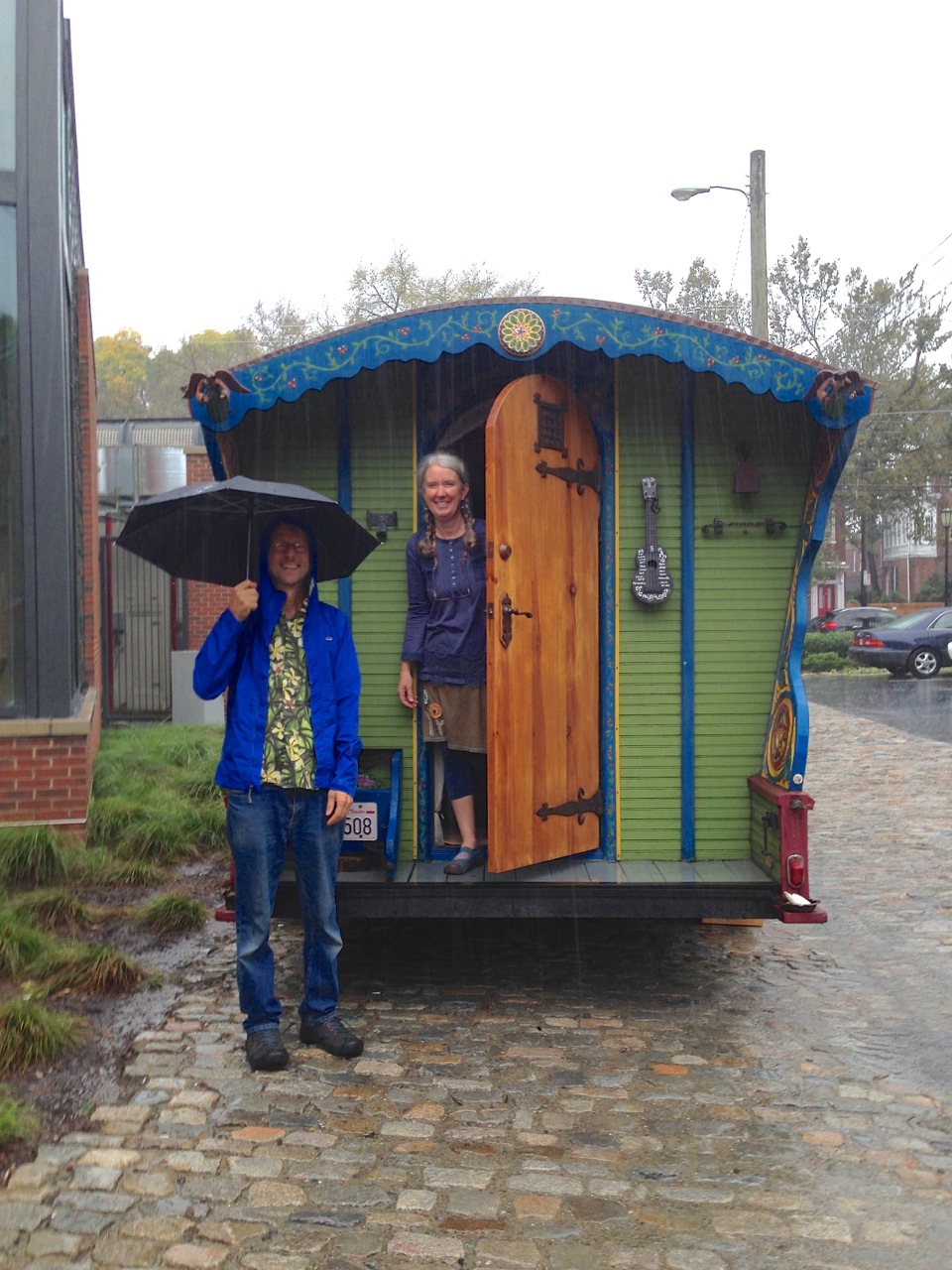
    Peter and Donna Thomas return to Rutgers with their Artists’ Bookmobile on October 4.

    Rutgers University Libraries and art librarian Megan Lotts are delighted to welcome Peter and Donna Thomas and their traveling Artists’ Bookmobile back to Rutgers. Peter and Donna are known for their workshops in paper and book arts. Visit the Artists’ Bookmobile—a self-contained exhibit of book arts—and learn how they make their books. Join in a book arts sing along at 3 p.m. featuring a ukulele book.

    The Bookmobile will be parked outside Alexander Library on October 4 from 2 to 3:30 p.m. See you there!

    Carr is Cutting the Ribbon

    Join us on Tuesday, October 17 at 10 a.m. as we dedicate the James Dickson Carr Library in honor of Rutgers University’s first African American graduate. The program includes remarks by Rutgers–New Brunswick chancellor Debasish Dutta, an exhibit of materials about Carr and the history of the former Kilmer Library, as well as a reception. Please register to attend at https://www.eventbrite.com/e/carr-library-dedication-ceremony-registration-38281939311.

    #RutgersDana50 Kicks Off on a High Note

    Dana Library kicked off its 50th anniversary celebration with a birthday bash during Rutgers–Newark’s Fall Fest in September. The festivities included cupcakes and a live performance by hip-hop/jazz fusion band Nickel and Dime OPS. Check out a clip of the band courtesy of @RUNewark_Dana on Twitter.

    Exploring the Wonderful World of Illusions

    Thomas V. Papathomas, director of the Rutgers Laboratory of Vision Research, visited the Library of Science and Medicine last week for a special presentation on optical illusions, how our minds process perspective, and even how illusions can be used as accurate measures of schizophrenia.

    Aiding the Relief Effort in Puerto Rico

    Alexander and Dana Libraries hosted open data editathons last week in response to the Red Cross’s request for geospatial data to help with their relief operations on the island. Participants mapped from pre-hurricane imagery to give those involved in the relief efforts an operating picture of the island before the storm made impact. Kudos to our colleagues Francesca Giannetti and Krista White for their part in bringing this program together so quickly!

    New Video for Banned Books Week

    Save

  • Digital Publishing in WordPress and Omeka

    The Libraries’ Digital Humanities Working Group, with the support of Integrated Information Systems, just launched an informal digital publishing service offering two popular open source platforms: WordPress and Omeka. Both are relatively easy to learn, and allow users to develop digital publishing skills, such as the integration of texts, images, and multimedia, digital citation practices, and digital collaboration on course projects and informal research in an online environment.

    WordPress and Omeka are both used for digital publishing, although they have different strengths. WordPress is widely known as a blogging platform. As the name implies, it is a text-centric application, even if themes and plugins greatly extend its appearance and functionality. Omeka excels at the presentation of small to medium-sized digital collections, which can then be curated to create digital exhibits integrating text and media. Dublin Core metadata connect items to their presentation in collections and exhibits, ensuring that context and provenance are not lost. Omeka was created by the Center for History and New Media at George Mason University.

    Libraries faculty and staff and Rutgers graduate students and faculty in humanities and adjacent fields (meaning interdisciplinary research with a humanist twist) may request a site in WordPress, Omeka, or both. Potential users should contact their Digital Humanities library liaison to request a site. The liaison for Camden is Zara Wilkinson; for New Brunswick, Francesca Giannetti; and for Newark, Krista White (for Rutgers-Newark) and Bob Vietrogoski (for RBHS). In the first phase of this service, priority will be given to users whose projects integrate Libraries resources.

    Many Rutgers librarians already use one or both of these applications. Laura Palumbo shares news on important resources in scientific disciplines at ChemInformer. Ryan Womack posts regular reflections on the data librarianship profession at RyanData. Kayo Denda created the blog of the Margery Somers Foster Center to provide an informal publication venue for student interns. Christie Lutz and other Special Collections colleagues write about rare and unique New Jerseyana at What Exit? And The Agenda newsletter itself is published in WordPress! The following three case studies demonstrate how these platforms can be used in support of library and scholarly work.

    Pedagogy and Professionalization

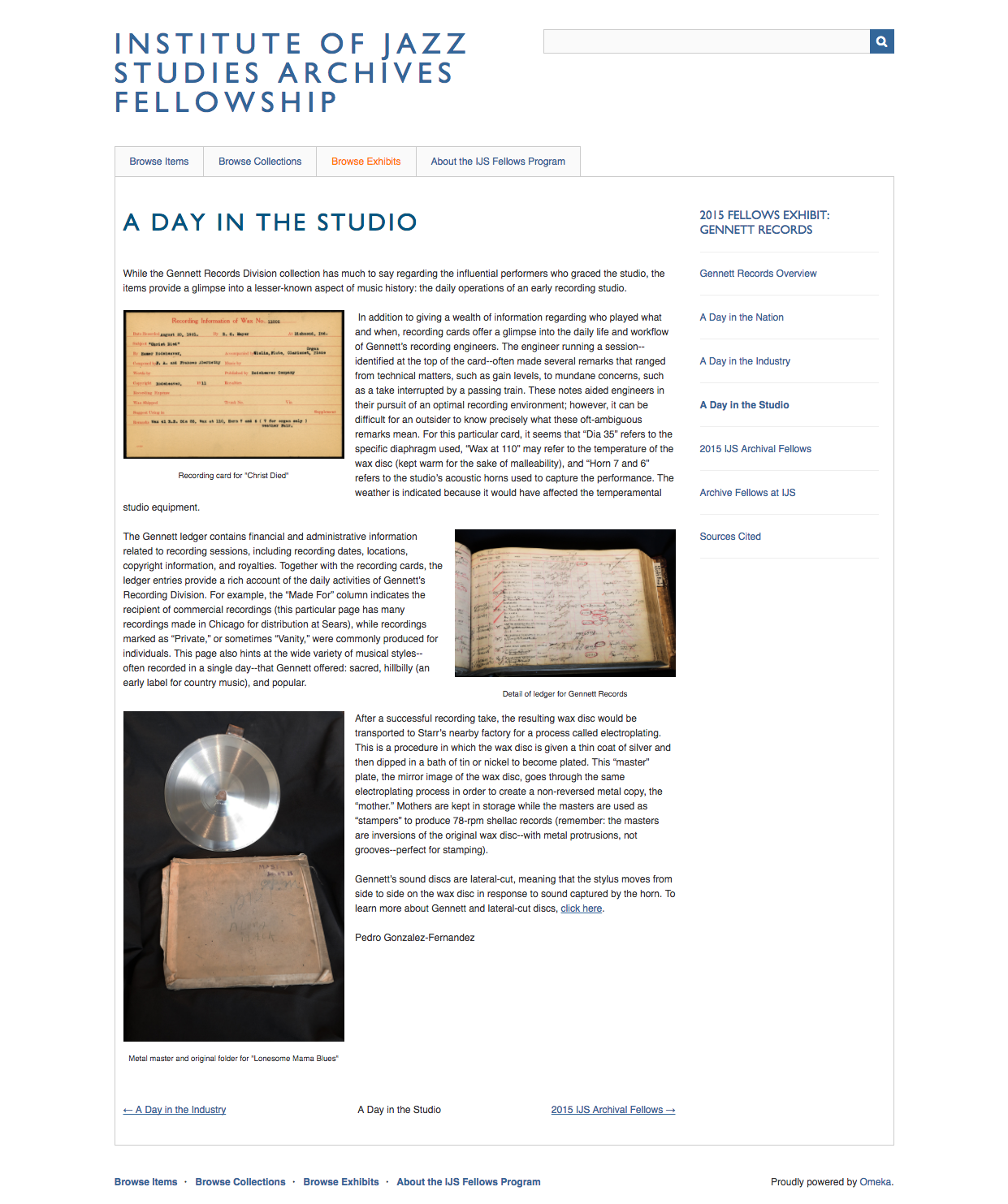
    A section of the exhibit on Gennett Records on the IJS Archives Fellowship site.

    The Institute of Jazz Studies Archival Fellowship Program, instituted in 2010, supports the professional development of early career archivists and is dedicated to promoting diversity in the field of archives. The Institute of Jazz Studies (IJS) has its home in the John Cotton Dana Library at Rutgers–Newark. Krista White, the digital humanities librarian at the Dana Library, works beside IJS archivists Elizabeth Surles, Angela Lawrence, and Tad Hershorn; IJS Fellowship Program coordinator Ed Berger; and current associate director Adriana Cuervo in mentoring the IJS Archives Fellows through the process of archiving a single, small collection each year.

    Krista White spearheads a digital project for the fellows each year and has used Omeka for the last two years. White chose Omeka because it is free and open source. Many archives and cultural institutions need to establish an online presence, but may not have the resources to produce expensive digital exhibits. By using Omeka as a learning tool, the fellows gained hands-on experience designing digital exhibits, evaluating copyright and intellectual property issues, and administrating metadata for public display in an online environment. Furthermore, exposure to open source tools provides a way for IJS Archives Fellows to build value-added expertise in creative digital solutions.

    Project Outreach and Communication

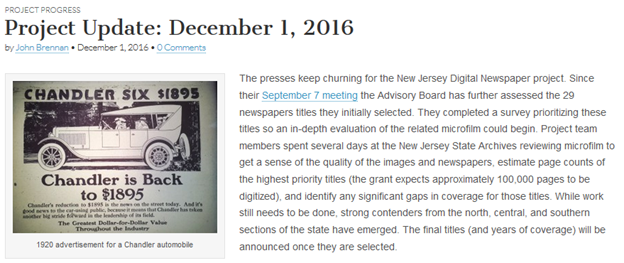
    A project update on the New Jersey Digital Newspaper Project blog.

    In late July, Rutgers University Libraries learned that they, the New Jersey State Library, and the New Jersey State Archives had been awarded a National Endowment for the Humanities grant to digitize New Jersey newspapers as part of the National Digital Newspaper Program. The project team wanted to quickly establish a presence for the project and did so by starting the “New Jersey Digital Newspaper Project” blog using WordPress. The blog is administered by Isaiah Beard, John Brennan, and Caryn Radick and includes content provided by project team members.

    The blog format lets the project team provide different types of information in one place including status updates, information about the partners, project staff, and advisory board, and provides a contact form for readers. Using a WordPress blog also allowed the project team to share password protected information with the Newspaper Project Advisory Board, who have helped guide the selection process.

    First and foremost, the blog serves as a way to share news of the project. Currently, the partners are working to identify newspapers and learning the processes and procedures of the work involved in digitizing these newspapers for the Library of Congress Chronicling America Project. The blog has detailed various trips and meetings for getting these underway. As the newspapers are digitized, the blog will also let the project team share stories of interest from New Jersey history and provide further updates about progress.

    Digital Editing and Reconstruction

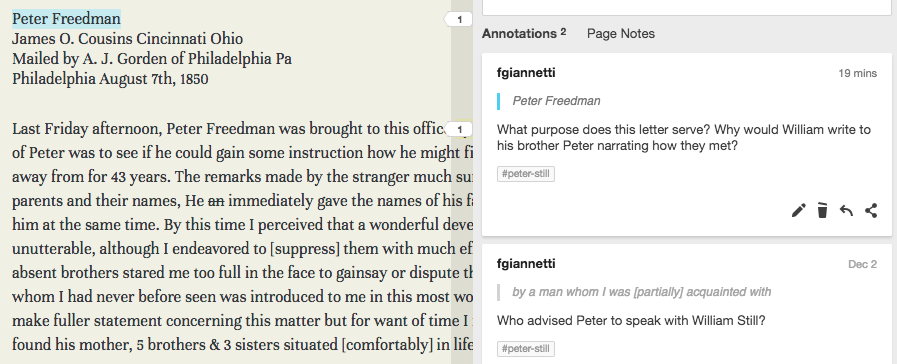
    Digital annotations to William Still’s letter, dated August 7, 1850.

    Francesca Giannetti is creating a digital edition of the Peter Still Papers, a small manuscript collection held in Special Collections and University Archives. These manuscript letters have already been published in RUcore; a primary goal of the digital edition is to provide digital full text transcriptions. Giannetti is working with Aresty research assistants to transcribe and encode the letters using the Text Encoding Initiative (TEI) framework of XML. The TEI allows keyword searchability across the letters, and also provides structured data that will allow future researchers to query the letters for names, places, and dates. This Omeka site will include lightly edited HTML transcriptions of the letters, while a link included in the relation field takes the reader to a more diplomatic style transcription with original spellings and line breaks preserved, and presented alongside expandable thumbnails of the page images. The Omeka site also features a hypothes.is annotation layer (right sidebar), which could serve as the basis of group digital annotation exercises in a digital or public history course. A next step for this project will involve finding faculty collaborators in history and American studies to bring these primary documents into the classroom for study and further research.

    If you have questions about how to get started using WordPress or Omeka in your work, or have comments on any of the projects mentioned in these case studies, please write to the Digital Humanities Working Group.

    -Francesca Giannetti, Caryn Radick, Krista White, Bob Vietrogoski, Zara Wilkinson, Ron Jantz, Fengzhi Fan, and Tibor Purger

  • RUcore hosts “Signs@40: Feminist Scholarship through Four Decades”

    RUcore hosts “Signs@40: Feminist Scholarship through Four Decades”

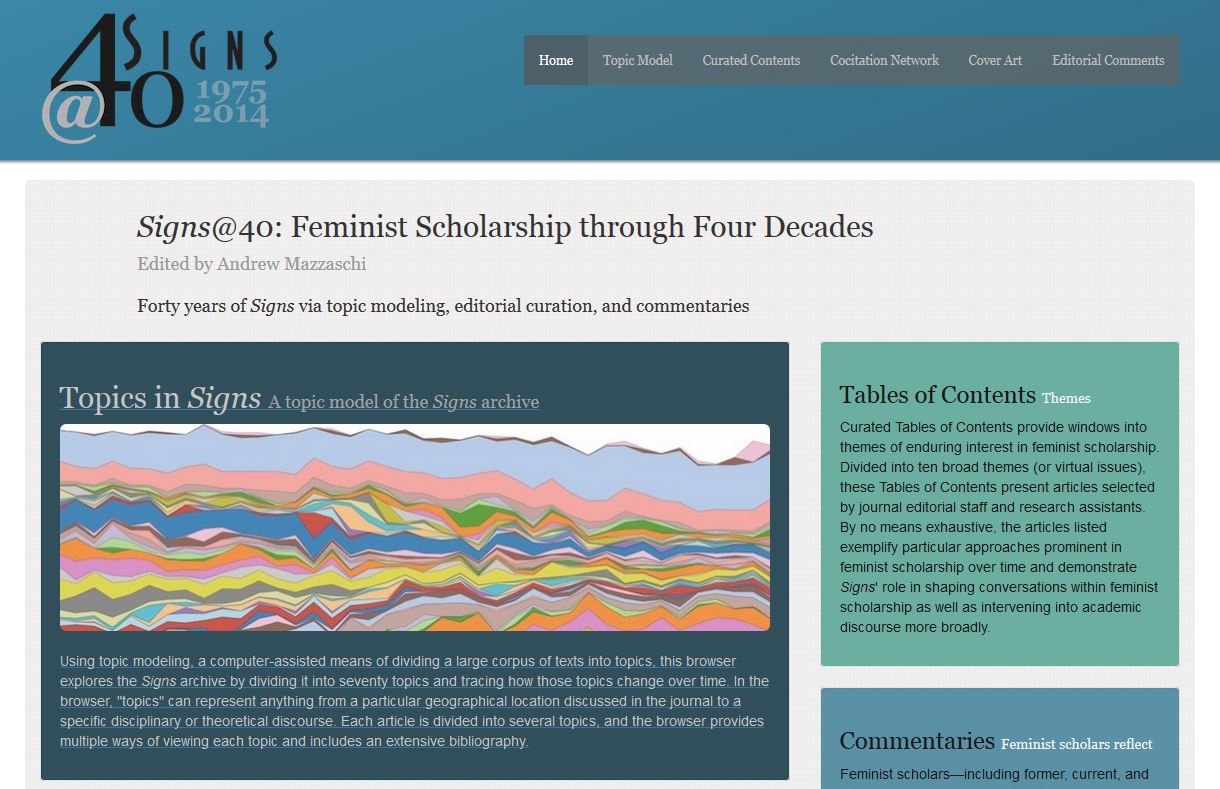
    CaptureThe interactive topic model for the fortieth anniversary edition of SignsSigns@40: Feminist Scholarship through Four Decades, is now publicly available in RUcore (http://dx.doi.org/doi:10.7282/T35D8TVZ). Users may download the entire project (topic model data and browser software) or selectively download either the data or the software.

    This collaborative project uses digital techniques to explore the Signs archive, the changes in the journal’s content over time, and its role in shaping the fields of Women’s, Gender, Sexuality, and Feminist Studies. Visitors will discover a visual exploration of the journal’s archive and a snapshot of how topics change over time. While there, they can also view a cocitation network graph that maps the citation patterns in Signs, read commentaries from feminist scholars reflecting on the editorial content and evolution of the journal since its launch, ooh and ahh over forty years’ worth of cover art, and more.

    Thanks to journal editor Mary Hawkesworth and the project creators, Andrew Goldstone, Susana Galán, C. Laura Lovin, Andrew Mazzaschi, and Lindsey Whitmore, as well as Ron Jantz and Kayo Denda of the Rutgers University Libraries, this project is now archived for posterity and downloadable by anyone interested in exploring, reusing, or adapting this rich artifact of feminist scholarship.