Category: Chang Science Library

  • NBL’s 2022 Finals Week and Stressbuster Events Schedule

    Stressbuster.

    Stop by the following NBL locations for finals week/stressbuster events:

    Alexander Library
    • Thursday, December 15, to Friday, December 23
    • Stop by Alexander Library for a treat during finals week! At various times, Stressbuster Grab n’ Go snack bags will be placed in the lobby (while supplies last).
    Art Library
    • Thursday, December 15, to Friday, December 23
    • Visit the Art Library during finals week for a Stressbuster Grab n’ Go snack bag (while supplies last).
    Carr Library
    • Thursday, December 15, 3–4 p.m.
    • Tuesday, December 20, 3–4 p.m.
    • Visit Carr Library during finals week for Stressbuster Grab N’ Go snack bags (while supplies last).
    Chang Library
    • Thursday, December 15, 11 a.m.
    • Take a study break at Chang Library and refuel for finals with delicious snacks (while supplies last).
    Douglass Library
    • Thursday, December 15, noon–2 p.m.
    • Monday, December 19, 10 a.m.–noon
    • Wednesday, December 21, noon–2 p.m.
    • Thursday, December 22, 10 a.m.–noon
    • Stop by Douglass Library for snacks and water bottles (while supplies last).
    Math and Physics Library
    • Thursday, December 15, 1–4 p.m.
    • Friday, December 16, 1–4 p.m.
    • Warm up at Math and Physics Library with coffee, cocoa, or apple cider (while supplies last).
    LSM
    • Thursday, December 15, 11 a.m.
    • Good luck with finals! Stop by LSM for a snack break and games.
  • Responsibility Grows in the Garden State

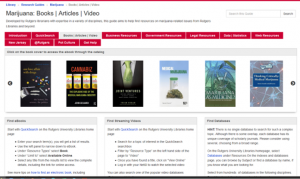
    A new Marijuana Research Guide from Rutgers librarians is ready to help researchers, students, and the public after legalization.

    A new Marijuana Research Guide from Rutgers librarians is ready to help researchers, students, and the public after legalization.

    The moment the news came in that New Jersey voters opted for the legalization of recreational marijuana, a new research guide seemed reasonable and necessary. Based on my previous experience and information collected earlier for a potential guide, I invited two colleagues to create a Rutgers Libraries guide to resources on marijuana-related issues. The guide is intended for Rutgers faculty, staff, and students, as well as for the public.

    Government resources librarian Stephanie Bartz selected relevant sources from the federal and state governments, complementing the collection with international resources. Becky Diamond, New Brunswick Libraries business librarian, added business resources, such as industry and company information, market research, and related databases. They both also contributed to other tabs such as data and statistics, New Jersey resources and services, and Rutgers resources. The legal resources tab benefits from the expertise of the Newark Law Library, with law librarian Rebecca Kunkel as partner. Book recommendations also came from Nicholas Allred, Graduate Specialist for the Chang Library’s Books We Read.

    The Marijuana Research Guide will remain a work in progress for a while, as the State of New Jersey works out the nuts and bolts of the complex procedure post-legalization. Updates will be included in several areas as we go.

    Read more in the blog post from Books We Read. Comments and suggestions are welcome.

  • Banned Books Week in New Brunswick

    By Judit H. Ward and Nicholas Allred

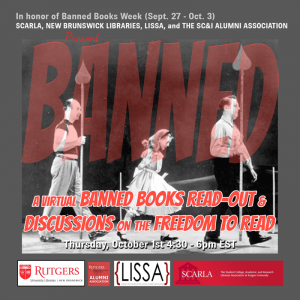
    New Brunswick Libraries partnered with the Student College, Academic, and Research Libraries Association (SCARLA), the Library and Information Science Student Association (LISSA), and the SC&I Alumni Association to host an online Banned Books Week event on October 1, 2020. The engaging event called Banned: a virtual read-out and discussion on the freedom to read featured read-outs of banned books from students and faculty, flash talks from SC&I and NBL faculty, a zine workshop, and trivia from LISSA. The 90-minute student-hosted event was extremely well received. It managed to connect a variety of audiences across Rutgers fostering a greater sense of community through sharing personal narratives and experiences. See a sample list of Banned Books we read at the event.

    The Books We Read team at Chang also documented the event with a page dedicated to Banned Books Week 2020, complemented with a collection of short essays inspired by the flash talks. In the Introduction to Banned Books Graduate Specialist Nicholas Allred poses the ultimate question “Why study censorship?” His perspective, based on his main interest in British literature, suggests that censorship can often provide a window into the anxieties of the censoring authorities. As an example, he mentions George Orwell’s Animal Farm, banned in the Soviet bloc, “because the allegory of a barnyard revolution hijacked by a regime of self-serving pigs who hollow out its utopian promises hit too close to home.”

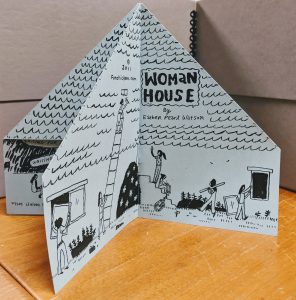
    Censorship has also shaped publishing and literary history, lending a thrill of the forbidden to challenged works and spurring DIY publication tactics like zines, the topic of Art Librarian Megan Lotts’ presentation entitled What is a Zine? In her definition, zines represent a unique subculture which has emerged around making and collecting as a powerful tool representing creative, low-cost, DIY means of self-expression and idea sharing. She recommended exploring zines in libraries not only as a creative way to learn about visual culture, open-access, visual literacy, and information but also as an engaging and non-threatening way to talk about issues around cultural appropriation, cultural sensitivity, and inclusivity.
    The Banned Books Week event also reminds us of what we have to lose. A flash talk by science librarian Judit Ward What is Samizdat? highlighted this term from the Cold War, referring to the underground publication and circulation of articles or books with political views in stark contrast to the party line. Samizdat editions were books that covered current political topics, written by foreign authors with political content, or new publications of blacklisted authors. Forbidden to publish, read, and circulate, these titles taught generations to reflect and read between lines for ever.

    “Censorship succeeds when no one talks about it”––NBL Special Projects Librarian and SC&I lecturer Nancy Kranich emphasized the importance of celebrating Banned Books Week in her flash talk entitled Ban No More. Focusing on the role of libraries and librarians, she also suggested that more banning would occur without librarians, teachers, journalists and others speaking out to defend the freedom to read. Although books in libraries are constantly challenged, i.e., someone tries to remove or restrict them based on their content, library policies and practices can ensure that (unlike during the Cold War in the Eastern Bloc) the freedom to read will prevail as one of the most basic freedoms of democracy.

    A large portion of challenged titles belongs to a genre called Young Adult (YA) literature. Challenged for their difficult topics related to gender, mental health, violence, or racism to protect the readers dealing with these problems in their everyday lives, many of these Banned Bestsellers can actually function conversely and assist processing the issue at hand instead, as suggested by Julie Rossano, Books We Read team member and graduate student in the course taught by Marc Aronson at SC&I.

    Banning books has been a long practice as a form of censorship for a great variety of reasons. Spearheaded by the American Library Association, Banned Books Week (September 27 – October 3, 2020) is an annual event celebrating the freedom to read. The Office for Intellectual Freedom (OIF) compiles lists of challenged books based on reports received from libraries, schools, and the media on attempts to ban books in the United States.


  • A Project Finds Its Moment: Books We Read, (Virtually) at Chang Science Library

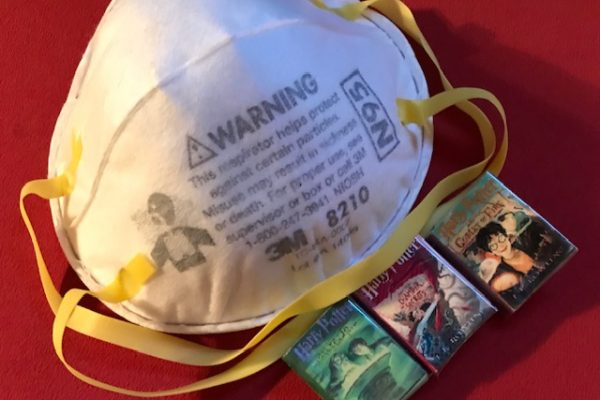
    Like people across the country and the world, many Rutgers students, faculty, and staff now find themselves stuck at home, their normal routines of work and leisure upended by the coronavirus pandemic and efforts to mitigate its spread. Chang Science Library has a prescription for the isolation and anxiety of social distancing: a good book.

    Chang Library’s Books We Read program, begun in the fall of 2019 to promote recreational reading on campus, has retooled and refocused for the present challenge: helping users discover pleasure reading that they can access at home.  A website hosted through sites.rutgers.edu offers guides to ebook and audiobook resources available to the Rutgers community or to the general public as well as reading recommendations and links to other recreational library activities. The first coronavirus-specific initiative within Books We Read was dubbed RUGRAT: Rutgers University Groups Reading Alone Together. A partner initiative, Cook Reads, was targeted specifically at Cook campus staff.

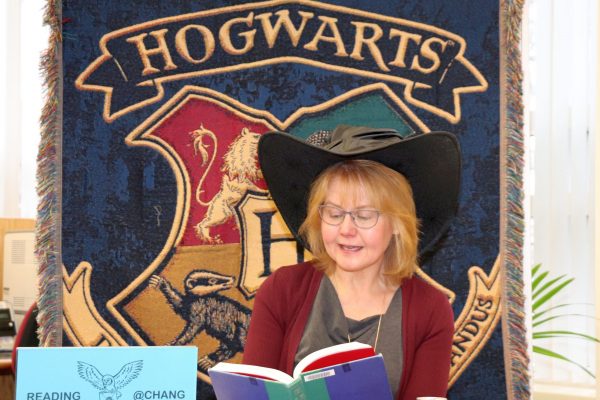
    In the fall of 2019, the Books We Read program officially began with a marathon reading of Harry Potter in Chang Science Library on the Cook Campus, as a partnership among New Brunswick Libraries, the School of Environmental and Biological Sciences, and student groups Rutgers Reads and Muggle Mayhem. The fall semester focused on curating a LibGuide for recreational books available at Rutgers University Libraries and on creating short story discussion sheets for use in recreational reading groups. When the COVID-19 pandemic began threatening campus life, however, the mission to promote recreational reading had to become less reliant on physical spaces and in-person gatherings. A blog post on March 8 marks the beginning of the new initiative, highlighting ebook and audiobook resources available online.

    Shortly after that March 8 post came the project’s first recommended reading list for the pandemic, “Classics for the Coronavirus.” The following weeks have seen more “social distancing” book recommendations, from public health nonfiction for the curious to travel fiction for those feeling cooped up. These recommendations have tried to balance the different motivations people may have for reading at the current time by including texts that deal with disease or isolation as well as texts that allow for a few hours’ escape from reality. After all, reading has traditionally offered guidance, reassurance, or space to process events as well as a way to forget one’s troubles.

    Statistics from our similar initiative at the Rutgers Center of Alcohol Studies Library called R4R @ Rutgers: Reading for Recovery, funded by an ALA Carnegie-Whitney grant in 2015–2016, indicated the possible applications of guided reading in difficult times. Books We Read draws on this experience while scaling up from the specific issues around addiction and recovery to the wide range of needs people may have in a global pandemic. Whatever Rutgers community members are looking for in a book, the Books We Read site aims to help them find it.

    Responding to the popular demand how to find a particular ebook or newspaper article, and wary of the random, dubious ebook download recommendations popping up on Rutgers-related social media and mailing lists, we added a few pages on how to find electronic resources from RUL with a Net ID. Highlighting ebook resources allowed us to showcase the comprehensive LibGuide to electronic resources, while a happy accident prompted us to add a guide to newspaper access.

    The same demand inspired us to incorporate media outside of books, increasing the visibility of the remote resources that Rutgers has to offer for both instruction and fun. Patrons may be surprised to hear that Rutgers allows remote access to some video resources; the site explains how to find them and offers some public health documentary recommendations. No matter the platform, the Books We Read project equips patrons with library resources and empowers them to ask for help.

    Patrons with an artistic flair (or who simply want to stop reading books for a moment and start drawing in them!) are connected through the Books We Read site to Rutgers’ Color Our Collections page, a project of Special Collections and University Archives (SCUA) that allows people to print out and color a curated set of images from the library’s holdings. Coloring archival images and making buttons or magnets from them has been a crowd favorite at in-person library events, and the online link allows users to enjoy the activity from the comfort of their own homes. In addition to fun and recreation, the site also connects users with potential archival resources for remote learning: a new page recommending SCUA resources links readers to the SEBS-specific installment in SCUA’s Archives at Home series, including a video interview.

    A robust social media presence has helped amplify the program’s impact, reaching out on widely used platforms in order to guide and inform online library users adjusting to remote instruction and research. The School of Environmental and Biological Science Office of Communications and Marketing has been instrumental in promoting the site, helping to drive nearly four thousand pageviews and counting in the past month or so of online-only operation.

    Books We Read has proven a successful tool to promote libraries while building connections and communities. Rutgers University Groups Reading Alone Together, in addition to a silly acronym (RUGRAT), captures the paradoxical promise of reading at a time like this: reading is one of the oldest and most effective ways to be alone without feeling alone. The Books We Read program maintains that even without a physical space to gather, the library can still offer, in addition to continuing support for remote learning and research, the simple solace of a good book. Visit us at go.rutgers.edu/booksweread.

    Nicholas Allred and Judit H. Ward