September 11, 2001: The Day That Changed The World, is an educational exhibition from the 9/11 Memorial & Museum that presents the history of 9/11, its origins, and its ongoing implications through the personal stories of those who witnessed and survived the attacks. This exhibit includes archival photographs and images of artifacts from the permanent collection of the 9/11 Memorial & Museum. It explores the consequences of terrorism on individual lives and communities at the local, national, and international levels, and encourages critical thinking about the legacies of 9/11.
Twenty years after the attacks, with terrorism still a threat today, the events of 9/11 and its aftermath remind us that we may never be able to prevent all the actions of people intent on harming others, but we do have control over how we respond to such events. Whether by volunteering in our local communities, serving our nation in the military, caring for the sick, or through other efforts, all of us can help build the world in which we want to live. As we witness history unfolding in our own time, the ways we choose to respond—both large and small—can demonstrate the best of human nature after even the worst of days.
The exhibit was developed by the 9/11 Memorial & Museum and has been made possible in part by the National Endowment for the Humanities: Democracy Demands Wisdom. Any views, findings, conclusions, or recommendations expressed in this exhibition do not necessarily represent those of the National Endowment for Humanities.
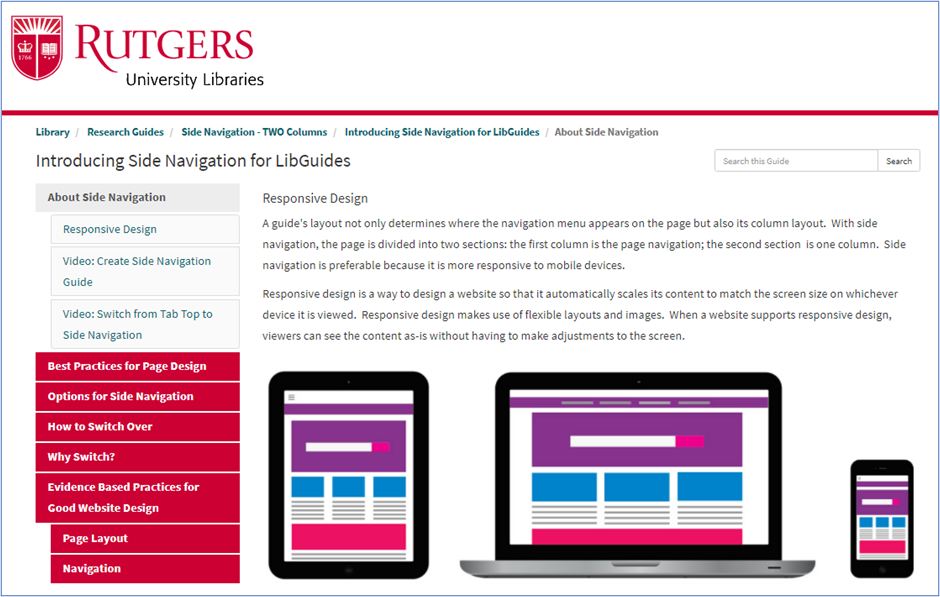
Rutgers Libraries have adopted the side navigation (“side-nav”) layout for new and existing LibGuides. Side-nav layout will result in more responsive web design on all devices. All existing tab top guides will be switched over to side-nav by June 30, 2022.
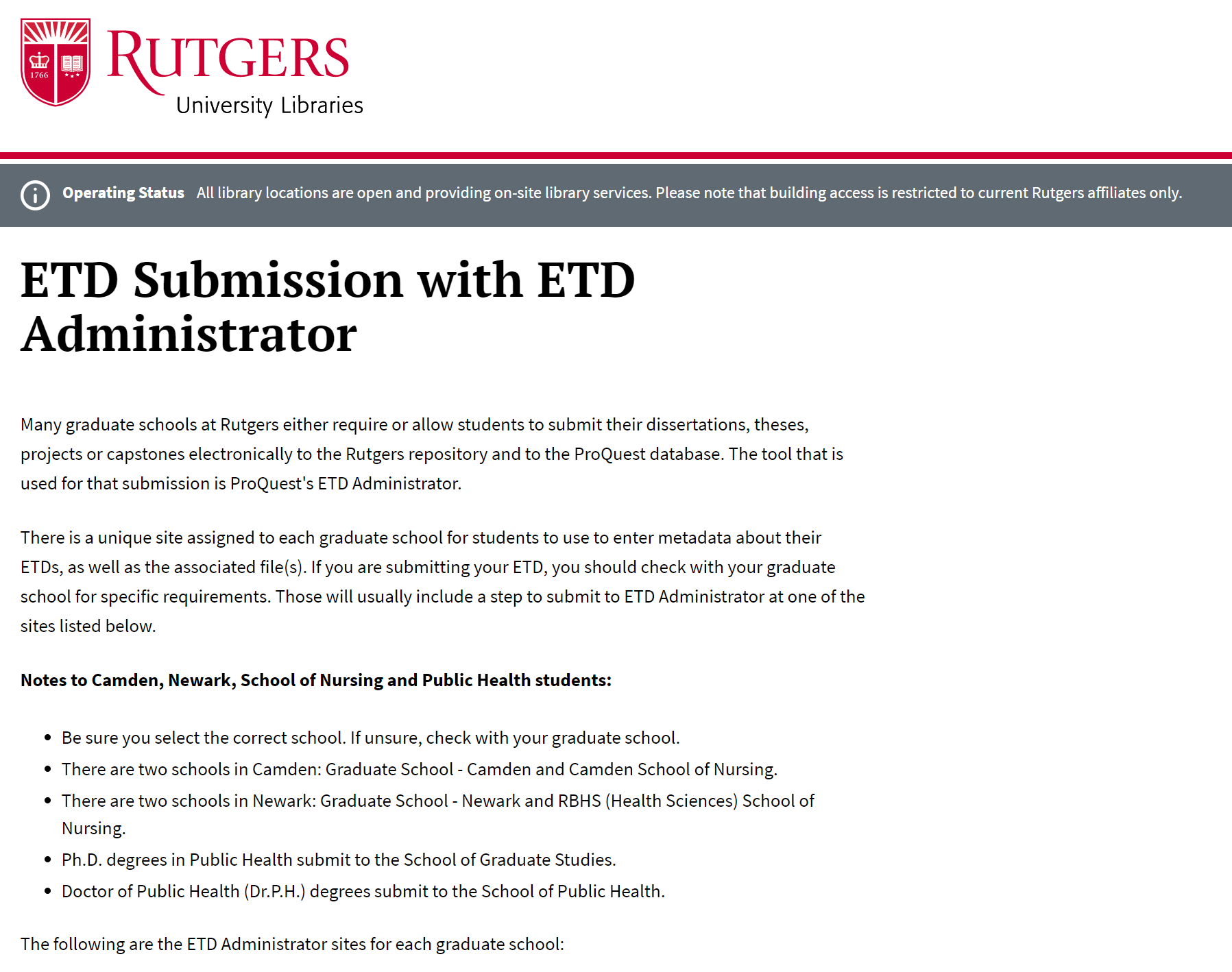
Many graduate schools at Rutgers require that their students submit an online copy of their dissertation or thesis for archival in the Rutgers repository. For 14 years, the RUetd Submission System, developed in house, was used for uploading and reviewing the submissions. This summer, it has been replaced with ProQuest’s ETD Administrator, a tool that is widely used by other academic institutions.
The ETD Administrator guides students and graduate school staff through the submission process. It involves cooperation between students, graduate school staff, and RUL. Students submit metadata about their degree and dissertation/thesis, as well as the actual PDF. They can also request bound copies and request that ProQuest register copyright for them. Graduate school staff review the submissions for completeness and to make sure requirements are met. Once the submission is approved, the ETD is delivered to ProQuest for publication and to Rutgers for archival in the RUcore repository.
RUL supports use of this tool for all ten graduate schools that require online submission. Students from the two schools that have August graduations have submitted their ETDs using this tool. The next ETDs will be submitted for October, followed by January and May. You can see the page being created for ETD submission help at https://www.libraries.rutgers.edu/submit-your-etd.
If you have questions or want to know more about ETDs, please contact Marty Barnett (martyb@libraries.rutgers.edu).
Now that the fall semester has begun on-site, we’re all becoming involved with new hybrid projects and tools. Many of us will have tasks that involve use of the LibCal application. To recap, LibCal, one of the LibApps applications from Springshare, has four modules that we use in RUL: Appointments, Events, Hours, and Spaces. We’re using the LibCal application in both new and revived ways.
The Appointments module is particularly useful once we start having in-person meetings with patrons. However, as many of us know, it can also be used for online consultations.
The Events module is in use, along with the new newly redesigned website, for posting events on the RUL calendar. Events, such as workshops and stressbusters, can be added to and displayed on specific-use calendars owned by local libraries. Registrations for events can be accepted and tracked as well.
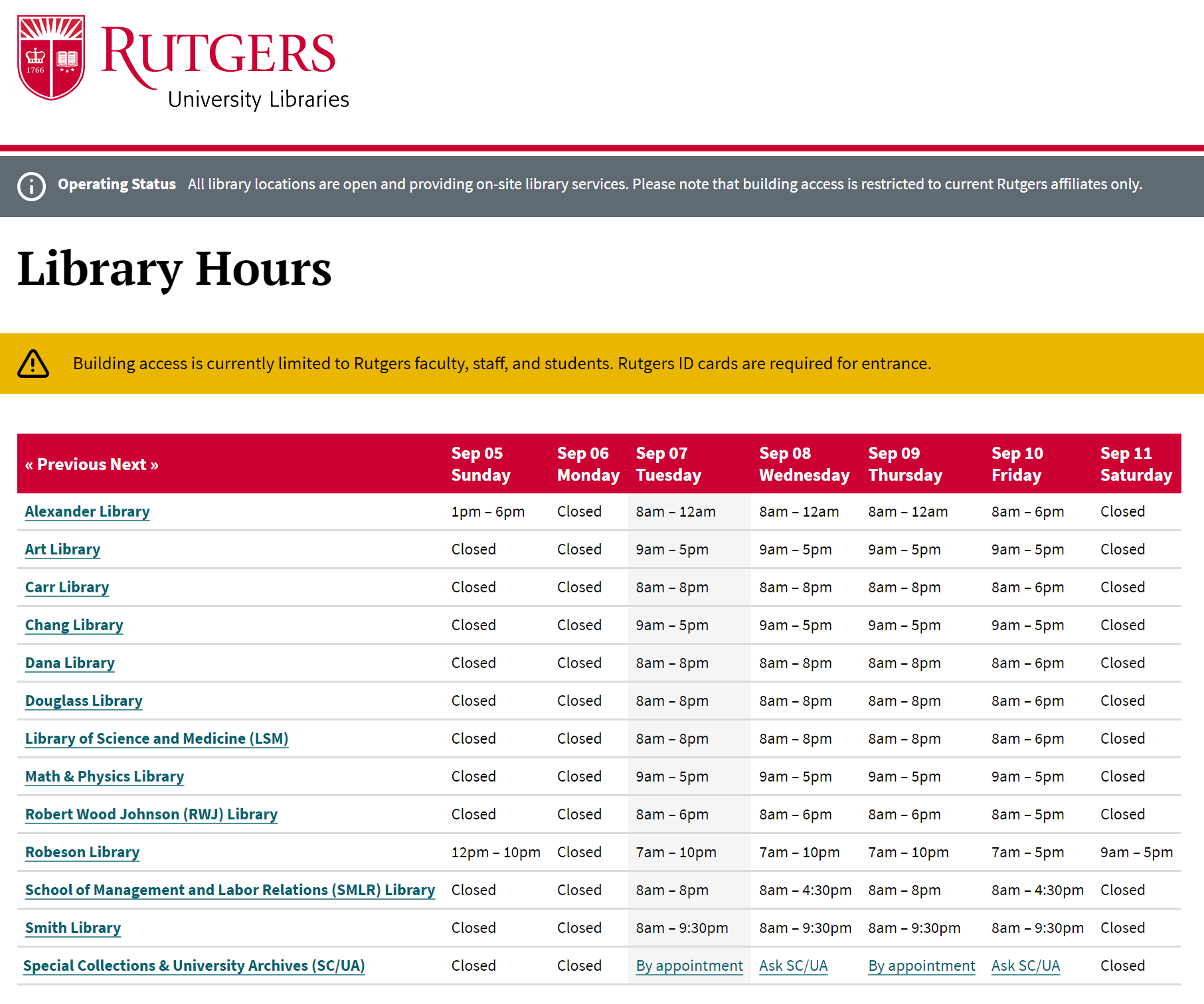
The Hours module has been used consistently, before, during and after the recent closure. It displays the times that our libraries’ buildings, desks and departments are open, in addition to giving links to additional help, where appropriate.
Finally, the Spaces module, which had been used to make pickup appointment times available for Click and Collect over the past year, is now set up for patrons to make appointments to use study rooms at our libraries. These rooms, some of which are available for group study and some for individual study, are popular with patrons. More of these spaces for study are being created, such as the new Digital Learning Commons at Alexander Library.
On August 12 all PALCI institutions moved to ReShare as the new platform to process and manage EZBorrow requests. We are so pleased to report that this transition has been successful and I would like to personally thank everyone for their patience and assistance over the past couple of months. Along with our partner institutions, we continue to provide feedback to developers to help make this new platform even better. In the first week we have already made several improvements, including one, patron searches. Clicking on the EZBorrow button in QuickSearch will now automatically search the PALCI shared index and present related results. Patrons no longer have to manually repeat their search in the EZBorrow interface.
EZBorrow patrons have received their final reminder regarding requests placed prior to the ReShare implementation. Access to these requests will not be possible after August 31. All users were provided with instructions on how to download a report of their requests from the old system prior to its retirement.
Thank you for the support you have provided during this transitional phase. Please feel free to contact me if you have any questions regarding ReShare.
Last week, we celebrated a day 18 months in the making—the launch of our new website!
As of 7 o’clock last Wednesday, anyone who visits libraries.rutgers.edu will be brought to our redesigned website. In case you missed it, here is a video highlighting some of the new features that users can now take advantage of (with special thanks to graduate assistant Natalie Lau for the narration):
It is so exciting for me to see how far this project has come. From our early sessions sorting cards or post-its and sketching personas, to the many phases of user research and testing, to the shiny new product you see here today, it has been an amazing process to be a part of. I know it will take some getting used to for everyone involved—both our users as well as our faculty and staff—but I think we’ve created a site that’s very special and something we all should be proud of.
As Consuella mentioned in her email, there are so many people to thank for helping this project come to fruition. Of course, this includes the project team—Doug Allen, Antonio Barrera, Amy Kimura, John Powell, Jonathan Torres, Sonia Yaco, and Yini Zhu—and especially the local representatives, who have had the difficult task of communicating with their units about a website that was constantly changing and growing. (This was such a fun and productive group to be a part of, and I will miss all of our pre-meeting shenanigans with the fancy Zoom filters!) It also includes the AULs and AVP—Judy Cohn, Regina Koury, Dee Magnoni, and Rhonda Marker—as well as their local teams, who have all had to prioritize this project despite so many other competing demands on their time. Last but certainly not least, thanks to the technical team who have dedicated many hours of development work to the site after it was handed off to us by NewCity—Eva Chan, Jie Geng, Dave Hoover, and Sam McDonald.
To that, I would like to add my personal thanks to the following people:
Amy Kimura, without whose Herculean effort creating content, coordinating working groups, and liaising with NewCity this project would simply not have been possible;
Antonio Barrera, whose project management and development expertise shone throughout this project, especially as he bridged the gap between the development teams at the Libraries and NewCity;
Abbey DiPaolo, who was a constant champion for the project and always pushed us to make the website the best it could be, even when there were tough decisions to be made;
Kris Maloney, whose vision for a better web presence for the Libraries inspired this project from the beginning; and
Consuella Askew, who seamlessly took over the reins in the late phases and led our way to the finish line.
Of course, this is just the tip of the iceberg, and many other cooks have contributed to this particular kitchen. But it has been one of the highlights of my professional career to have been a part of this project with this outstanding team, and I’m grateful to have played a small part in getting it to where it is today. That said, I know there is plenty more work to be done, and I am looking forward to continuing our efforts to make the Libraries’ website the best it can be for our users.
As a reminder, if you have any questions or concerns about the new site—whether yours or a patron’s—please direct them to webservices@libraries.rutgers.edu. You can also learn more about the site and the redesign project by visiting the Web Redesign Project Team’s staff resources page.
The New Brunswick Libraries have partnered with South Asian Studies Program (SASP) in the School of Arts and Sciences, New Brunswick to acquire a membership for the South Asian Open Archive (SAOA) database.
SAOA is a part of the South Asian Materials Project of the Center for Research Libraries and uses the versatile search interface of JSTOR. The collections in this open archive are curated and include a variety of materials including books, census data, journals, magazines, newspapers, and documents in the areas of literature, women & gender, social structure, and economic and social history. Over 26 languages are represented in these collections including South Asian languages such as Assamese, Awadhi, Bengali, Bhojpuri, Braj, Gujarati, Hindi, Italian, Japanese, Kannada, Latin, Malayalam, Marathi, Marwari, Nepali, Oriya, Punjabi, Sanskrit, Sinhala; Sinhalese, Tamil, Telugu, and Urdu. Documents in English and other languages such as German, Italian, French, Japanese, Persian and Arabic are also available. This database is now also accessible via the libraries’ list of Indexes and Databases.
The partnership was made possible through SASP’s Chakra Fund and New Brunswick Libraries Collections. Please contact triveni.kuchi@rutgers.edu for more information.
This spring the Paul Robeson Library launched the Undergraduate Research Award, a new initiative designed to recognize and celebrate excellence in original undergraduate research. Undergraduate students from all schools at Rutgers University–Camden were invited to submit research papers or other research projects completed between spring 2020 and spring 2021. Applications were required to include a completed project, a bibliography, and a reflective essay describing the search strategy employed and how sources were evaluated.
An evaluation committee of both teaching and library faculty reviewed each application, looking for those that made use of a range of library resources, collections, and services and showed evidence of critical thinking, originality, and creativity. Five winning papers were selected. Each winner received a cash prize and certificate, an invitation to include their paper in a digital collection, and recognition at a virtual event held on May 24, 2021.
Julia DeFeo, “Evaluating the effects of wild and prescribed fire on the taxonomic and functional diversity of soil-dwelling arthropods in the New Jersey Pinelands, a high-disturbance system”
A phishing attempt is one of the common types of cybersecurity threats we face daily. Anyone with an email account is a target for phishing scammers. The primary goal of phishing is to trick you into providing your credentials such as passwords or other sensitive information. In other cases, scammers may impersonate someone you know and try to convince you to purchase gift cards, asking you to provide the card number. Scammers and hackers are consistently finding new ways to make their messages more convincing, making even the most careful among us a victim by clicking on a link, opening an attachment, or simply responding to a message. Because these actions can have dire consequences, it is important to remain vigilant, use common sense, and understand the best practices that can keep your information safe.
To combat phishing attempts, the OIT has created a website, Phish Bowl, consisting of helpful tips to identify and avoid phishing scams, including links to the Cybersecurity and Infrastructure Security Agency (CISA) alerts page, and the SANS Institute’s Security Awareness Tip of the Day. Also included on the Phish Bowl page are a series of brief and entertaining YouTube videos on topics such as passwords, data handling, computer theft, phishing, and ransomware, and more. In just a few minutes per video, you can raise your awareness of crucial security best practices. For more information on how to identify and report phishing messages, please see https://agenda.libraries.rutgers.edu/iis-updates-january-2021/#phishing.
You are the first line of defense. If you receive a suspicious message, please forward it with Message Details to support@rulhelp.rutgers.edu immediately. We will review your message and report it to OIT, if necessary.
To further increase security, Rutgers has already required Duo two-step login for Rutgers Connect. Since it has been required for Rutgers Connect logins, cybercriminals have not gained access to a single Rutgers Connect account. Starting on July 1, Duo will be required for all websites and services accessed through Rutgers’ Central Authentication System (CAS) from on campus and off campus, including Box, Canvas, myRutgers, Webex, Zoom, and many others.
If you have concerns or questions about phishing or the additional Duo requirements, send an email to support@rulhelp.rutgers.edu.
ReShare, the new platform for managing E-ZBorrow requests, is now in the final stage of implementation. ReShare will provide our patrons with consortial discovery, offering real-time availability. Additionally, ReShare supports batch processing which will allow staff to process multiple requests quickly.
In the coming weeks we will be adding configurations, creating staff user accounts, and training staff on processing requests in ReShare. Staff at all PALCI partner libraries will be spending the first two weeks of July working with test requests and fine-tuning the process. PALCI is anticipating this testing phase to be completed by mid-July, at which point all partner libraries would enable patron discovery and go live on the new platform on the same day.
Relais, the platform we currently use, will remain available for the completion of current requests until August 31. Requests will not be migrated to the new platform. Patrons who have used the E-ZBorrow service in the past two years will receive a notification with instructions on how to export a list of their requests. The first of these notifications will be sent on July 7 and two reminders will be sent before the August 31 deadline.
More information about Project ReShare can be found here.

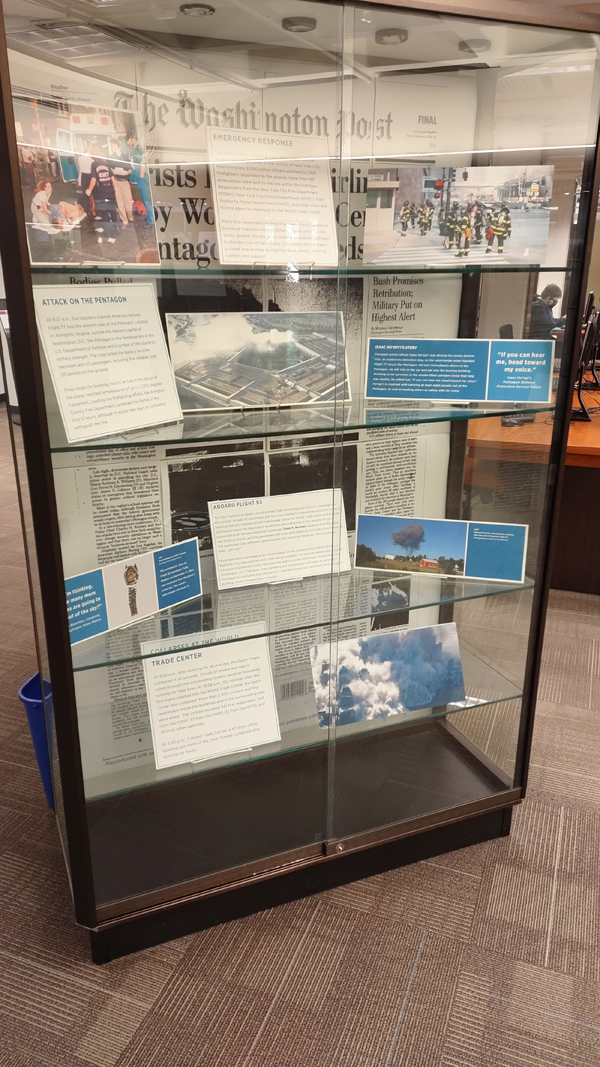 September 11, 2001: The Day That Changed The World, is an educational exhibition from the 9/11 Memorial & Museum that presents the history of 9/11, its origins, and its ongoing implications through the personal stories of those who witnessed and survived the attacks. This exhibit includes archival photographs and images of artifacts from the permanent collection of the 9/11 Memorial & Museum. It explores the consequences of terrorism on individual lives and communities at the local, national, and international levels, and encourages critical thinking about the legacies of 9/11.