Also, join us as we celebrate a milestone in the historical research at the Center of Alcohol Studies Library. One of the most important founders of alcohol and addiction studies, E. M. Jellinek, also laid down the foundations of the current CAS Library. The most recent issue of the Journal of Studies on Alcohol and Drugs, published at CAS, features three open-access articles with CAS Library’s contributions to the history of alcohol studies. CAS Library staff has compiled Jellinek’s most comprehensive bibliography to date based on their original research that discovered new biographical data and articles. His seminal articles have also become freely available on the JSAD website. See the reintroduction of Jellinek to current addiction science at: http://www.jsad.com/page/bunkybundle
This course is ideal for staff, managers, supervisors, and administrators who recognize the need to improve their overall confidence and competence in critical skills and apply positive strategies for transferring ideas learned to the workplace.
Location: Pane Room, 1st floor, Alexander Library with teleconference to Smith Library, Dana Library and Robeson Library
RSVP: Erica Parin on behalf of the Professional Development Committee
Digital Humanities Lab Open Houses
June 2. 2016
10 a.m.June 8. 2016
12 p.m.
We’re hosting a couple of DH Lab Open House events in early summer session as a way to acquaint faculty and students with this research space. If you are curious about how to use this space, or what is available there, please feel free to join us. At each event, there’ll be a short presentation followed by an open discussion on digital humanities work and research at Rutgers.
Location: Digital Humanities Lab, Room 406-407, Alexander Library
Refreshments will be provided. RSVP with preferred date to Francesca Giannetti.
Open and Affordable Textbooks at Rutgers
The Libraries have recently formed a taskforce to plan and implement the President’s Affordable Textbook grant initiative. This taskforce has representation from RBHS, Newark, Camden, and New Brunswick and will be charged, among other things, with creating criteria for judging course redesign grants. We are excited to have the support of the Open Textbook Network in these efforts, as we have recently joined this nation-wide system of partners, with a wealth of experience in promoting access, affordability, and student success through the use of open and affordable textbooks. In the next few months, we will be actively working with all of our colleagues at the Libraries to shape this program and educate students and faculty about the importance (and learning benefits) of open texts. Stay tuned for much more to come, including a website describing the grant process, application guidelines to share with interested faculty, as well as workshops organized by the Open Textbook Network in the fall semester. Please feel free to email the chair of the taskforce, Lily Todorinova, with any thoughts or suggestions. We look forward to working with you!
-Lily Todorinova
Dana Library Loans Portable DVD Players
As part of the growing TechnologyLending @Dana Library program, four portable DVD players will be available for short-term loan to Rutgers University students, faculty, and staff, beginning May 31, 2016. The players may be borrowed for up to four hours, with the option of one in-person, four-hour renewal, if there is at least one other DVD player available. They may be used in or out of the library, and must be returned exclusively to the Dana Library circulation desk at least 30 minutes before library closing. Students are also asked to report any problems with the DVD players to library staff upon return.For more complete information, please read Portable DVD Player Borrowing: Policy and Procedures, issued on May 25.
-Tad Hershorn
Watch “Preserving Your Digital Life” with Krista White and Isaiah Beard
Our stories as individuals and as members of a community are preserved in each of our homes, in our family histories, and in life stories—not just in libraries, archives, and museums. Today, many of us record and keep these stories in digital formats, often on our smartphones. The ability to easily create audio and video recordings leads to deep and rich documentation of events that may be personally important but may also have regional or national significance. Preserving these narratives for our families and for future generations means considering how we create the files and how we store them. As part of ALA Preservation Week, Krista White and Isaiah Beard presented a Webinar Titled “Preserving Your Digital Life” that touched on these issues, and provided a high-level primer on how best to make sure your digital memories stay in focus for years to come. Watch their presentation on YouTube.
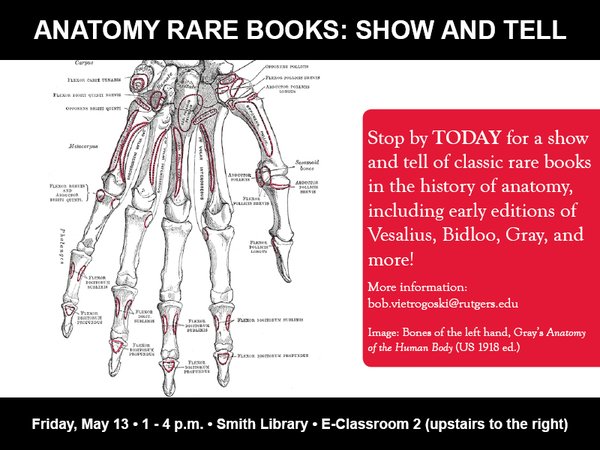
In addition to bubble-popping and “make your own squeeze ball” stressbuster activities, the George F. Smith Library of the Health Sciences hosted its first “Anatomy Rare Book Show and Tell” on Friday, May 13. Over the afternoon, 18 attendees (15 students, 2 librarians, and a regular library visitor) dropped by to see, touch (supervised!), and learn about:
Andreas Vesalius, De Humani Corporis Fabrica (2nd edition, 1555 – a gorgeous book with renowned illustrations, with our copy featuring a magnificent 1572 binding)
G. Bidloo, Anatomia Humani Corporis (1st edition, 1685 – folio size with awesome and gruesome giant plates)
Henry Gray, Anatomy: Descriptive and Surgical (1st British edition, 1858, and 1st American edition, 1859 – fantastic pedagogical illustrations, and thanks to television, probably the best-known textbook title)
Librarian lessons learned:
Patron serendipity: A first-year medical student recently visited Special Collections and expressed interest in the rare books. She was concluding gross anatomy studies, and really liked the idea of a show and tell of classic anatomical works. She was happy to post news of the event on the private Facebook page of the first year students. So if one patron is interested, it’s reasonable to conclude that maybe more than one will be interested!
Location location location: Instead of using the Special Collections reading room, the books were displayed in E-Classroom 2, a recently renovated room closer to where students congregate on Smith Library’s upper floor. A sign taped to a chair and an open door worked to draw some second-year students temporarily away from their USMLE Step 1 studies. Prompted by a Vesalian illustration, some even recalled which bone in the human body is the only bone not connected to another.
If it works, do it again: Attendees showed interest and stayed longer than originally anticipated. (By the end, my voice was shot.) So I intend to make similar rare book, manuscript, or even historical object show and tell events a regular end of semester activity.
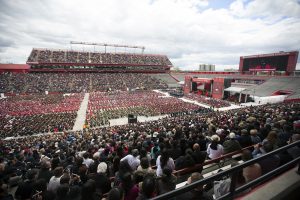
The view on commencement day. Photo credit: Nick Romanenko, University Photographer, Creative Services
On September 27, 2005 at the opening of the exhibition of the newly purchased East Jersey materials held at Morven Museum and Gardens in Princeton, Richard P. McCormick, distinguished professor of history at Rutgers, presented remarks on the extraordinary acquisition of colonial New Jersey documents from Christie’s. “What a glorious day!” McCormick stated at the beginning of his address. I’m sure that, as a Rutgers University historian, he would have felt the same way about Commencement in 2016.
Indeed, it was a “glorious day” for the entire university community. To have the first sitting President of United States present the Commencement address was perhaps the signature event in the year-long celebration of Rutgers’ 250th anniversary.
As a member of the Executive Planning Committee for Rutgers 250, I was involved in early discussions and was delighted to hear Matt Weismantel, Senior Director of Rutgers 250, was considering extending an invitation to President Barack Obama. We knew it was likely a far-fetched idea, given the complexity of scheduling and the number of invitations a president receives for such occasions, but there were numerous factors that weighed in favor of Rutgers, particularly its celebration as the eighth oldest college in the nation and its distinctly diverse student population. A three-year campaign, as highlighted in President Obama’s commencement remarks, resulted in a last-minute acceptance and dramatic preparations for a presidential visit to the Banks of the Old Raritan.
I was fortunate to contribute to the events of this remarkable day. On the Friday preceding commencement, I received a call from Greg Trevor, director of media relations, asking if I would do an interview with WNYC (NPR) about Rutgers history. I told Greg that I would be more than willing to participate and that evening I participated in a five-minute conversation for a segment of “All Things Considered” that aired the following day at 5:30 p.m.
During our preparations for the “All Things Considered” interview, I mentioned to Greg that I did not have a ticket for Sunday’s ceremony. If anything, I thought he might be able to get me a ticket as a professional courtesy, so I could observe this historic moment in my capacity as the university archivist. But Greg went one step further and added me to the Media Relations team that assembled in the press box at High Point Solutions Stadium.
So, in addition to being a spectator, I also contributed to the event by informing the media about Rutgers past. During commencement, I was interviewed by both print media (the Star Ledger, Home News, Bergen Record, among others) as well as broadcast media (WCTC and WRSU).
As I sat in the box at the 50-yard line looking at the crowd and listening to a wonderful commencement address, I kept thinking about Richard P. McCormick and wondering what his reaction would have been. To me, it was one of the most significant days in Rutgers history and I’m sure Richard McCormick would have agreed!
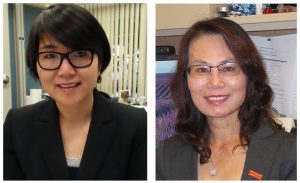
Yingting Zhang from RWJ Library (l) and Yini Zhu from Smith Library (r) were both named to the prestigious Medicine Medical Informatics Fellowship.
Yini Zhu (Smith Library) and Yingting Zhang (RWJ Library) were both named to the National Library of Medicine’s (NLM) Biomedical Informatics Fellow program through a competitive application process. Yini attended a week-long medical informatics workshop held at Augusta University, Augusta, GA, in April 2016. Yingting will attend the same program in fall 2016.
This program introduces participants to the fundamental concepts and application areas of biomedical informatics with components including principles of controlled terminology/vocabulary, standards, mathematical modeling, bioinformatics, natural language processing, and more.
NLM’s program recruits from health sciences educators, librarians, administrators, clinical practitioners, and faculty who can become agents of change in their respective institutions by becoming a “field force” to train other on these concepts.
The benefits of attendance at the fellowship program were immediate. Following her participation in the NLM program, Yini Zhu joined Minglu Wang and Bonnie L. Fong to present a Data Management Plan workshop to a group of Rutgers Newark and RBHS faculty, researchers, and staff on May 3, 2016. Yini covered the fundamentals and best practices of data sharing plans required by the National Institutes of Health (NIH) while Minglu and Bonnie addressed data management plans.
Click here to learn more about the Biomedical Informatics program.
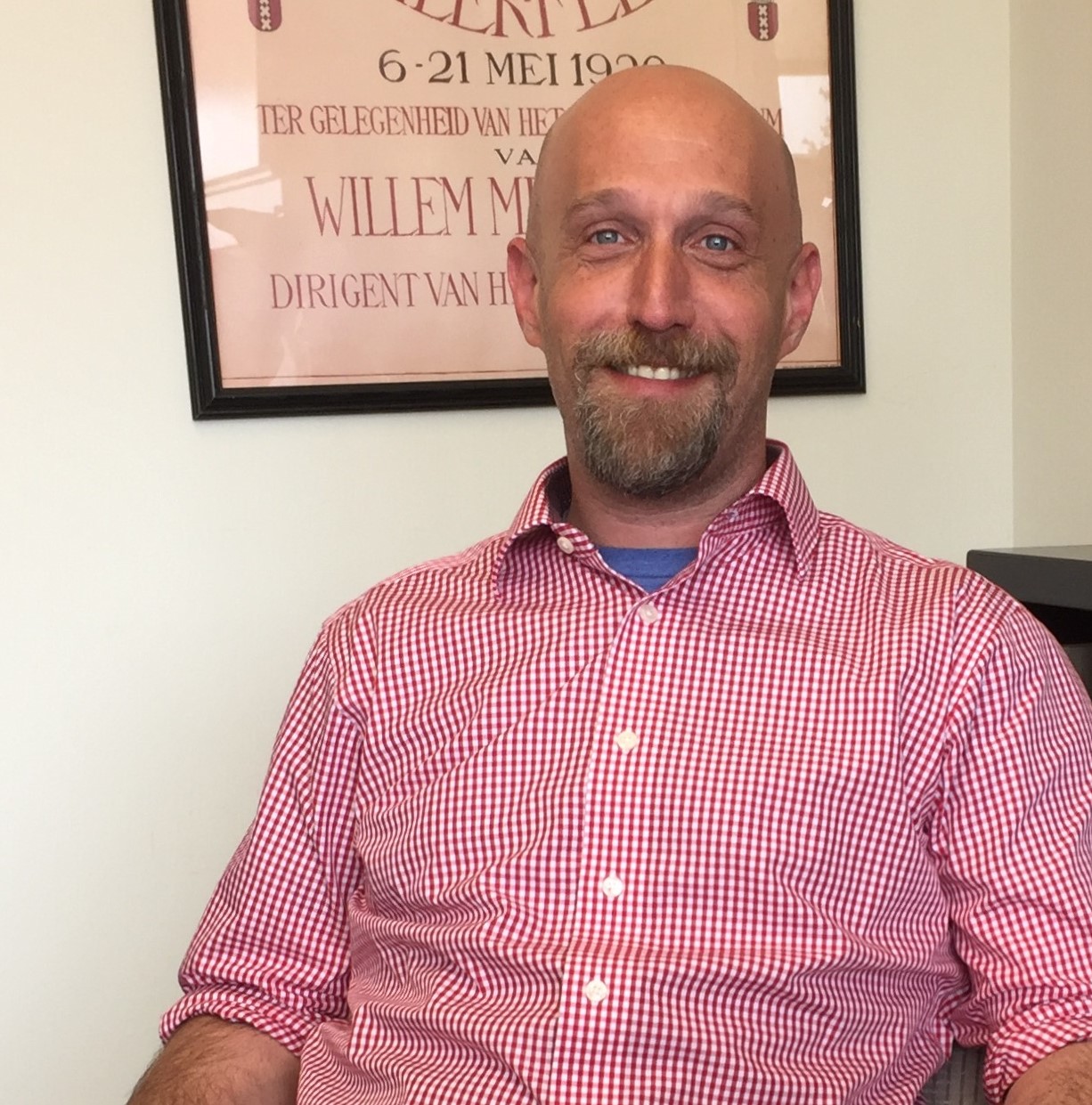
Micah Kleit, incoming director, Rutgers University Press
We are holding the reception for A Celebration of Books (previously called the Faculty Author Celebration) on April 12 at 5 p.m. in Alexander Library. In addition to a display of books and poster giveaways, we are delighted to announce that our featured speaker for the evening will be Micah Kleit, the incoming director at Rutgers University Press.
He will address the convergence of publishing, libraries, and universities and what it is that causes us to want to produce—and reproduce—knowledge. Exploring the landscape of publishing (generally) and university press publishing (more specifically), he will discuss how libraries, scholars, and universities with and without presses need each other now more than ever. The talk will take into account questions of risk, especially as the landscape of scholarly publishing and depositories is changing, and how the risks embedded in contemporary publishing offer new opportunities for scholars, students, and the general public.
Micah Kleit is the incoming director of Rutgers University Press. He has been at Temple University Press for the last seventeen years, first as executive editor, then as interim editorial director, and most recently as editor-in-chief. Before Temple, he was an editor at Beacon Press and the University of Minnesota Press.
His publisher, Fordham University Press, was kind enough to give us a review copy of his book for a giveaway. This giveaway is only for faculty, staff, student workers, interns, and other employees of Rutgers University Libraries. See below for details on how to enter. You can receive up to 3 entries if you complete all three actions:
As many in the Libraries have already heard, the university has started the migration of faculty and staff email and calendaring to a unified system, called Rutgers Connect, in the Microsoft Cloud using Office 365. The Libraries are scheduled to migrate in Phase 2, sometime between June and August of 2016, but we are still working with colleagues in the Health Sciences Libraries to determine whether they will be part of the Libraries’ migration, or remain part of RBHS, which is scheduled to migrate in the ongoing Phase 1.
There is plenty of good news to look forward to, even if some effort will be required from everyone in the course of the migration:
Uniform availability anytime, anywhere, of mail, calendar, and the basic Office 365 applications on any platform: Windows, Mac as well as tablets and smart phones of all three flavors (Android, iOS, and Windows)
The Office 365 cloud-based suite offers all major productivity apps: Word, Excel, PowerPoint, Outlook, and OneNote, which will also be available in desktop versions
The email/calendaring client, called Outlook, including Tasks and Contacts (now called People), and its Web-based version, called OWA (for Outlook Web Access), offer each user 50 Gigabytes of mail storage – an order of magnitude higher than what is currently available
In addition to the large mail quota, each user will get 1 Terabyte of shareable file storage for collaboration (similar to Google Docs) on Microsoft OneDrive that will show up in your Windows Explorer (now called File Explorer in Windows 10; had been called File Manager before 2000) as just another “drive”
In addition, Rutgers Connect includes access to Skype for Business for everyone
More collaboration tools (like SharePoint) will be probably added in 2017
The Rutgers Office of Information Technology (OIT) has contracted a third-party integrator, Comparex, to help with the migration. They will provide webinar-based instruction and tutorials for the use of the entire Office 365 suite. The Libraries’ own Integrated Information Systems (IIS), together with the Libraries’ Unit Computing Specialists, will provide local, customized help in transitioning from Zimbra to Outlook.
As part of the transition to Office 365, our email addresses will change from “@rulmail.rutgers.edu” to the more intuitive “@libraries.rutgers.edu.” To prepare for this change, everyone is encouraged to set up a Rutgers-wide alias in the form of [firstname].[lastname]@rutgers.edu, and have it point to the current @rulmail.rutgers.edu address. (This can be done now by each user on their own, or IIS can help with the rather simple process that takes but a few minutes.)
Much more information will follow in the coming weeks and months as IIS prepares the support infrastructure for everyone to use. We will have a Communications Plan and a Support Website (just like for the Zimbra transition in 2011) with all relevant information, so you won’t have to search several Rutgers sites for every detail. The final migration plan itself will be worked out together with representatives of OIT and Comparex about one month before the actual date.
Here are a few pointers to alleviate early concerns:
The current @rulmail.rutgers.edu addresses will forward incoming mail to our new accounts for one full year after migration (without the possibility of logging into the old account) – so that people will have plenty of time to adjust their external list subscriptions.
All internal lists will be migrated and/or updated manually by IIS, or support will be provided for lists that we don’t have access to.
Since all Rutgers Faculty and Staff domains will “trust” each other, it will be easy to find anyone in the global directory, and to sign up for lists from other departments.
Please look for a lot more information coming to your mailboxes as we move closer to the migration period. It is a good idea to take the online webinars close to the migration date (so as not to forget everything by the time you need to use the new apps). In the meantime, please let IIS know of any concern or question you might have at support@rulhelp.rutgers.edu and, in a few weeks, at the support website.

 As part of the growing TechnologyLending @Dana Library program, four portable DVD players will be available for short-term loan to Rutgers University students, faculty, and staff, beginning May 31, 2016. The players may be borrowed for up to four hours, with the option of one in-person, four-hour renewal, if there is at least one other DVD player available. They may be used in or out of the library, and must be returned exclusively to the Dana Library circulation desk at least 30 minutes before library closing. Students are also asked to report any problems with the DVD players to library staff upon return.For more complete information, please read