Category: Ex Libris

The implementation team will provide regular updates via The Agenda.

  • Ex Libris Implementation Project Update – May 2019

    quicksearch logo

    Rutgers Law Libraries to Join Alma/Primo

    The Rutgers Law Libraries are joining our Alma and Primo instances in January 2020! Project planning for appending the Law libraries catalog has begun. We are currently participating in bi-weekly planning meetings with Ex Libris and the Law libraries. Progress will be communicated through the Ex Libris Implementation team. This is an exciting opportunity for us and the faculty and students that we serve. 

    Leganto Update

    The Leganto implementation team is preparing to go live with 16 pilot courses from the School of Social Work. This summer, social work graduate students will be able to access their course reserves, including electronic course reserves, live links to the physical reserves holdings, and access to our journal and database subscription content, directly from their course in Canvas. The team is planning a soft launch for fall, so if you know of a department that would be interested in this comprehensive course reserves solution, please contact your campus representative to the Leganto team or the Ex Libris Team at exlibris@rutgers.libanswers.com 

    FRBRization disabled for music materials 

    FRBRization refers to the process by which different versions of the same work are grouped together. Generally speaking, FRBRization is a useful feature that allows researchers to easily find and identify related works (e.g., different editions of the same book). However, in some cases, unrelated works are mistakenly grouped together, which causes confusion and makes these resources more difficult to find. This is especially true for musical scores and audio recordings where heavy use of generic titles, complex statements of responsibility, and variations of performance can lead to erroneous matches. Accordingly, FRBRization has been disabled for these materials. This decision was made in consultation with and based on feedback from experts in public services, cataloging, and the music department. The exemption applies to scores and audio recordings only. All other types of materials will continue to be FRBRized.

    Improved metadata for Academic Video Online (AVON)

    Academic Video Online (AVON) is a large streaming video collection of documentaries, interviews, performances, and feature films spanning a wide variety of subjects. However, the metadata provided by Ex Libris for this collection suffered from a number of limitations impacting its discoverability in QuickSearch. Accordingly, these records have been replaced with vendor-supplied MARC records. The new records are not only of higher quality but also offer more reliable linking, less duplication, and improved result filtering. However, in order to keep the collection up-to-date, the records must be reloaded every six months. Since record permalinks will change every time the records are reloaded, it is recommended that librarians and instructors who wish to link to this content use direct links to the platform rather than link to the record in QuickSearch. To do this, simply click “Embed/Link” below the video player in AVON (see screenshot).

    Where did all the ISSNs go?

    Standard identifiers such as ISBN, ISSN, and OCLC number are currently not being displayed in QuickSearch. This information typically appears in the “Identifier” field of the detailed record. Although this data is still searchable, it is currently not being displayed to the public. The issue has been confirmed by Ex Libris to be related to a known defect that is scheduled to be fixed in the July 2019 release. Until a fix is released, the only way to view this information in QuickSearch is to click the “View Source Record” link at the bottom of the record and look for it in the appropriate MARC field.

    Primo 2019 Roadmap

    Related reading? Citation trails? Enhanced personalization? Want to know what new features and functionality are coming to Primo this year? Check out the 2019 Primo Roadmap.

  • Ex Libris Implementation Project Update – March 2019

    quicksearch logoThis month, the Ex Libris Implementation Team welcomed back Megan Drake from Ex Libris for our follow up to the six-month health check. Following two days of meeting with representatives from various Ex Libris working groups, Megan provided some very actionable suggestions for improving our processes and making our workflow more efficient in Alma. The team is working hard to integrate her suggestions into our processes.

    Leganto Implementation

    This month also marked the kickoff of the Ex Libris Leganto project. Leganto is a course reserves platform that is integrated with both Alma and the course management systems we support at Rutgers, like Canvas, Sakai, Moodle, and Blackboard. This product will give instructors more control over developing their course reserves lists and put the power of the library directly in their course space to help them provide electronic resources and streaming video from our subscriptions, and realtime catalog information for physical reserves.

    Because faculty members are able to create their own course reading lists, Leganto will enable us to increase our course reserves services without creating additional work for reserves management in access services. Students will be able to access course reserves directly from their course management system on any device and Leganto will help faculty select clean pdfs from our subscription databases rather than scans of readings. The system also provides robust analytics and encourages faculty to use materials from within our subscription databases for course reserves, providing us with a more accurate understanding of usage. Ex Libris provides a good overview of the product in this video demo.

    Ex Libris expects that our implementation process will take 12 weeks and the team plans to conduct a pilot with several courses during the summer with an official launch in Fall 2019. Faculty engagement is important for the success of Leganto, so expect to hear soon from your campus Leganto Team representative about communication strategies and training.

  • Ex Libris Implementation Project Update – January 2019

    quicksearch logoAs we move into spring semester, the Ex Libris Implementation Team is working towards optimizing our workflows and resolving remaining issues in the systems. We passed a major milestone in December with the end of our subscription to Symphony. Integrated Information Systems (IIS) has archived our data and will make it available on request. The Ex Libris Fulfillment Team has also transformed in the New Year and will continue in a new form as the Fulfillment Working Group, addressing central coordination for systems and processes for access services. The Ex Libris Implementation Team moved to a new schedule and will be meeting every other week during spring semester as we address the remaining implementation issues. Some other updates from our work include:

    Updates to QuickSearch

    We made several updates to QuickSearch in early January based on feedback from user testing and from system enhancements provided by Ex Libris. These updates include direct linking through Get it @ R, increased clarity in the display of some menus and options, and search improvements.

    Six-Month Health Check

    Megan Drake, a representative from Ex Libris, visited onsite in January to review workflows and address system issues. Representatives from each working group brought lingering problems for review and Megan suggested alternative strategies and optimizations that will help improve efficiency in Alma.

    Analytics Training for Selectors

    We held our first analytics training session for selectors on January 7. This active training session focused on learning the analytics platform and testing queries related to circulation and fund information. Future sessions are planned for 1–3 p.m. on January 17 and January 22 in New Brunswick and via WebEx and 9–11 a.m. on January 18 in Newark. Prior registration is not necessary, but if you have questions, please contact Laura Costello.

    Ex Libris Identity Service

    At the end of January, Ex Libris will debut an identity management service that will improve security for our barcode and password users. New security standards will ensure better privacy protection and users will be able to change their own password and retrieve a lost password via “My Account.” This update will not impact our users that authenticate via NetID.

  • Ex Libris Implementation Project Update – November 2018

    quicksearch logoAs we reach the midpoint of the semester, the focus of the Ex Libris project has begun to shift from planning and implementation to maintenance and support. Since its formation, the team has received close to 700 questions, comments, and suggestions on issues ranging from access and authentication to resource management and user interface design. Approximately 75% of tickets were answered in under 12 hours (40% were answered in under 10 minutes!). Thanks to feedback from library users and staff, the team has continued to make improvements to QuickSearch. Some highlights since the last update include:

    Improved journal searching
    Relevance ranking of one-word journal titles (Nature, Science, Cell, etc.) has been improved, making these publications easier to locate using the Journal Search option

    Browse options restored
    The ability to browse library materials by title, author, and subject has been restored. (These options were disabled at the start of the semester due to a software bug.)

    Can’t find what you’re looking for?
    Suggestions have been added to the bottom of the search results page to help users improve or expand their search. Suggestions vary depending on the type of search performed and include links to external borrowing services such as E-ZBorrow and Interlibrary Loan.

    System alerts
    System alerts have been added to allow for improved communication of service disruptions and outages.

    Improved facet and summary holdings display
    The formatting of long facets and summary holdings statements has been improved by allowing them to wrap to the next line instead of truncating them.

    Next/previous record
    When viewing a record, users can navigate to the next or previous record without having to return to the search results page.

    Translation of foreign language serial titles
    English translations of foreign language serial titles now appear in the main title entry of the brief and full record display.

    Firefox bug fix
    There was a bug in Firefox that produced different results depending on whether a search was executed by clicking the search button or pressing enter. This has been fixed.

    Since going live in June, QuickSearch has clocked over 470,000 sessions and handled roughly 850,000 queries. Though transaction logs are useful for measuring usage, they don’t tell us how well a product meets the needs of its users. That’s why, in November, we’ll be conducting a universitywide usability study to learn more about how library patrons use QuickSearch. Students and faculty from all four campuses have been invited to participate and share their thoughts on the new interface. Findings from the study will be used to guide further enhancements to QuickSearch and improve the overall user experience.

  • Ex Libris Implementation Project Update – September 2018

    quicksearch logoThe fall semester has started, and September 5 marks the third month of Alma and QuickSearch implementation. We have focused on rectifying known problems in preparation for the new school year, and have made many improvements to the system and the services it provides. Thanks to feedback from users and library staff, we are continually making improvements to the system. We encourage and welcome your input and questions—submit them by visiting https://apps.libraries.rutgers.edu/ex-libris/contact.

    As reported in the July update, the Implementation Team visited all four campuses in August. During those meetings, the team reported on the respective working groups and held discussions with library personnel. We appreciate the fact that people took the time to participate in these sessions and provided thoughtful feedback and questions. The discussions were lively and productive.

    The Implementation Team would like to take this opportunity to share the following updates:

    • A QuickSearch tutorial has been created and will be available this fall. An announcement is forthcoming.
    • The library names facet in Primo has been revised to reflect abbreviated and more commonly known library names, making it more usable for patrons. For example, Archibald S. Alexander Library will now display as “Alexander Library”.
    • 856 links to finding aids and other materials are now available in the “Links” section of QuickSearch records.
    • Sign in has been improved to allow users to sign in with fewer actions and to more easily access account options such as loans, requests, and favorites.
    • Database lookup has been enabled so that users who enter database names (PubMed, JSTOR, Factiva) in the search box get a direct link to that resource at the top of their search results.
    • An open access filter is now available in QuickSearch, enabling users to limit results to content published in open access publications.
    • A number of fields are now available in QuickSearch record displays, including uniform title, language, identifier, related work, and several local note fields (e.g., general, bound with, performer, production credits, donor, and finding aid). Additionally, the donor note is now searchable, making it easier to identify specific gift collections and to retrieve records for items in those collections.
    • Harvard has been added to the list of citation options and MLA has been updated to the 8th edition.
    • Users can now save records to Zotero.
    • Users are now able to pick up materials from off-site delivery locations, such as the law libraries.
    • A new marketing campaign for QuickSearch will be unveiled this fall.

    The Implementation Team’s website is available at https://apps.libraries.rutgers.edu/ex-libris. It includes the various teams and working groups associated with the implementation, a timeline for the project, resources, an FAQ, and a list of known issues for Alma and QuickSearch (alias Primo). The team is working through both lists of issues, and the lists are updated as progress is made and issues are resolved.

    We are fully aware that our experience with QuickSearch and Alma is one of learning and trial and error. The Implementation Team values input and collaboration from the Libraries as well as our user community to continually refine and improve this service.

  • QuickSearch marketing materials for fall campaign

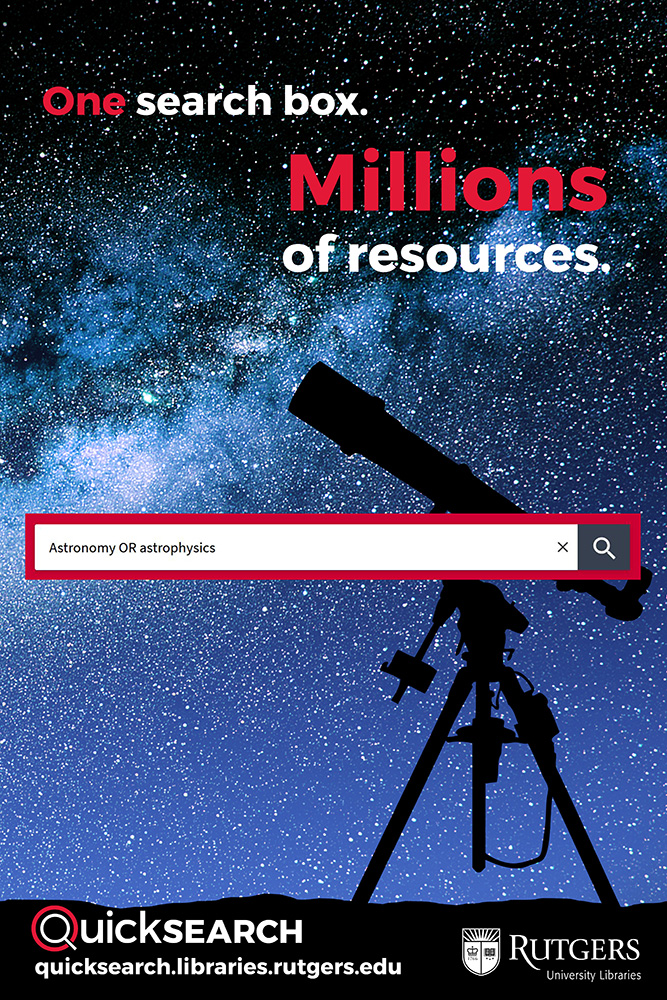
    For Fall 2018, we will have new marketing materials for QuickSearch. While our summer campaign was designed to raise awareness of the name of our search engine, this campaign will highlight the breadth of our collection and what QuickSearch enables users to do.

    The tag line is One Search Box, Millions of Resources. The images suggest the breadth of our resources and how they can be used for discovery and research. The search box terms also incorporate a soft approach to introducing advanced search technique using Boolean terms.

    This campaign is designed to be flexible — it will be used on posters, postcards, bookmarks, and social media. It also allows us to tailor the messaging to different disciplines. In addition to these materials, we will also have some new promotional items to distribute — pens, highlighters, and maybe even flashlights.

    Download copies of the finished materials as PDFs.

    We also hope you will send along additional suggestions for imagery that we should use for different disciplines. Matt Badessa and Mary Ann Koruth have contributed to this design and we owe a big thank you to Sarah Jewell for recommending the astronomy/universe image which helped us to conceptualize this campaign.

    Please send suggestions and comments to Jessica Pellien.

  • Ex Libris Implementation Project Update – July 2018

    quicksearch logo
    The team is planning to visit each campus where we will hold open Q&A sessions. This will be an open forum where you can bring any questions or concerns you have about QuickSearch, Alma, or related processes.

    After much planning and preparation from all of the Libraries, QuickSearch and Alma went live on June 5. It’s so hard to believe that we are already almost four weeks past go live! The implementation team would like to thank everyone for your hard work in making go live a success. Each and every person in the Libraries has helped move us forward, be it by serving on a working group, attending a training, or by submitting a help ticket to point out a concern. We couldn’t have done it without you!

    Of course, we also continue to experience bumps along the way, but this is expected with an implementation this large. The team has spent much of the time since our last post focused on those bumps… addressing critical post-go live activities, implementing fixes, and responding to help tickets. In addition, we are reviewing our lists of known issues and possible future improvements in order to prioritize items for completion. The website will be updated with this information as soon as the process is complete.

    The team is also planning to visit each campus where we will hold open Q&A sessions. This will be an open forum where you can bring any questions or concerns you have about QuickSearch, Alma, or related processes. Be on the lookout for an announcement about dates in the very near future. Your feedback is critical and we really hope that you will join us.

    Lastly, as Tao steps away from the team, I would like to thank him for his contributions to the group and to the project. I know that we will all miss working with him as we continue to forge ahead.

    Abbey

  • Ex Libris Implementation Project Update – June 2018

    quicksearch logo
    QuickSearch goes live on June 5.

    Our new library system Alma and Primo (a.k.a QuickSearch) are expected to go live next week. It is incredibly exciting to be in the home stretch after more than a year of hard work. We truly appreciate what library colleagues, especially those on the Implementation Team and working groups, have done to get us to this point. We anticipate that the last few days before launch will be full of questions and new developments, so we have started to send daily emails to RUL everyone with updates and additional information. Please follow these daily messages for up-to-date information. In this report, we will summarize the progress made in the previous month.

    Migration Update

    The Libraries began technical services freeze to extract Sirsi data for the migration to Alma in early May. The Implementation Team submitted the data on May 11 and received the migrated data in the Alma implementation environment from Ex Libris on May 25, both on schedule. Over the Memorial Day weekend, we discovered some errors in the migrated data and had a conference call with Ex Libris. Ex Libris assured us that they would work with us to correct the errors but several additional days would be required to complete the necessary work. Therefore, we determined the launch of the new system would be delayed until Tuesday, June 5. The delay has ramifications for workflows, work schedules, and more, but there are also benefits to the change. Going live early in the work week is much better and the extra time can be used for additional preparations. We thank everyone for their patience and support as we work through these unexpected hiccups.

    The Access Services staff started to use Alma offline client for circulation activities on May 26. On May 28, we delivered to Ex Libris the Sirsi circulation (or fulfillment) data for migration to Alma. The offline client will be in use until go-live on June 5.

    In anticipation of the launch of the new system, the Implementation Team and working groups made significant progress on many issues related to the new system, including the access for barcode and PIN users, simplification of location codes, digitization and ILL workflows, and Alma permissions and roles. The content on the library website has been updated to reflect the adoption of Primo, and further changes will be planned and implemented after go-live. Our communications activities were strengthened by the expert advice and support from the Communications Department. In the meantime, we are continuing to investigate some outstanding issues, such as book delivery to offsite locations.

    Primo Training and Important Links

    Earlier in May, a total of over 150 library faculty and staff attended nine Primo (QuickSearch) training sessions across all four campuses. We thank everyone who participated in the training. Here are some additional resources about Primo features and functionalities:

    Search Box and Website

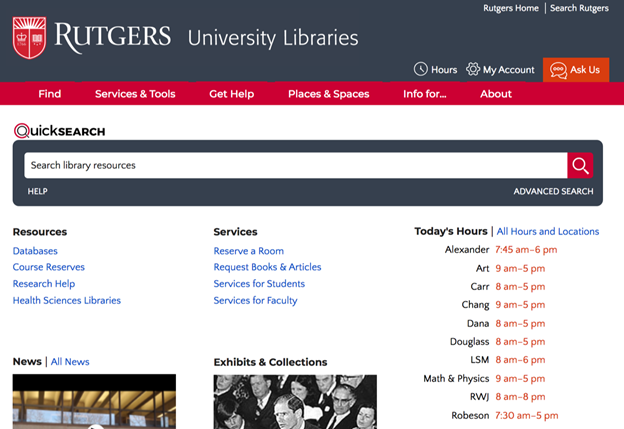
    We have finalized what the search box and website will look like at go-live. We are happy to share with you this sneak peek (see below). The decision was made to use a full-width single search box and you can see the QuickSearch logo in place.

    Please feel free to email the Implementation Team at exlibris@rutgers.libanswers.com for any questions. Thank you!

    Tao Yang and Abbey DiPaolo

  • Ex Libris Implementation Project Update – May 2018

    ExLibris graphicMigration Milestones 

    The implementation project continued to move forward as scheduled in April. We submitted the final migration form and link resolver form to Ex Libris. To address issues encountered during the Alma/Primo testing, we have been having weekly functional calls with Ex Libris and communicating with them constantly via the project’s Basecamp site. The Data Migration and System Integration Working Group has also been working hard on the third-party integration issues. The extract of Sirsi data for the final data load to Alma will start on May 5.  

    QuickSearch Announcements and News Page 

    Primo will be known as QuickSearch to the Rutgers community after we go live on June 1. In her recent messages to the university and RUL communities, Krisellen announced the release date of QuickSearch (June 1) and its impact on students and faculty. The Libraries also created a QuickSearch news page for the public. Please use the news page as a resource to answer user inquiries. Students and faculty can also submit questions or comments about QuickSearch directly to reference@rutgers.libanswers.com 

    Upcoming Service Changes 

    In her message to RUL everyone, Krisellen also highlighted the following service changes that are coming up:  

    • Acquisitions: There will be a freeze of acquisitions and cataloging activities (except reserve purchases) between May 5 and June 1. Normal acquisitions functions will resume after June 1, but we will prioritize the purchase of course reserves and faculty requests. The process of allocating funds for selector-initiated acquisitions will resume in the fall, which is in line with previous years. 
    • Reserves: Starting May 5, we will have a special process in place to accept and place reserve orders, but we anticipate the turnaround time will be longer than usual. Reserves that are placed after May 5 will not transfer automatically to Alma and will be manually transferred after June 1. Additional summer programs like EOF may be similarly affected. 
    • Circulation and ILL: From May 29 to May 31, we will transition to an Alma offline client for circulation. This step is necessary to populate Alma with existing circulation data prior to launch. Users will not experience down time, but during this three-day period, Access Services staff will stop using Sirsi and instead work with the Alma client. On June 1, the data from the offline client will be merged back into Alma, so there will be no data loss and everything will be synced. This will also impact Interlibrary Loan, as there will be potential delays and interruptions in processing loans and borrows of physical items. More information on these workflows and training opportunities will be available soon. 

    These temporary or short-term service changes are necessary for the successful implementation of Alma and Primo. We thank all the library faculty and staff for the help to minimize disruption.  

    Primo Training Schedule 

    Discovery Services Librarian Joseph Deodato recently announced a Primo/QuickSearch training schedule (see following) for public services librarians and staff. Many library faculty and staff have registered to attend the training sessions. Even though the registration is now closed, Joseph welcomes colleagues who did not register to attend any of the sessions. Please contact Joseph if you have any questions.  

    Primo Training Schedule (as of April 25, 2018) 

    Date  Location  Time 
    May 1  Dana Electronic Classroom II  2 p.m. – 4 p.m.
    May 2*  Robeson Electronic Classroom  2 p.m.. – 4 p.m.
    May 4*  Alexander SCC Lecture Hall  2 p.m. – 4 p.m.
    May 8  RWJ Electronic Classroom  2 p.m. – 4 p.m.
    May 9  Dana Electronic Classroom II  10 a.m. – 12 p.m.
    May 11  Smith Electronic Classroom I  10 a.m. – 12 p.m.
    May 15*  Carr Conference Room  2 p.m. – 4 p.m.
    May 18  Alexander Pane Room  10 a.m. – 12 p.m.

    *indicates a new session or change of location 

    Submitted by Tao Yang and Abbey DiPaolo.

  • Ex Libris Implementation Project Update – April 2018

    ExLibris graphicAlma Workshop 

    From March 13 to 15, an Ex Libris consultant came to the Libraries and facilitated a three-day workshop on Alma workflows. The first one and half days of the workshop were devoted to technical services topics, from ordering to receiving/activating to invoicing to cataloging. The second half of the workshop covered fulfillment issues, such as user management, circulation, requests, resource sharing, and course reserves. The participants of the workshop included the Implementation Team members, the working group members, and staff from technical, collection, and access services. The university librarian also attended most of the sessions. The feedback on the workshop was generally positive: The Ex Libris facilitator was very knowledgeable and well prepared. The demonstrations went smoothly. The discussions were both lively and calm, perhaps thanks to the puppy pictures the facilitator included throughout her presentation.  

    An important takeaway for everyone at the workshop is that we need to think about changing our workflows and sometimes policies to maximize the benefits of Alma, instead of simply trying to transfer our current practices in the Sirsi environment to Alma. This will guide the work of the team and working groups in the coming months. 

    Other Developments 

    Preparing for and participating in the Alma workshop was the main activity for the Implementation Team and working groups in March. All the working groups were also busy with both internal training and testing. The Implementation Team had four weekly training sessions with Ex Libris, two on Alma and two on Primo VE. On the migration front, the Data Migration and System Integration Group is currently working hard on third-party integration issues. 

    Submitted by Tao Yang and Abbey DiPaolo