A new exhibition at Carr Library explores how qualitative research methodologies can be used to uncover and address complex cases such as campus food insecurity.
Xu Guo, graduate specialist for qualitative methods at the Rutgers–New Brunswick Libraries, contributed to this report and to the development of the exhibition.
In celebration of International Love Data Week, a new exhibition opened on February 9 at Carr Library. When Data Speaks: Stories from People, Places, and Time aims to show how qualitative research methodologies can be used to uncover and address complex cases such as campus food insecurity. Centered around a comprehensive introduction, the multidimensional display utilizes three curated cases to transition between theoretical frameworks and the lived experiences of a college campus.
The installation employs a diverse array of media to engage visitors’ senses and intellect. Academic rigor is represented through illustrated texts on qualitative methods and peer-reviewed journals featuring interview scripts, participant responses, and ethnographic field notes. These are juxtaposed with hyperrealistic food models and everyday tableware to symbolize the basic human needs at the heart of the study. Visual data, such as infographics regarding Rutgers-specific food security statistics and a detailed campus map, help ground the research in a local context.
Beyond static displays, the exhibition incorporates digital storytelling through curated podcasts and videos, offering a deeper dive into the systemic challenges of student basic needs. To bridge the gap between researchers and the public, a visitor interactive board was integrated, inviting the community to share their reflections and foster a dialogue.
The exhibition will remain in the library for the duration of the spring semester.
The New Brunswick Libraries have partnered with South Asian Studies Program (SASP) in the School of Arts and Sciences, New Brunswick to acquire a membership for the South Asian Open Archive (SAOA) database.
SAOA is a part of the South Asian Materials Project of the Center for Research Libraries and uses the versatile search interface of JSTOR. The collections in this open archive are curated and include a variety of materials including books, census data, journals, magazines, newspapers, and documents in the areas of literature, women & gender, social structure, and economic and social history. Over 26 languages are represented in these collections including South Asian languages such as Assamese, Awadhi, Bengali, Bhojpuri, Braj, Gujarati, Hindi, Italian, Japanese, Kannada, Latin, Malayalam, Marathi, Marwari, Nepali, Oriya, Punjabi, Sanskrit, Sinhala; Sinhalese, Tamil, Telugu, and Urdu. Documents in English and other languages such as German, Italian, French, Japanese, Persian and Arabic are also available. This database is now also accessible via the libraries’ list of Indexes and Databases.
The partnership was made possible through SASP’s Chakra Fund and New Brunswick Libraries Collections. Please contact triveni.kuchi@rutgers.edu for more information.
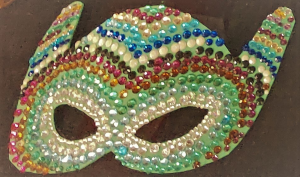
A decorative mask crafted for the exhibit out of foam and beads.
The Carr Library exhibit on masks was developed as a supplement to the Mid-Winter Mask Making student engagement event held on February 7, 2020 in partnership with the Friendship Fridays program organized by Rutgers Global. In the initial stages of development, masks were interpreted as objects from a more distant point of view. As the COVID-19 pandemic became a global health issue by March 2020 and began to impact day to day activities, masks quickly turned into a necessary and sought after object. The demand for masks as personal protective equipment skyrocketed and vendors continue to be overwhelmed with requests, and are unable to fulfill orders, or require an extended period of time for processing and shipping. This has also led to more creative and innovative outlets with people completing DIY masks and recycling different fabric materials to do so. Masks are being made for personal use, as well as to donate to others in need to share this precautionary measure.
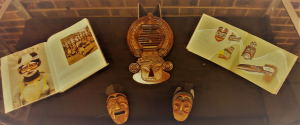
The center case of the exhibit featured masks from India and Korea as well as books from the Libraries’ collection that revolved around the ritual and cultural uses of masks by different groups around the world.
Requirements made by states throughout the U.S. for people to wear masks while out in public have also altered the way we prepare ourselves to leave our homes. There are new rituals of putting on gloves and a mask to help flatten the curve and prevent the spread of the virus. The way we see other people has changed, as eyes are the only facial features left exposed, and proper distance must be kept from others. Masks have now taken on a new meaning and significance, and will be enveloped into our attire and lifestyle for the foreseeable future.
The exhibit explores the ways masks are constructed and how these objects serve larger purposes. Like the personal protective equipment masks made at home, masks can be made from nearby materials on hand. Whether these items are found in the natural environment such as wood, bone, and clay, or man-made products like plastic and beads. These materials are combined together to develop the structure of the mask and enhance the imagery of the object through design and decoration. Regardless of material type, masks are constructed with a use and purpose in mind.
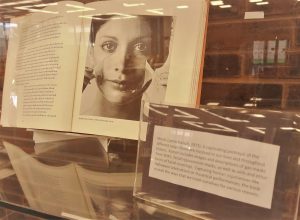
The right-side case of the exhibit featured the book Masks by Jamie Shalleck–a captivating visual portrayal of the different ways masks are involved in our lives and throughout history.
Widespread uses for masks were identified in the exhibit as relating to qualities of fun, ritual/culture, identity and protection. Most commonly, people associate masks with a form of costume or disguise. These celebrations make masks a fun accessory for Halloween or a masquerade and can allow the wearer to be creative with their appearance. The process of decorating the mask itself is entertaining and can be elaborately done to mimic something in nature, feature bold colors, or glisten with jewels and beads. The masks used in Mardi Gras parades and Venetian carnivals depict this celebratory nature of the objects and how they can be combined with an ensemble to develop a whole new appearance and costume.
Masks have also been a prominent part of cultural and social rituals. These objects exist as ritual devices of transformation and storytelling. Whether it be part of an ensemble for a ritual dance, a way to connect religiously, or to initiate members into a group. The masks are made to follow a pattern set over time through ritualized experience. Masks not only add to the sense of excitement and theatrics, but also create a sense of solidarity and belonging through the group experience. The repetition of these rituals causes the masks to become a part of one’s identity as it relates to a culture’s way of life.
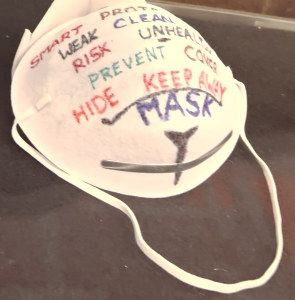
A protective mask modified with associated words and expressions.
In another sense, people can portray themselves a certain way to mask their identity and inner self from the outside world. Virtually, individuals can devise new identities and ways of representing themselves externally that differ from what lies behind their public profile. What kind of masks do we put on around others and how does this impact the way we view ourselves and others?
Masks can serve people in these intangible ways, but also are physically important when implemented as tools of protection. Constructed of materials such as bone or metal, masks have been brought into warfare as a form of armor. Often-times masks feature important cultural symbols or meanings in the design and construction, which can act as social or political protection and power as well. Or in the case of recent events, masks are tools to fight against the spread of disease and illnesses by creating barriers between people and prevent contact. Giving the wearer protection from the external environment and a sense of security and safety.
To expand on the ideas of the Masks exhibit, a libguide was created to offer a list of resources and other examples of how masks are present in society and used for various reasons. Books, articles, and images/videos related to the themes of fun, ritual/culture, identity, and protection are present on the page. Additionally, links to other exhibits on masks and how masks have been used in social movements and literary works are available. Discover more information about this topic in the libguide https://libguides.rutgers.edu/masks.