Author: Tad Hershorn

  • Friends Toast the Life of Ed Berger

    Ed Berger by Joe Wilder - 2001e
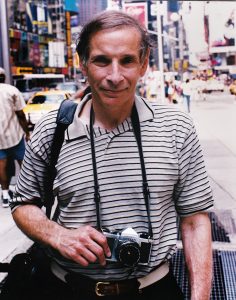
    Ed Berger, 2001. Photograph by Joe Wilder. Berger’s biography of trumpeter and fellow photographer Joe Wilder, Softly with Feeling, was published in 2014.

    Tears and laughter punctuated remembrances of longtime Institute of Jazz Studies associate director Ed Berger, during a celebration of his life on August 18 at the Dana Library.

    Berger, who died of heart failure January 21 at his home in Princeton Junction, joined the staff of the Institute in 1975. He filled many roles with uniform excellence: administrator, librarian, educator, discographer, scholar, editor, photographer, author, record producer, and label owner. He was known by those who met him in casual encounters and others who interacted with him over decades for his dedication to disseminating jazz history and for his compassion, modesty, and quiet killer wit.

    Among those taking the podium in the Dana Room included Institute colleagues: former director Dan Morgenstern; director of operations Vincent Pelote; executive director Wayne Winborne; associate director Adriana Cuervo; archivists Elizabeth Surles, Angela Lawrence, and Tad Hershorn; public service associate Joe Peterson; and collections manager Elsa Alves. Morgenstern, who led the Institute for 36 years, stressed his admiration for Berger’s expertise and many talents that, along with the efforts of Pelote, positioned the Institute to extend its international reputation.
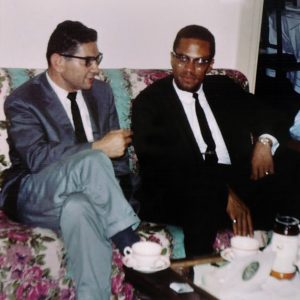
    Morroe Berger and Malcolm X listen to jazz records. photo credit: Ed Berger.
    Morroe Berger and Malcolm X listen to jazz records in the Bergers’ apartment in Cairo in 1964. Photograph by Ed Berger

    Hershorn produced a slide show of images of Berger’s life and photography, entitled “Triumph of the Quiet Man,” which focused on his family, jazz photography, and years at the Institute. (Among the photos was one of his father Morroe Berger, a famous Princeton sociologist, whose work took him to the Middle East in the 1950s and 1960s. Ed’s picture shows his father with Malcolm X in the living room of the Bergers’ Cairo apartment in 1964 listening to recordings of Louis Armstrong and Ella Fitzgerald.)

    Other guests included vice president for information services and university librarian Krisellen Maloney and Tom Frusciano and Erika Gorder from Special Collections and University Archives.
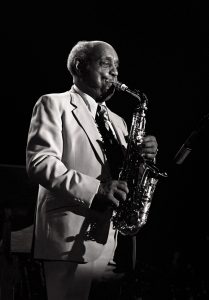
    Benny Carter, credit: Ed Berger
    The long association between the Benny Carter and the Berger families, which went on from the early 1970s until Berger’s death in January, was one their most fruitful associations. Photograph by Ed Berger, 1989.

    Musical tributes were offered by Newark veteran tenor saxophonist Leo Johnson and New York singer and pianist Daryl Sherman, both of whose CD covers were graced by the work of Berger (gratis, of course). Drummer Kenny Washington, one of the busiest drummers in New York and a frequent Institute patron, said Berger was one of the go-to guys to answer questions on the history and the music, as did Scott Wenzel, a 30-year veteran of Mosaic Records, jazz’s premiere reissue label.

    Berger’s younger brother Ken, also of Princeton Junction, who–along with another brother Larry of San Francisco–provided images for the slide show, represented the family at the event at Dana Library.

    Another gathering in Berger’s honor will take place between 3-5:30 on Sunday, September 24 at Jazz at Lincoln Center, where Berger taught courses as part of Jazz at Lincoln Center’s Swing University. Please RSVP by September 1 by contacting Larry Berger at rsvp@lpb.com.

    The Berger-Carter Jazz Research Fund at the Institute, memorializing the relationship between the Berger family and jazz great Benny Carter, will soon be renamed to include Ed’s name.
    Save

    Save

  • It’s Official: Dana Marks 50th Anniversary as Federal Depository

    federal-depositoryWhere do you find population figures from a century ago? Health statistics over time in Newark, New Jersey or the U.S. as a whole? Business and economic or other information for those studying small business development or wanting to go into business for themselves?

    Valuable information such as this can be summed up in two words: government publications.

    In December, Dana Library celebrates 50 years since it obtained its status as a Federal Depository Library for the 10th Congressional District of the State of New Jersey. It has been a boon to faculty, students, the general public and the business community. It promises to continue to be a major resource at Dana even as most of the government publications are now available online. Dana also serves as a depository for many, but not all, publications of the State of New Jersey.

    One enhancement that accompanies their presence at the libraries are classes in which library faculty reaches out to faculty and students to educate them on the use of publications distributed by the Government Publishing Office (GPO) and online resources issued by the Federal Government.

    “The subjects covered by government publications go from the general to the specific, essential for researchers as well as the general public. Most importantly, government publications are available to all users regardless of affiliation or age,” said Wen-Hua Ren, the documents librarian who supervises government publication collections at Dana.

    New Jersey is home to as many as 25 federal depositories. Each of Rutgers University campuses, including New Brunswick and Camden, has a designated federal depository library. RU-Newark has two, the other being the Law Library which receives depository materials that support legal research and study.

    Programs in recognition of the fiftieth anniversary will be held in December and possibly also in January 2017. In addition to a display, there will community instruction programs offered to educate the public on the usefulness of the collections and service.

  • Exhibit and Tours to Emphasize Modernist Aspects of Dana Library and Rutgers-Newark Campus

    docomomo-005
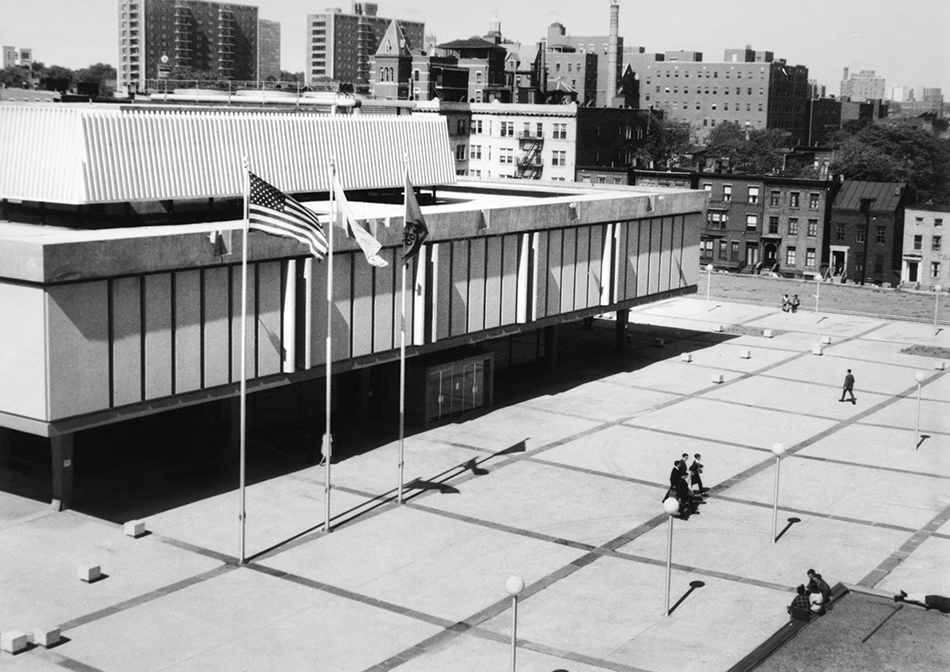
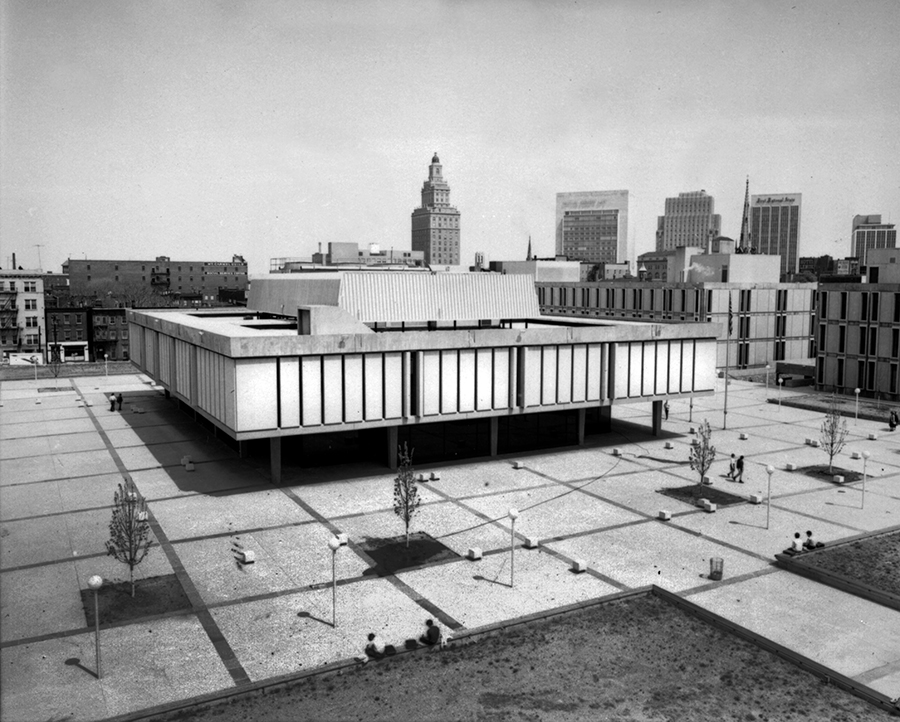
    Dana Library was the centerpiece for modernist buildings erected on the Rutgers University-Newark which are highlighted in an exhibit opening and tours at the library on October 15. Dana Library Archive.

    In 1959 Rutgers president Dr. Mason Gross fired a blunt shot across the bow in the pages of the New York Times in his quest to pass a $75 million bond issue. His plea was as much about expansion of the facilities as adding depth to the university’s core mission of education, culture, and social mobility for the burgeoning Baby Boom generation.

    Gross referred to New Jersey as educationally “impoverished” and culturally “almost bankrupt” in advocating Rutgers’ power to make a difference. The funding package passed and its impact on the Newark campus with construction of seven new buildings over the course of the 1960s was profound.

    Part of that legacy—the Newark campus’s inventory of significant modernist architecture and spatial concept—is the subject of an exhibit opening October 15 at the John Cotton Dana Library, Making a Place: Rutgers University-Newark as a Microcosm of 1960s America. Programming will also feature hour-long campus tours led by Newark-based architects, preservationists, and historians; in addition to tours of the world-renowned Institute of Jazz Studies, located on the fourth floor of the library. For additional details, see: http://docomomo-us.org/architecture_urbanism_rutgers_university_newark

    Cultural historian Dr. Eva Giloi, an associate professor of history at Rutgers University-Newark who is organizing the festivities, said Newark figured prominently in Gross’s plans.

    “Buildings here were designed and situated on the campus as part of a coherent vision of modernist mid-century architecture, with Dana Library the center of student life and community involvement,” said Giloi. “It was a humanistic concept in the way it used open space.”

    dana-plaza-001
    October 15, 2016 has been designated a DOCOMOMO US Tour Day. Dana Library Archive.

    The project’s supporters go way beyond the Rutgers community. The campus will enter the registry of DOCOMOMO, the world’s leading modernist preservation organization located in Barcelona, Spain.

    Giloi describes the exhibit as a “multisensory exhibit about the campus history and architecture in Dana Library,” using original architectural blueprints, photographs, yearbooks, and other artifacts bearing on the campus and student life during socially tumultuous times.

    Dr. Askew, director of Dana Library, said of Giloi’s research, “The campus plan from 50 years ago all started with a library building. Therefore, it is befitting that Dana Library, in addition to being a stop along the tour, also has a central role in this event.”

    The exhibit and programs are sponsored by the Dana Library, the Institute of Jazz Studies, Rutgers University-Newark Department of History, The Clement A. Price Institute, and DOCOMOMO, which has designated the events as an official U.S. Tour Day.

    Activities this month will be amplified when the fiftieth anniversary of Dana Library gets underway next year.


    Save

    Save

  • Dana Library Transformation into 21st-Century Knowledge Center Heading from the Drawing Board into Reality by 2018

    Dana Library Transformation into 21st-Century Knowledge Center Heading from the Drawing Board into Reality by 2018

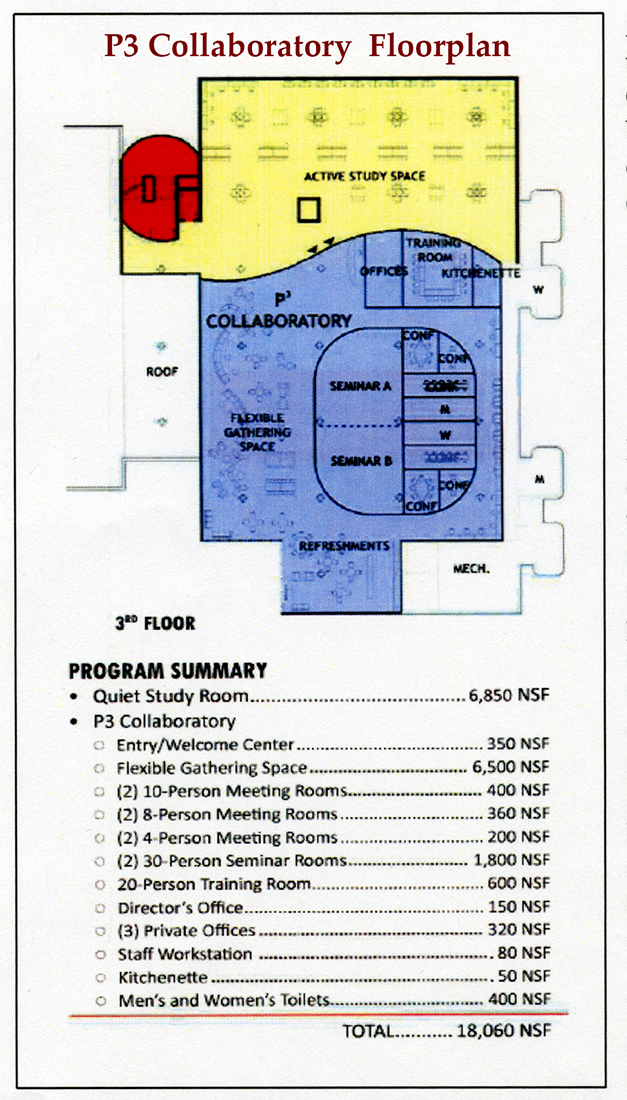
    Floor-plan of the P3 Collaboratory which is expected to be in operation on the third floor of Dana Library by 2018. Click to enlarge.
    Floor-plan of the P3 Collaboratory which is expected to be in operation on the third floor of Dana Library by 2018. Click to enlarge.

    Imminent plans to develop the third floor of the John Cotton Dana Library by 2018 are integrated with a farsighted and sweeping reconceptualization of the role of libraries at the juncture where 21st-century pedagogy and information delivery meet. These were among topics addressed in an initial report and recommendations released September 26 by the New Professoriate Study Group, co-chaired by Dr. Bonita Vesey, vice chancellor for planning and implementation, and Dr. Consuella Askew, director of Dana Library.

    The P3: A Collaboratory for Pedagogy, Professional Development and Publicly-Engaged Scholarship is designed to meet the needs of educators from preparation of graduate students for high impact, publicly engaged scholarship and leadership skills. Attracting promising scholars to a curriculum offering broad strategies for career-long activities in the world of academe and beyond holds the keys to success of the concept.

    Programming in support of the P3 Collaboratory is getting underway this fall with offices located on the second floor of the library. In addition, Rutgers-Newark chancellor Nancy Cantor is convening a two-day conference on the new professoriate October 28-29. The initiative is also the motivation behind $2 million in seed grants through the chancellor’s office to encourage creative cross-disciplinary, high impact, sustainable and innovative programs.

    Dr. Vesey said that while aspects of the P3 Collaboratory are not new, the combination and depth of the programs on the Rutgers-Newark campus is unusual and ideal for the diversity of students, faculty, and staff of Rutgers-Newark.

    “Under this plan, the library will be less of a repository of books, but the intellectual center of the campus, a role Dana Library already fulfills,” she said. “Consuella really understands and supports the mission of libraries in the 21st century.”

    Save

    Save

  • New Honors Living-Learning Community to Be Based at Dana Library

    Dana exterior sunny, credit Ed Berger
    Credit: Ed Berger.

    Rutgers University-Newark’s Honors Living-Learning Community (HLLC) is an initiative intended to go beyond high SAT scores or high school rankings. The goal is to identify and blend an international group of traditional and non-traditional students into a curriculum based on themes of “Local Citizenship in a Global World,” and focusing on academic, social, and personal development.

    Among the targeted student populations are high school graduates, first-generation college students, transfer students, veterans, older students, General Education Development (GED) recipients, student parents, and financially independent students. Dana librarians will be important liaisons in building the effort, according to Bobbie Tipton, the library’s point person who recently met with Marta Esquilin, the associate dean of HLLC and assistant professor of professional practice. HLLC will be divided into “cohorts,” each containing about ten students, which may be mentored by a librarian. The curriculum will be a mixture of core classes specific to HLLC, as well as a capstone project, filled in by required classes to earn an undergraduate degree.

    Among the areas of instruction librarians would provide to new and transfer students through workshops are finding their subject librarian; finding core databases in the subject area; using a citation manager; determining the correction citation style for the subject; and avoiding plagiarism.

    “This is intended to be a holistic learning experience with a strong emphasis on social justice and community,” Tipton said. “It is definitely an expanded definition of ‘honors’ that goes beyond academic performance. The intention is to educate movers and shakers in social engagement.”