Author: Samantha Kannegiser

  • PRL Undergraduate Research Award Winners

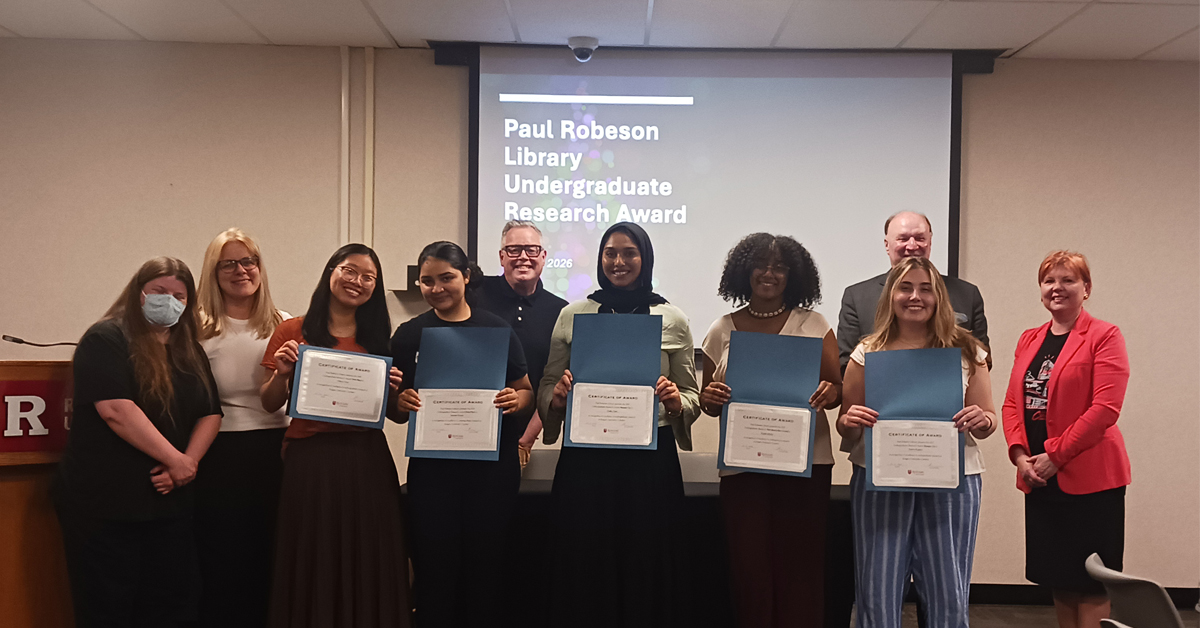
    This spring the Paul Robeson Library launched the Undergraduate Research Award, a new initiative designed to recognize and celebrate excellence in original undergraduate research. Undergraduate students from all schools at Rutgers University–Camden were invited to submit research papers or other research projects completed between spring 2020 and spring 2021. Applications were required to include a completed project, a bibliography, and a reflective essay describing the search strategy employed and how sources were evaluated.

    An evaluation committee of both teaching and library faculty reviewed each application, looking for those that made use of a range of library resources, collections, and services and showed evidence of critical thinking, originality, and creativity. Five winning papers were selected. Each winner received a cash prize and certificate, an invitation to include their paper in a digital collection, and recognition at a virtual event held on May 24, 2021.

    First Place

    Second Place

    Honorable Mentions


    Samantha Kannegiser & Zara Wilkinson

  • Promoting OAT at Rutgers–Camden

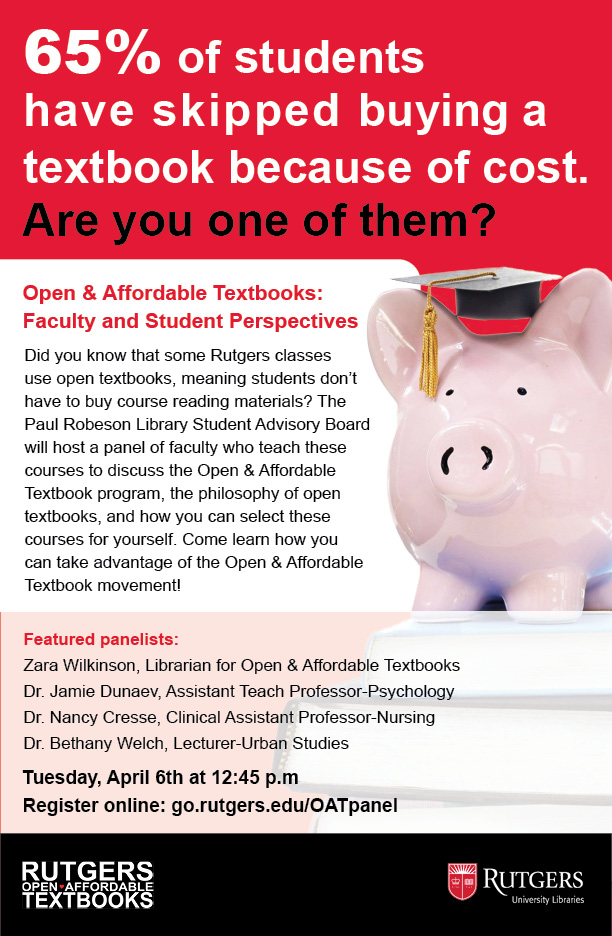
    During a Library Student Advisory Board meeting in the fall, student members discussed the difficulty their peers experience paying for required textbooks. To learn more, we invited Zara Wilkinson to talk to us about the library’s Open & Affordable Textbooks (OAT) program. This inspired board members Oriana Holmes-Price, Grace Latini, and Erika Pitsker to plan a faculty panel event to promote the OAT program to the rest of the student body. They invited Zara Wilkinson, librarian for the OAT program, Dr. Jamie Dunaev, Assistant Teaching Professor in Psychology, Dr. Nancy Cresse, Clinical Assistant Professor in Nursing, and Dr. Bethany Welch, Lecturer in Urban Studies to discuss their experiences with the OAT program and their philosophy towards open educational resources more generally. After diligent effort on the part of the Board members, we held the panel, Open & Affordable Textbooks: Faculty and Student Perspectives, on April 6th. Faculty, staff, and students in Camden attended and learned about the importance and impact of open and affordable textbooks and the library’s efforts to support students and faculty through the OAT program. Many students expressed interest in taking an OAT course and helping to expand the program to additional courses and departments. The Paul Robeson Library Student Advisory Board plans to continue championing the Open & Affordable Textbooks program.   

    Additionally, the Rutgers-Camden Student Government Association has voiced its support for the OAT Program through ongoing dialogues with librarians Zara Wilkinson and John Powell. The executive board of the SGA has brainstormed a variety of collaborative initiatives, including the development of a university-wide portal of course materials developed because of the OAT program and a form where students can submit recommendations for OAT or submit classes which they had to drop due to additional costs from textbooks or access codes.  

  • Personal Librarian Program Enters Its Second Year

    Student success librarian Samantha Kannegiser of the Paul Robeson Library kicked off the Personal Librarian Program, now in its second year, on August 28 with a “Meet Your Personal Librarian” event. The Personal Librarian Program is run in collaboration with the Student Success Coach office, part of the Department of Student Academic Success on the Camden campus. Through this program, the library personally connects with over 400 students per year.

    As part of this program, our Scarlet Scholar students have a dedicated librarian throughout their first academic year. Personal Librarians Katie Anderson, Samantha Kannegiser, Julie Still, and Zara Wilkinson are each paired with a Student Success Coach to provide targeted outreach to a select cohort of students, sending timely emails with tips, tutorials, library updates, and events. Library processes, terminology, resources, and services can overwhelm new students who are unfamiliar with academic libraries. Our goal is to relay information to students when it is most needed, making them comfortable asking questions of librarians, navigating library resources, and attending library events with their peers.

    We are looking forward to another year connecting with our students through the Personal Librarian Program and hope to eventually expand the initiative to include more of our first-year undergraduates.

  • Institute for Research Design in Librarianship 2019

    The Institute for Research Design in Librarianship is an IMLS-funded program “designed to bring together a diverse group of academic and research librarians who are motivated and enthusiastic about conducting research but need additional training and/or other support to perform the steps successfully.”

    The institute started in 2014. My cohort (2019) is the last IMLS-funded year, but the creators will continue the project using a paid model in the future. Our cohort included 23 librarians from colleges and universities all over the country. Our interests, experiences, and areas of librarianship were varied.

    The 2019 cohort kicked things off in June with a one-week research boot camp at Loyola Marymount University. In seven days, we received research instruction from Dr. Lili Luo and Dr. Greg Guest, as well as individual consultations with our instructors and the IRDL creators, Kris Brancolini and Marie Kennedy. We also relied on each other to get “fresh eyes” on our projects and to commiserate when our projects seemed bigger than we could handle!

    After that first week, our cohort will continue working with Kris, Marie, and a research mentor (a previous IRDL scholar) throughout the coming academic year. We each committed to completing our research projects in that time. To stay on track, we have periodic check-ins with each other to update everyone on progress, ask questions, and get support. We also work with our mentors monthly to review our work and get feedback. Our cohort also created a Slack group for talking about the different research methods we are using and coordinating future meetups.

    The boot camp covered sampling techniques, proper statistical measures, and strategies for doing qualitative analysis. This was especially useful because after we learned something in class, we could request a consultation with one of the instructors to see how we could best apply a technique to our research project. I found this incredibly helpful when considering what statistical tests I should use for my study. The goal of my project is to determine the effectiveness of augmented reality on students’ perception of the library and librarians when used as part of an orientation for incoming first-year students. I’ll be comparing pre and post-orientation questionnaires from a group of students taking an augmented reality orientation and a group participating in a traditional orientation.

    IRDL has already had a major impact on my research design. The proposal I submitted to the Institute in January is much different from the one I will be submitting in July. My methodology, sampling technique, and survey instruments underwent a complete overhaul in the week I spent at the institute. My confidence as a researcher has also increased and I feel more comfortable making decisions about what and how I will research as a practicing librarian.

    I’m looking forward to the coming year when I’ll be completing my research project and working closely with my cohort and mentor. One aspect of IRDL which the directors continually emphasize is that our fellow scholars are part of our lifelong research network. We can ask questions of each other, collaborate, generate ideas, and rely on each other for support as we research throughout our careers. This kind of support, along with the knowledge I gained at the institute, has been transformative by making me feel more confident in asking questions and making decisions.