Author: Jessica Pellien

  • Report from Social Media Summit 2017


    Video: Rutgers communications professionals discuss social media planning and how to best reach users.


    The Libraries held our second Social Media Summit on July 20, 2017. The full-day event, hosted by the Social Media Task Force, was broken into several sessions and attended by over 25 of our colleagues.

    During the introductory session, director of communications Jessica Pellien presented the work of the social media task force and reviewed the new social media guidelines, manual, and process for requesting a new social media account. This PowerPoint presentation is available below. Following this presentation, round-table discussions (15 minutes per topic – like speed dating but for social media topics) allowed the group to share ideas and experiences. Notes were taken at each table and are available below.

    Following lunch, there were two more sessions:

    • A workshop/training on HootSuite presented by Dory Devlin of University Communications and Marketing
    • A panel of Rutgers University communicators, including Stefanie Charles, social media manager for all of Rutgers–Camden; Brice Hammack, marketing professional from Rutgers University Press; and Jennifer Valera,  marketing manager of  Rutgers University-New Brunswick, Division of Continuing Studies.

    If you have any questions about the materials below or the Social Media Summit, please reach out to a member of the Social Media Task Force.

    Social Media Summit Documents:

    Social Media Documents

  • Back to School Outreach to Our Users

    The fall semester officially begins in four days, and we are prepared. Matt Badessa made this wonderful welcome video for our students. We weren’t sure how it would turn out, so we kept the project relatively small and only interviewed faculty and staff in New Brunswick. We are happy with the video and would like to do more like this in the future. Let us know if you’d like to participate or if you have an idea for a short video about the Libraries or a service.

    We are also sending out a September newsletter to our email list, featuring current exhibits and upcoming events. You should receive a copy of this on the morning of September 5th. It includes the following events:

    John Haworth, senior executive emeritus of the National Museum of the American Indian, Smithsonian Institution, visits Alexander Library on September 19 to share his knowledge about cultural and arts issues impacting Native Americans, including key museum practices, repatriation, and social change.

    More

    Relive the rich history of student art and literary magazines at Rutgers with By Ourselves: Rutgers Student Literary Journals 1923–2017, a joint exhibition of the Robeson Library and the Rutgers–Camden Writers House from September 1 to October 31. Spanning nearly a century and two campuses, this exhibition highlights the creativity and initiative of Rutgers students through Quintessence, The Anthologist, and other publications.

    More

    The Libraries at Rutgers–New Brunswick will help new and returning students ease into the semester again this year with snack breaks during Welcome Days.

    • September 6 & 7, 2 p.m. Cookies and coffee at Douglass Library.
    • September 7, 1–2 p.m. Popcorn on the steps of the Art Library and Zimmerli Museum
    • September 7, 2–3 p.m. Snack break at Carr Library
    • September 12, 2–3 p.m. Snack break at Carr Library
    • September 26, 1:30–2:30 p.m. Snack break at Alexander Library

    More

    In celebration of the 100th anniversary of Douglass Residential College, the artwork of renowned feminist artist and Rutgers graduate Mimi Smith will be on display at Douglass Library from September 5 through December 15. Embodying the relationship between everyday life, intimacy, anxiety, and time, Smith’s works include clothing made from plastic and steel wool, traditionally rendered drawings, drawings made from knotted thread and tape measures, clocks, and knitted sculptures.
    More
    With support from a Freedom to Read Foundation grant, the Art Library will host a number of programs celebrating Banned Books Week from September 24 to September 30. The activities will provide students, faculty and staff, and community members the opportunity to explore the ideas of intellectual freedom, censorship, and banned books by creating and displaying original art.

    More

    The New Brunswick Music Scene Archive in Special Collections and University Archives will kick off Hub City Sounds’ ROCK New Brunswick music festival weekend on September 8 with a discussion panel featuring New Brunswick music insiders past and present: Dennis Diken of The Smithereens, Sharief Hobley of Sharief in Burgundy, Makin Waves columnist Bob Makin, Audrey Rose of The Wichts, and Spina Records’ Andrew Spina.

    More

    This fall, data librarian Ryan Womack will offer a series of workshops on statistical software and data at both Alexander Library and the Library of Science and Medicine. September’s topics include “Introduction to SPSS, Strata, and SAS”; “Introduction to R”; and “Data Visualization in R.”

    More

    Special Collections and University Archives’ exhibit “Heaven, Hell, or Hoboken!”: New Jersey in the Great War has been extended to September 22. Featuring one-of-a-kind documents, photographs, and artifacts reflecting the wartime experiences of New Jerseyans both at home and abroad, this display is a must-see for Garden State history buffs and World War I aficionados alike.

    More

    John Cotton Dana Library will commemorate its 50th anniversary with a host of free events and activities throughout the academic year. Exhibits showcasing the history of the library and its namesake as well as a birthday party during Rutgers–Newark’s Fall Fest will highlight the fall schedule. A number of guest speakers will visit the library to share their wisdom throughout the spring semester, and the year will culminate with a special event on Rutgers Day. Additional details are forthcoming, so stay tuned to our website for the latest on the #RutgersDana50 celebration.

    If you have an event coming up in September that is not mentioned here – there is still time to include it in our email newsletter. Send info to jessica.pellien@rutgers.edu.

  • New Resources from the Communications Department

    The following resources are now available on the communications department website. We hope you find them useful. We’re trying to actively identified shared resources that we can supply to save our colleagues time and to create a cohesive visual identity for our libraries. If you have suggestions of new projects, please let me know.
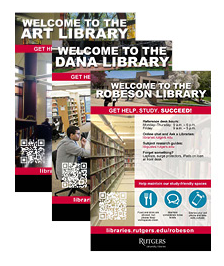
    New signage templates:

    During our last signage inventory, we tried to identify signs that appear in multiple libraries, and we’ve added a bunch of new templates to the signage library. We now have some templates for quiet and collaborative study areas, guest and Net ID computers, reshelving books and shelving carts, and keep your belongings safe.

    We also have Welcome to the Library signs prepared for all public library spaces (except for the Annex, which we will get to soon). These are available in two sizes – 24” x 36” large posters, and 8.5” x 11” in landscape and portrait orientation.

    In the signage section, you will also find our policy sign toolkit, including icons for policy signs and welcome signs, and build your own signage templates. If you make a sign that might be useful for other libraries, please send it to us and we’ll post it in the sign library so others can access it.

    link: https://apps.libraries.rutgers.edu/communications/signage-templates

    Powerpoint templates:
    Complete Powerpoint templates, featuring the new shield logo, are now available. Please do not use the older Powerpoint templates with the Rutgers seal. The Rutgers informal seal is no longer part of the university’s visual identity and we should be using the shield wherever possible. There are two versions of the template – an all-white version, and one with a scarlet band. These templates include title pages and sub-pages and also have a color theme that includes Rutgers colors.

    To edit the Optional Presentation Title area on the slide, go to “View,” select “Master,” and then choose “Slide Master.” You will then be able to double click on the Optional Presentation Title text and edit the area. The template must be resaved before creating a presentation.

    To select the Rutgers color theme, go to “View,” select “Master,” and then choose “Slide Master.” Select Colors and scroll down to select Rutgers University Libraries under the Custom subheading.

    link: https://apps.libraries.rutgers.edu/communications/visual-identity-resources
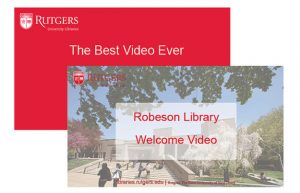
    Video branding elements:

    Video branding elements are also now available for you to use. These should be used in any video you make that promotes Library services, spaces, or resources. It is very important that the branding is used because it will make us compliant with the university visual identity policy for video standards, create greater visibility for the Libraries, and acknowledge our ownership of this material (very important when videos are being repurposed, embedded, or linked to from other users).

    The visual identity policy for video standards is:

    The Rutgers logotype, with or without a signature, must appear prominently at or near the opening or closing of a Rutgers video. In addition, the appropriate Rutgers name (i.e., Rutgers, The State University of New Jersey; Rutgers University–New Brunswick; Rutgers University–Newark; Rutgers University–Camden; Rutgers Biomedical and Health Sciences) must appear somewhere in the course of the video.”

    **Please note: we should use the full university name, “Rutgers, The State University of New Jersey,” and not a local university name since the libraries are a central unit.

    The Communications Department is supplying four branding elements that can be personalized to some extent, depending on your project:

    These branding elements can be mixed and matched, appear at the beginning or the end of your video – just so long as you are compliant with the visual identity policy quoted above. If you have a special video project or series and would like a tailor-made branding element, please let us know. We’re happy to work with you to accommodate these requests.

    link: https://apps.libraries.rutgers.edu/communications/visual-identity-resources

    Revised Rutgers University Libraries editorial style guide:

    The Libraries’ style guide has been updated to address issues particular to the Libraries that are not covered in the university’s guidelines and to offer quick tips for remaining consistent with the established Rutgers style. Our goal is to foster clear, consistent messaging in all of the Libraries’ official communication channels, including our website, blogs, social media, print and electronic newsletters, brochures, flyers, and so on. It is not intended to supplant the style guidelines of any academic journal or news outlet to which you may be contributing material.

    link: https://www.libraries.rutgers.edu/rul/staff/pub_serv/procedures/stylesheet.shtml

    Save

    Save

    Save

    Save

    Save

    Save

    Save

    Save

    Save

  • Fellows Learn Jazz and Archives in Institute Program

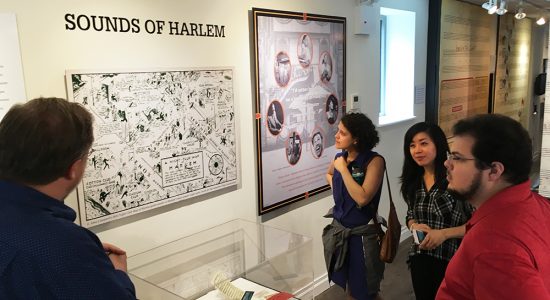
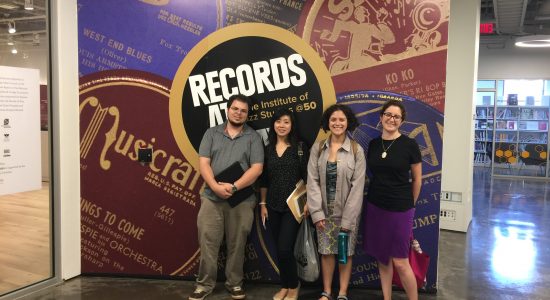
    • 2017 Institute of Jazz Studies Fellows, from left, Ana Niño, Jeannie Chen and Adam Berkowitz, tour an exhibit at the National Jazz Museum in Harlem. Leading them through Harlem jazz history is Ryan Maloney, a former employee of the Institute and director of education and programs at the Museum.

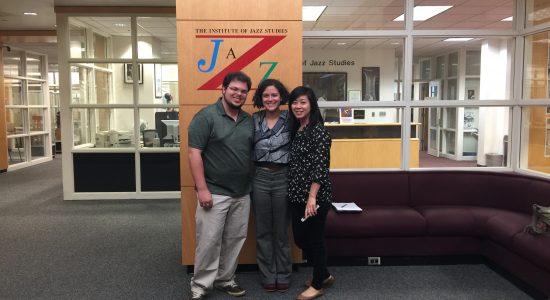
    Three archives students from across the country, each with strong musical backgrounds, undertook to learn jazz as a second language as they burnished their archival credentials from the classroom in an intensive two-week program at the Institute of Jazz Studies (IJS) this past June. They were the fifth class of Jazz Archival Fellows, a program underwritten by Jon Van Rens, a longtime IJS supporter and administered until earlier this year by the late Ed Berger, the previous IJS associate director.

    The selected candidates who came to Rutgers University-Newark were:

    • Ana Niño, a student at the University of North Texas who works in a Dallas-area library and plays guitar in an all-female rock band.
    • Jeannie Chen, a student at UCLA who has a background in classical piano that propelled her into international piano competition
    • Adam Berkowitz, a MLIS student at University of South Florida in Tampa who is also a professional percussionist interested in jazz and classical music and music educator with a special interest in Jewish musicians and composers.

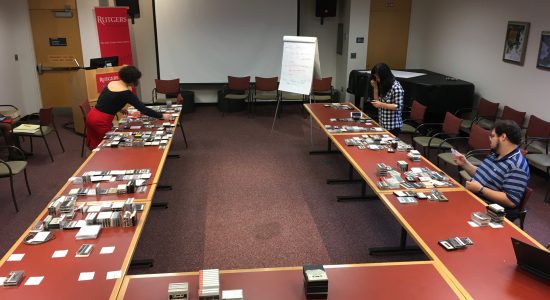
    During their time at IJS, they arranged, described, and produced a finding aid for over 400 taped interviews with jazz musicians and other figures on the jazz scene designated as the Institute of Jazz Studies Collection of Jazz Oral Sound Recordings. Materials in the collection were made between 1956 and 2007 and include mostly audiocassettes and some reel-to-reel tapes.

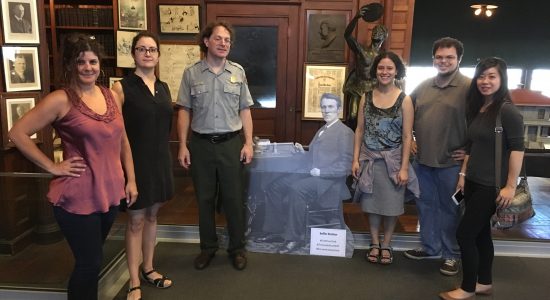
    Field trips afforded the fellows a glimpse of how other area repositories and museums conduct their work. These trips have proven to be one of the more popular features of the fellowship experience, and this year was no exception. The fellows visited the Louis Armstrong House/Archive, the National Jazz Museum in Harlem, the New York Philharmonic Archives, the Carnegie Hall Archives, and the Thomas Edison National Park in West Orange.

    In addition, Niño, Chen, and Berkowitz received an overview of issues in managing oral history collections from Dana Library’s digital humanities librarian Krista White. Archivist Elizabeth Surles spoke on rudiments of Encoded Archival Description (EAD), a program utilized to post archival finding aids on the web. IJS archivist Angela Lawrence also worked closely with the students as they processed the interviews.

  • Librarians at the John Cotton Dana Library win a Research Award

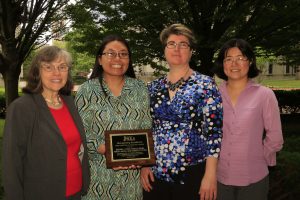
    Roberta Tipton, Bonnie L. Fong, Krista White and Minglu Wang (l to r).

    Librarians Bonnie L. Fong, Minglu Wang, Krista White, and Roberta Tipton were presented the 2017 ACRL-NJ/NJLA CUS Research Award for their article, “Assessing and Serving the Workshop Needs of Graduate Students,” (The Journal of Academic Librarianship) during the NJLA Conference in April 2017.

    Each year, the Research Committee of the NJLA College and University Section (CUS) and the ACRL New Jersey Chapter selects the best published research completed by a New Jersey librarian during the past year for this honor. Fong, Wang, White, and Tipton’s journal article was one of two winners in 2017. Their research determined which workshop topics graduate students in the humanities, science, and social science disciplines are most interested in, and what their preferences are for workshop formats, times, and communication. What made their study unique was the comparison of student and graduate program director viewpoints on topic importance. In addition, they compared and contrasted Master’s and doctoral student training needs.

    The John Cotton Dana Library and other Rutgers University-Newark campus units are already using the research results as they develop workshops and other services to more fully support graduate students’ research, grant, career, teaching, and technology training requirements.

  • Toward a Hybrid Model of Organizational Structure

    The summer has been flying by! I can’t believe it is already August!

    In reviewing the past few issues of The Agenda, I realize that most of my posts have related to the structural changes within the university and changes that we are making within our organization to adapt. This month I would like to take a step back and look more broadly at organizational structures—especially those that are most effective in rapidly changing environments—and how these might apply to Rutgers University Libraries.

    Essentially every large organization today (including the Libraries) is structured according to principles developed by Max Weber’s industrial revolution-era organizational theory and management practices for running large organizations. Weber proposed a top-down structure in which each element of the structure (he called them offices, but today they more likely represent departments or divisions) has a specific role within the organization. These hierarchical structures are stable and predictable, but hierarchical organizations need robust communication—horizontal, vertical, and within units—to be effective.

    During periods of rapid change, hierarchical organizations often face communication challenges. Communication from the top, related to mission and strategies—vertical communication—can be slow to reach all parts of the organization. Also, the connections between the well-defined units within the hierarchy—horizontal communication—can be weak. The hierarchical organization places impossible demands on a unit head who must manage both horizontal and vertical communication while keeping abreast of the functional requirements and activities. With insufficient information about mission and strategy and in the absence of strong connections to other units, units can become internally focused and inadvertently act at cross-purposes with other parts of the organization.

    In recent years, organizations, including many academic libraries, have experimented with replacing hierarchies with more adaptive structures that circumvent these communication challenges. I spent five years working in the University of Arizona Libraries, an organization that pioneered a team-based approach for academic libraries. The goal of these experiments is to create organizations where all decisions were data-driven and could be made at any level. We hoped that the availability of good data could replace some of the communication necessary to be effective. The experiment at the UA Libraries—and, I believe in other academic libraries—eventually failed and they reorganized into a traditional hierarchical model. It seems that establishing reliable data sources is at least as complicated as improving communication.

    People are beginning to look at networked structures for organizations. Networked structures lack formal hierarchical relationships and units can freely communicate with other units. This is quite effective in small organizations; however, as organizations grow, the lack of structure can become a problem. I do not know of any large organization that relies solely on a network structure; however, the Occupy Wall Street movement is a useful case study of the pitfalls associated with a large organization that has strong vertical coordination but lacks structure. Although the movement might have had some impact on society, it essentially dissolved, possibly due to its lack of structure.

    Among these three organizational structures, it seems that hierarchical models are the best structure for large organizations. However, in order for organizations to adapt during periods of rapid change and to react accordingly, communication must be strengthened. While newsletters like this are important—as are agendas and minutes—in communicating activities and decisions, organizations need deeper communication to truly adapt in times of change. It is important for every individual to understand three interdependent things: the mission and strategies of the organization at large; their unit’s vertical and horizontal impact on the organization; and the effect of their workplace decisions on the organization.

    The structure of the Libraries is hierarchical, but we are drawing on lessons from these experiments and taking big strides to improve communication. In Cabinet, we spent the last few weeks developing charges for new groups to help manage our shared infrastructure. You can see a list of the issues that we are addressing in my post from last month. While these groups are being charged to address specific short-term priorities, most of them will eventually become cross-unit workgroups. It is through these workgroups that communication will be improved and the charges for these groups pave the way by including specific communication requirements.

    These workgroups have important work to do and the work includes rich bidirectional communication between the work groups and the functional units. We have spent some time at Cabinet discussing the communication responsibilities of Cabinet representatives, group members, and group chairs. The expectation is that Cabinet representatives act as conduits of information—providing two-way communication that includes direction from Cabinet-level discussions and boots-on-the-ground experiences from members of the workgroup to help guide the work of the group.

    Members of the group, including the group chair, are responsible for considering organizational goals and developing a deeper understanding of broader issues, but they also must act as representatives of their functional groups (most often, this is their department and/or university). In this representative role, they must clearly communicate issues, findings, and actions back to their functional units; develop mechanisms for gathering feedback from their constituents; and then report to the workgroup on how their functional unit will be impacted by the proposals of the workgroups. Group chairs bear an additional responsibility of making good communication a priority for the group by encouraging and using this multidirectional communication to improve outcomes.

    As we shift the loci of work to these shared workgroups, we know we need to be proactive to avoid communication and work silos. It is also important to acknowledge the impact on our workloads and our organization. Our new task force charges include a section on Timeline/Communications and an Appendix that explains members’ participation is a significant part of their primary job responsibilities and will be evaluated as such. What this means in practice is that meetings are not extra work, but an essential part of our organization. And good communication is not optional, it’s a priority.

    I know that activity never stops in the Libraries, but I hope that the slightly slower pace of summer is giving you some time to catch up, reflect, and rest. I look forward to working together to continue our progress in the academic year to come.

  • Tips for videography; promotional items inventory; new signage templates from the Communications Department

    Tips for videography; promotional items inventory; new signage templates from the Communications Department

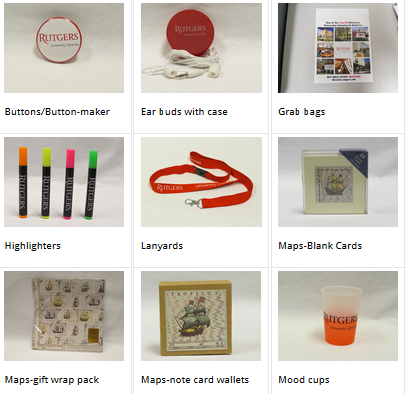
    promotional item samplesThe communications department has made some more useful items available on our website.

    A promotional item visual inventory. This website lists all the promotional items we currently have in stock. Many of these items are available in limited quantities, for Libraries events. To place a request, please send Ken Kuehl an email with the quantities, item names, what they will be used for, and an address for shipping.

    Helpful Hints for Videotaping Interviews. This Microsoft Word document contains some tips and tricks for planning for and improving the visuals of taped interviews. We hope this is helpful to anyone planning to record video for the Libraries. It is listed on the Communications Department website.

    New signage templates. On our signage template web page, you can download Word files that you can update with your library’s information (name of library, URL, specific text, images) and print in black and white or color. We will work on converting them to Powerpoint over the next month. We’ve added the following to the Shared Sign Library:


    • Allow Us to Reshelve Your Books
    • Please Do Not Reshelve Your Books
    • Keep Your Belongings Safe
    • Please Bring Your Own Change

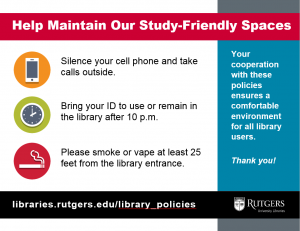
    sample policy sign imageWe’ve also added a Policy Signs and Toolkit. During our recent signage inventory, we saw lots of individual policy signs posted all over the libraries. These new Policy Signs and Toolkit will allow you to create signs that address multiple policies in a single page and hopefully eliminate the need for multiple single policy signs. The toolkit includes a vertical and horizontal version of this sign and a zip file of icons (hopefully live by the time this newsletter publishes) to use for signage.
    We have more signage templates on the way, including staff only and a replacement for the popular Can’t Find a Book signs. Stay tuned.


    Save

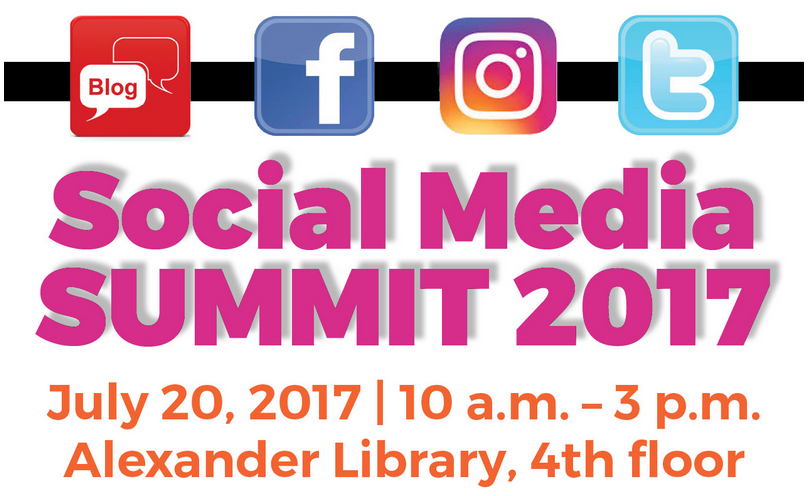
  • Social Media Summit 2017

    Social Media Summit 2017

    Social Media Summit image

    10 a.m. Introductory Presentation. The Social Media Task Force will lead a discussion of their work over the last year and the resultant social media guidelines and process.
    11 a.m. – 12:30 p.m. Round Table Discussions. Share your thoughts and experience in small group discussions. Moderators will then present findings to entire summit. Table topics include “Using social media to promote research,” “Creative social media ideas for libraries,” “Resources and strategies for finding great content,” “Promoting library services & resources via social media,” and “Best practices for interacting with users.”
    12:30 – 1:15 p.m. Lunch. Network with your colleagues over sandwiches and salads (provided).
    1:30 – 2:15 p.m. Workshop. Dory Devlin, University News and Media Relations, will demonstrate how to manage multiple accounts using tools like Hootsuite and Tweetdeck.
    2:15 – 3:00 p.m. Panel Event. Social media managers from other university departments will describe challenges and opportunities in assessing, serving, and growing social media audiences. Panelists will include Stefanie Charles, Rutgers–Camden, Brice Hammack, Rutgers University Press, and other Rutgers communications specialists. Panel will be moderated by John Brennan.

    Open to faculty and staff of Rutgers University Libraries. RSVP: go.rutgers.edu/prax7fo0


    Save

  • The Annual Louis Faugères Bishop III Lectures

    About the Lectures:

    The Annual Louis Faugères Bishop III Bishop Lectures are named in memory of the son of Louis Faugères Bishop, Jr., a prominent cardiologist and book lover with close family ties to Rutgers and New Brunswick– for example, Bishop House and Bishop Place on the College Avenue Campus–even though he himself was an alumnus of Yale University. In his honor, the annual Bishop Lecture brings noted scholars and subject experts to Rutgers to offer their insights on diverse topics related to book and manuscript collecting, printing history, and the use of rare archival materials for research.


    Bishop Lecture invite2017 Lecture:

    Remembering World War I
    Through the Eyes of a WWI Combat Engineer—Charles Edward Dilkes

    Virginia A. Dilkes

    March 9, 2017 • 6:00 P.M.

    In “Remembering World War I: Through the Eyes of a WWI Combat Engineer,” Dilkes will present the first-hand experiences of the War through the eyes of her father, Charles Edward Dilkes. Drawing on excerpts from his memoirs and pictures of his WWI artifacts, she will follow her father’s footsteps through the battlefields of France to his triumphant march through Luxembourg and his days in Germany serving in the U.S. Army of Occupation. Along the way, this personal history will wend from his birth in Philadelphia and childhood memories at the Jersey shore to work at Camp Dix, Camp Kilmer, and the Raritan Arsenal, from which he retired in 1958.


    Recent Lectures:

    Recent Bishop Lectures include, Roger L. Geiger, Pennsylvania State University history professor, on “Becoming a Modern Research University: the Postwar Challenges of Rutgers and Penn State, 1945-1965; film critic and Star-Ledger columnist Stephen Whitty on “Forbidden Words: Taboo Texts in Popular Literature and Cinema;” Dr. Karen Reeds on “Old Herbals, New Readers;” and James McPherson, Princeton University history professor, on “New Jersey and the Civil War.”

    Past lecturers include Roger L. Geiger, Karen Reeds,Stephen Witty, and James McPherson, l to r.


    A Timeline of Lectures:

    Save

    Save

    Save

    Save

  • Visual Identity Resources from the Communications Department

    Examples of signage templates that are available online in Word and Powerpoint. Users can modify the text and image to fit their needs.

    The central communications office faces a unique challenge. While we are tasked with improving the appearance of the signage and marketing materials used at the Libraries, we recognize that these signs must serve local needs and be tailored for local use. It is not always feasible for the communications department to create these local materials, so we must by necessity focus our efforts on providing resources and templates to make it easier for our colleagues to quickly and easily produce professional materials that fit with the Libraries’ and the university’s visual identity.

    Recently, we have expanded our visual identity resources to include a new logotype with the Rutgers shield, updated letterhead, and updated and expanded signage. To find these materials, navigate to the Staff Resources section of the website and click Marketing in the right menu. You should also review the revised visual identity guide for the university to learn how to use the shield logotype.

    We will continue to expand these toolboxes and add new resources (I have asked the university for a powerpoint template which I know would be useful to many of you). I also anticipate adding additional downloadable materials–brochures for undergraduate students, alumni and guest borrowers, graduate students, faculty, special collections and university archives, and more–in the coming weeks. This is a good time to reach out if you have an older brochure that needs updating or have a new service/information to promote.

    Signage Update

    At a recent cabinet meeting, I presented findings from a signage inventory the communications department undertook in March and April of this year to assess progress. The percentages of templated signs in the libraries range from 1% (Smith Library*) to 27% (Robeson). This inventory was our mid-year assessment of a year-long project (approved by Cabinet in September 2016) to implement new sign templates.

    As a result of our signage inventory, we are making new print-and-go signs to cover common needs—things like “Staff Only” to “Don’t Reshelf Books.” We plan to create two new templates each week through the summer. We also created “Welcome to X Library” signs for each library location that will soon be posted to the website that make it easy to post hours, policies, and additional information at entrances. Lastly, we are now providing templates in both Word and Powerpoint to accommodate users who prefer to work with Powerpoint.

    Our goal is to make signage templates that are easy to use and useful throughout the libraries—but we need your help. We are working to identify new signage needs, but we hope you will also share signs you design for your location so we can crowd-source signs that may be useful to others in the Libraries. If you use the template to create a sign that should be included in the signage library, send it to the communications department. We would also like to hear from you about your experience with the signage templates—what worked? What didn’t? What would make this work better for you? Please email Jessica Pellien with your feedback and suggestions.

    * Important to note that they have subsequently converted almost ALL their signs to the templates.