Author: Isaiah_Beard

  • New Digital Collection: Rutgers Meets Japan

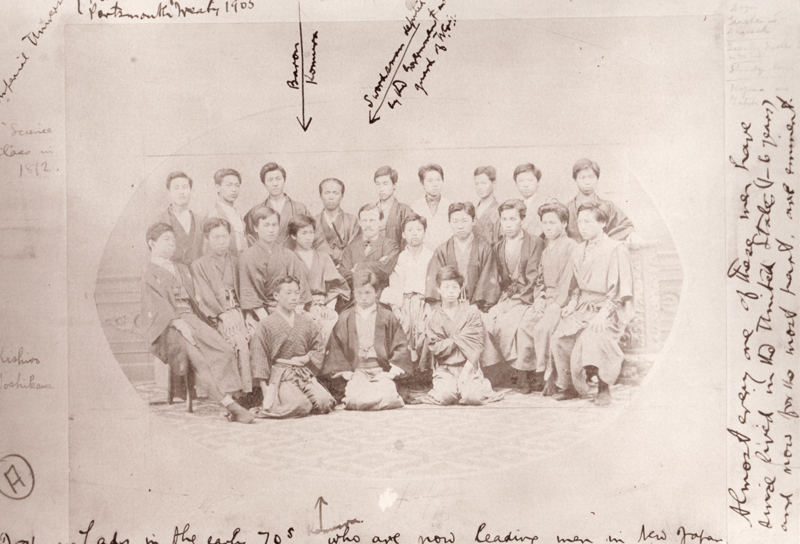
    Old, sepia-toned portrait of a group of people
    The Rutgers Meets Japan digital collection invites users to explore the people and places that shaped a pivotal moment in global education and cultural exchange.


    We are pleased to announce the launch of Rutgers Meets Japan, a new digital companion collection that brings to life a remarkable trans-Pacific story of intellectual exchange, cultural connection, and shared history. Developed in conjunction with the book Rutgers Meets Japan: A Trans-Pacific Network of the Late Nineteenth Century, this digital collection expands upon the book’s narrative by providing open access to a rich set of historical photographs drawn from the William E. Griffis Collection.

    The collection features portraits of some of Rutgers’ earliest Japanese students, as well as images of alumni who traveled to Japan as teachers and missionaries during the late 19th century. These photographs offer a rare visual window into a formative period of U.S.-Japan relations, capturing individuals, institutions, and everyday scenes across locations such as Fukui, Yokohama, Tokyo, and Shizuoka. In addition to images reproduced in the book, the digital companion includes many photographs that could not be published due to space constraints, significantly broadening access to these materials for researchers, students, and the public.

    Funded by a grant from the New Jersey Historical Commission, the project involved the careful digitization, transcription, and annotation of materials, ensuring both accessibility and scholarly value. By pairing rigorous historical scholarship with digital access, Rutgers Meets Japan invites users to explore the people and places that shaped a pivotal moment in global education and cultural exchange.

    The launch of this digital collection also coincided with an event held on April 17, Rutgers Meets Japan: In Conversation with the Authors. This event was held in the Alexander Library Pane Room and featured presenters Haruko Wakabayashi and Fernanda Perrone, with Janet Walker moderating.

  • Libraries Launch Queer Newark Oral History Project

    Queer Newark Oral History Project

    Rutgers University Libraries is pleased to announce the launch of the Queer Newark Oral History Project (QNOHP). QNOHP is a community-based and community-directed interdisciplinary initiative supported by Rutgers University–Newark. Queer Newark interviews LGBTQ and gender non-conforming people in Newark. We collect, catalog, and transcribe these oral histories to make their stories accessible to everyone, including researchers, students, and artists. Queer Newark also digitizes and preserves papers and artifacts about Newark’s LGBTQ history at Rutgers–Newark. Please visit this link to browse this collection.

    Work on the project took place over the spring and summer of 2022 in a collaboration between staff at Dana Library and the Libraries’ Central Applications and Development Team. QNOHP involved a partnership with the Department of History at Rutgers–Newark and received a grant from the New Jersey Historical Commission to complete the work of transcribing and editing recorded oral histories. At their outset, the QNOHP and Newark Black Newspapers Collection projects were supported greatly by work performed by the late Krista White, digital scholarship and pedagogies librarian at Dana Library.

  • Test Driving Alma Digital: A New Tool for Making Digital Collections Available Online

    The challenges of the past year have really demonstrated the importance of our online resources and digital projects. We’ve been able to forge new partnerships and strengthen relationships with academic departments across the university, thanks to our ability to pivot and provide the digital resources our students and researchers really need, even if they can’t visit us in person. Our digital resources, however, are useful to our patrons and online visitors only if the tools used to deliver them work well. In an effort to further expand our capabilities, we’re been testing something new for our expanding digital projects toolbox.
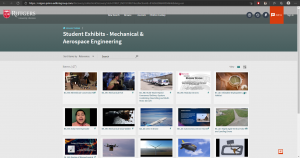
    Alma Digital is an extension of the Ex Libris services we already use for the discovery of information resources and other online services. It adds collection management and delivery capabilities for digital resources and gives us more options to make our digital collections discoverable. If we choose, we can make a digital collection in Alma Digital discoverable in our QuickSearch interface, better unifying how we share our digital resources. To get a feel for how Alma Digital works, and how it can serve our needs, Central IT and members of Instructional and Publishing Support (IPS) have been looking for potential digital projects to pilot test this platform. For our initial test, we chose the New Brunswick Student Exhibits collection.

    One of the biggest success stories of the past year has been the partnerships forged between the Libraries and our schools in showcasing student research. Since last year, we’ve been working with both Camden and New Brunswick schools to bring what used to be in-person research symposia to the virtual space. When we began this initiative, it required a lot of work from Libraries faculty and staff to manage deposited presentations and make them accessible online. With the demand for service growing for our second year, we were expecting the number of deposits to more than double from last year. It was clear we needed a better way than the manual process put in place during our first attempt.

    We learned that Alma Digital provides a method for managing deposits and accepting patron-driven content using deposit forms. Using this capability, the team behind the New Brunswick Student Exhibits was able to streamline the process for students sending in their presentations. This gave us a way to quickly manage both the media students were sending in and the metadata describing that media.

    The results so far have pretty impressive: in one week, we processed the same number of presentations that we received in over three months last year… and the students taking part aren’t even close to finished with sending us their work. Using Alma’s digital lobby, we’ve also offered an easily searchable way for to students to explore their work and that of their classmates, offering up documents, infographics, poster PDFs, podcasts and video summaries.

    What we’ve learned so far is that Alma Digital does an excellent job of collection management and delivery for digital collections with born digital content – resources that originally started as a digital document. We hope to continue exploring what other types of digital collections Alma Digital will be useful for. As we get more digital collection proposals from library unites, I hope to work with collection sponsors to see what tools in our toolbox will work best to tell each digital collection’s story.

    Visit the collections here:

  • Digital Projects Status Page

    Over the past couple of years, the digital projects team in Shared User Services has been actively assisting campus libraries in organizing their work on digital collections, and making them available online. Thirty-one such projects are now publicly accessible through our digital collections page and span a variety of topics, from Inclusion and Diversity, to showcasing the research articles and presentations of our undergraduates. This list continues to grow, as new collections are proposed and some of our ongoing projects continue to be renewed and expanded upon.
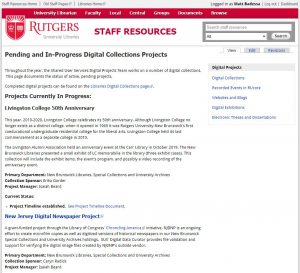
    But everyone wants to know what’s in the pipeline. In order to keep the RUL community up to date on the projects we’re working on, we’ve created a page for Pending and In-Progress Digital Projects that lists most of the digital collections and exhibits that are upcoming, along with their status and proposed work timelines. We hope you’ll visit our status page and keep abreast of our ever-growing digital collections work!

  • Simplifying Routine Digital Projects

    poster
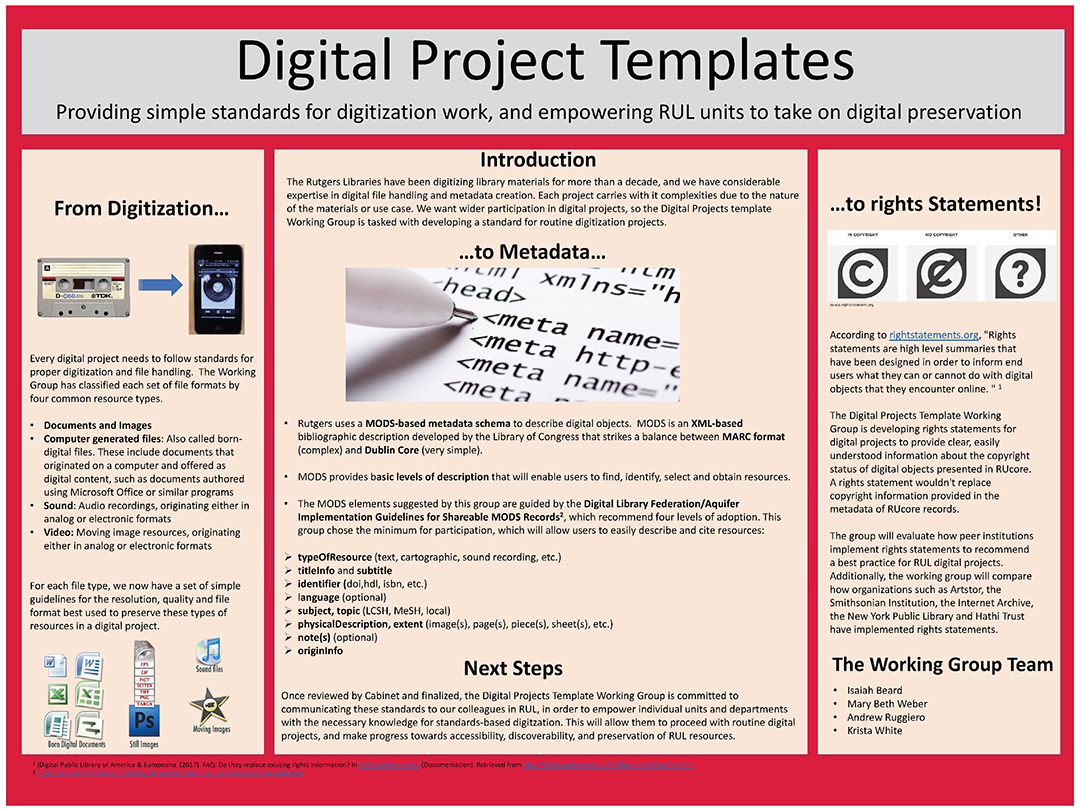
    The Digital Projects Template Working Group presented an interim report poster at the last State of the Libraries.

    Digital projects have been an integral part of the services that Rutgers University Libraries have provided over the past decade. Making some of our resources available online adds to the discovery and accessibility of those holdings, providing a valuable service to our patrons. The digitization of physical items also provides an additional layer of preservation, protecting the original item from additional wear, while ensuring the content lives on.

    In light of this, the Digital Projects Template Working Group was formed in September 2017 to streamline and simplify the process for individual units, empowering them with the knowledge to embark on their own routine digital projects as their resources permit.  We’ve worked hard during this time to document what types of items and collections make up a potential “routine” project; provide technical information on file formats and digitization standards; offer up minimum required descriptive metadata; and provide recommendations on rights statements. With this simplification documentation, we hope that there will be less of a bottleneck for routine digitization projects.

    While the Digital Projects Template Working Group has completed their work, we realize that libraries also need guidance about the process to begin carrying out this work. Cabinet determined that a group will develop a workflow for routine digital projects.  That effort is already under discussion.

    Central units will provide support for these routine digital projects in the areas of digital preservation assessment, accessibility, and search portal and website creation. Shared User Services can consult with directors and project managers to answer questions about whether a digital project is routine, or perhaps more complex. We encourage everyone to visit our website and review the recommended guidelines for digital projects.