Author: Ermira Mitre

  • Promoting Well-Being Through Crocheting and Knitting

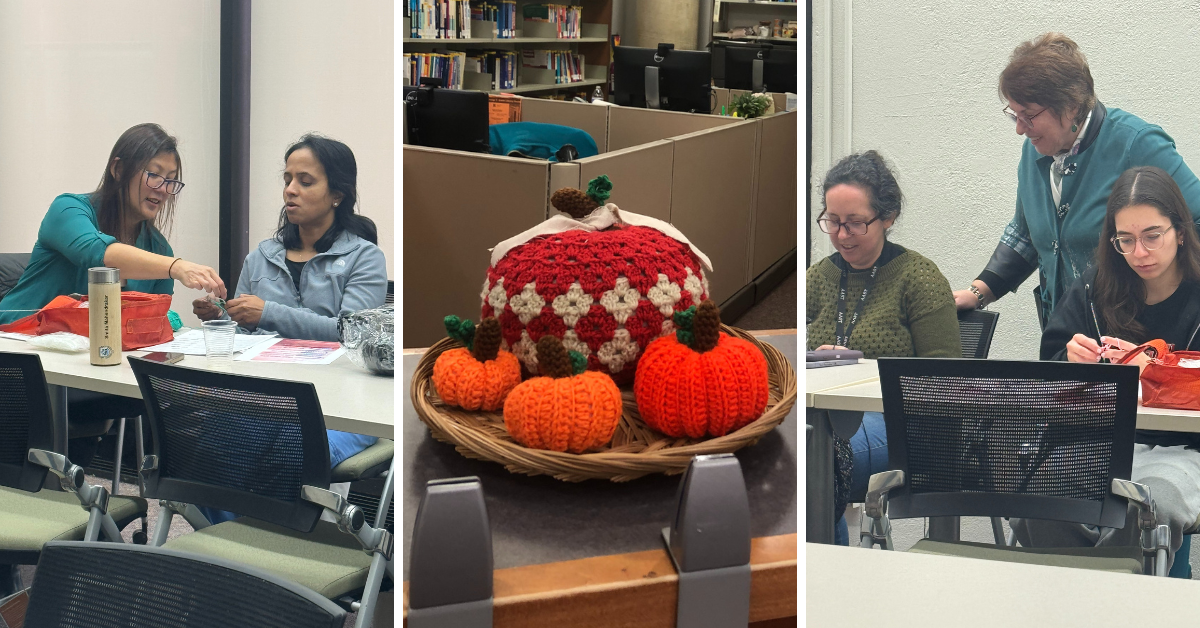
    Collage of images depicting people working with yarn and a close-up of a pumpkin craft
    Joyful Collégialité through Crocheting and Knitting, a monthly initiative at Smith Library, is funded by the Rutgers Health Joy at Work Mini-Grant Program.

    George F. Smith Library of the Health Sciences has successfully hosted four open crochet/knit gatherings in collaboration with the NJMS Crochet and Knitting Club, with a strong turnout of 36 participants, including New Jersey Medical School students, faculty, and staff. This monthly initiative, Joyful Collégialité through Crocheting and Knitting, is funded by the Rutgers Health Joy at Work Mini-Grant Program, which aims to promote a culture of well-being in the workplace, fostering belonging, human connection, and collegial support.

    Participation in the events has surpassed expectations, and the waiting list continues to grow. While the project is scheduled to conclude in March 2026, the Smith Library team remains committed to continuing the program well beyond the grant period.

    The workshops offer group and one-on-one skill-building opportunities for beginners and experienced crafters, creating an enthusiastic and engaging environment. Instructors Chun Yen Chen and Purvi Shakelly, both NJMS students, and Ermira Mitre, a library technician in Access Services at Smith Library, prepare pattern handouts and offer hands-on guidance. In addition, library technology, including OkidCam and SmartBoard, enhances live demonstrations of crocheting techniques through large-screen displays of stitching and pattern techniques, ensuring clear visual learning for all participants.

    The creative projects these workshops undertake are both joyful and skill building, ranging from seasonal items (e.g., pumpkins and holiday-themed coasters) to detailed, three-dimensional anatomical pieces (e.g., hearts and blood cells). The instructors also have incorporated a brief Emotional Freedom Technique (EFT) tapping practice to begin each session, sending calming signals to the nervous system and promoting a relaxing atmosphere for crocheting sessions.

    Survey responses highlight the program’s positive impact: reduced stress levels, increased joy through creative expression, and strengthened interpersonal connections. Participants consistently describe the workshops as restorative, uplifting, and community-building.

    Overall, this initiative has contributed to a more supportive campus environment and reflects the library’s ongoing commitment to promoting well-being, creativity, and collegial engagement across the Rutgers Health community.

  • Ermira Mitre Publishes Second Collection of Poetry, “LOTUS”

    "Lotus" book event for Ermira Mitre.

    Ermira Mitre, a Library Technician at Smith Library, published her second poetry collection in May. Written in Albanian, LOTUS was featured at a book launch in Ermira’s hometown of Durrës, Albania, and a book fair in Kosovo.

    Local writers, poets, and poetry enthusiasts attended the book launch organized by Ermira’s publisher and the Durrës public library. Several writers critiqued LOTUS, and four poets read from the book. A local news station’s segment about the event can be viewed at youtube.com/watch?v=hkqJAU0NpgY.

    Ermira Mitre is a bilingual poet, essayist, and translator. Her poetry has appeared in various international and national poetry anthologies and journals, including Jerry Jazz Musician, Red Wheelbarrow Poets Journals, THE POET Anthology Series, Live Encounters, Kistrech Poetry Festival, Mediterranean Poetry, and Montclair Write Group. She published her first book of poetry, Soul’s Gravity, in Albanian and translated the fiction novel The King’s Shadow from Albanian into English. Currently, Ermira is writing her first English poetry collection, Blooming as a Sacred Lotus, as well as a bilingual anthology (English and Albanian).

  • Creating Homemade PPE

    I would like to share my experience during these difficult days of our quarantine to fight against COVID-19.

    While all of us are working from home, the medical staff are on the front line fighting the virus while lacking the PPEs. This became a great concern in my family, when my daughter called me three weeks ago, and asked if I could make some masks and head covers for her husband, who is a doctor, and also her doctor friends who are taking care of COVID-19 patients.

    She did some research how to make safe cloth masks for medical staff to place over the N95 masks to make them last longer. Pretty quickly, we figured out how to make them out of cotton fabric and flannel while using different filters. I used any item possible at home: T-shirts, cotton sheets, cotton tablecloths, bags, baby wipes, laundry softeners, vacuum cleaner filters. I also made head covers out of shower curtains while sending her all transparent plastic available at home so she could use it to make face shields, helped by her friend who made parts of them by 3D printing. She was able to make 30 face shields.

    My daughter and I also started a campaign on social media, asking people to make masks and sharing the instructions, suggesting they donate them to the community. The social media network in New York, Connecticut, and New Jersey was able to make 350 masks and donated them to hospitals and friends. My daughter, who is also a doctor, for about a month never stopped raising awareness on social media that everyone needs to wear a mask when we go out.

    I shared my experience with the Smith Library access services staff and shared guidelines about how to make masks. I will continue to make cloth masks and head covers until the pandemic is over. Doing something good for the community helps me release the stress and be happy that I can do my little part to fight the pandemic.

    How to Sew a Medical Face Mask

    Materials

    • 2 pieces of 100% cotton fabric that measure about 7 inches by 9 inches—cotton T-shirts, dish towels and pillowcases are good options (make sure all fabric is washed and dry)
    • 2 pieces of cotton fabric that measure about 1.5 inches by 40 inches for the mask’s strap (in a pinch, you can use something like shoelaces, elastic 6 inch long or ribbon)
    • A ruler, sewing pins, a pair of scissors, thread, an iron and a sewing machine.

    Video Tutorials

    Instructions

    Step 1: Sew the two main rectangle pieces together with the “right” sides of the fabric—the side you want to see—facing each other. Sew almost all the way around the rectangles, leaving a small gap (a few inches) open on the long side.

    Step 2: Turn the rectangle right-side-out by reaching into the gap you left open and pulling the fabric through. Now your edges are on the inside and you have a neatly sewn two-sided rectangle. At the gap you left open, just tuck the edges inside for now; you’ll sew it closed later.

    Step 3: Make three evenly spaced pleats along both 7-inch sides of the fabric, making sure to keep all of your tucks facing in the same direction, and pin in place. One way to do this is by marking the spacing with pins: place one about 1.5 inches down the short side of the fabric; add the next 1 inch down from that, then the third ½ inch down from that, and keep alternating between 1 and ½ inches until you’ve used all six pins. To create the pleats, just bring the first pin down to meet the second, the third to meet the fourth, and the fifth to meet the sixth. Repeat on the other side.

    Step 4: Once the pleats are pinned, stitch all the way around the perimeter of the rectangle. This will sew the pleats into place and also close the gap you had left open in Step 1.

    Step 5: If you’re using a strip of fabric for your strap, fold and iron it in half lengthwise and then fold and iron the raw edges in. Find the centers of your straps and the centers of the long sides of your mask, and match them. Pin the straps in place along the long edges of the mask, so there is a strap on the top of the mask and one on the bottom, with equally long pieces coming out to the sides. If you’re using a strip of fabric, pin it so it’s wrapped around the edge of the rectangle.

    Step 6: Sew the strap to the mask by stitching all the way down each strap, catching the edges of the mask as you pass. (If you are using a strap that did not require folding, you can opt instead to stitch around the perimeter of the rectangle one more time.)